

How to Pour and Finish Concrete
Everything you need to know about mixing, pouring, and finishing concrete — from subgrade prep and formwork to floating, curing, and sealing. Follow these guides in order for your best results.
First time? Start with Concrete 101 →
Start Here
First Concrete Pour: Complete Beginner's Guide (Plan to Finish)
Your first concrete pour feels overwhelming because there's no redo button. Once concrete starts flowing, you're committed. But here's the truth: thousands of homeowners pour concrete successfully every weekend. The key is preparation—knowing exactly what to buy, what to rent, and what order to do things before you mix the first bag.
Read Guide →Concrete 101: Everything You Need to Know
Before you calculate quantities or plan your pour, you need to understand what concrete actually is and how it works. This foundation knowledge prevents expensive mistakes—like adding too much water (permanently weakens concrete) or driving on a driveway too soon (causes surface damage).
Read Guide →Complete Guide to Concrete for DIY Projects
Concrete work is absolutely achievable for homeowners willing to plan carefully and respect the material's demands. This guide covers everything you need to successfully complete a concrete project—from understanding what concrete actually is, to calculating quantities, to finishing techniques that produce professional results.
Read Guide →Planning & Prep
How Thick Should Concrete Be? (By Project Type)
Patios need 4 inches. Driveways need 5-6 inches. Garage floors need 4-6 inches. The right thickness depends on what the concrete will support—foot traffic, passenger vehicles, or heavy trucks.
Gravel Under Concrete: Do You Need It, What Size, and How Much
Yes, in most cases. A 4-6 inch layer of compacted gravel under concrete provides essential drainage, prevents settling, and significantly extends the lifespan of your slab. Use angular 3/4-inch crushed stone (#57 stone) or crusher run, never pea gravel, and plan on about 1.25 cubic yards per 100 square feet at 4 inches deep. Skipping the gravel base is one of the most common shortcuts that leads to cracked, uneven, or failed concrete.
Concrete Subgrade Prep: Excavation, Base Material and Compaction
The ground under your concrete slab matters more than the concrete itself. A 4,000 PSI slab poured on poorly compacted fill will crack and settle. A 3,000 PSI slab on a proper gravel base will last decades. Most DIY concrete failures start below the surface—with inadequate excavation, wrong base material, or skipped compaction.
How to Build Concrete Forms (DIY Guide)
Forms are the mold that shapes your concrete. Get them right, and the pour is straightforward. Get them wrong, and you'll fight problems from start to finish—bulging forms, uneven thickness, improper drainage, or concrete that leaks underneath.
DIY Concrete Forms: Bracing, Setup and Preventing Blowouts
A form blowout mid-pour is one of the most expensive DIY concrete mistakes. Wet concrete pushes outward with surprising force—a 4-inch slab exerts about 50 pounds per square foot at the base of the forms, and a 6-inch pour about 75. If your stakes and braces can't handle the pressure, forms bow, shift, or blow out entirely, and you've got a mess that hardens before you can fix it.
Best Time to Pour Concrete (Season, Weather, and Temperature)
Pour on a dry day with the air at 50 to 60°F and no freeze forecast for 48 hours. Aim for spring and fall: late May and September fall inside the frost-free season of all 10 cities below, though in Dallas, Houston or Phoenix heat is the limit. Under 12 inches thick, the concrete should be 55°F or warmer as placed and 95°F at most at the chute.
Concrete Pouring Temperature: Ideal Range, Cold and Hot Weather Limits
The best temperature to pour concrete is 50–60°F, and air temperatures of roughly 50–85°F need no special precautions. Below 40°F (ACI 306 cold weather), protect the slab with blankets, heated water or accelerators until it reaches 500 PSI; above 90°F, use retarder, cold water and a dawn start. Most crews postpone below 25°F or above 95°F.
Reinforcement & Moisture Control
When Do You Need Rebar in Concrete? (Decision Guide)
Driveways, foundations, and footings need rebar. Patios and sidewalks typically only need wire mesh—or sometimes no reinforcement at all. The deciding factors are load bearing, span length, and soil conditions.
Concrete Reinforcement: Rebar vs Wire Mesh vs Fiber (When to Use Each)
Polypropylene fiber, dosed at 1 to 1.5 lb per cubic yard, limits plastic-shrinkage cracking and adds almost no tensile strength. Rebar carries tension and holds cracks tight once they form. Fiber alone is enough for patios, walks and shed pads on stable soil; driveways and garage floors call for rebar, with fiber as an add-on. High-swell clay needs a soil report and an engineered slab.
Rebar Sizes Chart: Diameter, Weight, and Grade Reference (#3–#18)
Rebar sizes run from #3 (⅜-inch diameter) up to #18 (2.257-inch diameter), numbered so the digit represents eighths of an inch — #4 rebar is 4/8″, or exactly 0.500 inches thick. A #3 bar weighs 0.376 lb per foot; a #4 weighs 0.668 lb/ft; a #8 weighs 2.670 lb/ft. Residential slabs and driveways typically use #3 or #4, footings and foundations step up to #4–#5, and structural columns or beams use #6 and larger.
Vapor Barriers Under Concrete: When You Need One and How to Install
"Do I need plastic under my slab?" is one of the most common questions in concrete planning--and the answer matters more than most people think. Skip the vapor barrier under a basement floor and you get perpetual moisture problems, mold, and flooring failures. Install one incorrectly and you can actually create problems that wouldn't exist otherwise. This guide covers when a vapor barrier is necessary, what type to use, and how to install it right.
Vapor Barrier vs Vapor Retarder: What's the Actual Difference?
Most people use these terms interchangeably. Most flooring manufacturers, building codes, and coating spec sheets do not. A vapor barrier and a vapor retarder are different product classifications with different performance specs. Installing a vapor retarder where a barrier is required is technically compliant with nothing—and the failure mode shows up years later in adhesive bond failures and flooring damage.
Vapor Barrier for Garage Floors: What You Need to Know
Garage floors are the most frequently skipped vapor barrier application—and among the most consequential to skip. If you ever plan to apply an epoxy coating, moisture vapor transmission will cause it to delaminate. If the garage is attached and conditioned or semi-conditioned, you have moisture-in-living-space problems. The cost of installing a vapor barrier during the pour is negligible. The cost of not having one shows up later.
Mixing & Pouring
How to Mix Concrete (Bags, Mixer, or By Hand)
Add approximately 3 quarts of water per 80-lb bag and mix for 3-5 minutes until the consistency resembles thick oatmeal or peanut butter. The exact water amount varies by humidity and desired workability—start with less and add more as needed.
How to Pour Concrete (Complete DIY Guide)
Pouring concrete is the moment everything comes together—or falls apart. The actual pour is surprisingly fast (30-90 minutes for most residential projects), but it's unforgiving. Once concrete starts setting, you can't pause, restart, or fix major mistakes. Success depends entirely on preparation and coordination.
How Much Water per Bag of Concrete? Exact Amounts by Brand and Bag Size
The most common DIY concrete failure starts with water. Too much makes concrete weak and crumbly. Too little makes it unworkable and full of voids. The frustrating part: bag instructions say 'add water' without telling you exactly how much. This guide gives you the exact water quantities for every major brand, plus what to do if you've already added too much or too little.
How to Calculate Concrete (Step-by-Step Guide)
The formula for calculating concrete is Length × Width × Thickness (all in feet) ÷ 27 = cubic yards. For a 12×10 foot patio at 4 inches thick, that's 12 × 10 × 0.33 ÷ 27 = 1.47 cubic yards.
How Many Bags of Concrete in a Yard? 45 (80-lb), 60 (60-lb), 90 (40-lb)
One cubic yard of concrete equals 45 bags of 80-lb mix, 60 bags of 60-lb mix, or 90 bags of 40-lb mix, because a yard is 27 cubic feet and an 80-lb bag yields 0.60 cubic feet. For a 10×10 patio at 4 inches thick, you need approximately 55 bags of 80-lb concrete.
How Much Concrete Do I Need? (Quick Answer + Calculator)
A 10×10 slab at 4 inches thick needs 1.2 cubic yards (about 55 bags of 80-lb concrete). A 12×12 patio needs 1.8 cubic yards (about 80 bags). Check the reference table below for common sizes, or use our concrete calculator for your exact dimensions.
Ready-Mix vs Bagged Concrete: Which Should You Use?
The decision comes down to project size: use bagged concrete for projects under 1 cubic yard (about 45 bags), and ready-mix delivery for anything larger. The break-even point is roughly 1-1.5 cubic yards, where the convenience of ready-mix starts to outweigh the cost savings of bags.
Bagged Concrete vs Ready-Mix vs Pump Truck: When to Use Each
Use bagged concrete for projects under 0.5 cubic yards, a ready-mix truck for 1 cubic yard and up when a truck can reach the pour, and add a pump truck when the site is restricted, elevated, or too far from the truck's chute. The pump truck is not a replacement for ready-mix - it's an add-on that moves the concrete from the truck to a location the chute can't reach. Knowing which combination fits your project saves you from ordering the wrong delivery or renting equipment you don't need.
What Is a Yard of Concrete? (Volume Explained)
A "yard" of concrete means one cubic yard—a cube measuring 3 feet on each side. That's 27 cubic feet of concrete, and it covers roughly 81 square feet at 4 inches thick or 54 square feet at 6 inches thick.
Finishing & Curing
How to Finish Concrete: Complete Guide to Timing, Technique and Curing
Concrete finishing is not a single step — it is a sequence of decisions made under time pressure. The pour is the easy part. The finish is where the slab either succeeds or fails. This guide covers the full picture: when to start, which technique to choose, whether to DIY or hire out, and how to cure correctly once the finish is done.
How to Finish Concrete (Tools & Techniques)
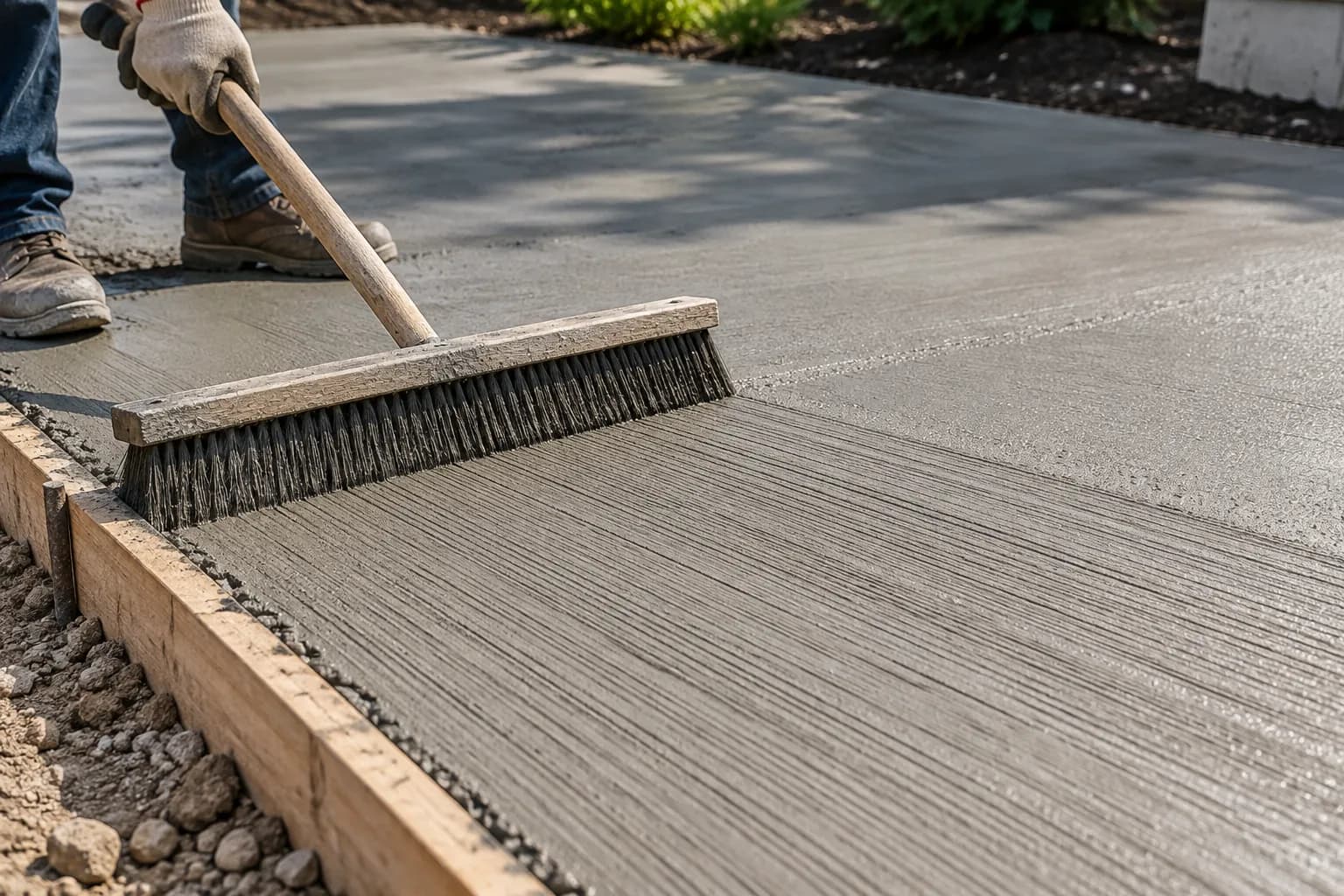
Concrete finishing is the sequence of tool passes that levels, densifies, and textures fresh concrete: screed, bull float, wait for the bleed water to disappear, edge, cut control joints 1/4 of the slab depth, hand float, then broom or trowel. At 65-80°F the hand-float window opens 45-90 minutes after the pour. Timing, not technique, is where most DIY finishes fail.
How to Level Uneven Concrete (DIY Options)
Uneven concrete creates trip hazards, drainage problems, and that frustrating rocking furniture situation. The fix depends on what's causing the unevenness: minor surface irregularities call for self-leveling compound, while sunken slabs need lifting or replacement.
When to Float, Edge and Trowel Concrete: Finishing Timing Guide
The difference between a smooth, professional concrete finish and a rough, flawed surface comes down to timing. Start too early and you'll trap bleed water under the surface, creating a weak layer that flakes off within a year. Start too late and the concrete is too hard to work—you'll fight it with every pass and end up with trowel marks and rough spots.
How to Seal Concrete (Step-by-Step Guide)
Sealing concrete is one of the easiest ways to extend its lifespan and improve its appearance. A quality sealer protects against water penetration, staining, freeze-thaw damage, and UV fading. The application process is straightforward—even beginners can achieve professional results with proper preparation.
Concrete Curing Methods: Wet Burlap, Plastic, Compounds and What Actually Works
Proper curing is the difference between concrete that reaches its design strength and concrete that tops out at 50-60% of what it should be. The method you choose depends on your project size, climate, and how much effort you're willing to put in. Here's an honest comparison of every common curing method—what works, what doesn't, and what's worth the hassle.
How Long Does Concrete Take to Cure? (Complete Timeline)
You can walk on concrete after 24-48 hours and drive on it after 7 days minimum—but full strength takes 28 days. Rushing these timelines causes permanent damage that weakens your slab for its entire lifespan.
How Long Does Concrete Last? (Lifespan by Project)
Properly installed and maintained concrete lasts 25-30 years for residential surfaces like driveways and patios, and 50-100+ years for structural elements like foundations. These aren't guaranteed lifespans—they're achievable with quality installation and basic maintenance.
Concrete Finish Type Cost Comparison
Choosing a concrete finish is a budget decision as much as an aesthetic one. A basic broom finish runs $6-12 per square foot installed, while stamped concrete can hit $10-18 per square foot — and the cost differences compound over time through maintenance, resealing, and repair. This guide breaks down installed cost, long-term durability, and maintenance burden for every major finish type so you can model total cost of ownership before committing.
DIY vs Professional Concrete Finishing
Finishing is the highest-skill phase of any concrete project — and the phase where DIY failures cost the most to fix. A botched finish on a 400-square-foot patio means $1,500-3,000 in demolition and replacement, often more than hiring a professional would have cost in the first place. This guide provides a decision framework based on project size, finish complexity, and your actual risk exposure — not generic advice to "just hire a pro."
Weather Impact on Concrete Finishing
Weather is the single largest variable in concrete finishing — more influential than mix design, tool selection, or operator skill. A slab poured at 60 degrees F in calm conditions gives you a 90-minute finishing window. The same slab at 95 degrees F with 15 mph wind may give you under 20 minutes before the surface is unworkable. This guide quantifies those effects with risk tables and scheduling guidance so you can plan pours around conditions, not hope for the best.
Concrete Finishing and Long-Term Durability
The finish you choose at pour time determines what you'll spend on maintenance for the next three decades. A broom finish costs the least upfront but may need resurfacing sooner. Stamped concrete looks impressive on day one but demands regular resealing to avoid costly surface failures. Every finish type comes with a different durability profile and a different long-term cost curve. This guide breaks down those numbers so you can plan past the initial pour.
Concrete Finishing Mistakes That Increase Lifetime Cost
Concrete finishing mistakes don't just look bad--they create compounding maintenance costs that can exceed the original pour price within a decade. A slab finished too early develops surface scaling that costs $3-5 per sq ft to resurface. The wrong sealer on stamped concrete leads to full strip-and-reseal jobs at $2-4 per sq ft every few years. These aren't cosmetic inconveniences. They're budget failures that start at pour time and escalate with every season of exposure.
Calculate Before You Pour
Use our free concrete calculator to find exactly how many bags or yards you need — before you order materials.
Open Concrete Calculator →