

Vapor Barrier for Garage Floors: What You Need to Know
Garage floors are the most frequently skipped vapor barrier application—and among the most consequential to skip. If you ever plan to apply an epoxy coating, moisture vapor transmission will cause it to delaminate. If the garage is attached and conditioned or semi-conditioned, you have moisture-in-living-space problems. The cost of installing a vapor barrier during the pour is negligible. The cost of not having one shows up later.
This guide covers what makes garages different from other slabs, the code requirements for attached vs. detached structures, how vapor barriers interact with epoxy and floor coatings, and what to specify for your project.
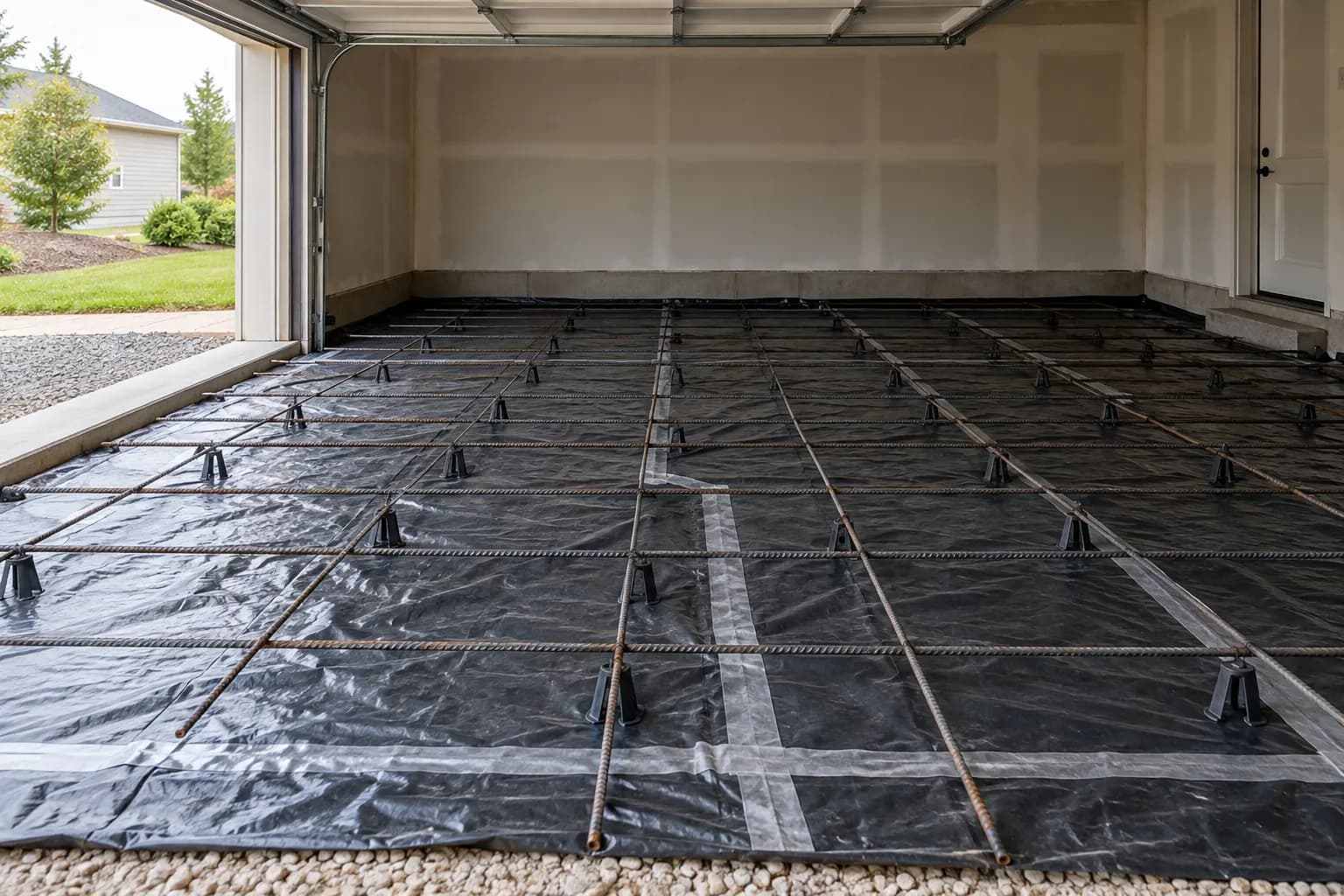
Why Garage Floors Have Specific Moisture Concerns
Slab on grade moisture vapor transmission happens in all climates—the ground below any slab maintains moisture content year-round. Garage floors face three conditions that make this particularly consequential:
Thermal cycling. Garages experience extreme temperature swings—cold nights, hot days from sun on the concrete, vehicle heat. Temperature differentials drive vapor transmission more aggressively than in temperature-stable environments.
Planned coatings. More garage floors receive epoxy or other coatings than any other concrete application. These coatings are adhesive systems that require a dry, vapor-stable substrate. Moisture from below breaks the adhesive bond.
Attached garage conditions. An attached garage is often semi-conditioned: it shares walls with the house, may have a door to conditioned space, and often has HVAC ducts running through it. Moisture entering through the floor affects interior air quality and relative humidity in adjacent spaces.
Code Requirements: Attached vs. Detached
Attached garages are treated by most building codes as conditioned or semi-conditioned space. The International Residential Code (IRC) Section R506.2.3 requires a minimum vapor retarder (6-mil polyethylene or equivalent) under concrete floors in conditioned and semi-conditioned spaces. Many local jurisdictions require 10-mil or 15-mil as a minimum.
Detached garages fall into a grayer area. If the structure is unheated and used purely for vehicle storage, vapor barrier requirements are often reduced or absent in the code. In practice, the "future use" argument almost always applies—people add heat, convert to workshops, apply floor coatings—which means installing a barrier during construction is standard practice even where not strictly required.
Heated or conditioned garages (any structure with HVAC, radiant floor heating, or regular occupancy) should use a minimum 10-mil polyethylene barrier, with 15-mil or Class A membrane for heated floors.
Always check your local code. State-level amendments frequently exceed IRC minimums.
The Epoxy Connection
This is where most DIY garage floor projects run into problems. Moisture vapor transmission is the leading cause of epoxy garage floor failure—not poor surface prep, not incorrect mixing ratios, not insufficient cure time.
Here's why: Epoxy is applied as a two-part adhesive system that bonds to the concrete surface. When moisture vapor rises through the concrete and hits the bond line, it creates vapor pressure between the concrete and the coating. Over time—sometimes within months—this pressure causes:
- Bubbling: Visible domes in the coating surface as vapor accumulates in small pockets
- Delamination: Full sections of coating lifting from the slab
- Lifting at edges: The first areas to fail are usually perimeter edges and doorway transitions
The test manufacturers require: Many epoxy manufacturers require a calcium chloride test (ASTM F1869) or relative humidity probe test (ASTM F2170) before applying their product. If moisture emission exceeds their threshold, they specify a moisture-mitigating primer. Installing a vapor barrier during the pour means this test is almost never an issue—the barrier handles it.
What the spec sheets say: Most epoxy manufacturers include language in their warranty documentation requiring a "vapor barrier installed during concrete placement" for warranty coverage on slab-on-grade applications. Skipping the barrier can invalidate the warranty before you even open the product bucket.
What Type to Use for a Garage
Standard unfinished garage, bare concrete expected: 10-mil polyethylene meets code and provides adequate moisture protection for long-term bare floor use.
Garage you plan to coat or finish: 10-mil minimum, but 15-mil reinforced polyethylene is worth the modest upgrade. The better puncture resistance means fewer installation-phase tears, and the lower perm rating satisfies most coating manufacturer specs.
Heated garage or any garage with radiant in-floor heating: Use a Class A membrane meeting ASTM E1745. Heated floors dramatically accelerate vapor transmission from the ground, and the lower perm rating of Class A products matters here.
Conditioned workspace (regular HVAC, frequent occupancy): 15-mil or Class A. Treat it like an interior slab.
For a full breakdown of vapor barrier types and perm ratings, see vapor barrier types for concrete.
Installation in a Garage Context
Garage floor vapor barrier installation follows the same principles as any slab on grade pour, with a few garage-specific considerations. See how to install a vapor barrier under a concrete slab for the complete step-by-step.
Garage-specific points:
Apron transition. The garage apron (the slab extending outside the garage door) typically doesn't need a vapor barrier—it's an outdoor slab exposed to air. Transition the vapor barrier near the inside face of the garage door opening and seal the edge.
Floor drain penetrations. Many garage floors include a center drain. The drain body penetrates the vapor barrier and must be sealed with vapor barrier tape and a compatible sealant where the pipe enters the barrier.
Overhead door threshold. The area at the garage door threshold sees heavy vehicle traffic and is a common puncture zone during construction. Use extra caution here, and do a careful pre-pour inspection of this area.
Vehicle access. If other trades need vehicle access to the site, they'll track across the vapor barrier. Have tape ready to patch tire damage before the pour.
Calculate Before You Pour
Use our garage floor calculator to determine concrete volume for your project:
Includes 10% waste factor
For a full-size two-car garage (20×20), plan for approximately 5 cubic yards of concrete at 4-inch thickness. The vapor barrier adds roughly $80–200 in materials depending on the product spec—a fraction of total project cost, and far less than the cost of coating failure remediation.
Related Garage Floor Guides
The moisture barrier decision connects directly to two other major garage floor considerations:
- Garage floor thickness guide — thickness requirements for different vehicle loads and use conditions
- Garage floor epoxy guide — preparation, application, and coating selection for garage floors (includes moisture testing requirements before epoxy application)
For the complete overview of vapor barriers for all concrete applications, see our concrete vapor barrier guide.
The Efflorescence Connection
One visible indicator of moisture transmission through a concrete floor without vapor protection: white mineral deposits on the surface, called efflorescence. These appear when moisture carries dissolved salts from the soil or concrete through to the surface, where they crystallize as the water evaporates. Efflorescence doesn't damage structural integrity but signals active moisture movement—and it will interfere with any coating you try to apply.
If you see efflorescence on an existing slab, test for moisture before applying any coating and plan for topside mitigation if the levels exceed product spec.