

Shrinkage Cracking in Concrete: Identification, Repair & Prevention Guide
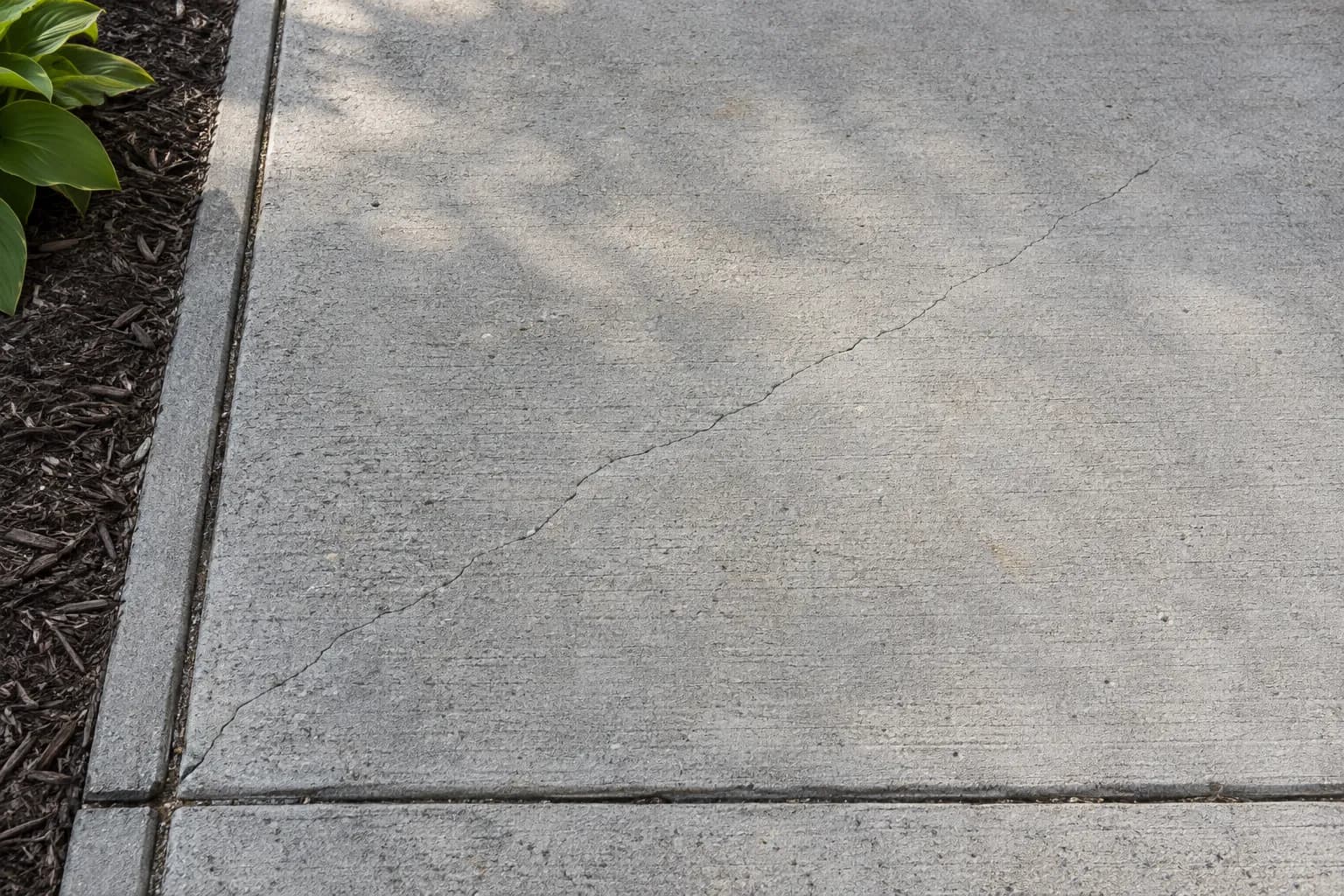
Shrinkage cracks are fine cracks, usually hairline to 1/8 inch wide with both edges level, that form in the first 28 days as concrete loses water and contracts against the subbase, forms, or rebar. They are the most common crack type in concrete, almost always cosmetic (severity 1–2), and are fixed by sealing: a penetrating sealer for hairlines, polyurethane caulk up to 1/4 inch, for $15–$60 in DIY materials.
What Is Shrinkage Cracking?
Shrinkage cracking is the formation of fine, shallow cracks in concrete caused by volume reduction as the material loses moisture during and after curing. It is the single most prevalent defect in concrete flatwork — the Portland Cement Association (PCA) estimates that over 90% of all concrete slabs develop some form of shrinkage cracking within the first year.
The physics behind shrinkage cracking are straightforward. Portland cement hydration is a chemical reaction between cement and water that produces calcium silicate hydrate (C-S-H) gel — the "glue" that binds concrete together. Only about half of the mix water is consumed by hydration. The remaining free water occupies pore space within the hardened paste. As this free water evaporates, capillary tension develops in the pore network, pulling the paste inward. The cement paste volume decreases by approximately 1% for every 1% of moisture loss by weight. Since the paste is bonded to rigid aggregate particles and restrained by the subbase, forms, and any embedded reinforcement, this contraction generates internal tensile stress. Concrete's tensile strength is only about 8–15% of its compressive strength — typically 320–600 PSI for a standard 4,000 PSI mix — so cracking occurs wherever the shrinkage-induced tension exceeds the concrete's tensile capacity.
Plastic Shrinkage vs. Drying Shrinkage
Shrinkage cracking occurs in two distinct phases, and understanding the difference matters for both prevention and diagnosis.
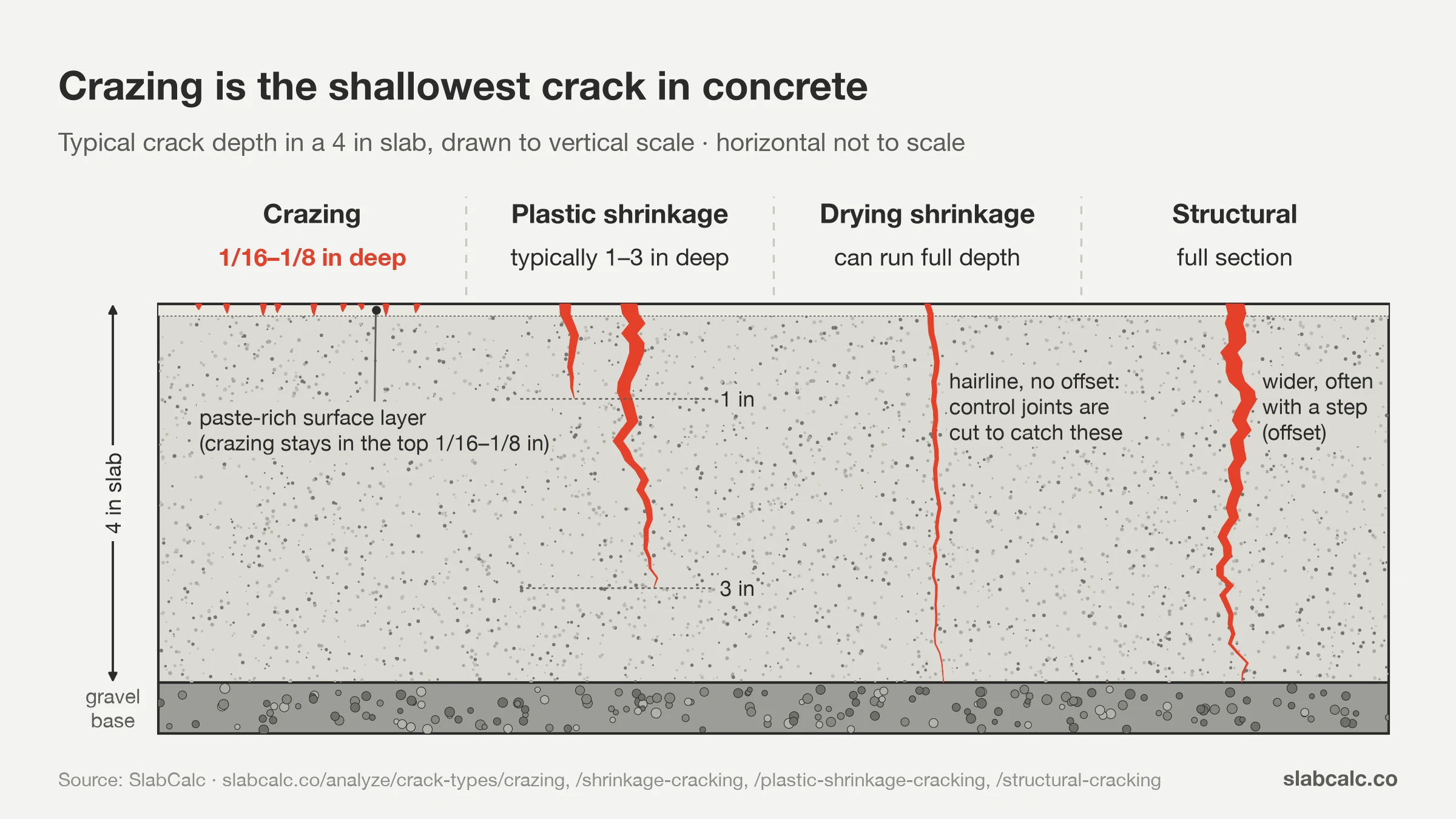
Plastic shrinkage happens during the first 1–6 hours after placement, while the concrete is still in a plastic (workable) state. When the surface evaporation rate exceeds the bleed water rate, the top layer dries and contracts before the concrete has developed any tensile strength. The result is typically parallel cracks, 1–3 feet apart, running at roughly 45 degrees to the slab edges. These cracks can be 1–3 inches deep and are most common on hot, dry, windy days. ACI 305R identifies an evaporation rate of 0.2 lb/ft-squared/hr as the critical threshold above which plastic shrinkage cracking becomes likely.
Drying shrinkage is the slower, long-term process that occurs over days, weeks, and months as the hardened concrete continues to lose moisture to the environment. The majority of drying shrinkage occurs within the first 28 days, but the process can continue at a diminishing rate for 2–5 years. Drying shrinkage produces the characteristic random map pattern (also called pattern cracking) of fine cracks on the slab surface. It is related to, but deeper and more widely spaced than, crazing. Typical drying shrinkage strain for normal concrete ranges from 400–800 microstrain (0.04–0.08%), which translates to approximately 1/16 inch of contraction per 10 linear feet.
For an in-depth guide to plastic shrinkage — including evaporation rate calculation, windbreaks, fiber reinforcement dosage, and real-time prevention during placement — see the dedicated Plastic shrinkage cracking guide.
Acceptable Crack Widths
ACI 224R-01 ("Control of Cracking in Concrete Structures") provides widely referenced crack width limits based on exposure conditions. For residential flatwork in a dry environment, cracks up to 0.016 inches (0.4 mm) are classified as acceptable. For slabs exposed to weather, the limit tightens to 0.012 inches (0.3 mm). Most shrinkage cracks fall well within these limits — hairline cracks are typically 0.005–0.010 inches wide (0.1–0.25 mm), posing no structural concern whatsoever.
What Causes Shrinkage Cracking?
Shrinkage cracking results from the combination of moisture loss, restraint, and insufficient tensile strength. Four controllable factors account for the vast majority of shrinkage cracking in residential and commercial flatwork.
Excess Water in the Mix
The water-to-cement (w/c) ratio is the single most influential variable controlling shrinkage magnitude. A w/c ratio of 0.40 produces a workable, low-shrinkage mix. A w/c ratio of 0.60 — common when water is added on-site for workability — dramatically increases both the volume of free water and the resulting shrinkage strain.
The relationship is roughly linear: every additional gallon of water per cubic yard of concrete increases drying shrinkage by approximately 20%. A standard 4,000 PSI residential mix at w/c = 0.50 contains about 33 gallons of water per yard. Adding just 2 gallons on-site (a common practice to improve slump for easier placement) pushes the w/c to approximately 0.55 and increases total shrinkage by roughly 40%. This is why the PCA and ACI 302.1R recommend specifying concrete by w/c ratio rather than slump alone, and why site-added water is one of the most damaging practices in flatwork construction.
Rapid Moisture Loss
When the surface evaporation rate exceeds the rate at which bleed water rises to the surface, the top layer of concrete dries faster than the interior, creating a moisture gradient that produces differential shrinkage. The surface wants to contract; the wetter interior restrains it; the surface cracks.
ACI 305R-20 ("Guide to Hot Weather Concreting") defines the critical evaporation rate as 0.2 lb/ft-squared/hr (1.0 kg/m²/h). Evaporation rate depends on four environmental variables: air temperature, concrete temperature, relative humidity, and wind speed. The Menzel/ACI nomograph quantifies these relationships. For example, at 90 degrees F air temperature, 70 degrees F concrete temperature, 40% relative humidity, and 10 mph wind, the evaporation rate reaches approximately 0.30 lb/ft-squared/hr — above the critical threshold. At 50% humidity with no wind, the same temperatures produce only 0.10 lb/ft-squared/hr.
Practical implication: pouring on a hot, windy day with low humidity is the highest-risk scenario for plastic shrinkage cracking. Windbreaks, fog spraying, and evaporation retarders are essential mitigation tools in these conditions.
Inadequate or Late Control Joints
Control joints (also called contraction joints) are intentional weak planes cut into the slab surface to predetermine where shrinkage cracks will form. The principle is simple: if the concrete is going to crack anyway, force it to crack at a location and in a pattern you choose.
ACI 302.1R-15 ("Guide for Concrete Floor and Slab Construction") specifies control joint spacing at 2 to 3 times the slab thickness in feet. For the standard 4-inch residential slab, this means joints every 8 to 12 feet. For a 6-inch slab, 12 to 18 feet. The joint depth must be at least 1/4 of the slab thickness — 1 inch minimum for a 4-inch slab — to create a sufficient stress concentration that attracts the crack.
Timing is equally critical. Joints must be saw-cut within 6–18 hours of finishing, before the shrinkage stress exceeds the concrete's early tensile strength. In hot weather, the window may be as short as 4–6 hours. Late-cut joints are ineffective because the concrete has already cracked randomly before the joint could control the cracking location. This is one of the most common causes of unwanted shrinkage cracks in otherwise well-designed slabs.
Insufficient Curing
Curing maintains adequate moisture and temperature in the concrete during the critical early hydration period. ACI 308R-16 ("Guide to External Curing of Concrete") recommends a minimum of 7 days of moist curing for standard flatwork. For high-performance or low-w/c mixes, 14 days is preferred.
Each day of curing skipped during the first week can increase ultimate drying shrinkage by 10–15%. Concrete cured for only 1 day may exhibit 40–50% more shrinkage than identical concrete cured for 7 days, because the hydration reaction is interrupted before sufficient C-S-H gel has formed to resist shrinkage stress.
Effective curing methods include wet burlap covered with plastic sheeting, ponding, curing compounds (ASTM C309, applied within 30 minutes of finishing), and sheet curing with polyethylene film. Curing compound is the most common method for residential flatwork because it requires the least labor — a single spray application forms a moisture-retaining membrane on the concrete surface.
How to Identify Shrinkage Cracking
Shrinkage cracks have a distinct visual signature that separates them from structural, settlement, and chemical cracking. The key diagnostic markers are pattern, width, displacement, depth, and timing.
| Feature | Shrinkage Cracks | Structural Cracks | Settlement Cracks |
|---|---|---|---|
| Pattern | Map/web or parallel | Single linear | Along joints/edges |
| Width | Hairline to 1/8 inch | Over 1/4 inch | Variable |
| Displacement | None | Visible step | One side lower |
| Depth | Crazing: top 1/8 in; plastic: 1–3 in; drying: can be full depth | Full depth | Full depth |
| Timing | First 28 days | Anytime | Months to years |
Pattern is the strongest diagnostic indicator. Drying shrinkage produces a random, interconnected web of fine cracks — often called map cracking or pattern cracking — that resembles a dried mud flat. The cracks form irregular polygonal cells, typically 6–24 inches across (much finer 1/2–1 1/2 inch cells point to crazing instead). Plastic shrinkage produces roughly parallel cracks, 1–3 feet apart, at diagonal angles to the slab edge. Both patterns differ sharply from structural cracks, which run as single, isolated lines along stress paths, and from settlement cracks, which follow edges and joints where support has been lost. For a detailed side-by-side comparison with photos, see shrinkage vs. structural cracks.
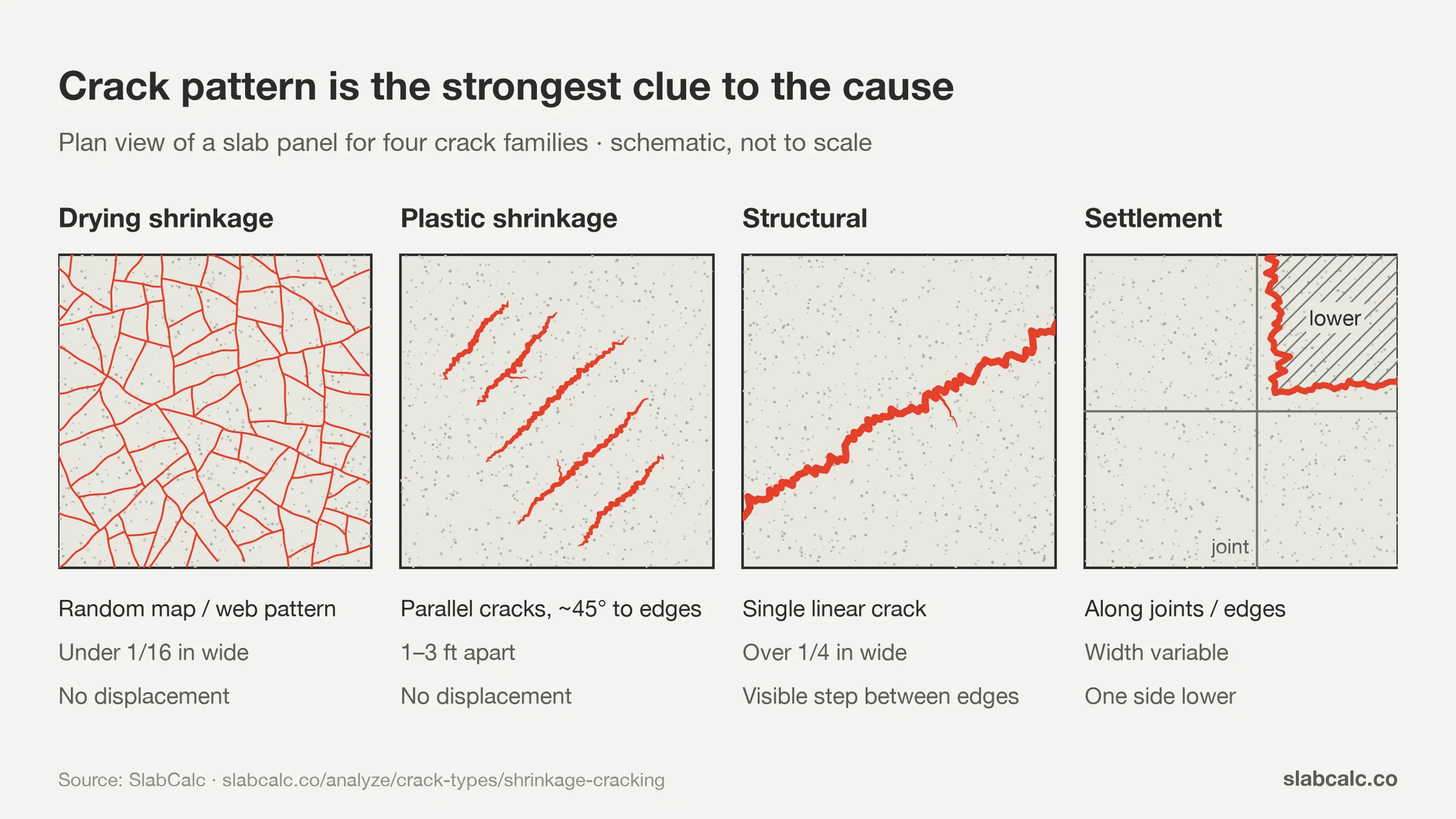
Width uniformity is another reliable marker. Shrinkage cracks are characteristically narrow and relatively uniform in width along their entire length. A crack that starts at 1/32 inch and widens to 1/4 inch is not behaving like a shrinkage crack — it indicates differential movement or structural loading.
Displacement is the single most important diagnostic check. Run your fingertip across both sides of the crack. If both edges are at exactly the same height, the crack is almost certainly shrinkage. Any vertical offset (step) between the two sides — even 1/16 inch — indicates differential movement and requires further investigation as a potential structural or settlement issue.
Depth is a weak test on its own. Crazing stays in the top 1/8 inch, but restrained drying-shrinkage cracks commonly run the full depth of the slab — that is exactly what control joints are cut to control. A full-depth crack that stays hairline-wide with no vertical offset is usually shrinkage; a full-depth crack that is widening or shows a step between the two sides points to a structural or settlement problem.
Shrinkage Cracks vs. Settlement Cracks
The two crack types most often confused on a residential slab are shrinkage and settlement. The difference decides the fix: a shrinkage crack is sealed, a settlement crack needs its cause (lost or poorly compacted support) addressed first.
| Check | Shrinkage Crack | Settlement Crack |
|---|---|---|
| Edges | Level on both sides | One side lower (step of 1/16 inch or more) |
| Width over time | Stable after ~28 days | Keeps widening over months or years |
| Where it forms | Mid-panel, at re-entrant corners, between joints | Along edges, over fill, near downspouts or utility trenches |
| Width | Hairline to 1/8 inch | Often over 1/4 inch at the low end |
| Typical fix | Penetrating sealer or polyurethane caulk ($15–$60 DIY) | Fix drainage/support first, then mudjack, foam-lift, or replace |
A quick test: lay a straightedge across the crack. If it rocks or shows a gap on one side, treat it as settlement and see the settlement crack guide.
Not sure what type of crack you have? Upload a photo to the AI crack analyzer →
Severity Assessment
Not all shrinkage cracks demand the same response. The following severity scale helps you prioritize repairs and allocate budget appropriately.
| Severity | Width | Description | Recommended Action | Est. Cost |
|---|---|---|---|---|
| 1 | < 1/32" | Hairline, stable | Monitor; optional sealer | $0–$25 |
| 2 | 1/32"–1/8" | Fine, may collect dirt | Seal with penetrating sealer | $25–$100 |
| 3 | 1/8"–1/4" | Moderate (unusual for shrinkage) | Fill and seal; verify not structural | $100–$300 |
| 4 | > 1/4" | Wide — likely not pure shrinkage | Professional assessment needed | $300–$800 |
| 5 | Any + displacement | Structural involvement | Structural engineer evaluation | $500+ |
Most shrinkage cracks fall squarely in severity 1 or 2. A severity 3 crack that you believe to be shrinkage warrants a second look — pure drying shrinkage rarely produces cracks wider than 1/8 inch in a properly proportioned mix. If you are seeing 1/4-inch-wide cracks in a random map pattern, the mix likely had excessive water content, or there may be a secondary mechanism (such as subbase settlement or alkali-silica reaction) contributing to crack growth.
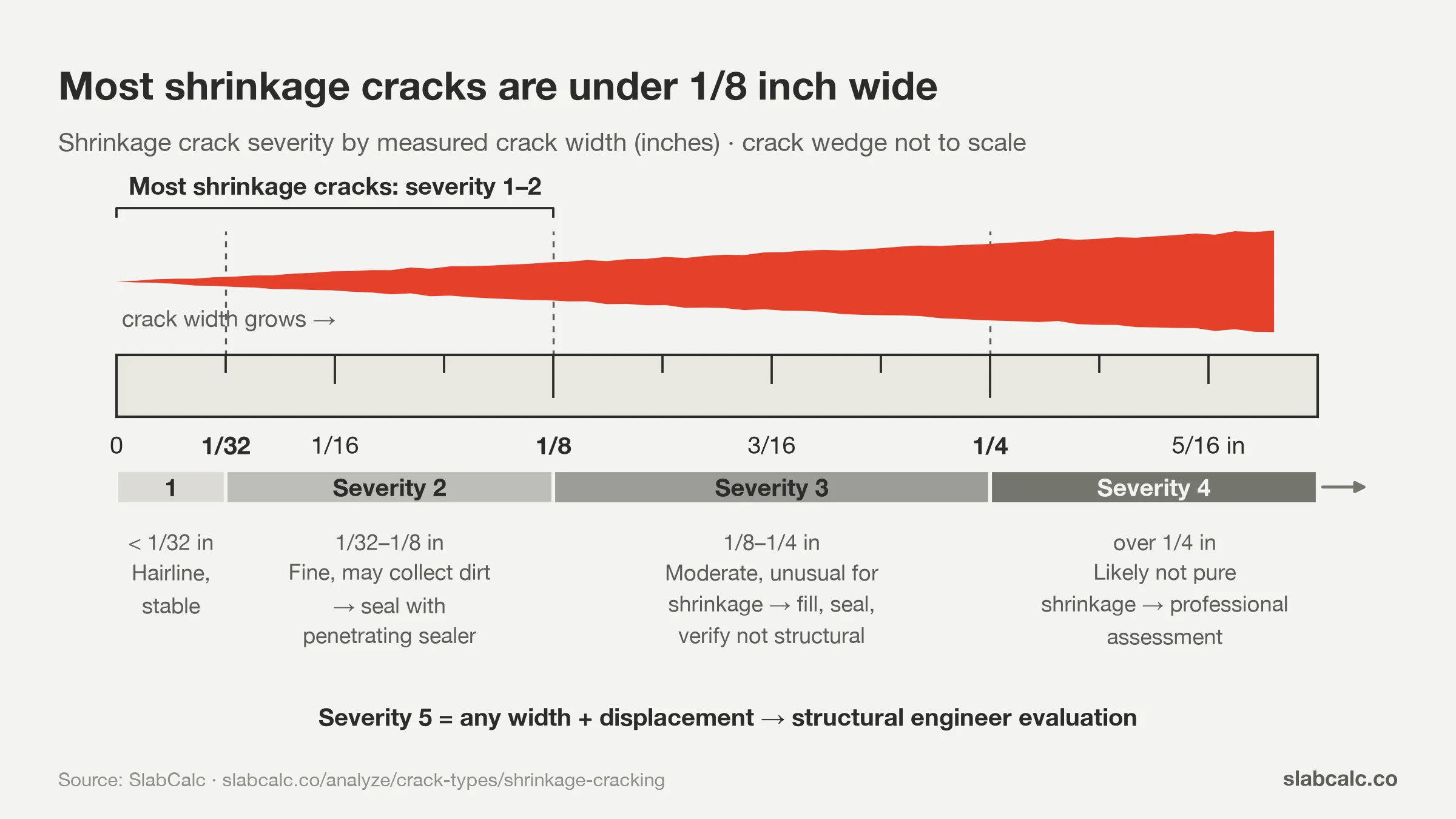
Severity 4 and 5 are outside the normal range for shrinkage cracking. Any crack wider than 1/4 inch, or any crack with vertical displacement between edges, should be evaluated by a structural engineer before repair. Filling a structural crack without addressing the root cause is a waste of money — the crack will reopen.
Full 1–5 severity scale explained →
How to Repair Shrinkage Cracks
How to fix shrinkage cracks in concrete: clean the crack, then seal hairlines under 1/32 inch with a penetrating silane/siloxane sealer, fill 1/32–1/4 inch cracks with polyurethane caulk (or epoxy for a rigid repair), and finish with a sealer over the whole slab. Materials cost $15–$60 for a typical driveway.
Shrinkage crack repair is one of the most straightforward concrete maintenance tasks. The goal is to seal the crack against moisture infiltration and restore a uniform surface appearance. For severity 1–2 cracks, this is a simple DIY project that takes 1–2 hours of active work.
Step 1: Assess the Crack
Before buying materials, characterize the crack so you select the right repair product. Measure the crack width with a crack comparator card (available at most concrete supply stores for $5–$10) or a standard ruler. Cracks under 1/32 inch are hairline and need only a penetrating sealer. Cracks 1/32 to 1/8 inch wide require a crack filler. Cracks wider than 1/8 inch should be filled and evaluated for possible non-shrinkage causes.
Run your finger across both edges to check for displacement. Photograph the crack with a coin placed next to it for scale — this creates a baseline record you can compare against in 3–6 months to confirm the crack has stabilized.
Step 2: Clean the Crack
Proper cleaning is essential for adhesion. Use a stiff wire brush to remove loose particles, followed by compressed air to blow out fine dust from inside the crack. For cracks that have accumulated embedded dirt over months or years, a pressure washer at 1,500–2,000 PSI will clean effectively without damaging the surrounding concrete. Higher pressures can erode the crack edges and make the problem worse.
After washing, allow the crack and surrounding concrete to dry completely — a minimum of 24 hours in dry weather, 48 hours in humid conditions. Most crack fillers require a dry substrate for proper adhesion. Applying filler to damp concrete is the number-one cause of repair failure.
Step 3: Apply Crack Filler
Product selection depends on crack width and whether you need a rigid or flexible repair.
| Product Type | Best For | Approx. Cost | Durability |
|---|---|---|---|
| Penetrating sealer (silane/siloxane) | Hairline cracks + prevention | $30–$60/gal | 5–10 years |
| Polyurethane caulk | Cracks 1/32"–1/4" | $8–$15/tube | 10+ years |
| Epoxy crack filler | Rigid repair, cracks 1/16"–1/4" | $15–$30/kit | Permanent |
| Concrete resurfacer | Dense map cracking over large area | $25–$50/bag | 3–5 years |
For hairline cracks (under 1/32 inch): Apply a penetrating concrete sealer (silane/siloxane blend such as Siloxa-Tek 8500 or equivalent) directly over the cracked area using a pump sprayer or roller. The low-viscosity sealer wicks into fine cracks by capillary action, sealing them from the inside. No crack chasing or filling is needed. Apply at the manufacturer's recommended rate — typically 200–300 square feet per gallon.
For cracks 1/32 to 1/8 inch wide: Use a polyurethane sealant (such as Sikaflex Pro Select or Quikrete Advanced Polymer) applied with a standard caulking gun. Cut the nozzle tip to match the crack width. Apply the sealant slightly proud of the surface (overfilled by 1/16 inch), then immediately smooth flush with a plastic putty knife. Polyurethane remains flexible after curing, which is important because shrinkage cracks may undergo minor seasonal movement in freeze-thaw climates.
For cracks 1/8 to 1/4 inch wide: Epoxy crack filler provides a rigid, structural-grade repair. Two-part epoxy kits come with a mixing nozzle that blends the components as you dispense. Fill from the bottom of the crack upward to avoid trapping air. Epoxy repairs are permanent and can be ground flush once cured. Note that epoxy is rigid and will crack again if the underlying crack continues to move — use polyurethane instead if movement is expected.
For dense map cracking over a large area: When the entire slab surface shows a dense network of fine cracks (crazing), individual crack filling is impractical. A cementitious concrete resurfacer (such as Quikrete Re-Cap or Sakrete Top 'N Bond) applied at 1/16 to 1/8 inch thickness covers the entire surface and encapsulates all cracks. This is a more involved project — surface preparation with a concrete grinder or acid etch is required for adhesion — but it restores a uniform appearance that individual crack repairs cannot.
Step 4: Allow to Cure
Cure times vary by product. Polyurethane sealants typically require 24–48 hours to reach full cure, though they are tack-free in 2–4 hours. Epoxy fillers cure faster — 4–8 hours for foot traffic, 24 hours for full strength. Cementitious resurfacers need 24 hours before foot traffic and 72 hours before vehicle traffic.
Temperature matters. Do not apply any crack repair product below 40 degrees F or above 95 degrees F. Cold temperatures slow chemical reactions and prevent proper curing. High temperatures cause rapid surface drying that can lead to the repair material itself cracking. The ideal application window is 50–80 degrees F with low wind.
Step 5: Seal the Surface
After individual crack repairs have cured, apply a penetrating concrete sealer to the entire slab surface. This step is critical for two reasons: it prevents moisture from entering repaired cracks (which could undermine the filler bond) and it protects against future shrinkage and weathering.
Silane/siloxane-based penetrating sealers are the gold standard for exterior flatwork. Unlike topical film-forming sealers (acrylics), penetrating sealers chemically bond within the concrete pore structure and do not alter the surface appearance, create a slippery film, or peel over time. They reduce water absorption by 85–95% while remaining fully breathable (allowing water vapor to escape from below). Application life is 5–10 years, compared to 1–3 years for film-forming acrylics.
Apply with a low-pressure pump sprayer in two coats: the first coat saturates the surface, and the second coat is applied 5–10 minutes later (while the first coat is still wet) to maximize penetration depth. Typical coverage is 200–300 square feet per gallon per coat, so a two-car driveway (approximately 400 square feet) requires 3–4 gallons total across both coats.
DIY vs. Professional Repair
Shrinkage crack repair is the most DIY-friendly of all concrete repair tasks. The cracks are shallow, the products are readily available at any hardware store, and the consequences of an imperfect repair are purely cosmetic.
Handle it yourself if:
- Cracks are stable (not visibly growing week to week)
- Width is under 1/8 inch with no displacement
- The cracked area is manageable (under 500 square feet)
- You are comfortable with basic tools (caulk gun, wire brush, pump sprayer)
Call a contractor if:
- Dense map cracking covers a large area and you want resurfacing
- Cracks exceed 1/4 inch wide or show any vertical displacement
- Cracks are actively growing or new cracks are appearing months after the pour
- You are unsure whether the cracking is shrinkage, structural, or settlement
- The slab is under warranty and you need documentation for a claim
Professional crack filling for a typical 2-car driveway (400–500 sq ft) runs $150–$400 depending on the number and severity of cracks. Full-slab sealing adds $200–$600 for the same area. For comparison, structural crack repair by injection starts at $500–$1,000 per crack, and full slab replacement for a driveway ranges from $3,000–$8,000.
The cost gap between DIY and professional repair for shrinkage cracks is significant: $15–$50 in materials versus $150–$400+ for labor. Given the low skill threshold and minimal risk, DIY repair makes strong economic sense for severity 1–2 shrinkage cracks.
Prevention Strategies
Preventing shrinkage cracks entirely is not possible — some degree of volume change is inherent to cement hydration. However, the number, width, and visibility of shrinkage cracks can be reduced by 80–90% through proper mix design, placement practices, joint layout, and curing.
Control Joint Layout
Control joints are the most effective single measure for managing shrinkage cracking. ACI 302.1R recommends spacing control joints at 2 to 3 times the slab thickness expressed in feet.
| Slab Thickness | Minimum Joint Spacing | Maximum Joint Spacing |
|---|---|---|
| 4 inches | 8 feet | 12 feet |
| 5 inches | 10 feet | 15 feet |
| 6 inches | 12 feet | 18 feet |
Joint panels should be as close to square as possible — the length-to-width ratio of any panel should not exceed 1.5:1. L-shaped and T-shaped panels concentrate stress at the inside corners and should be avoided. Re-entrant corners (inside corners where two slab edges meet) require diagonal crack-control joints radiating from the corner at 45 degrees to relieve the stress concentration.
Cut joints within 6–18 hours of finishing using an early-entry dry-cut saw. In hot weather (above 85 degrees F) or windy conditions, cut within 4–6 hours. The joint depth must be at least 1/4 of the slab thickness — 1 inch for a 4-inch slab.
Proper Curing
Maintain moisture at the concrete surface for a minimum of 7 days per ACI 308R. The three most practical methods for residential flatwork are:
-
Liquid curing compound (ASTM C309): Spray a uniform coat within 30 minutes of final finishing at the manufacturer's recommended rate (typically 150–200 sq ft per gallon). This is the most common method and the minimum standard of care.
-
Wet curing with burlap and plastic: Lay wet burlap over the surface within 1–2 hours of finishing, cover with polyethylene sheeting, and keep the burlap wet for 7 days. This produces the best results but is labor-intensive.
-
Polyethylene sheeting alone: Cover the slab with 4-mil or thicker plastic within 2–4 hours of finishing. Seal the edges with concrete or tape to prevent wind from displacing the sheet. This is effective but can cause uneven coloring (mottling) on decorative or exposed-aggregate finishes.
Each day of moist curing skipped during the first week increases ultimate shrinkage by 10–15% and reduces 28-day compressive strength by 5–8%.
Mix Design Optimization
Specify a maximum w/c ratio of 0.45 for exterior flatwork (ACI 302.1R recommendation for exposed slabs). Use the lowest slump that allows proper placement and consolidation — 4 to 5 inches for most residential work, achieved through mix proportioning and water-reducing admixtures rather than added water.
For large pours (over 2,000 square feet), consider specifying a shrinkage-reducing admixture (SRA) such as MasterLife SRA 035 or Eclipse Floor. SRAs reduce the surface tension of pore water, which lowers capillary stress and can reduce drying shrinkage by 25–50%. The cost premium is approximately $5–$10 per cubic yard.
Shrinkage-compensating concrete (ASTM C845, Type K cement) contains an expansive component that causes the concrete to expand slightly during early curing, offsetting subsequent drying shrinkage. This is an effective but more expensive option typically reserved for large commercial floor slabs where crack-free performance is critical.
Fiber Reinforcement
Synthetic microfibers (polypropylene or nylon) at a dosage of 1.5 lb per cubic yard reduce plastic shrinkage cracking by 80–90% per PCA testing. The fibers are pre-measured in water-soluble bags and added directly to the truck mixer — no change to the mix design or placement procedure is required. The cost is approximately $6–$10 per cubic yard.
Microfibers are effective against plastic shrinkage cracking (the first 1–6 hours) but have minimal effect on long-term drying shrinkage. For drying shrinkage control, macro fibers (steel or synthetic, 1.5–2 inches long) at 3–5 lb/yd3 provide post-crack load transfer that keeps cracks tight, though they do not prevent crack initiation.
For more detail on these strategies, see How to prevent concrete cracking and Curing methods compared.
Cost Estimates
Shrinkage crack repair is among the least expensive concrete maintenance tasks. The following table summarizes typical costs by repair scope for residential flatwork.
| Repair Scope | DIY Cost | Professional Cost | Notes |
|---|---|---|---|
| Seal 1–5 hairline cracks | $15–$30 | $75–$150 | Penetrating sealer, single application |
| Fill 5–15 fine cracks (1/32"–1/8") | $25–$60 | $150–$400 | Polyurethane caulk or epoxy |
| Full-slab penetrating sealer (400 sq ft) | $60–$120 | $200–$600 | Two-coat silane/siloxane application |
| Resurface dense map cracking (400 sq ft) | $100–$200 | $800–$1,500 | Cementitious overlay at 1/16"–1/8" |
| Structural crack evaluation | N/A | $200–$500 | Licensed structural engineer inspection |
| Full slab replacement (400 sq ft driveway) | N/A | $3,000–$8,000 | Tear-out, regrading, new pour |
For most homeowners dealing with typical severity 1–2 shrinkage cracks, the total investment is $15–$60 in materials for a DIY repair that takes 1–2 hours plus cure time. Full-slab sealing is recommended regardless of cracking — it protects against future moisture damage, freeze-thaw deterioration, and staining, and pays for itself by extending slab service life.
To estimate concrete costs for a new pour with proper shrinkage control measures built in, use the concrete cost calculator.
Key Takeaways
- Shrinkage cracks are normal. Over 90% of concrete slabs develop some form of shrinkage cracking. They are a cosmetic issue, not a structural one, in the vast majority of cases.
- Identification is simple. Shrinkage cracks form random map/web patterns or parallel lines, are narrower than 1/16 inch, have no vertical displacement between edges, and appear within the first 28 days.
- Severity 1–2 cracks need minimal repair. A penetrating sealer or polyurethane caulk applied as a DIY project for $15–$60 is sufficient. No professional is needed.
- Displacement is the red flag. If one side of the crack is higher than the other, it is not a pure shrinkage crack. Stop and get a professional evaluation before proceeding.
- Prevention starts at the mix truck. Specifying a w/c ratio at or below 0.45, refusing site-added water, cutting control joints within 6–18 hours, and curing for a minimum of 7 days will eliminate the majority of avoidable shrinkage cracking.
- Sealing the slab is always worthwhile. Even if cracks are too fine to fill individually, a penetrating sealer protects the entire slab against moisture infiltration, freeze-thaw damage, and staining for 5–10 years at a cost of $60–$120 DIY.
- Crack width above 1/4 inch or any displacement warrants professional evaluation. These conditions are outside the normal range for shrinkage and suggest a structural or settlement mechanism that filling alone will not resolve.