

Shrinkage vs. Structural Cracks in Concrete
A hairline map crack and a displaced diagonal crack can look similar at first glance — but one is cosmetic and the other signals structural failure. This guide gives you a direct side-by-side comparison, a 3-step diagnostic process, and the cost difference between the two repair paths.
Side-by-Side Comparison
| Feature | Shrinkage Crack | Structural Crack |
|---|---|---|
| Pattern | Random map/web or parallel lines | Single line — diagonal, vertical, or stair-step |
| Width | Under 1/16 inch (hairline) | Often wider than 1/4 inch |
| Displacement | None — edges are flush | One side higher or offset from the other |
| Depth | Crazing is shallow; restrained drying cracks can run full depth (but stay hairline, no offset) | Through full slab or wall thickness |
| Timing | First 1–28 days after pour | Any time — can appear years later |
| Location | Flatwork surfaces (driveways, slabs, sidewalks) | Foundation walls, beams, load-bearing slabs |
| Activity | Stabilizes after curing | May be active — widening or lengthening over time |
| Severity Range | 1–2 (cosmetic) | 3–5 (professional to engineer) |
How to Tell the Difference: 3-Step Diagnostic
Distinguishing shrinkage from structural cracking takes less than 60 seconds. Work through these checks in order — if any step flags structural, stop and get professional evaluation.
Step 1: Check for Displacement
Run your finger or a straightedge perpendicular across the crack. Feel for any height difference between the two edges.
- No displacement → Likely shrinkage. Continue to Step 2.
- Any displacement → Structural. Stop here. The crack indicates differential movement of the slab sections, regardless of width or pattern.
Displacement is the single most reliable indicator. A crack can be hairline-thin and still be structural if one side has shifted.
Step 2: Check the Pattern
Stand back and observe the crack layout across the entire surface.
- Map/web pattern or multiple parallel lines → Shrinkage. The random network indicates uniform volume reduction during curing — a surface phenomenon.
- Single line running diagonally, vertically, or in a stair-step through mortar joints → Structural. A single directional crack follows a stress concentration caused by loading, settlement, or lateral pressure.
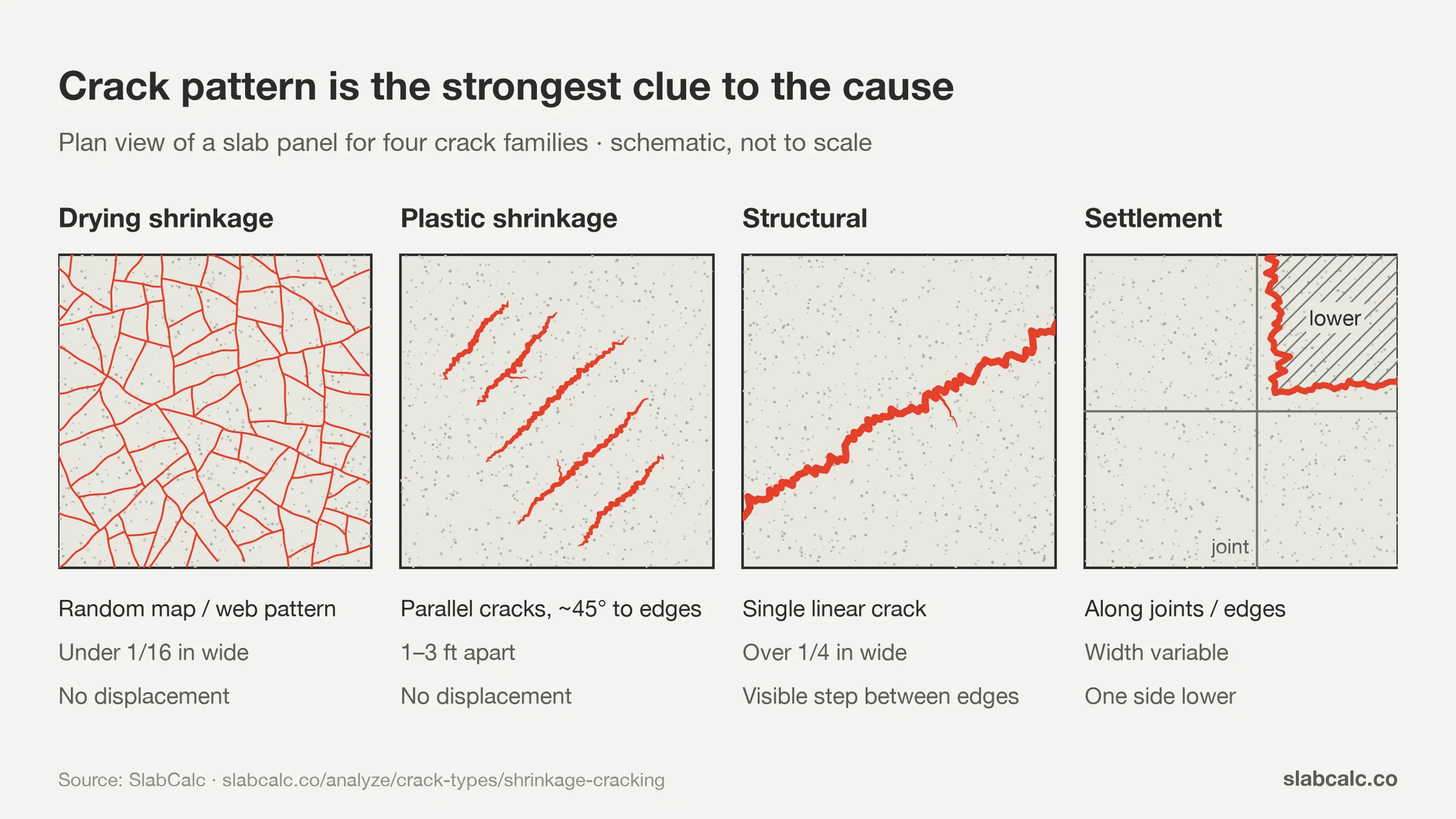
Step 3: Check Width and Location
Measure the crack width with a crack comparator card or ruler.
- Under 1/16 inch in flatwork (driveway, patio, sidewalk) → Shrinkage. Seal it and monitor.
- Over 1/4 inch, or any width in a foundation wall, beam, or column → Structural. Get engineering evaluation.
- Between 1/16 and 1/4 inch → Gray zone. Monitor monthly for 3 months. If it widens or develops displacement, treat as structural.
Still unsure? Upload a photo to the concrete crack analyzer for an instant AI classification.
When Shrinkage Cracks Become Concerning
Most shrinkage cracks are permanently cosmetic — they form during curing and never worsen. But three scenarios escalate a shrinkage crack beyond routine maintenance:
Freeze-thaw widening. In cold climates, water enters unsealed cracks, freezes (expanding 9% by volume), and forces the crack wider. After several winter cycles, a hairline crack can open to 1/8 inch or more. The fix is simple — seal cracks before the first freeze — but the damage is cumulative if ignored.
Width exceeding 1/4 inch. A crack that started as shrinkage but has widened beyond 1/4 inch warrants investigation. While still not structural if there's no displacement, wide cracks allow significant moisture, insect, and radon infiltration. Professional crack filling or routing-and-sealing is appropriate.
Displacement appears. If a formerly flush shrinkage crack develops any height difference between edges, the cause has changed. Soil settlement, root intrusion, or frost heave is now moving the slab — and the crack is no longer a shrinkage issue. Treat as structural.
For the full shrinkage cracking guide — causes, prevention, and step-by-step repair — see Shrinkage Cracking in Concrete.
When Structural Cracks Are Actually Cosmetic
Not every crack in a foundation wall is an emergency. These scenarios produce cracks that look structural but have stabilized and pose no ongoing risk:
Old, stable cracks. A foundation crack that hasn't changed in width, length, or displacement for 12+ months has likely completed its movement. Common in homes 5–20 years old where initial settlement has finished. Monitor annually, but immediate repair isn't urgent.
Completed settlement. When a slab settles due to soil consolidation, the movement eventually stops — soil reaches its bearing capacity and stabilizes. The resulting cracks may show displacement, but if they're dormant (no seasonal changes), the structural event is over.
Hairline cracks in non-structural elements. A hairline crack in a garden wall, decorative column, or non-load-bearing partition is cosmetic regardless of pattern. Structural assessment applies only to elements that carry building loads.
For the full structural cracking guide — load analysis, repair methods, and when to get engineering evaluation — see Structural Cracking in Concrete.
Cost Comparison
| Repair Scenario | Cost Range | Who Does It |
|---|---|---|
| Shrinkage — DIY crack sealer | $15–$60 | Homeowner |
| Shrinkage — professional sealing | $150–$400 | Contractor |
| Shrinkage — full-slab resurfacing | $500–$2,500 | Contractor |
| Structural — epoxy injection (stable crack) | $300–$800 | Contractor |
| Structural — carbon fiber reinforcement | $1,000–$5,000 | Specialist |
| Structural — wall anchors or bracing | $3,000–$15,000 | Specialist |
| Structural — underpinning / piering | $5,000–$45,000 | Engineer + contractor |
Shrinkage repair is a weekend project. Structural repair is a capital expense. Accurate diagnosis at the start can save thousands in unnecessary engineering fees — or prevent tens of thousands in damage from ignoring a structural problem.
For local pricing, see concrete cost estimates by city or use the concrete cost calculator.
What to Do Next
No displacement, map pattern, under 1/16 inch? → You have shrinkage cracking. Read the shrinkage cracking guide for DIY repair steps.
Displacement, single diagonal line, or wider than 1/4 inch? → You likely have structural cracking. Read the structural cracking guide and get professional evaluation.
Not sure? → Upload a photo to the concrete crack analyzer for an instant AI diagnosis with failure mode classification and severity score.
Key Takeaways
- Displacement is the #1 indicator. If one side of the crack is higher than the other, it's structural — regardless of width.
- Shrinkage cracks form a map pattern; structural cracks run in a single direction. Pattern is the second-best diagnostic after displacement.
- Most concrete cracks are shrinkage. Over 90% of cracks on residential flatwork are cosmetic shrinkage cracks that need only sealing.
- The cost gap is enormous. Shrinkage repair costs $15–$60 DIY; structural repair starts at $300 and can exceed $45,000.
- When in doubt, monitor first. Mark crack ends, measure width monthly, and watch for displacement. Three months of stable monitoring often resolves the diagnosis without professional fees.