

Structural Cracking in Concrete: Warning Signs, Assessment & Repair Guide
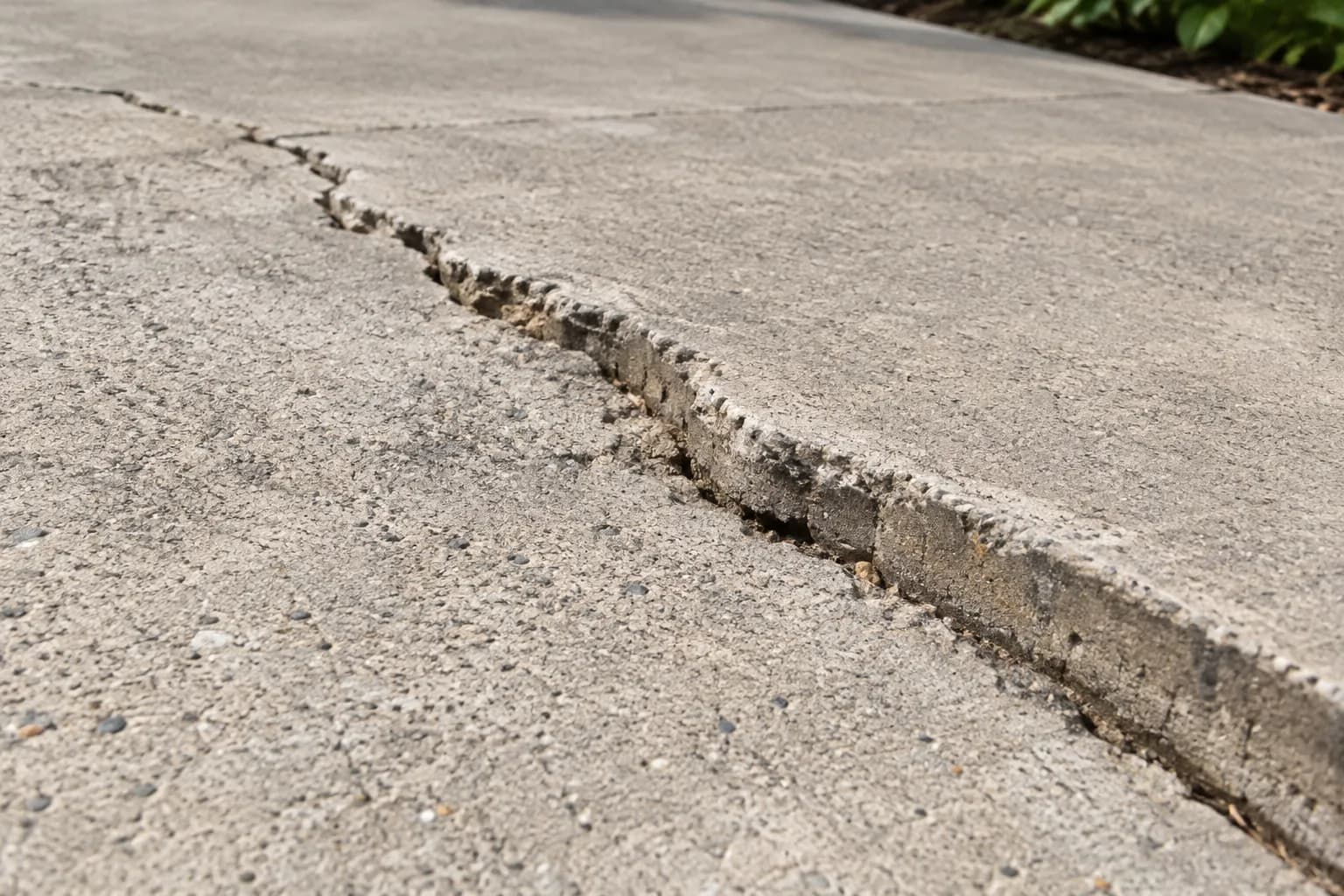
Structural cracks are the most serious category of concrete cracking — they indicate that forces have exceeded the concrete's load-bearing capacity. Unlike cosmetic shrinkage cracks, structural cracks show displacement (one side higher than the other), are often wider than 1/4 inch, and can compromise the safety of foundations, beams, columns, and load-bearing slabs. Any crack with visible displacement requires professional evaluation.
Structural cracking is not a cosmetic issue. It is a warning that the concrete element — whether a foundation wall, a beam, a column, or a load-bearing slab — is under stress that exceeds its design capacity. Unlike shrinkage cracks that stabilize within the first month of curing, structural cracks can propagate, widen, and ultimately compromise the integrity of the entire structure. Understanding the mechanics behind structural cracking, recognizing the warning signs, and knowing the correct response can prevent catastrophic failure and save thousands of dollars in repair costs.
What Is Structural Cracking?
Structural cracking occurs when applied forces — whether from loading, settlement, lateral pressure, or thermal stress — exceed the concrete's tensile capacity. This is the fundamental distinction: cosmetic cracks form from the concrete's own internal curing process, while structural cracks form because external forces are pulling, pushing, or bending the concrete beyond what it can withstand.
Concrete is inherently weak in tension. As a standard engineering estimate, concrete's tensile strength is only 8-15% of its compressive strength (ACI 318's modulus of rupture, 7.5√f'c, gives about 474 PSI for 4,000 PSI concrete). A 4,000 PSI concrete mix — standard for residential foundations — has a compressive strength of 4,000 pounds per square inch but a tensile strength of only 320-600 PSI. This disparity is why concrete is reinforced with steel rebar: the rebar carries the tensile loads that concrete cannot.
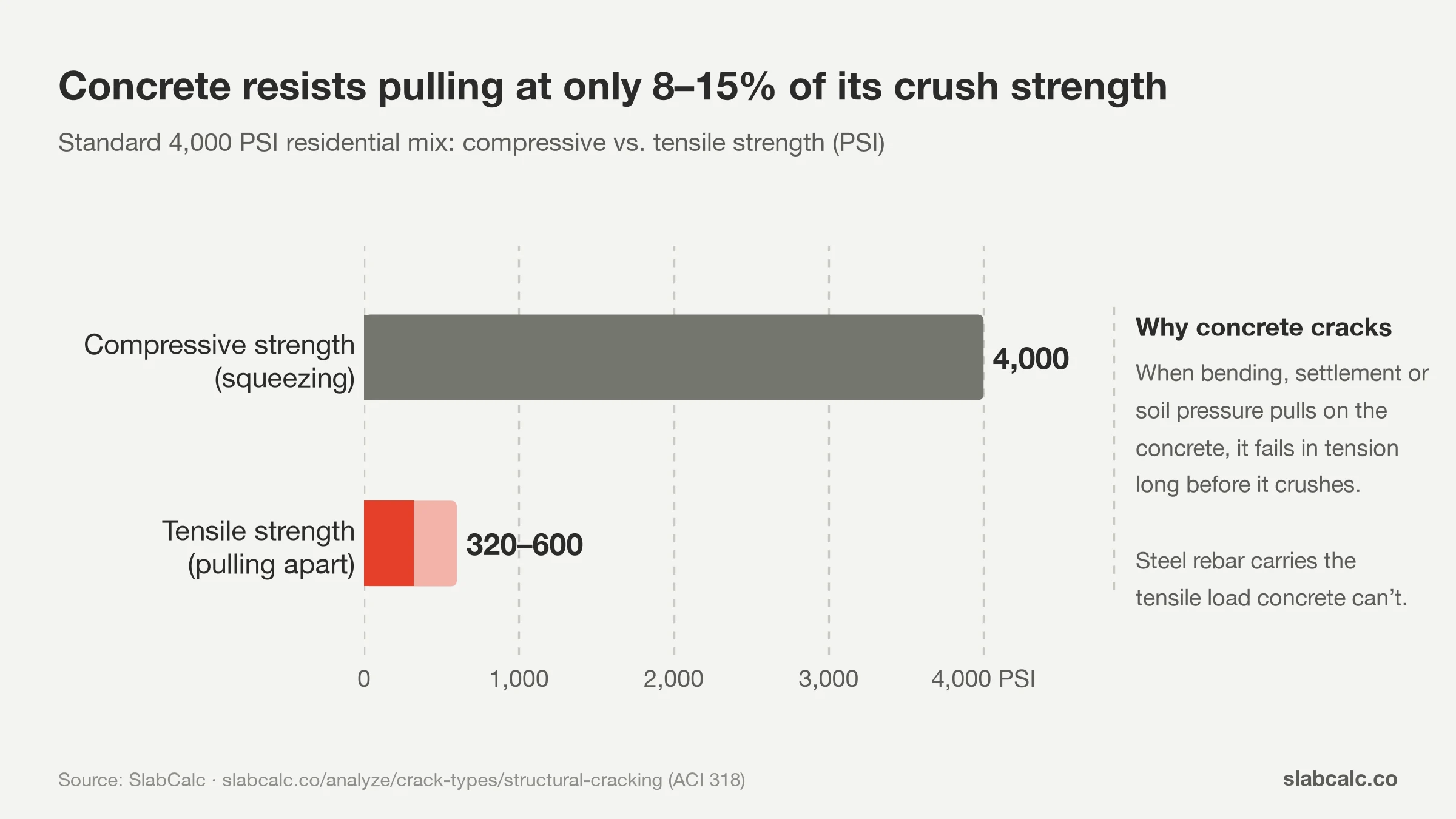
When tensile stress exceeds this threshold and the reinforcement (if present) cannot absorb the load, the concrete cracks. ACI 318, the Building Code Requirements for Structural Concrete, governs how structural concrete elements must be designed to resist combined dead loads (the structure's own weight), live loads (occupants, furniture, vehicles), environmental loads (wind, seismic, soil pressure), and thermal loads. When any of these exceed the design envelope, structural cracking results.
There are three primary types of structural cracks, each revealing a different failure mode:
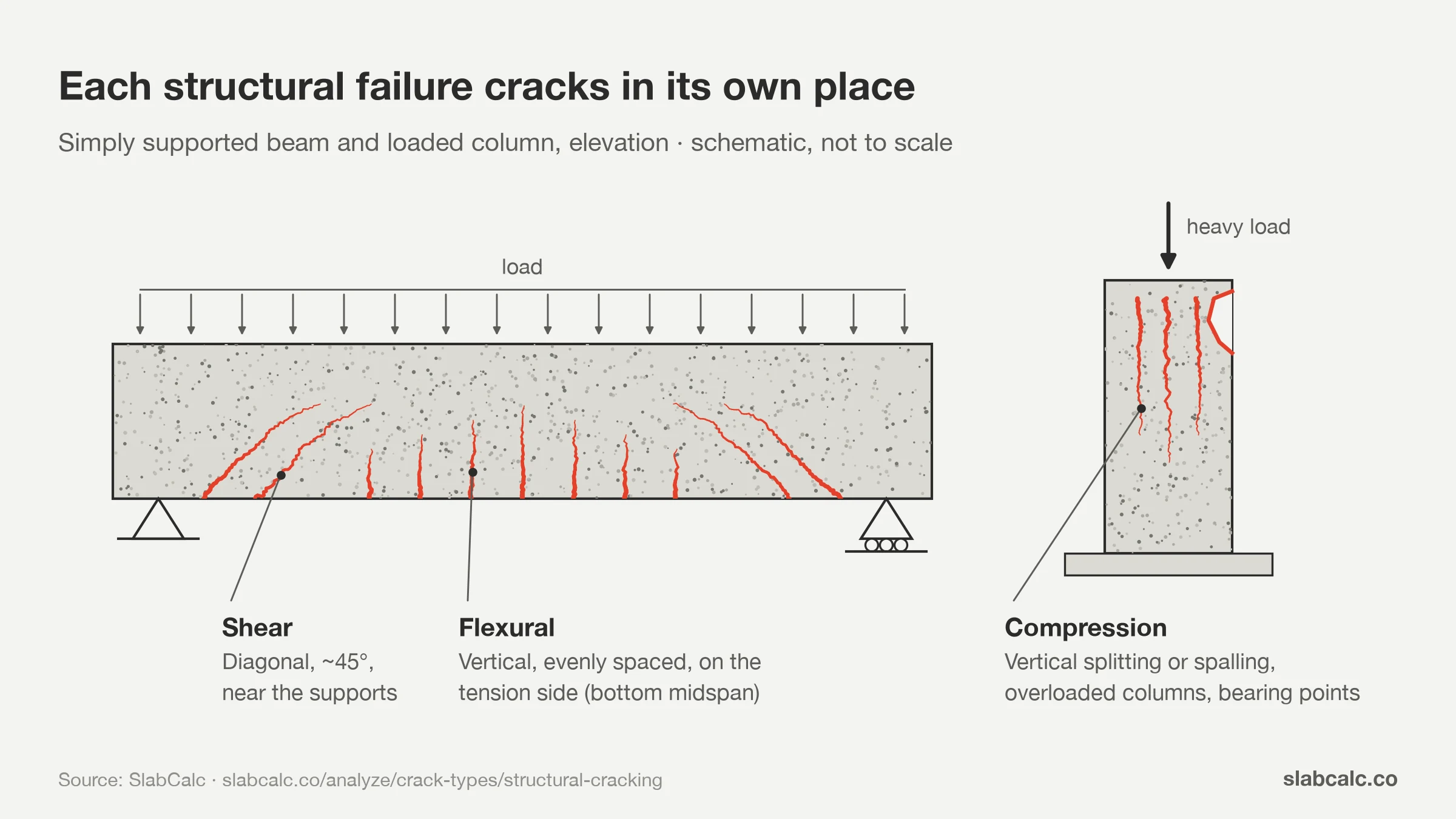
Flexural cracks form on the tension side of a bending member. In a simply supported beam, these appear at the bottom midspan where tensile stress is highest. In a cantilevered slab, they appear on top at the support. Flexural cracks are typically vertical and evenly spaced.
Shear cracks form diagonally, typically at approximately 45 degrees, in areas where shear forces are concentrated — near the supports of beams, in foundation walls subjected to differential settlement, and at the corners of openings in walls. Diagonal cracks in foundation walls are among the most concerning patterns a homeowner can observe.
Compression cracks appear as vertical splitting or spalling when compressive loads exceed the concrete's capacity. These are less common in residential construction but can occur in overloaded columns or at bearing points where concentrated loads are applied to insufficient cross-sections.
What Causes Structural Cracking?
Structural cracks always have a cause. Identifying that cause is the first and most critical step before any repair, because a repair that does not address the root cause will fail.
Overloading Beyond Design Capacity
Every concrete element is designed for a specific combination of dead and live loads. ACI 318 requires load factors — the design must handle 1.2 times the dead load plus 1.6 times the live load as a minimum safety margin. When actual loads exceed these factored design loads, cracking initiates.
Common overloading scenarios in residential construction include adding a heavy structure (hot tub, large planter, heavy equipment) to a slab designed only for foot traffic, converting a garage to living space without assessing floor load capacity, storing heavy materials on a floor system not rated for the weight, and vehicle traffic on a 4-inch slab designed for pedestrians. A standard 4-inch residential slab is designed for approximately 50 PSF live load. A loaded pickup truck concentrates roughly 4,000 pounds on each tire contact patch — far exceeding what a pedestrian slab can handle.
Foundation Settlement
Differential settlement — where one section of a foundation settles more than an adjacent section — is one of the most common causes of structural cracking in residential buildings. The Structural Engineers Association (SEA) generally considers differential settlement exceeding 1/4 inch across a 10-foot span to be a threshold for potential structural distress.
Settlement cracks are characterized by displacement: one side of the crack sits higher or lower than the other. The crack pattern typically radiates from the point of greatest settlement, often appearing as diagonal cracks in walls and stair-step cracks in masonry. Causes include poorly compacted fill soil, changes in soil moisture content (drought or flooding), erosion of supporting soil due to inadequate drainage, decomposition of organic material beneath the foundation, and adjacent excavation or construction activity.
Lateral Earth Pressure
Basement walls and retaining walls resist horizontal soil pressure. This pressure increases with depth and is amplified when the soil is saturated with water or when surface loads (vehicles, soil stockpiles, heavy equipment) are applied above the wall. When lateral pressure exceeds the wall's design capacity, the wall bows inward and cracks horizontally, typically at mid-height where bending stress is maximum.
The effective horizontal soil pressure on a basement wall can double when the backfill becomes fully saturated. A wall designed for "at-rest" dry soil conditions may not have adequate capacity for saturated conditions with hydrostatic pressure — a design oversight that is unfortunately common in older residential construction predating modern codes. Horizontal cracks with inward displacement greater than 1 inch are a serious structural concern requiring immediate professional evaluation.
Inadequate Reinforcement
Older construction, structures built without permits, and do-it-yourself projects frequently lack adequate steel reinforcement. Pre-1970s residential foundations were commonly built with little or no rebar. Even when rebar is present, common deficiencies include insufficient cross-sectional area for the span and load, improper spacing (too far apart), lack of temperature and shrinkage steel, inadequate concrete cover over the rebar (leading to corrosion), and improper lap splice lengths.
ACI 318 specifies minimum reinforcement ratios for all structural elements. For example, a foundation wall must have minimum horizontal reinforcement of 0.0020 times the gross cross-sectional area for Grade 60 deformed bars. A 10-inch-thick wall requires at least 0.24 square inches of horizontal steel per foot of height — roughly #4 bars at 10-inch spacing. Many older walls have far less.
Thermal Stress in Restrained Members
Concrete expands and contracts with temperature changes at a rate of approximately 5.5 millionths per degree Fahrenheit. For a 100-foot-long slab, a 50-degree temperature swing produces nearly 1/3 inch of movement. When this movement is restrained — by connections to walls, abutments, or other rigid elements — significant tensile stresses develop.
ACI 224R notes that temperature differentials exceeding 35 degrees F in massive concrete pours (thick foundations, bridge abutments, dam sections) can produce internal thermal cracking as the exterior cools faster than the interior. In residential construction, thermal cracking is most problematic in long walls or slabs without adequate expansion joints, slabs-on-grade connected rigidly to foundation walls, and concrete placed in extreme temperature conditions without proper precautions (see best time to pour concrete).
How to Identify Structural Cracking
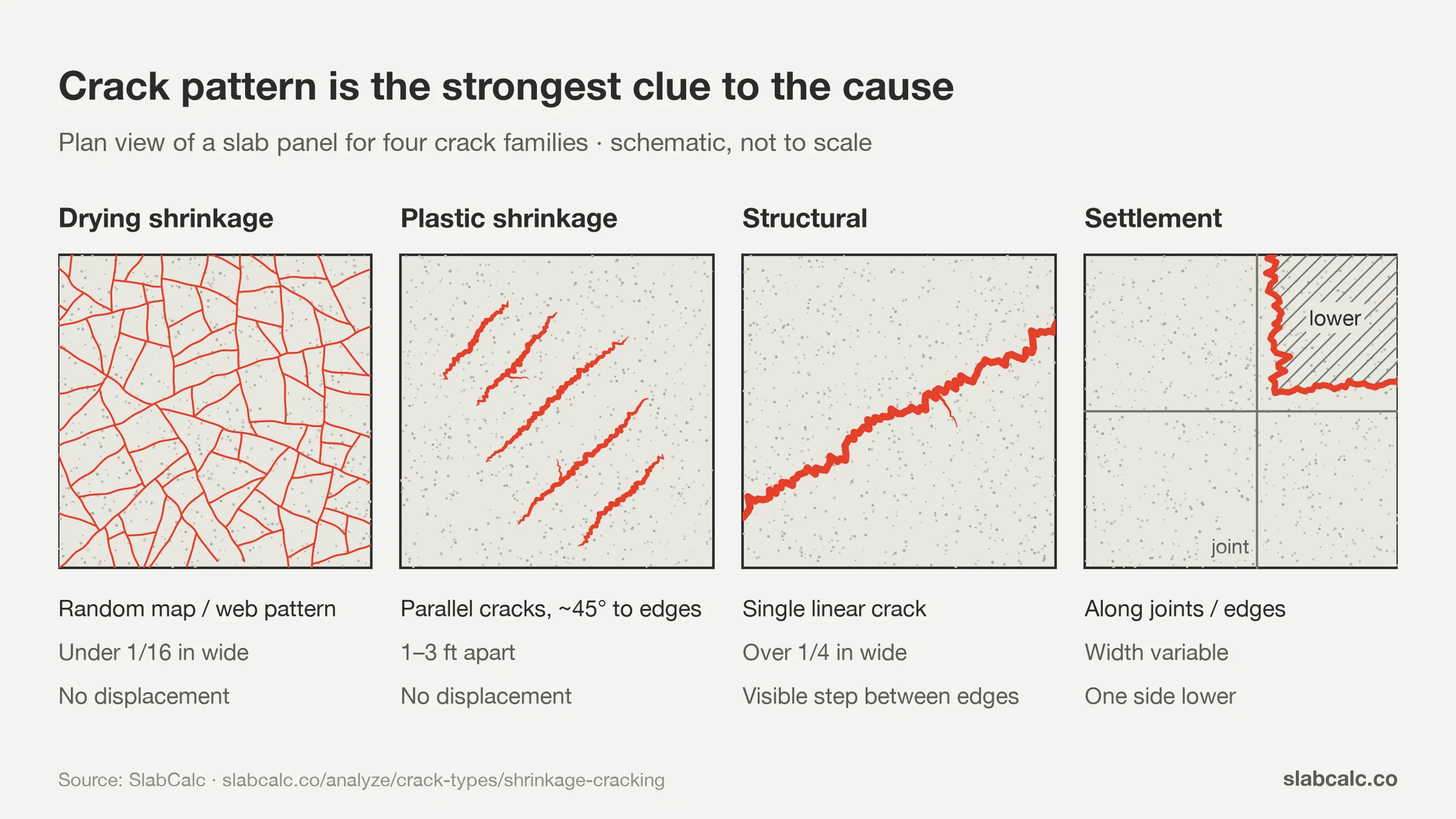
The single most important diagnostic feature of a structural crack is displacement — one side of the crack is offset from the other, either vertically (one side higher), laterally (one side shifted sideways), or rotationally (one side tilted). Non-structural cracks, by contrast, have flush edges on both sides.
The following table summarizes the key differences between structural cracks and other common crack types:
| Feature | Structural Cracks | Shrinkage Cracks | Freeze-Thaw Damage |
|---|---|---|---|
| Pattern | Linear, diagonal | Map/web pattern | Surface flaking |
| Width | >1/4 inch typical | <1/16 inch | N/A — surface loss |
| Displacement | Yes — visible step | None | None |
| Depth | Full section | Hairline; can be full depth (no offset) | Surface to 1/4" |
| Location | Load-bearing elements | Any surface | Exposed surfaces |
| Growth | Often progressive | Stabilizes at 28 days | Seasonal cycles |
Beyond displacement, several other indicators point toward structural origin:
Location matters. A crack in a load-bearing foundation wall is inherently more concerning than the same crack in a decorative garden wall. Cracks in beams, columns, headers over openings, and foundation footings should always be treated as potentially structural until proven otherwise.
Pattern matters. Diagonal cracks radiating from the corners of door and window openings indicate shear stress from differential settlement. Horizontal cracks at mid-height of a basement wall indicate lateral pressure failure. Vertical cracks at regular intervals in a beam indicate flexural overload. Random map-pattern cracking on a flat slab surface is almost always shrinkage — not structural. See the shrinkage vs. structural cracks comparison for a 3-step diagnostic.
Activity matters. A crack that is growing — getting wider, longer, or showing increasing displacement — is an active structural concern regardless of its current size. Install inexpensive crack monitors ($10-$20 at any hardware store) and check them monthly to determine if a crack is active.
Not sure if your crack is structural? Upload a photo to the AI crack analyzer
Severity Assessment
Structural cracks are always severity 3 or higher on the standard 1-5 scale. The specific severity level determines the urgency of response and the likely scope of repair. A severity 1-2 crack is, by definition, not structural — it is cosmetic or minor.
| Severity | Indicators | Risk Level | Required Action | Est. Cost |
|---|---|---|---|---|
| 3 | Width 1/8"–1/4", slight displacement, stable | Moderate | Professional assessment within 30 days | $300–$800 |
| 4 | Width >1/4", displacement >1/8", or active growth | High | Structural engineer within 1 week | $1,000–$5,000 |
| 5 | Large displacement, spalling, rebar exposed, element at risk | Critical | Immediate action — evacuate if necessary | $3,000–$15,000+ |
Severity 3 cracks are concerning but not immediately dangerous. They show early signs of structural distress — slight displacement, moderate width, or location in a structural element — but appear stable. The appropriate response is to document the crack thoroughly (photographs, measurements, dated markings at crack tips), install crack monitors, and schedule a professional assessment within 30 days. Many severity 3 cracks, once evaluated, turn out to be old and stable — the result of a one-time settlement event that has completed.
Severity 4 cracks demand urgent attention. Active growth (the crack is getting wider or longer over weeks or months), displacement exceeding 1/8 inch, or width exceeding 1/4 inch all qualify. These indicate an ongoing structural problem — active settlement, progressive overload, or lateral pressure that is increasing. A licensed structural engineer (PE) should evaluate the crack within one week. Do not attempt any repair before the engineer's assessment.
Severity 5 is a structural emergency. Indicators include large visible displacement (1/4 inch or more), concrete spalling or crushing near the crack, exposed or buckled reinforcing steel, visible deflection of beams or slabs, doors and windows that no longer operate, and any crack accompanied by unusual sounds (popping, grinding). If a load-bearing element shows severity 5 indicators, the area should be evacuated and shored immediately. Call a structural engineer the same day.
Full 1-5 severity scale explained
How to Repair Structural Cracks
Repairing a structural crack is a multi-step process that must follow a specific sequence. Skipping steps — especially the root cause identification step — guarantees failure. The five steps below represent the standard professional approach.
Step 1: Document the crack. Photograph the crack with a ruler or coin for scale at multiple points along its length. Mark the ends of the crack with pencil and write the date next to each mark. Measure and record the width at the widest point using a crack comparator card (available for a few dollars from engineering supply stores). Measure any vertical or lateral displacement between the two sides. This documentation serves two purposes: it establishes a baseline for monitoring, and it provides critical information for the structural engineer.
Step 2: Assess for active movement. Install crack monitors across the crack at multiple points. These simple devices (two overlapping plates with grid markings, adhered across the crack) cost $10-$20 each and provide a precise, ongoing record of any movement. Check monthly for a minimum of 3 months. Any measurable growth indicates an active, unstable crack that requires immediate professional assessment. Record temperature and recent weather at each reading, as thermal expansion can produce apparent movement that is not structural.
Step 3: Get professional evaluation. For any crack at severity 3 or above, hire a licensed structural engineer (PE — Professional Engineer, not just a contractor). The engineer will perform a visual inspection and may recommend additional investigation: coring the concrete to assess internal condition and strength, load analysis to determine if the element is overstressed, soil testing (borings) to evaluate foundation bearing capacity, or a survey to measure settlement. A structural assessment typically costs $300-$600 for residential work and produces a written report with specific repair recommendations and engineering drawings if needed.
Step 4: Address root cause. This is the step most often skipped — and skipping it is why so many crack repairs fail. Before any crack is repaired, the underlying cause must be resolved. If poor drainage caused soil erosion and settlement, install proper drainage first. If overloading caused flexural cracking, reduce the load or reinforce the element. If lateral soil pressure is bowing a basement wall, relieve the pressure (exterior drainage, reduce surcharge loads) before stabilizing the wall. The engineer's report should identify the cause and specify the corrective action.
Step 5: Execute professional repair. With the cause addressed, the crack itself can be repaired per the engineer's specification. The repair method depends on the crack type, location, and severity.
Repair Methods Comparison
| Method | Application | Load Restoration | Approx. Cost | Durability |
|---|---|---|---|---|
| Epoxy injection | Stable cracks in walls/beams | Yes — full tensile | $300–$800/crack | Permanent if cause fixed |
| Carbon fiber straps | Bowing basement walls | Stabilizes lateral | $400–$800/strap | 25+ years |
| Underpinning (push piers) | Foundation settlement | Lifts and stabilizes | $1,500–$3,000/pier | Permanent |
| Section replacement | Severe damage, crushed concrete | Full restoration | $2,000–$10,000+ | Life of structure |
| Structural steel reinforcement | Beams/columns, added capacity | Yes | $1,500–$5,000 | Life of structure |
Epoxy injection is the standard repair for stable structural cracks in sound concrete, per ACI 224.1R. Low-viscosity structural epoxy is injected under pressure into the crack, bonding the two faces and restoring tensile strength across the crack plane. When properly executed, the epoxy bond is stronger than the surrounding concrete. This method is appropriate only for cracks that are stable (not actively moving) and where the root cause has been resolved. Cost runs $300-$800 per crack depending on length and accessibility.
Carbon fiber reinforcement straps are used primarily for bowed or cracked basement walls. High-strength carbon fiber fabric is bonded to the wall surface with structural epoxy, spanning the crack and resisting further lateral movement. Each strap can resist approximately 7,000-14,000 pounds of lateral force, depending on the product and installation. Straps are typically installed at 4-foot intervals along the affected wall. Cost is $400-$800 per strap installed, with most basement wall repairs requiring 5-10 straps ($2,000-$8,000 total).
Underpinning with push piers or helical piers addresses foundation settlement by transferring the building's load from the failing surface soils to competent bearing strata deeper underground. Push piers are driven hydraulically through brackets mounted to the foundation footing until they reach load-bearing soil or bedrock, then the building is lifted back toward level. Helical piers are screwed into the ground and serve the same function. Typical residential pier installations require 8-15 piers at $1,500-$3,000 each, for a total project cost of $12,000-$45,000.
Section replacement — removing and replacing the damaged concrete — is the last resort when the concrete is too severely damaged for injection or reinforcement. This includes situations with crushed concrete, severely corroded rebar, or large displacement that cannot be realigned. The damaged section is saw-cut and removed, new reinforcement is tied to the existing steel with proper lap splices, and new concrete is placed. This is major structural work requiring engineering design, permits, and experienced contractors. Costs range from $2,000 for a small slab section to $10,000 or more for foundation wall or beam replacement.
Structural steel reinforcement — adding steel plates, angles, channels, or beams to an existing concrete element — provides additional capacity when the original element is underdesigned or when loads have increased. This is common in renovation projects where walls are removed, loads are increased, or openings are added to load-bearing walls. The steel is typically bolted or epoxied to the concrete surface and engineered to carry the required loads. Costs range from $1,500-$5,000 depending on the scope, excluding any associated concrete work.
DIY vs. Professional
Structural cracks are not DIY territory. This is a firm boundary, not a general suggestion. The consequences of an incorrect assessment or improper repair can include progressive structural failure, loss of property value, building code violations, personal liability if the structure is sold, and in extreme cases, collapse.
The only DIY steps appropriate for structural cracks are monitoring and documentation. Any homeowner can and should photograph cracks when they are discovered, install crack monitors and check them monthly, maintain a log of crack width, length, and displacement over time, and note any correlating factors (heavy rain, drought, new construction nearby, changes in loading).
Everything beyond documentation requires professional involvement. A licensed structural engineer (PE) should perform the assessment and write the repair specification. A licensed contractor experienced in structural concrete repair should execute the repair. In most jurisdictions, structural repairs require a building permit and will be inspected by the building department.
The temptation to fill a structural crack with caulk, hydraulic cement, or surface-applied crack filler is understandable but dangerous. These products may temporarily seal the surface, but they do not restore structural capacity, they do not address the root cause, and they hide the crack from future inspection — making it harder for the next person (or the next engineer) to assess the true condition of the structure. A surface-filled structural crack is arguably worse than an open one.
One exception where limited DIY work is appropriate: if a structural engineer has evaluated the crack, determined it is stable, identified and resolved the root cause, and explicitly recommended a specific repair product (such as a consumer-grade epoxy injection kit), then a capable homeowner may perform the injection following the engineer's instructions. But the assessment and specification must come from a professional first.
Prevention Strategies
Structural cracking is fundamentally a design and construction quality issue. The most effective prevention happens before concrete is ever placed.
Proper structural design per ACI 318. Every load-bearing concrete element should be designed by a licensed engineer for the specific loads it will carry, with appropriate safety factors. This is not optional for foundations, beams, columns, and load-bearing walls — it is a building code requirement. In residential construction, the most common design-related causes of structural cracking are undersized footings for the soil bearing capacity, inadequate wall thickness for the depth of backfill, insufficient reinforcement for the span and loading, and absence of expansion joints in long walls and slabs.
Adequate reinforcement. Rebar is what gives concrete its tensile capacity. ACI 318 specifies minimum reinforcement ratios for every type of structural element. For residential foundations, the critical details include horizontal and vertical wall reinforcement at the code-minimum ratio, dowels connecting footings to walls, temperature and shrinkage steel in slabs, and proper concrete cover (typically 3 inches against soil) to protect rebar from corrosion. Learn more about reinforcement requirements in our rebar guide.
Proper drainage and waterproofing. Water is the primary enemy of foundations. Soil that stays saturated exerts hydrostatic pressure on basement walls, causes expansive clay soils to swell, erodes granular soils from beneath footings, and accelerates freeze-thaw damage in cold climates. Effective prevention includes sloping grade away from the foundation (minimum 6 inches of fall in the first 10 feet), installing perimeter drain tile at the footing level, applying waterproof membrane to the exterior of foundation walls, and maintaining gutters and downspouts that discharge water well away from the foundation. See our drainage guide for detailed specifications.
Soil testing before foundation work. A geotechnical investigation (soil boring and analysis) costs $1,500-$3,000 for a typical residential project and provides critical information: bearing capacity of the native soil, depth to competent bearing strata, presence of expansive or organic soils, groundwater level, and recommendations for foundation type and size. This small investment prevents the much larger cost of foundation failure. It is required by code for commercial construction and strongly recommended for any residential foundation.
Control of backfill compaction. Poorly compacted backfill against foundation walls settles over time, creating a trough that collects water against the foundation. The backfill should be placed in 8-12-inch lifts and mechanically compacted to at least 95% of the modified Proctor maximum dry density. Heavy compaction equipment should not be used until the foundation wall has adequate lateral support (typically, the first floor structure must be in place).
Cost Estimates
Structural crack investigation and repair costs vary substantially depending on the severity, cause, and required repair method. The following table provides realistic cost ranges for residential work in most U.S. markets.
| Item | Cost Range | Notes |
|---|---|---|
| Structural engineer assessment | $300–$600 | Visual inspection + written report |
| Geotechnical investigation | $1,500–$3,000 | Soil borings + lab analysis |
| Crack monitoring (DIY) | $10–$40 | Per monitor, 3+ recommended |
| Epoxy injection | $300–$800/crack | Per crack, professional installation |
| Carbon fiber straps | $400–$800/strap | Typical wall needs 5–10 straps |
| Basement wall stabilization (full) | $2,000–$8,000 | Carbon fiber, full wall |
| Push pier installation | $1,500–$3,000/pier | Typical home needs 8–15 piers |
| Foundation underpinning (full project) | $12,000–$45,000 | Complete settlement correction |
| Slab section replacement | $2,000–$5,000 | Per section, 4–6 foot area |
| Foundation wall section replacement | $5,000–$10,000+ | Per section, includes excavation |
| Structural steel reinforcement | $1,500–$5,000 | Per element, installed |
| Drainage correction | $2,000–$8,000 | Exterior perimeter drain |
These costs do not include finishing work (repainting, flooring, landscaping) that may be required after structural repairs. In many cases, the drainage or soil correction costs are as significant as the crack repair itself — but they are essential for a lasting solution.
For estimating concrete replacement costs specific to your area, use our concrete cost calculator.
Key Takeaways
- Displacement is the defining feature of structural cracks. A crack with one side higher than the other is far more concerning than a wide crack with level edges. Any visible displacement warrants professional evaluation.
- Always get a professional assessment for severity 3+ cracks. A $300-$600 structural engineer evaluation can prevent thousands in future damage and provides the information needed for an effective repair plan.
- Address the root cause before repairing the crack. Drainage problems, soil movement, overloading, or lateral pressure must be resolved first. Repairing the symptom without fixing the cause guarantees recurrence.
- Do not DIY structural crack repairs. Documentation and monitoring are appropriate for homeowners. Assessment, specification, and repair require licensed professionals. Surface-filling a structural crack without professional guidance is dangerous.
- Monitor cracks for activity before and after repair. Install crack monitors and check monthly. A 3-month monitoring period before non-emergency repair helps distinguish active problems from old, stable cracks.
- Prevention is far cheaper than repair. Proper drainage, adequate reinforcement, soil testing, and code-compliant structural design eliminate most causes of structural cracking before they start.
- When in doubt, act. Structural cracks rarely improve on their own, and many get worse over time. The cost of early intervention is almost always less than the cost of delayed action.
Next Steps
- Upload a photo for AI crack analysis — instant severity assessment
- How to repair concrete cracks — full guide covering all crack types
- Concrete damage assessment guide — comprehensive inspection framework
- Settlement repair options — detailed guide for foundation settlement
- DIY concrete failure: repair or replace? — decision framework
- Concrete slab calculator — estimate material for replacement sections
- Concrete cost calculator — local pricing for your area