

Concrete Repair Guide: Fix Cracks, Spalling, and Damage
Concrete problems don't always mean a full tear-out. These guides help you diagnose what went wrong, decide whether to repair or replace, and walk through the fix step by step.
Diagnose the Problem
Why Concrete Cracks (Causes and Prevention)
All concrete cracks. This isn't a defect—it's physics. Concrete shrinks as it cures, expands and contracts with temperature changes, and eventually develops cracks. The goal isn't to prevent cracking entirely (impossible), but to control where cracks occur and minimize problematic ones.
New Concrete Cracking: What's Normal vs. What's a Problem
Your new concrete has cracks and you're wondering if something went wrong. Here's the reality: all concrete cracks. The question isn't whether your concrete will crack—it's whether those cracks are cosmetic (normal) or structural (a problem). This guide gives you a timeline-based assessment so you can tell the difference.
Concrete Damage Assessment: A Homeowner's Visual Inspection Guide
Your driveway, patio, or garage floor has seen better days. But how bad is it really? This guide walks you through a systematic visual inspection of existing concrete—not a new pour, but concrete that's been in service for years. You'll learn to identify what you're seeing, rate its severity, and decide whether you need a simple repair, a full resurface, or a complete replacement.
Concrete Settling: Causes, Signs, and How to Fix It
Concrete settling happens when the soil beneath a slab compacts, erodes, or shifts, causing sections to sink. A well-installed slab on properly prepared soil shouldn't settle—but shortcuts in base preparation, poor drainage, or natural soil changes can undermine even good concrete.
Not sure what you're looking at?
Upload a photo for an instant AI diagnosis — failure mode, severity score, and repair recommendation.
Surface Repairs
How to Repair Concrete Cracks (DIY Guide)
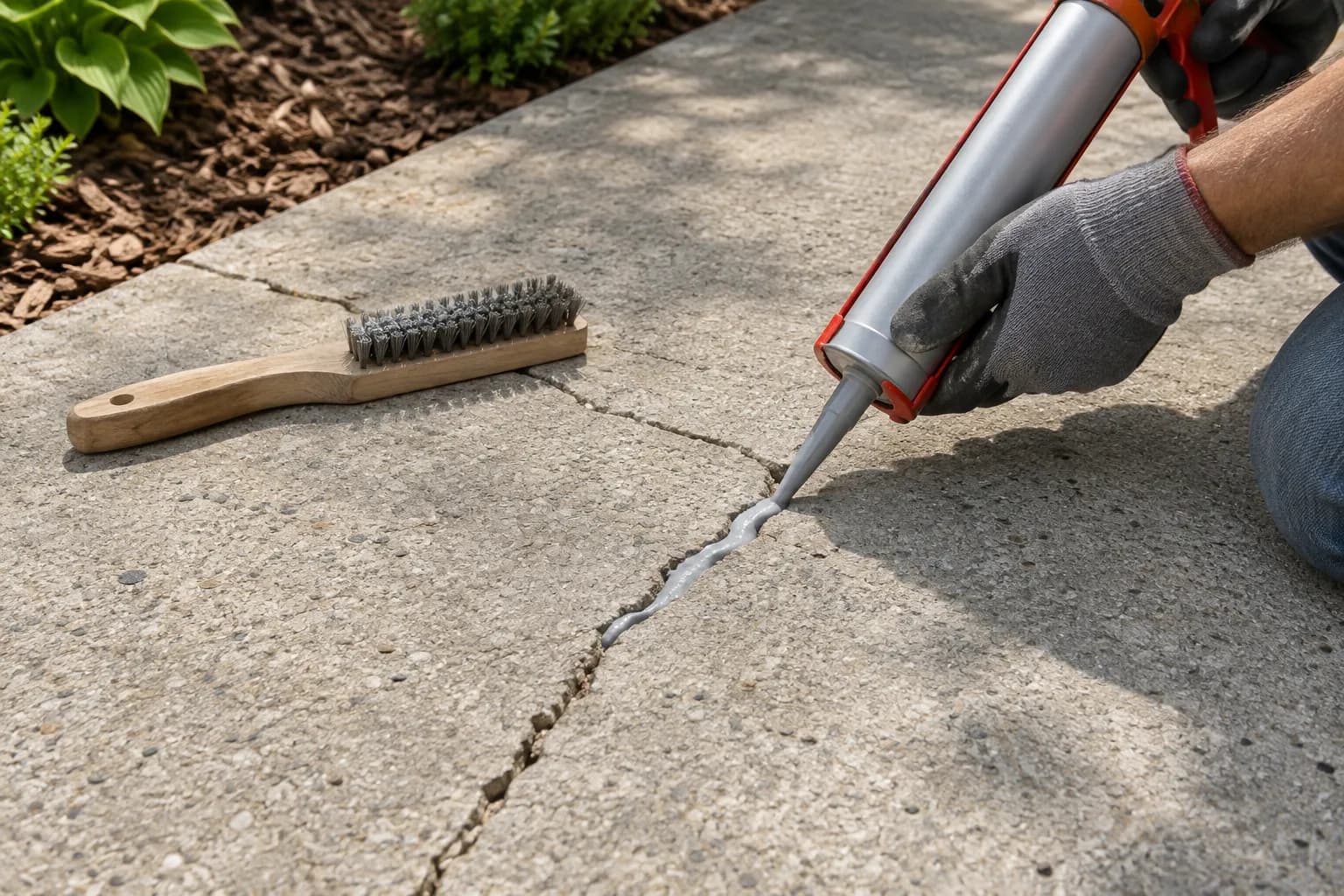
Most concrete crack repairs are straightforward DIY projects. The key is matching the repair method to the crack size and type. Hairline cracks need simple sealers, wider cracks need flexible fillers, and structural cracks need professional assessment before any repair.
How to Patch Small Holes and Chips in Concrete (DIY Guide)
Small holes, chips, and surface pitting in concrete are common — and fixable in an afternoon without professional help. The key is using the right patching material, properly preparing the damaged area, and following the curing steps. This guide covers the complete process for DIY concrete patching.
Concrete Spalling: What It Is and How to Fix It
Spalling is when the concrete surface flakes, peels, or chips away, leaving a rough, pitted appearance. It's primarily a cold-climate problem caused by freeze-thaw cycles and deicing salt, though poor finishing techniques can cause it anywhere. The damage is usually cosmetic but worsens over time if untreated.
Why Concrete Surfaces Fail: Spalling, Scaling and How to Fix Them
Your concrete surface is crumbling, flaking, or pitting—but which problem do you actually have? Spalling, scaling, pitting, and delamination look similar but have different causes and different fixes. Using the wrong repair method wastes money and makes things worse. This guide helps you identify exactly what's happening and match it to the right repair.
Concrete Surface Finish Problems: Pinholes, Rough Spots and Color Issues
Your finish has a problem — and the first thing you need to know is what you're actually dealing with. Pinholes, rough texture, blotchy color, and trowel marks all have different causes and very different fixes. Most concrete surface defects are cosmetic: the slab is structurally sound even when it looks wrong. Identify the problem first, then decide whether you're looking at a simple fill, a grinder pass, or a resurfacing overlay.
Concrete Stain Removal: Oil, Rust, Efflorescence and How to Clean Each
Concrete stains don't all respond to the same treatment. Pouring bleach on a rust stain makes it worse. Pressure washing efflorescence just pushes it deeper. Each stain type has a specific removal method, and using the wrong one wastes time and can permanently damage the surface. This guide covers the most common concrete stains and exactly how to remove each one.
Structural & Environmental Damage
Basement Concrete Problems: Cracks, Water and When to Call a Pro
Water on your basement floor. A crack creeping up the wall. White powder forming on the concrete. These problems range from cosmetic nuisances you can fix in an afternoon to structural issues that need professional intervention. The key is knowing which is which—because overreacting wastes money, and underreacting leads to serious damage.
Concrete Control Joints and Expansion Joints: Purpose, Problems and Fixes
That gap between your concrete slabs isn't a flaw—it's engineered. Control joints and expansion joints serve critical functions, but homeowners often misunderstand them, neglect them, or try to fix problems that aren't actually problems. This guide explains what each joint type does, what goes wrong with them, and how to maintain or repair them properly.
Concrete Discoloration: Causes and Solutions
Concrete discoloration—blotchy patches, white deposits, rust stains, or uneven color—is almost always a cosmetic issue rather than a structural one. The cause determines whether it's fixable: efflorescence usually disappears on its own, while some stains require specific cleaners. In stubborn cases, staining or dyeing the concrete can create a uniform appearance.
Rain on Fresh Concrete: Emergency Assessment and What to Do Right Now
Rain is hitting your fresh concrete and you need answers fast. The good news: depending on when the rain started relative to your pour, your concrete may be fine. The bad news: if rain hits within the first 2-4 hours, you could have serious surface damage. Here's exactly what to do based on your timeline.
Winter Concrete Damage: What Happened and Spring Repair Options
Spring reveals what winter did to your concrete. Surfaces that looked fine in November are now flaking, pitting, cracking, or heaving. Freeze-thaw cycles, deicing salt, and frost heave each cause different types of damage--and each requires a different repair approach. This guide helps you identify what happened, assess severity, and plan repairs before the damage gets worse.
Concrete Chemical Burns: First Aid, Treatment and When to See a Doctor
Concrete burns are chemical burns caused by the high alkalinity (pH 12-13) of wet cement. They're deceptive—you might not feel pain for hours while the cement slowly destroys skin tissue. By the time it hurts, the damage can be severe. Knowing what to do immediately and when to seek medical help can prevent permanent scarring.
Parking Garage Concrete Repair: Patching, Spalling and Delamination
Parking garage concrete deteriorates through a predictable sequence — deicing salt infiltration, corrosion-induced spalling, joint failure, and water infiltration — and repair decisions made at each stage determine whether the structure remains serviceable or requires accelerating capital expenditure. This guide addresses minimum patch thickness, repair material selection, and the repair-vs-resurfacing threshold for facility managers and maintenance contractors.
Sunken Concrete & Lifting
Lift or replace?
Price mudjacking and foam lifting for your slab next to the cost of replacing it in your metro.
Mudjacking vs Polyjacking: Cost, Lifespan, and When to Replace Instead
Mudjacking lifts a sunken slab with a cement slurry for $4–9 per square foot; polyjacking does it with expanding polyurethane foam for $8–25 per square foot. Mudjacking is cheaper and fills big voids well. Foam weighs about 2–4 lb per cubic foot instead of roughly 100, will not wash out, and can be driven on in about 15 minutes. Replace the slab instead when it is broken into pieces or has sunk more than about 4 inches.
Mudjacking: What It Is, What It Costs, and How Long It Lasts
Mudjacking, also called slab jacking or concrete jacking, raises a sunken slab by pumping a cement-and-sand slurry underneath it through 1.5–2 inch holes. It costs $4–9 per square foot, with most contractors charging a $300–700 minimum, and the slab can be used again after about 24 hours. On stable soil a mudjacked slab can hold for 5–10 years or more; if water keeps washing soil out, it sinks again.
Polyjacking: Polyurethane Foam Concrete Lifting Cost and How It Works
Polyjacking, also called foam jacking or polyurethane concrete lifting, raises a sunken slab by injecting a two-part polyurethane that expands under it. It costs $8–25 per square foot, with a $300–700 minimum at most companies, which is roughly two to three times mudjacking at list prices. In return the foam weighs about 2–4 lb per cubic foot, does not wash out, goes in through holes about 5/8 inch wide, and is ready for traffic in about 15 minutes.
Sunken Driveway Repair: Lift, Mudjack, or Replace? (2026 Costs)
A sunken driveway slab can usually be lifted back to level instead of replaced. Mudjacking a 10×20 ft section costs about $800–1,800 and foam lifting about $1,600–5,000, against roughly $1,450–3,500 to tear it out and pour new at US median prices. Lift it if the slab is in one piece and dropped less than about 4 inches; replace it if it is broken up, badly sunk, or poured too thin in the first place.
Sunken Sidewalk Repair: Trip Hazards, Lifting Costs, and Who Pays
A sunken sidewalk slab costs $400–900 to mudjack or $800–2,500 to foam-lift for about 100 sq ft, and a single square usually costs the contractor's $300–700 job minimum. Replacing 100 sq ft runs about $640–1,600 at US median prices. A lip under 1/2 inch can often be ground flat instead. Before paying, check whether your city makes the adjacent owner responsible, and whether it runs a cost-share program.
How to Level Uneven Concrete (DIY Options)
Uneven concrete creates trip hazards, drainage problems, and that frustrating rocking furniture situation. The fix depends on what's causing the unevenness: minor surface irregularities call for self-leveling compound, while sunken slabs need lifting or replacement.
Restore & Maintain
DIY Concrete Gone Wrong: When to Repair vs. Tear Out and Start Over
The pour is done and something went wrong. Maybe the surface is rough and ugly. Maybe cracks appeared before the forms came off. Maybe the whole slab looks like a disaster. Before you panic or start swinging a sledgehammer, take a breath and assess what actually happened—because most concrete failures are fixable, and the ones that aren't need a clear-headed evaluation, not an emotional reaction.
Concrete Resurfacing and Overlays: When It Works, When It Doesn't
Your concrete looks terrible but the slab itself is solid. You've seen products that promise to give old concrete a new surface for a fraction of replacement cost. The question is whether that actually works for your situation. Resurfacing is a legitimate repair method when the underlying concrete is structurally sound--but it fails predictably when applied over unstable slabs, active cracks, or poor subgrades. This guide covers when resurfacing works, which product to use, and how to avoid the most common failures.
Concrete Demolition and Removal: DIY Methods, Tools and Disposal
Every concrete replacement starts with removing the old slab. Most homeowners underestimate how physically demanding and logistically complicated this is--concrete is heavy (about 150 lbs per cubic foot), the pieces are awkward, and disposal isn't as simple as putting it at the curb. This guide covers the tools, techniques, and real costs of concrete removal so you can decide whether to tackle it yourself or hire it out.
Concrete Maintenance: How to Make Your Concrete Last
Concrete is low maintenance, not no maintenance. A few hours of care each year can extend your concrete's lifespan by 10-15 years and keep it looking good throughout. The essentials are simple: keep it clean, keep it sealed, and fix small problems before they become big ones.
Need to Estimate Materials for a Repair?
Use our free concrete calculator to figure out exactly how much material you need for patching, resurfacing, or replacing a section.