

Concrete Surface Finish Problems: Pinholes, Rough Spots and Color Issues
Your finish has a problem — and the first thing you need to know is what you're actually dealing with. Pinholes, rough texture, blotchy color, and trowel marks all have different causes and very different fixes. Most concrete surface defects are cosmetic: the slab is structurally sound even when it looks wrong. Identify the problem first, then decide whether you're looking at a simple fill, a grinder pass, or a resurfacing overlay.
Identify the problem first, then decide whether you're looking at a simple fill, a grinder pass, or a resurfacing overlay. If you want to avoid these problems on future pours, the finishing timing guide covers the errors that cause most surface defects. For the full finishing picture, see the concrete finishing hub.
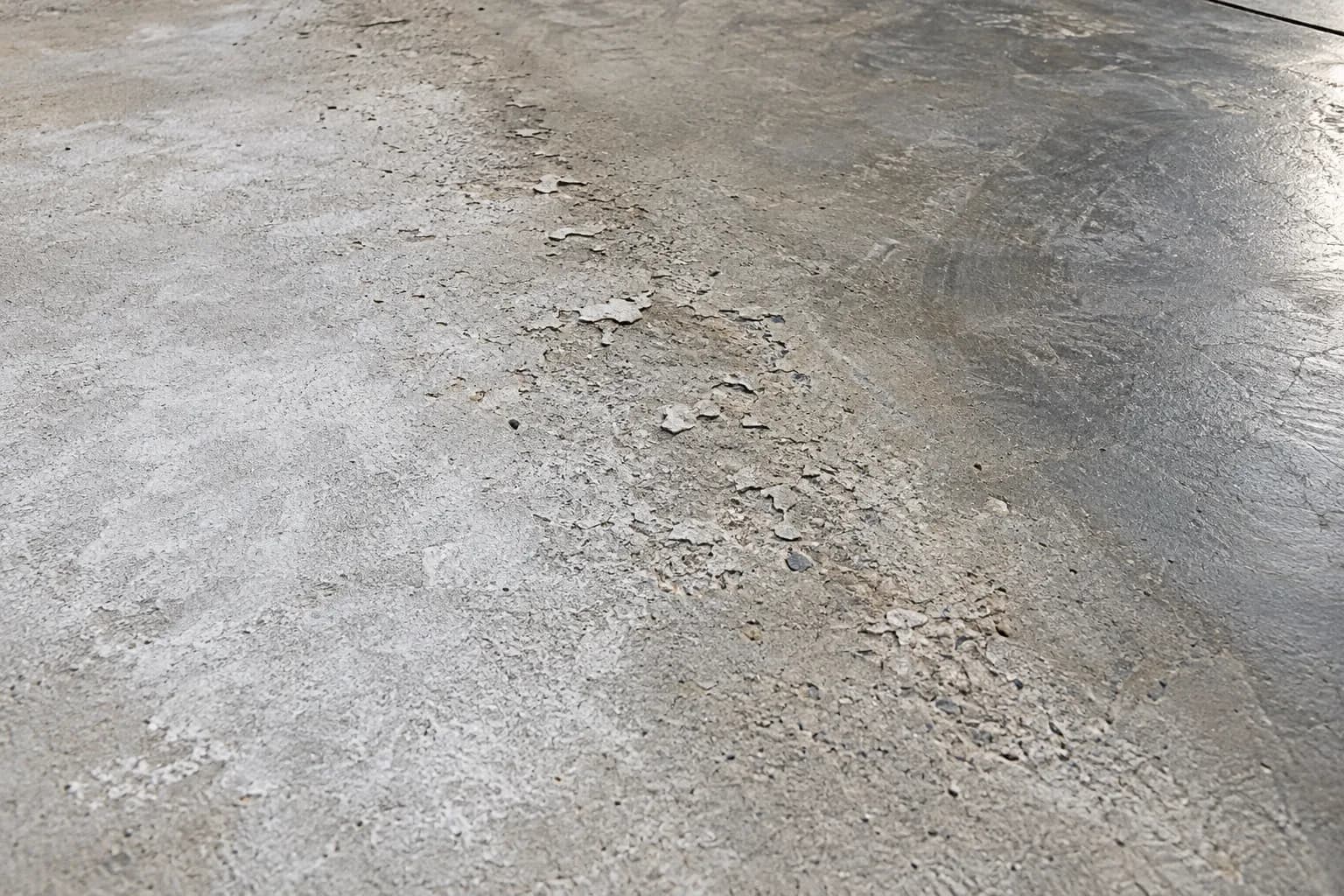
Pinholes and Bug Holes
Pinholes are tiny surface voids (1/32 to 1/8 inch) scattered across the finished surface. Bug holes are slightly larger (1/8 to 3/8 inch). Both are caused by air or water trapped at the surface during finishing.
Common Causes
- Finishing too early: Starting the troweling process before bleed water has fully risen seals the surface over trapped moisture and air
- Excessive vibration followed by inadequate finishing: Vibrating the concrete brings air bubbles to the surface, but they need to be troweled shut
- High-slump (wet) concrete: More water means more bleed water and more bubbles rising to the surface
- Insufficient floating: The bull float pass closes the surface; skipping or rushing it leaves voids open
Fixes
For scattered pinholes: Mix Portland cement with water to a thin paste consistency. Work it into the pinholes with a rubber float or damp sponge, forcing paste into the holes. Wipe the excess off the surface. This is called a slurry rub and is standard practice on architectural concrete.
For dense pinholes across a large area: A thin polymer-modified skim coat (1/16 to 1/8 inch) fills everything at once. Products like Ardex K-301 or SureCrete SureTex are designed for this. Cost: $1-2 per sq ft for materials.
For bug holes (larger voids): Fill individually with a non-shrink grout mixed to peanut butter consistency. Press firmly into each void and smooth with a margin trowel. Color-match by adding pigment to the grout.
Rough or Uneven Texture
A rough concrete surface feels like sandpaper underfoot instead of being smooth. This is different from a broom finish (which is intentionally textured for traction).
Common Causes
- Finishing too late: Concrete that has stiffened too much to trowel smoothly develops a rough, open texture
- Insufficient troweling passes: Smooth concrete requires multiple troweling passes. Each pass compresses and smoothes the surface further.
- Hot weather or wind: Rapid surface drying during finishing makes the surface set up before it can be properly closed
- Wrong finish for the conditions: Attempting a hard trowel finish in hot, windy conditions is fighting a losing battle
Fixes
Mild roughness: Grind with a concrete floor grinder fitted with 40-80 grit diamond tooling. This removes the top layer and exposes a smoother surface. Rental: $100-200/day for a walk-behind grinder.
Moderate roughness on a large area: Apply a self-leveling overlay (1/4 to 1/2 inch thick). This provides a new, smooth surface without removing the old one. Cost: $3-5 per sq ft.
Severe roughness or texture mismatch: A full resurfacing overlay (1/4 to 1/2 inch polymer-modified overlay) creates an entirely new surface. This is the most reliable fix when the original finish is beyond cosmetic touch-up.
Color Variation and Discoloration
Concrete should cure to a uniform color, but it often doesn't. Dark patches, light spots, whitish areas, and blotchy patterns are common complaints.
Types and Causes
| Appearance | Likely Cause | Will It Fade? |
|---|---|---|
| Dark patches (irregular) | Uneven curing--areas that stayed wetter dried darker | Usually fades in 3-12 months |
| Light patches (within dark) | Areas that dried faster or had different finishing timing | Often permanent |
| Overall dark tint | Excess calcium chloride accelerator or high water content | Gradually lightens |
| White haze (efflorescence) | Mineral salts deposited by moisture migrating through the slab | Usually fades in first year |
| Trowel burn (dark streaks following trowel pattern) | Over-troweling or troweling too late, creating dark burnished streaks | Permanent |
For more on concrete color issues, our discoloration guide covers the full diagnostic process.
Fixes
Wait first. Many color variations fade significantly within 6-12 months as the concrete fully cures and carbonates. Power-washing accelerates this by removing surface deposits.
Acid washing: A diluted muriatic acid wash (1:10 acid to water) removes the surface layer, often evening out mild color differences. Wet the concrete first, apply, scrub, neutralize with baking soda solution, rinse thoroughly.
Acid staining: For permanent color differences, an acid stain applied to the entire surface creates a uniform (or intentionally variegated) color that masks inconsistencies. This changes the look permanently--good for patios and decorative work.
Tinted sealer: A colored sealer overlays a semi-transparent tint that evens out mild variation while protecting the surface. The most cost-effective fix for large areas with moderate color issues.
Trowel Marks and Chatter
Visible trowel lines, arc patterns, or chattering (rippled texture from power trowel vibration) on an intended smooth surface.
Causes
- Power trowel timing: Starting the power trowel too early creates chatter marks; too late creates burn lines
- Blade angle too steep: Power trowel blades angled too aggressively dig in and leave marks
- Hand trowel pressure: Inconsistent pressure during hand troweling leaves visible overlapping arcs
- Using a magnesium float on air-entrained concrete: Mag floats tear the surface of air-entrained mixes. Use wood or composite floats instead.
Fixes
Light trowel marks: Grinding with a 60-80 grit diamond floor grinder removes the top surface and eliminates marks. For stamped concrete, this isn't an option--you'd need to recolor after grinding.
Deep chatter marks: Skim coat with a polymer-modified overlay to fill the ripples and create a new smooth surface. Cost: $2-4 per sq ft.
Crazing (Map Cracking)
Crazing is a network of fine, shallow cracks resembling a spider web or dried mud, typically visible only when the surface is wet. The cracks are superficial--in the top 1/16 inch of the surface only.
Causes
- Rapid surface drying during or immediately after finishing (wind, hot sun, low humidity)
- Sprinkling water on the surface during finishing to make troweling easier
- Excessive floating or troweling that brings too much paste to the surface
- Applying curing compound too late after the surface has already started drying
Fixes
Crazing is cosmetic and doesn't affect durability or strength. Options:
- Do nothing. Crazing typically becomes less visible as the concrete ages and weathers
- Seal. A penetrating sealer reduces moisture contrast that makes crazing visible when wet
- Accept it. Most crazing is invisible when the surface is dry and doesn't affect function
If you're concerned about the structural implications of any concrete cracking, see how to finish concrete for proper technique that prevents these issues in future pours.
Key Takeaways
- Most finish problems are cosmetic--the concrete is structurally sound even if it looks wrong
- Pinholes are filled with cement slurry rub; large areas can be skim-coated ($1-2/sq ft)
- Color variation often fades naturally over 3-12 months--wait before committing to expensive fixes
- Grinding ($100-200/day rental) fixes mild roughness and trowel marks
- Resurfacing overlays ($3-5/sq ft) are the universal fix when surface defects are too widespread for spot repair
- Crazing is purely cosmetic and often invisible when dry--sealing reduces visibility
For more project guidance, browse our complete library of concrete guides and tutorials.