
Concrete Resurfacing and Overlays: When It Works, When It Doesn't
Your concrete looks terrible but the slab itself is solid. You've seen products that promise to give old concrete a new surface for a fraction of replacement cost. The question is whether that actually works for your situation. Resurfacing is a legitimate repair method when the underlying concrete is structurally sound--but it fails predictably when applied over unstable slabs, active cracks, or poor subgrades. This guide covers when resurfacing works, which product to use, and how to avoid the most common failures.
Resurfacing costs $3-8 per square foot depending on the product and complexity. Full replacement costs $8-18 per square foot. That price difference makes resurfacing appealing--but only if it works. Use our concrete cost calculator to compare resurfacing costs against full replacement for your project size.
When Resurfacing Works
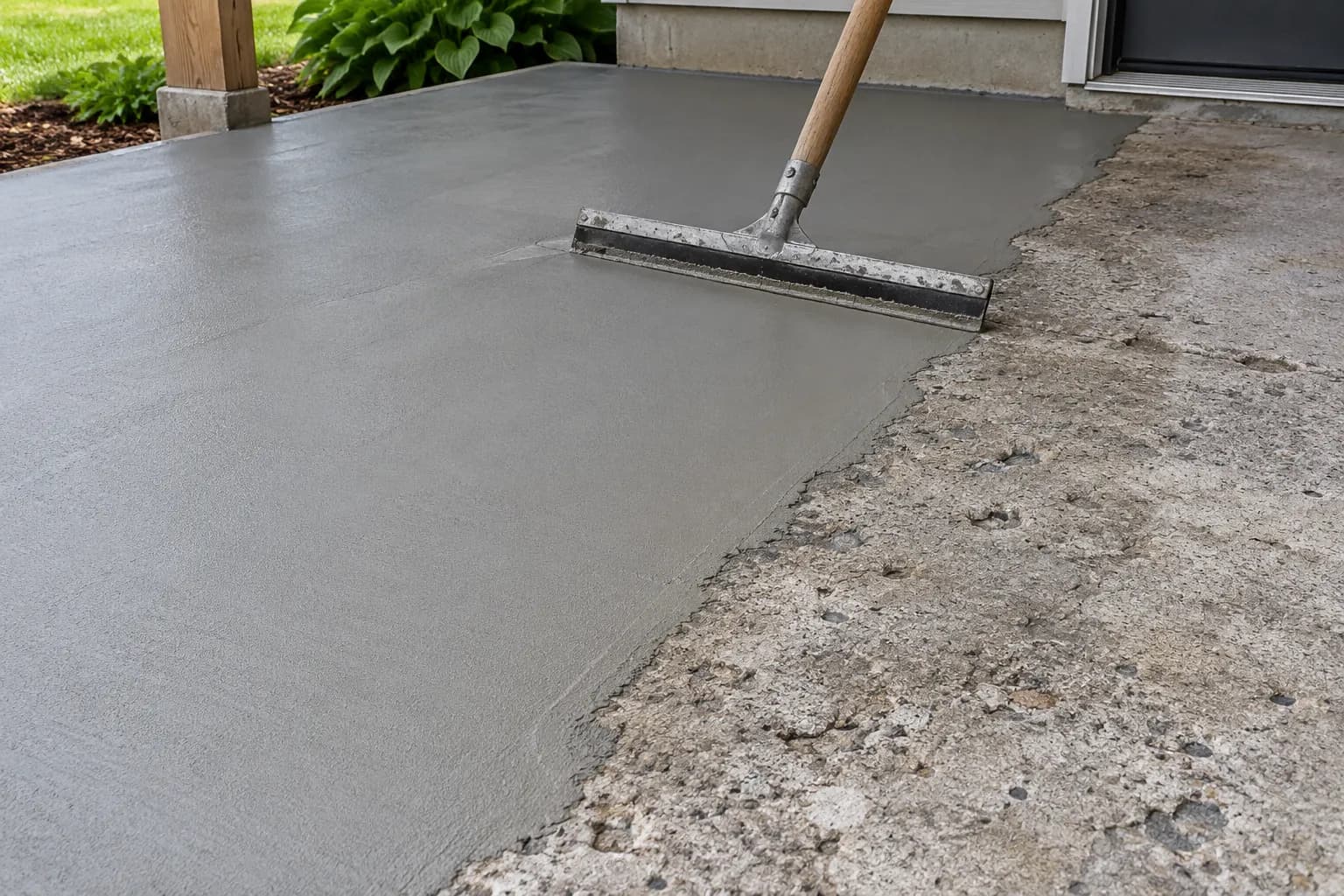
Resurfacing is a surface treatment. It fixes surface problems on structurally sound slabs:
- Surface scaling and spalling where the top layer has deteriorated but the slab body is solid
- Cosmetic damage like stains, discoloration, and rough texture
- Worn finishes on garage floors, patios, and decorative concrete
- Minor crazing (fine surface map cracking)
- Old but stable cracks that have been dormant for over a year
The slab beneath must be structurally intact, reasonably level, and not actively settling. If the foundation is good, the overlay can provide 10-15 years of renewed surface life.
When Resurfacing Does NOT Work
Don't resurface over these conditions--the overlay will fail:
- Active cracks that are still growing or changing width. These will crack through the overlay within one season.
- Settling or heaving slabs. If the slab is moving, the overlay moves with it and cracks. Fix the settlement first.
- Delaminated concrete. If the existing surface is hollow-sounding (tap with a hammer), the overlay has nothing solid to bond to.
- Severe structural damage. Slabs with through-cracks, displacement, or rebar corrosion need replacement, not covering up.
- Repeated freeze-thaw damage. If the concrete itself lacks air entrainment and keeps scaling, an overlay will scale too.
The test: Walk the entire slab and tap every 3-4 feet with a hammer or screwdriver handle. Solid ring = good bond surface. Hollow thud = delamination = don't resurface that area.
Types of Resurfacing Products
| Product Type | Thickness | Best For | Cost/sq ft | DIY? |
|---|---|---|---|---|
| Polymer-modified overlay | 1/4 - 1/2 inch | General resurfacing, broom or smooth finish | $3-5 | Moderate |
| Micro-topping | 1/16 - 1/8 inch | Decorative finish, color change, indoor floors | $4-8 | Difficult |
| Self-leveling overlay | 1/4 - 1-1/2 inch | Uneven floors, garage floors, interior prep for flooring | $3-6 | Moderate |
| Stamped overlay | 1/4 - 3/4 inch | Decorative stamped look over plain concrete | $6-12 | Professional |
| Concrete topping (standard) | 2+ inches | Heavy-duty resurfacing with significant damage | $4-8 | Yes (if experienced) |
Polymer-Modified Overlay (Most Common)
The workhorse for residential resurfacing. These products (Quikrete Re-Cap, Sakrete Flo-Coat, etc.) contain Portland cement plus polymer additives that provide adhesion, flexibility, and thin-application capability.
Strengths: Bonds to existing concrete without mechanical fastening. Can be applied as thin as 1/4 inch. Accepts broom, trowel, or textured finish. Available at major hardware stores.
Limitations: Sets fast--you have 15-30 minutes of working time per batch. Large areas require speed and a helper. Surface prep is critical.
Self-Leveling Overlay
Pourable product that flows to find its own level. Ideal for uneven interior floors, garage floors before coating, or creating a flat surface for flooring installation.
Strengths: Fills low spots and creates level surface without troweling skill. Excellent for interior applications.
Limitations: Can't be used on slopes. Requires primer. Higher cost. Not suitable for outdoor use in freeze-thaw climates without proper sealing.
Surface Preparation: The Make-or-Break Step
Surface prep determines 80% of whether an overlay succeeds or fails. Shortcut the prep and the overlay peels off within a year.
Required Preparation
-
Remove all loose material. Scrape, chip, and sweep away anything that isn't firmly bonded to the slab. If it moves when you push on it, it comes off.
-
Clean thoroughly. Degrease oil stains. Remove paint, sealer, and coatings. These prevent bond. A pressure washer at 3,000+ PSI is minimum.
-
Open the surface profile. The existing concrete needs to be rough enough for the overlay to grip. Options:
- Acid etching: Muriatic acid (1:4 dilution) for mild profiling. Cheapest option. Rinse and neutralize thoroughly.
- Grinding: Diamond grinder creates a consistent profile. Best for garage floors and interior.
- Shot blasting: Professional method for large areas. Most consistent results.
-
Repair cracks. Fill dormant cracks with flexible polyurethane caulk. For spalled areas, chip out loose material to solid concrete and fill with repair mortar.
-
Dampen the surface. Most overlays bond best to a damp (but not wet) surface. This is called SSD--saturated surface dry. Spray with water, then let surface water evaporate until no standing water remains.
-
Apply bonding agent or primer per the overlay manufacturer's instructions. Some products are self-bonding (no primer needed); others require a specific primer.
Application Process
For Polymer-Modified Overlay
- Mix per manufacturer's instructions--consistency should be like thick pancake batter
- Pour or dump onto the dampened, primed surface
- Spread with a gauge rake or squeegee to the desired thickness (1/4 to 1/2 inch)
- Back-roll or trowel for final finish
- Apply texture (broom, stamp, or knockdown) within the working time window
- Cure per product instructions (usually 24 hours before foot traffic, 72 hours before vehicle traffic)
Work in sections. Don't try to mix and spread enough for your entire area at once. Work in manageable sections (50-100 sq ft) and maintain a wet edge between sections.
Cost Comparison: Resurface vs. Replace
For a typical 400 sq ft driveway or patio:
| Approach | Material | Labor | Total | Lifespan |
|---|---|---|---|---|
| DIY resurfacing | $400-800 | Your time | $400-800 | 8-12 years |
| Professional resurfacing | $400-800 | $800-1,600 | $1,200-2,400 | 10-15 years |
| Full replacement | $800-1,200 | $2,400-4,800 | $3,200-6,000 | 20-30 years |
Resurfacing makes financial sense when:
- The slab is structurally sound (you'd be paying to replace a good foundation)
- The remaining lifespan of the base slab is 10+ years
- The surface damage is the primary issue
Replacement makes more sense when:
- The slab has structural problems that resurfacing would just cover up
- The concrete is already 20+ years old and approaching end-of-life
- You need to correct subgrade or drainage issues beneath the slab
For a detailed decision framework on repair vs. replacement, see our guide on when to repair vs. tear out and start over.
If replacement is the better path, understanding concrete costs per square foot helps you budget realistically.
Key Takeaways
- Resurfacing works on structurally sound slabs with surface-only damage--not on settling, cracking, or structurally compromised concrete
- Surface prep is 80% of success: clean, profile, repair cracks, prime
- Polymer-modified overlays are the most common DIY option ($3-5/sq ft materials)
- Standard concrete can't be applied thinner than 2 inches; resurfacing products go as thin as 1/4 inch
- Expect 8-15 year lifespan for a properly installed overlay vs. 20-30 years for full replacement
- For areas over 200 sq ft, professional installation usually produces better results than DIY
For more project guidance, browse our complete library of concrete guides and tutorials.