

When to Float, Edge and Trowel Concrete: Finishing Timing Guide
The difference between a smooth, professional concrete finish and a rough, flawed surface comes down to timing. Start too early and you'll trap bleed water under the surface, creating a weak layer that flakes off within a year. Start too late and the concrete is too hard to work—you'll fight it with every pass and end up with trowel marks and rough spots.
This guide focuses on the timing decisions during finishing--the cues you watch for, the tests you run, and the adjustments you make based on conditions. For the full sequence of tools and techniques, see our complete finishing guide. To make sure your quantities and slab dimensions are right before you pour, run the numbers through our concrete calculator.
When to Float Concrete
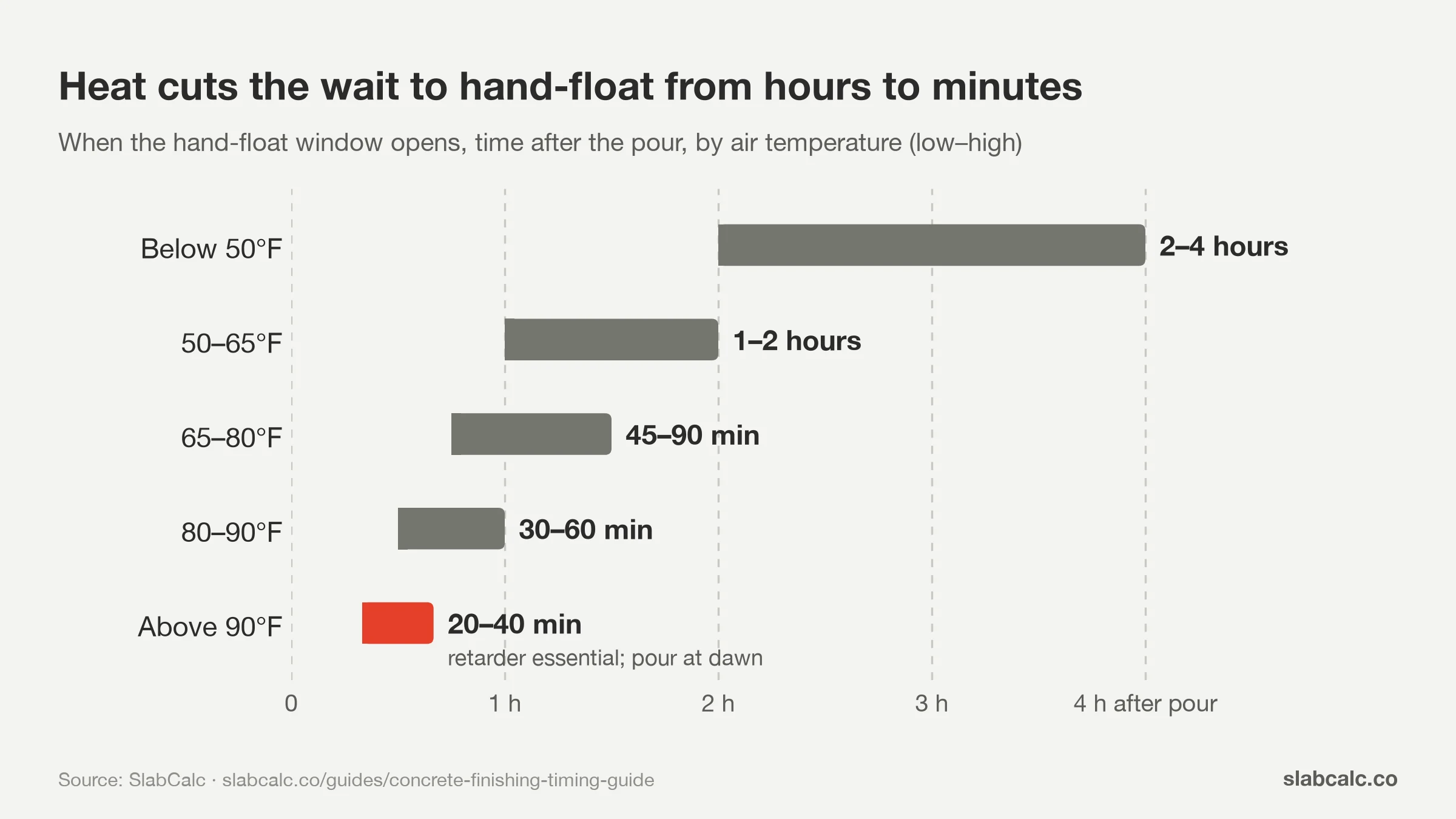
Bull float immediately after screeding, then hand float once the bleed water has disappeared and a footprint leaves a clean 1/4-inch impression with no water rising. At 65-80°F that is usually 45-90 minutes after the pour; below 50°F it can take 2-4 hours, and above 90°F as little as 20-40 minutes. The hand-float window typically lasts 30-60 minutes.
When to Edge Concrete
Edge as soon as the sheen is gone and the surface turns matte, the same moment the slab is ready for hand floating. Run the edger along the forms before the concrete stiffens; control joints are cut in the same window.
When to Trowel Concrete
Trowel after floating, once the surface is firm enough that float marks close easily and the steel trowel rings slightly as it passes. That window is narrower than floating, typically 15-30 minutes. Troweling while bleed water is present traps water under the surface and causes scaling. For a textured finish, broom at this stage instead of troweling.
The rest of this guide explains the tests behind these cues and how temperature, wind and humidity move them.
Bleed Water: The One Thing You Must Understand
After concrete is placed and screeded, water from the mix migrates upward as heavier cement and aggregate particles settle. This rising water--called bleed water--appears as a thin, shiny film on the surface. Every concrete mix bleeds. It is normal.
The amount and duration of bleeding depends on several factors: water content in the mix, cement fineness, ambient temperature, and whether the mix includes air entrainment or supplementary materials like fly ash. A typical residential mix (3,000-4,000 PSI) will bleed for 20 to 90 minutes after placement.
Why bleed water matters for finishing: If you work the surface while bleed water is present, your finishing tools push that water back down and seal it under a thin layer of cement paste. This creates a weak zone--sometimes only 1/16 to 1/8 inch thick--that has a much higher water-cement ratio than the rest of the slab. Within months, this layer dusts, scales, and flakes off. The damage is permanent and cannot be repaired with a simple resurface. This is the single most common cause of concrete surface failure on residential projects.
Screeding and bull floating happen immediately after the pour, while the concrete is still wet and plastic. These operations level the slab and close the surface. Everything after that--edging, hand floating, troweling, brooming--must wait until bleed water is gone.
The Readiness Tests
Forget the clock. Concrete does not follow a schedule--it follows chemistry and weather. These three field tests tell you when the surface is ready for finishing.
The Sheen Test
Look at the surface from a low angle. Fresh concrete with active bleed water has a visible sheen--a wet, reflective look. When the surface transitions from shiny to matte and dull, bleeding has stopped or nearly stopped. This is your first green light.
The Footprint Test
Step onto the slab. If water seeps up around your boot, bleed water is still active--get off and wait. When your footprint leaves a clean impression roughly 1/4 inch deep with no water rising around it, the surface is ready for hand floating.
If your boot sinks more than 1/2 inch, the concrete is still too soft for kneeling and working. If your footprint barely registers (1/8 inch or less), you may be getting late--move quickly.
The Finger Test
Press your fingertip into the surface. If it slides easily and feels slick, there is still a water film present. When the surface feels slightly tacky and your finger leaves a defined impression without moisture, you are in the finishing window.
Use all three tests together. No single test is definitive. Surface conditions can vary across a slab--shaded areas stay wetter longer, edges near warm forms may be ready sooner, and windy spots dry faster than sheltered ones.
Finishing Sequence and Timing Windows
Each finishing step has its own readiness point. Here is the full sequence with the timing cues for each transition.
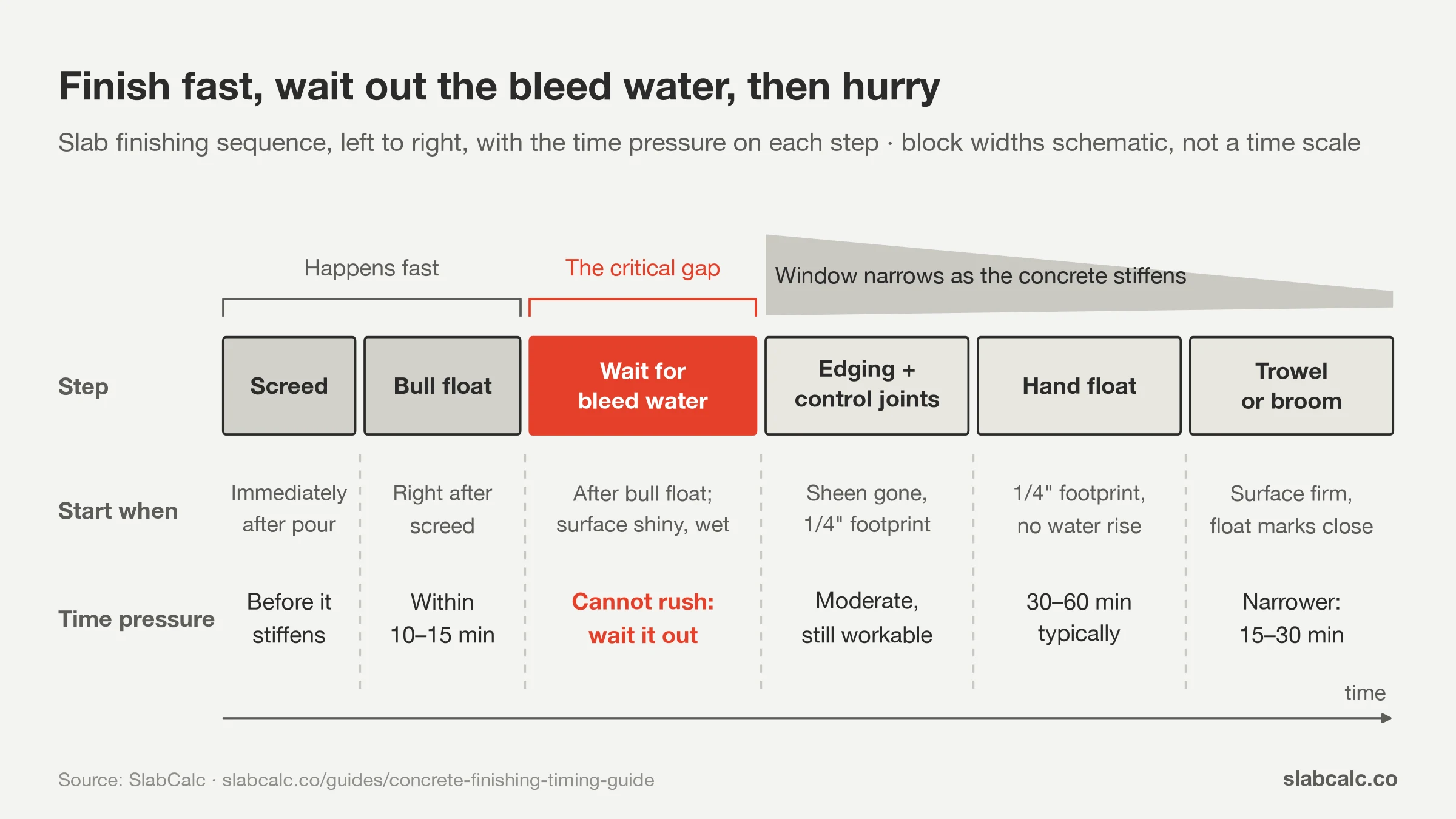
| Step | When to Start | How You Know | Time Pressure |
|---|---|---|---|
| Screeding | Immediately after pour | Concrete is placed in forms | Must complete before concrete stiffens |
| Bull floating | Immediately after screed | Surface is screeded level | Complete within 10-15 minutes of screed |
| Wait for bleed water | After bull float | Surface is shiny and wet | Cannot rush--wait it out |
| Edging | Bleed water gone, sheen gone | Matte surface, 1/4" footprint | Moderate--concrete is still workable |
| Control joints | During or after edging | Same as edging | Same window as edging |
| Hand floating | After edging | 1/4" footprint, no water rise | Window is 30-60 minutes typically |
| Troweling (if smooth finish) | After floating | Surface is firm, float marks close easily | Narrower window--15-30 minutes |
| Brooming (if textured finish) | After floating | Surface accepts broom lines cleanly | Same as troweling window |
The critical gap is between bull floating and hand floating. This is the bleed water wait, and it is where patience pays off. Everything before it happens fast. Everything after it happens in a progressively narrowing window as the concrete stiffens.
Use the Finishing Timing Estimator to get your specific window based on temperature, mix design, and slab size. Or open the Concrete Finishing Tools hub to access the timing estimator alongside finish cost comparisons and a DIY vs. pro assessment — all in one place.
After hand floating, each subsequent step must happen at a firmer stage. Troweling requires the firmest surface--you want the steel to ring slightly as it passes over the concrete. If you are brooming instead, you need the surface firm enough to hold broom marks without them filling back in, but soft enough that the bristles cut clean lines.
How Weather Changes Your Timing
Temperature, humidity, and wind affect bleed water evaporation and the rate of cement hydration. The same mix poured at 55°F and at 95°F will behave like two different materials. For a deep dive on temperature effects, see the concrete temperature guide.
Timing by Temperature Range
| Air Temperature | Bleed Water Duration | Hand Float Window Opens | Total Finishing Window | Adjustments |
|---|---|---|---|---|
| Below 50°F | 90-180+ minutes | 2-4 hours after pour | Wide (2-3 hours) | Long wait; set is very slow; consider accelerator |
| 50-65°F | 60-90 minutes | 1-2 hours after pour | Comfortable (1.5-2 hours) | Ideal range; standard timing |
| 65-80°F | 30-60 minutes | 45-90 minutes after pour | Moderate (45-75 minutes) | Watch for fast set in sun |
| 80-90°F | 15-30 minutes | 30-60 minutes after pour | Tight (30-45 minutes) | Work quickly; consider retarder |
| Above 90°F | 10-20 minutes | 20-40 minutes after pour | Very tight (20-30 minutes) | Retarder essential; pour at dawn; extra crew |
Wind is the hidden variable. A 15 mph breeze on a dry day can cause the surface to crust over while the interior is still plastic. This is called crusting or case hardening--the top looks ready but underneath is still soft. If you finish a crusted surface, the dried skin will crack and peel later. On windy days, you may need to mist the surface lightly (not flood it) or erect wind barriers. For more on pouring in difficult conditions, see our guide to your first concrete pour.
Humidity matters too. At 90% humidity, bleed water takes much longer to evaporate. At 20% humidity in desert conditions, the surface can dry dangerously fast. Low humidity plus wind plus heat is the worst combination--you can lose your finishing window before you realize it.
Common Timing Mistakes
Mistake 1: Finishing Over Bleed Water
This is the most damaging and most common error. The finisher sees bleed water and decides to work it into the surface rather than wait. The result is a sealed-in weak layer that dusts and flakes within the first year--sometimes within the first freeze-thaw cycle.
How to avoid it: Do not touch the surface with any tool (other than edgers on the perimeter) until all three readiness tests pass. If you are unsure, wait five more minutes. Waiting too long is fixable. Finishing too early is not. For a full breakdown of surface problems and solutions, see our guide on concrete finish problems and fixes.
Mistake 2: Watching the Clock Instead of the Concrete
"The guy at the supply yard said wait 45 minutes." Maybe--under his conditions. Your slab is in full sun on a 92°F day with a breeze. Your bleed water was gone in 15 minutes, and now the concrete is setting up hard while you wait for a number someone gave you for entirely different conditions.
How to avoid it: Use the physical tests described above. The concrete tells you when it is ready. The clock does not.
Mistake 3: Losing the Window on a Large Slab
On a slab larger than about 200 square feet, you cannot finish the entire surface at once. The section you poured first will be ready before the last section. If you do not plan for this, the early sections will be too hard by the time you get to them.
How to avoid it: Plan your pour sequence and finishing path before the truck arrives. Pour and screed in sections, and float each section as it becomes ready--do not wait until the entire slab is poured. On large slabs (400+ sq ft), have a second person dedicated to finishing while the first continues placing concrete. If you are deciding between DIY and hiring a contractor, slab size is a major factor--large pours demand crew coordination that is hard to manage solo.
Mistake 4: Adding Water to Extend Working Time
The concrete is getting hard and you are not done finishing. The temptation is to sprinkle water on the surface to soften it up. This weakens the surface layer just as badly as finishing over bleed water--you are reintroducing water to a partially hydrated surface.
How to avoid it: If you are running out of time, accept the finish you have. A slightly rough but structurally sound surface is far better than a smooth-looking surface that will fail. For future pours, use a retarder admixture and schedule more help.
Mistake 5: Overworking the Surface
Multiple aggressive trowel passes bring excess fine paste to the surface, creating a thin, dense layer with a high cement-to-aggregate ratio. This layer is prone to crazing (a network of fine hairline cracks) and can delaminate from the concrete below.
How to avoid it: Limit troweling to two or three passes. If the surface looks good, stop. The best finishers know when to put the trowel down.
Key Takeaways
- Bleed water is the gatekeeper. Never finish over it--this single mistake causes more surface failures than everything else combined.
- Use the sheen test, footprint test, and finger test to judge readiness. The clock is unreliable.
- Temperature drives the timeline. At 50°F you may wait 2+ hours; at 90°F you may have 20 minutes. Adjust your crew and admixtures accordingly.
- Wind and low humidity shrink your window fast. Monitor conditions, not just temperature.
- Plan large pours in sections so you can finish each area within its window instead of losing the early sections while placing the last ones.
- When in doubt, wait. A surface that set slightly too hard is workable with effort. A surface finished over bleed water is ruined.
For a complete walkthrough of tools, techniques, and finish types, read how to finish concrete. For help planning your pour from start to finish, see our how to pour concrete guide. And for all concrete guides in one place, visit the guides hub.