

Concrete Pouring Temperature: Ideal Range, Cold and Hot Weather Limits
The best temperature to pour concrete is 50–60°F, and air temperatures of roughly 50–85°F need no special precautions. Below 40°F (ACI 306 cold weather), protect the slab with blankets, heated water or accelerators until it reaches 500 PSI; above 90°F, use retarder, cold water and a dawn start. Most crews postpone below 25°F or above 95°F.
The ideal temperature to pour concrete is 50–60°F, with 50–85°F workable using standard procedures. Outside that range you can still pour, but you need cold-weather protection below 40°F and hot-weather controls above 85–90°F. Concrete cures through a chemical reaction (hydration) that is highly sensitive to temperature. Too cold, and the reaction slows to a crawl or stops entirely if the water freezes. Too hot, and the reaction accelerates out of control, robbing you of working time and long-term strength. Either extreme demands specific countermeasures--different additives, adjusted timing, and physical protection of the slab.
Before you start planning protection methods, make sure your quantities are dialed in. Use our concrete calculator to get accurate volume and bag counts, then factor in temperature-related adjustments from the sections below. For guidance on scheduling around weather windows, see our guide on the best time to pour concrete.
Temperature Range Quick Reference
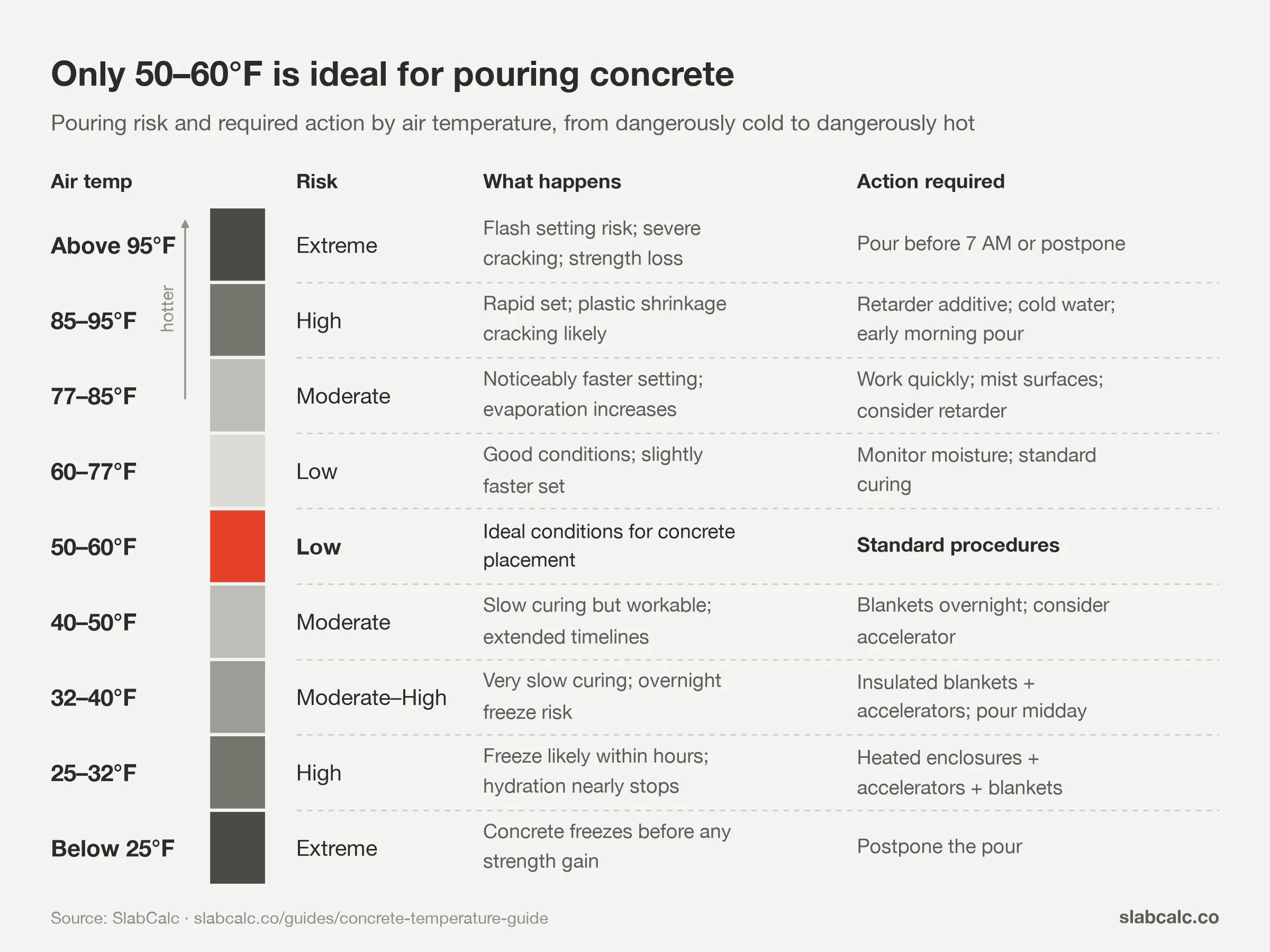
This table covers the full spectrum from dangerously cold to dangerously hot:
| Air Temperature | Risk Level | What Happens | Action Required |
|---|---|---|---|
| Below 25°F | Extreme | Concrete freezes before any strength gain | Postpone the pour |
| 25-32°F | High | Freeze likely within hours; hydration nearly stops | Heated enclosures + accelerators + blankets required |
| 32-40°F | Moderate-High | Very slow curing; overnight freeze risk | Insulated blankets + accelerators; pour midday |
| 40-50°F | Moderate | Slow curing but workable; extended timelines | Blankets overnight; consider accelerator |
| 50-60°F | Low | Ideal conditions for concrete placement | Standard procedures |
| 60-77°F | Low | Good conditions; slightly faster set | Monitor moisture; standard curing |
| 77-85°F | Moderate | Noticeably faster setting; evaporation increases | Work quickly; mist surfaces; consider retarder |
| 85-95°F | High | Rapid set; plastic shrinkage cracking likely | Retarder additive; cold water; early morning pour |
| Above 95°F | Extreme | Flash setting risk; severe cracking; strength loss | Pour before 7 AM or postpone |
Minimum Concrete Temperature at Placement (ACI 306 / ASTM C94)
Air temperature is only half of it — the concrete temperature matters too. ACI 306 and ASTM C94 set the minimum temperature of fresh concrete by the thinnest dimension of the section, because thin slabs lose heat fastest:
| Least Section Dimension | Example | Minimum Concrete Temperature |
|---|---|---|
| Under 12 in | Slabs, driveways, patios, walls | 55°F |
| 12–36 in | Thick footings, grade beams | 50°F |
| 36–72 in | Large foundations | 45°F |
| Over 72 in | Mass concrete | 40°F |
For hot weather, ACI 301 caps concrete temperature at 95°F at delivery unless the project specifies otherwise. For a residential slab, that means ordering concrete at 55°F or warmer in the cold (most ready-mix plants can heat to 60–65°F) and keeping it under 95°F in summer.
The critical number to remember: Concrete must reach 500 PSI before it can survive a freeze cycle without permanent damage. Under normal conditions (50-70°F), that takes 24-48 hours. In cold weather, it can take 72 hours or more.
Pouring Concrete in Cold Weather
Cold weather concrete work is defined by ACI 306 as any period when the air temperature has fallen to, or is expected to fall below, 40°F during the protection period. Practical problems start whenever overnight lows dip below freezing.
What Cold Does to Concrete
The hydration reaction slows by roughly half for every 20°F drop in temperature. At 50°F, concrete cures at about 60% of its normal rate. At 40°F, you're down to around 40%. Below 32°F, any water in the mix that freezes expands by 9%, creating internal pressure that fractures the developing cement bonds.
The damage is permanent. Concrete that freezes in the first 24 hours can lose 50% of its 28-day strength. Even if it thaws and appears normal, the internal structure is compromised. You won't see the consequences immediately--they show up as premature cracking, scaling, and spalling months or years later. For more on freeze-related damage, see our guide on winter concrete damage repair.
Cold Weather Protection Methods
There are three lines of defense for cold weather pours, and serious cold requires all three:
1. Insulated Concrete Blankets ($50-$150 each)
The most common and cost-effective protection. These are layered blankets (typically polyethylene outer shell with foam or fiberglass insulation) placed directly over finished concrete. A single layer provides protection down to about 20-25°F. Double-layering extends protection further.
- Place blankets immediately after finishing--don't wait for surface to set
- Overlap seams by at least 6 inches and weigh down edges
- Leave in place for a minimum of 48-72 hours in freezing conditions
- Check temperature under blankets periodically; you want 50°F+
2. Heated Enclosures ($200-$1,000+ depending on size)
For temperatures below 25°F or for critical pours where failure isn't an option, build a temporary enclosure over the slab and heat it. Options include:
- Propane or kerosene torpedo heaters (most common on job sites)
- Hydronic heating systems (tubing with heated fluid run under or alongside the slab)
- Poly sheeting or tarps over a wood frame to create the enclosure
Warning: Direct-fired heaters produce carbon dioxide and carbon monoxide. Ensure ventilation and keep heater exhaust away from the concrete surface--carbonation of fresh concrete weakens the surface layer.
3. Accelerator Additives ($8-$15 per dose)
Chemical accelerators (calcium chloride or non-chloride alternatives) speed up the hydration reaction, helping concrete gain strength faster before temperatures drop overnight.
- Calcium chloride is cheapest and most effective--add 1-2% by weight of cement
- Do not use calcium chloride in reinforced concrete (it promotes rebar corrosion)
- Non-chloride accelerators (like those based on calcium nitrite) cost more but are safe with rebar
- Never exceed manufacturer's recommended dosage--too much causes flash setting
Additional cold weather practices:
- Use hot mixing water (120-140°F) to raise the concrete temperature at placement
- Order concrete at a higher temperature from the batch plant (most ready-mix suppliers can heat to 60-65°F)
- Pour during the warmest part of the day (10 AM to 2 PM)
- Never place concrete on frozen ground--thaw the subgrade first with blankets or heaters
- Extend curing timelines: what takes 7 days at 70°F may take 14+ days at 40°F
Cold Weather Cost Impact
Expect cold weather precautions to add $0.50-$2.00 per square foot to your project cost. For a typical 400 sq ft slab, that's $200-$800 extra for blankets, additives, and potentially heater rental. Compare that against the cost of tearing out and replacing a freeze-damaged slab--which runs $8-$15 per square foot. The math heavily favors protection over risk. For a detailed breakdown of concrete pricing, see concrete cost per yard.
Pouring Concrete in Hot Weather
Hot weather concrete work (ACI 305 defines it by a combination of high air and concrete temperature, low humidity, wind, and sun rather than a single number; most contractors start precautions around 85°F) presents the opposite problem: everything happens too fast.
What Heat Does to Concrete
High temperatures accelerate hydration dramatically. For every 18°F increase in concrete temperature above 70°F, the setting time drops by roughly 30-50%. A mix that gives you 90 minutes of working time at 70°F may set in 45 minutes at 90°F and under 30 minutes at 100°F.
The consequences:
- Plastic shrinkage cracking. When evaporation from the surface exceeds the rate at which bleed water rises, the surface layer shrinks and cracks before the concrete has any tensile strength. Wind and low humidity make this worse.
- Cold joints. When concrete sets before the next batch is placed against it, you get a weak seam called a cold joint. In hot weather, this can happen even with continuous pours if the crew can't keep up.
- Reduced ultimate strength. Concrete that hydrates too fast develops a less organized crystal structure. It may show impressive early strength (1-3 days) but end up 10-15% weaker at 28 days compared to properly cured concrete.
- Increased water demand. Hot concrete feels stiff and unworkable, tempting crews to add water on site. Every gallon of extra water per yard reduces 28-day strength by roughly 200 PSI.
Hot Weather Protection Methods
1. Retarder Additives ($10-$20 per dose)
Chemical retarders (typically based on lignosulfonates or hydroxylated carboxylic acids) slow the hydration reaction, extending your working window. Most add 30-60 minutes of working time.
- Available in liquid form at home improvement stores
- Add to mixing water before combining with dry concrete
- Ready-mix suppliers can add retarder at the batch plant--request it when ordering
- Overdosing causes excessively slow setting (12+ hours)--follow instructions precisely
2. Cold Mixing Water and Ice
Replacing some or all mixing water with cold water (40-50°F) or crushed ice lowers the concrete temperature at placement. Reducing concrete temperature by 10°F gives you significantly more working time.
- For bagged concrete, use the coldest tap water available or add ice cubes to the mixing water
- Ready-mix plants can use chilled water or inject liquid nitrogen to cool the batch
- Ice must be fully melted before concrete is placed--unmelted ice creates voids
3. Timing Adjustments (Free)
The simplest and most effective hot weather strategy costs nothing:
- Pour at dawn or earlier--start placing concrete by 5-6 AM in extreme heat
- Dampen subgrade, forms, and reinforcement before the pour (dry materials absorb water from the mix)
- Keep bagged concrete in shade; cover aggregate piles
- Have all forms, reinforcement, and tools 100% ready before concrete arrives
- Increase crew size to finish faster
4. Evaporation Control
After finishing, hot weather requires aggressive moisture retention. For a detailed comparison of methods, see our guide on concrete curing methods compared.
- Apply curing compound immediately after final finish (spray-on membrane that seals in moisture)
- Or cover with wet burlap topped with plastic sheeting
- Mist the surface with water every 2-3 hours during the first day if using wet curing
- Shade structures (temporary canopies) reduce surface temperature and evaporation
Hot Weather Cost Impact
Hot weather protection is generally cheaper than cold weather measures: $0.25-$1.00 per square foot. Retarder additives and curing compound are the main expenses. The real cost is labor--you need more people working faster, and you may need to schedule pours at inconvenient early-morning hours.
Concrete Setting Temperature: Set and Cure Time by Temperature
Temperature controls how fast concrete sets (stiffens) and cures (gains strength). Use the figures from the sections above to plan your crew and your protection period:
| Concrete / Air Temperature | Working Time Before Set | Curing Pace | What to Plan For |
|---|---|---|---|
| 40°F | Long, slow set | ~40% of normal rate; 7-day strength can take 14+ days | Blankets, accelerator, 72+ hours to 500 PSI |
| 50°F | Moderate | ~60% of normal rate | Blankets overnight |
| 70°F | ~90 minutes | Normal (reference) | Standard curing |
| 90°F | ~45 minutes | Fast early, 10–15% lower 28-day strength | Retarder, cold water, extra crew |
| 100°F | Under 30 minutes | Very fast; plastic shrinkage cracking likely | Pour before 7 AM or postpone |
In short: the best temperature for concrete to set and cure is 50–75°F. Below 50°F, extend your protection and curing time; above 85°F, shorten the time between batching and finishing.
When Rain Complicates Temperature Issues
Temperature extremes often come paired with problematic weather. Summer thunderstorms follow extreme heat. Fall cold snaps bring rain before freezing. If you're dealing with both temperature and precipitation challenges simultaneously, see our guide on rain on fresh concrete for protocols on covering and protecting wet pours.
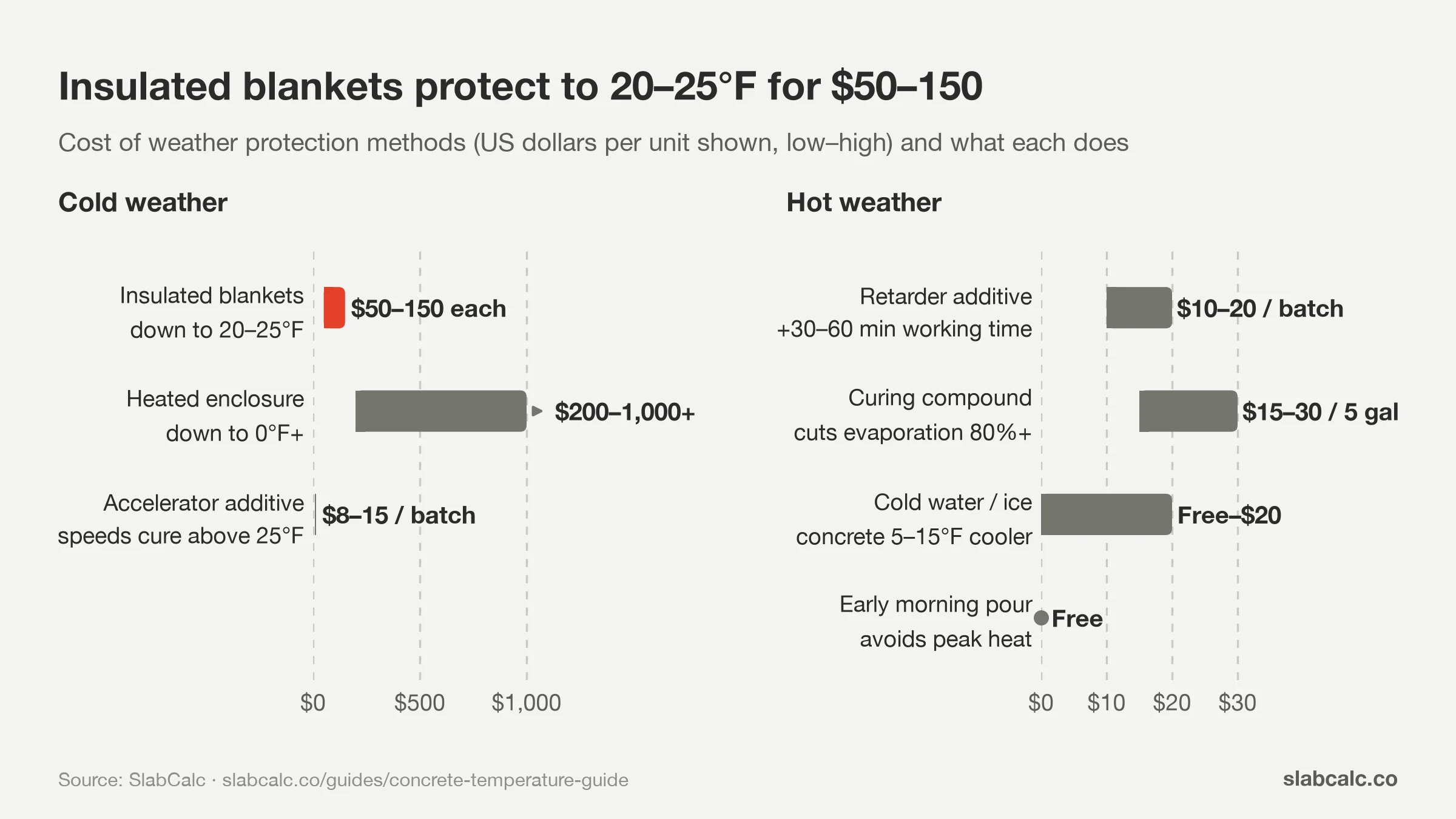
Protection Method Cost Comparison
| Method | Cost | Effective Range | Best For |
|---|---|---|---|
| Insulated blankets | $50-$150 each (reusable) | Down to 20-25°F | Most cold weather pours |
| Heated enclosure | $200-$1,000+ | Down to 0°F+ | Extreme cold; critical pours |
| Accelerator additive | $8-$15 per batch | Speeds cure above 25°F | Overnight freeze protection |
| Retarder additive | $10-$20 per batch | Extends working time 30-60 min | Hot weather above 85°F |
| Curing compound | $15-$30 per 5 gal | Reduces evaporation 80%+ | Hot weather moisture retention |
| Cold water / ice | Free-$20 | Lowers concrete temp 5-15°F | Hot weather above 90°F |
| Early morning pour | Free | Avoids peak heat | Any hot weather situation |
For context on overall project expenses, see concrete cost per yard.
Making the Call: Pour or Postpone?
Not every situation warrants pushing through. Here's a decision framework:
Pour with precautions when:
- Air temperature is 25-50°F and you have blankets, accelerator, and a protected forecast (no deep freeze for 72 hours)
- Air temperature is 85-95°F and you can start before 7 AM with retarder and adequate crew
Postpone when:
- Air temperature is below 25°F (protection costs escalate and risk remains high)
- Air temperature is above 95°F and you cannot start before dawn
- Overnight lows will drop below 20°F within 48 hours of placement
- You lack the equipment, additives, or crew to execute proper protection
- The project is a driveway or structural slab where failure cost is high
The financial rule of thumb: If protection costs exceed 15-20% of your total concrete cost, and postponing is an option, wait. A one-week delay is almost always cheaper than a failed pour. For complete curing timelines under various conditions, see how long concrete takes to cure.
Key Takeaways
- Ideal pouring temperature: 50-60°F--anything outside 40-85°F requires precautions
- Cold weather (below 40°F): Use insulated blankets, accelerators, and hot mixing water; never pour on frozen ground
- Critical threshold: Concrete must reach 500 PSI before freezing, or it suffers permanent strength loss of up to 50%
- Hot weather (above 85°F): Use retarders, cold water, and pour at dawn; evaporation control is essential
- Protection costs $0.25-$2.00/sq ft--far less than replacing a failed slab at $8-$15/sq ft
- Postpone when temperatures are below 25°F or above 95°F without early-morning scheduling
For more on planning your concrete project around weather and conditions, browse all concrete guides.