

Concrete Control Joints and Expansion Joints: Purpose, Problems and Fixes
That gap between your concrete slabs isn't a flaw—it's engineered. Control joints and expansion joints serve critical functions, but homeowners often misunderstand them, neglect them, or try to fix problems that aren't actually problems. This guide explains what each joint type does, what goes wrong with them, and how to maintain or repair them properly.
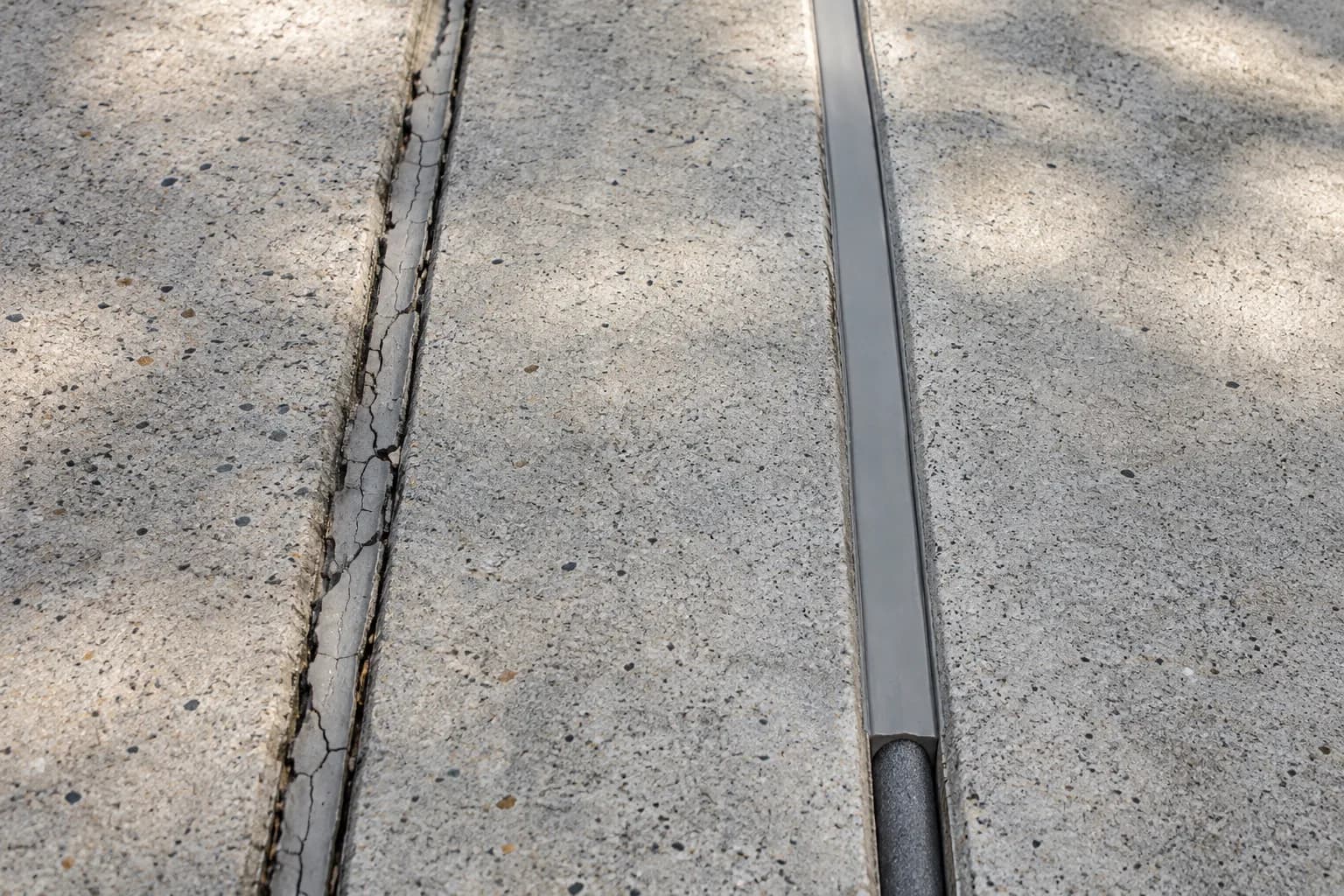
Types of Concrete Joints
There are three joint types you will encounter in residential concrete work. Each serves a different purpose, and confusing them leads to incorrect repairs.
| Joint Type | What It Is | Purpose | Typical Location |
|---|---|---|---|
| Control joint (contraction joint) | Groove cut or tooled into a single slab | Creates a weak point so cracks form here instead of randomly | Every 8-12 ft within a slab (driveways, sidewalks, patios) |
| Expansion joint (isolation joint) | Full-depth gap between separate slabs, filled with compressible material | Allows slabs to expand and contract independently without pushing against each other | Where concrete meets a structure, between separate pours, at transitions |
| Construction joint | The edge where one pour ends and another begins | Connects two separately poured sections | Between day's pours, at planned stopping points |
Understanding which joint you are looking at determines the correct repair approach. Filling an expansion joint with rigid material, for example, defeats its purpose entirely.
What Each Joint Does
Control Joints
Concrete shrinks as it cures--roughly 1/16 inch per 10 feet. That shrinkage creates internal stress, and when the stress exceeds the concrete's tensile strength, it cracks. Control joints work by intentionally weakening specific lines in the slab so cracks form there instead of randomly across the surface.
A properly cut control joint should be:
- 1/4 to 1/3 of slab depth (minimum 1 inch on a 4-inch slab)
- Spaced at 2-3 times the slab thickness in feet (8-12 feet for a 4-inch slab)
- Cut within 6-18 hours of the pour, before shrinkage cracking begins
If your slab has random cracks running across it instead of forming at the joints, the joints were likely too shallow, too far apart, or cut too late.
Expansion Joints
Concrete expands when heated and contracts when cooled. A 50-foot driveway can move nearly 1/2 inch between summer and winter extremes. Expansion joints provide the space for this movement by placing compressible filler (typically fiber board or foam) between separate slabs.
Expansion joints are required:
- Where a slab meets a building foundation
- Where a driveway meets a garage floor
- Between separate concrete pours
- Around fixed objects (columns, posts, utility covers)
- At intervals in long slabs (typically every 20-30 feet)
Without expansion joints, slabs push against each other or against structures as they expand, causing buckling, cracking, or damage to the adjacent structure. For guidance on connecting new and old slabs, see pouring concrete next to existing.
Construction Joints
These form where one concrete pour ends and another begins. They are planned stopping points with keyed or doweled connections to transfer load between slabs. Construction joints need the same sealing attention as other joint types but rarely cause problems on their own.
Common Joint Problems
1. Cracks Running Parallel to Control Joints
Cause: The joint is too shallow. If the groove does not reach at least 1/4 of the slab depth, the weakened plane is insufficient and the concrete cracks beside the joint instead of within it.
Fix: You cannot deepen an existing control joint effectively. Seal the crack as you would any other slab crack (see why concrete cracks for assessment). For future pours, ensure joints meet the minimum depth.
2. Expansion Joint Filler Pushed Out or Missing
Cause: The original fiber board or foam filler deteriorates, compresses permanently, or gets pushed out by debris and slab movement. This leaves an open gap that collects water, dirt, and weeds.
Fix: Clean the joint thoroughly. Remove old filler, debris, and vegetation. Install backer rod (closed-cell foam rope) to the correct depth, then seal over the top with self-leveling polyurethane sealant.
3. Joint Edge Spalling
Cause: Freeze-thaw cycles damage joint edges when water sits in unsealed joints. Hard-wheeled traffic (hand trucks, carts) also chips joint edges. Related: concrete spalling.
Fix: For minor edge chipping, clean and seal the joint to prevent further water entry. For significant spalling, patch the edges with polymer-modified repair mortar, let it cure, then seal the joint.
4. Sealant Failure
Cause: All joint sealants degrade over time from UV exposure, temperature cycling, and physical wear. Rigid sealants (silicone caulk, concrete, mortar) fail fastest because they cannot flex with joint movement.
Fix: Remove the failed sealant completely, clean the joint, install new backer rod if needed, and apply flexible polyurethane sealant. See how to seal concrete for detailed product guidance.
5. Joint Filled with Rigid Material
Cause: A previous homeowner or uninformed contractor filled expansion joints with concrete, mortar, or rigid epoxy. The joint can no longer absorb movement.
Result: The slabs crack elsewhere to relieve stress, or they buckle upward at the rigid joint.
Fix: Remove the rigid filler (chisel, angle grinder, or oscillating tool), clean the joint, and reseal properly with flexible sealant over backer rod.
How to Repair and Reseal Joints
Materials Needed
- Backer rod (closed-cell foam, sized slightly wider than the joint)
- Self-leveling polyurethane sealant (Sikaflex, Quikrete polyurethane, or equivalent)
- Wire brush or angle grinder for cleaning
- Caulk gun
- Mineral spirits for tooling
Step-by-Step Process
- Remove old sealant and debris. Use a putty knife, oscillating tool, or angle grinder to remove all existing filler. Clean loose material with a wire brush.
- Clean the joint. Pressure wash or blow out with compressed air. The joint must be dry and free of dust, oil, and vegetation.
- Install backer rod. Press closed-cell foam backer rod into the joint so it sits 1/4 to 1/2 inch below the surface. The rod should be about 25% wider than the joint so it stays in place by compression.
- Apply sealant. Fill from backer rod to just below the slab surface. For self-leveling sealant, pour slowly and evenly. For non-sag formulas, use a caulk gun and tool smooth.
- Tool the surface. For non-self-leveling products, smooth with a putty knife dampened with mineral spirits. The sealant should be slightly recessed, not mounded above the surface.
- Cure. Keep traffic off for 24-48 hours. Full cure takes 3-7 days depending on the product and temperature.
Cost: Backer rod runs $5-10 per 20-foot roll. Polyurethane sealant costs $6-12 per tube (covers roughly 12-20 linear feet depending on joint width). A typical two-car driveway has 40-60 linear feet of joints--materials run $20-40 total.
When Joints Need Professional Help
Some joint problems go beyond DIY sealant work. Call a concrete contractor when:
- Slabs have shifted vertically more than 1/4 inch at the joint (indicates subgrade failure--the soil beneath has eroded or settled unevenly)
- Joints are wider than 1 inch and growing (ongoing structural movement)
- Multiple joints show severe edge spalling (may indicate systemic freeze-thaw damage or mix problems; see your concrete maintenance plan)
- Slabs are buckling upward at joints (expansion with no room to move--joints may need to be re-cut)
- Water is pooling at joints due to grade changes (may need mudjacking or slab replacement to restore proper drainage)
- The subgrade is visibly washing out through joints (requires excavation and subgrade repair before joint work)
A concrete contractor can assess whether joints need re-cutting, whether slabs need leveling, or whether replacement is the most cost-effective path. For a broader assessment of your concrete's condition, see our damage assessment guide.
Key Takeaways
- Control joints manage where cracks form; expansion joints manage slab movement--they serve different purposes
- Never fill expansion joints with concrete, mortar, or rigid material--use flexible polyurethane sealant over backer rod
- Control joints must be deep enough (1/4 to 1/3 of slab thickness) and cut early (6-18 hours after pour)
- Reseal joints every 3-5 years--unsealed joints let water erode the subgrade and accelerate freeze-thaw damage
- Joint edge spalling and sealant failure are the most common problems, both preventable with regular maintenance
- Call a professional if slabs have shifted, joints are widening, or the subgrade is washing out
For related guidance, see why concrete cracks, how to seal concrete, and how to pour concrete. For all guides, visit the guide hub. To plan your next project, use the concrete calculator.