

Pouring Concrete Next to Existing Concrete: Joints, Bonding and Matching
Extending a patio, replacing a driveway section, or adding a sidewalk next to an existing slab? The joint between old and new concrete is where most problems happen. Skip the expansion joint and the new slab cracks. Use the wrong bonding approach and it separates. Ignore color matching and it looks like a patch job forever. Here's how to connect new concrete to existing concrete properly.
Yes, you can pour concrete next to an existing slab, and the connection is simple: set a 1/2-inch full-depth isolation joint against the old edge, match the old slab's thickness and height, and on driveways drill and epoxy smooth dowels (1/2-inch diameter, 12-18 inches apart, 6-8 inches into the old slab) to keep the two slabs flush. Do not glue side-by-side slabs together; a bonding agent is only for concrete poured on top of old concrete.
The method depends on whether you're adding new concrete beside existing (extension), replacing a section (cut-and-replace), or pouring on top (overlay). Each has different joint, bonding, and preparation requirements. Use our concrete slab calculator to estimate material quantities for the new section.
Extension: Adding New Concrete Beside Existing
This is the most common scenario--extending a patio, widening a driveway, or adding a walkway alongside an existing slab.
The Critical Rule: Use an Expansion Joint
New concrete shrinks as it cures. Old concrete doesn't. If they're bonded together, the new slab's shrinkage pulls against the rigid old slab and cracks right at the joint. An expansion joint allows independent movement.
How to install the expansion joint:
- Clean the edge of the existing slab--remove dirt, loose material, and any old joint filler
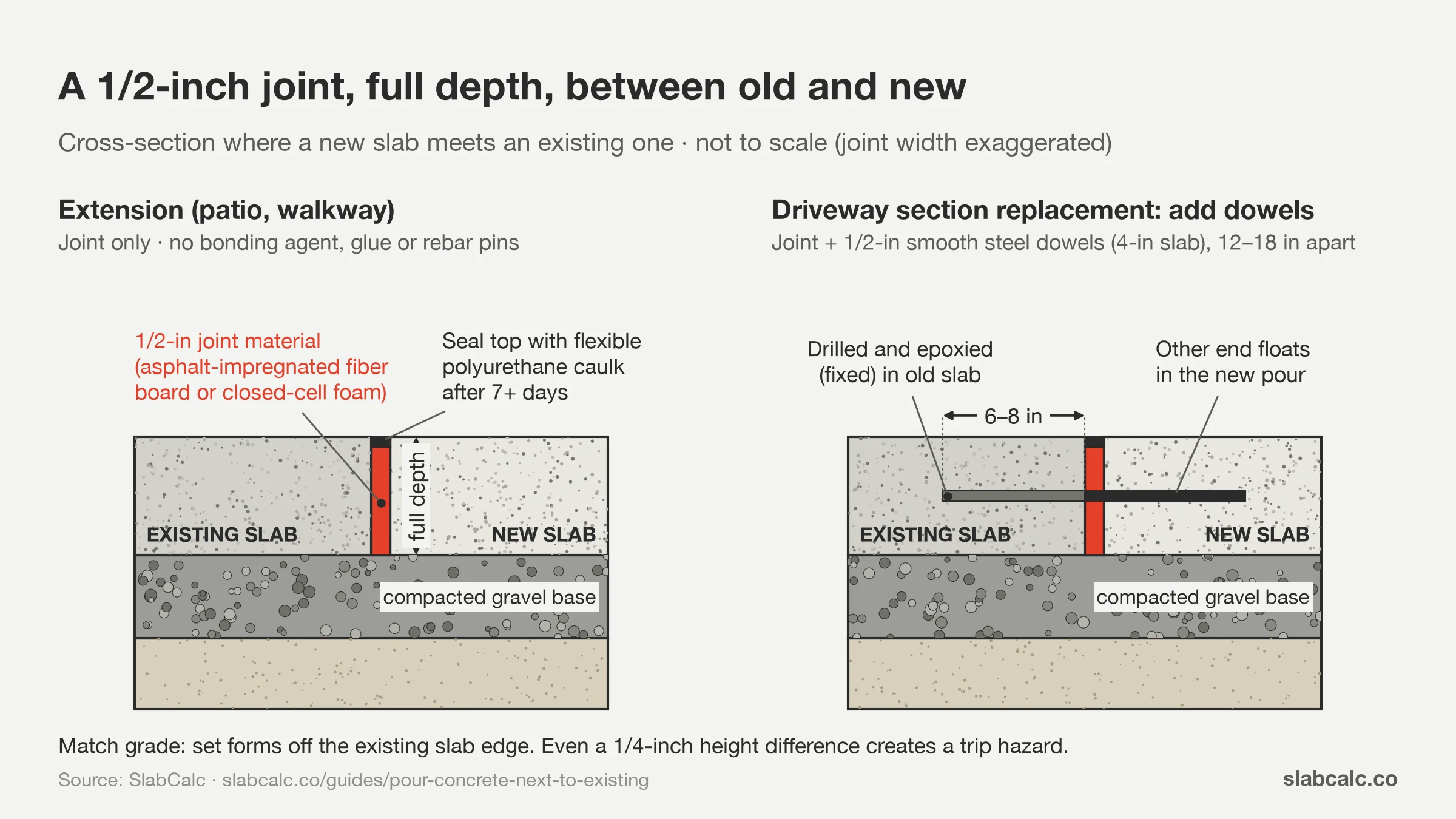
- Place 1/2-inch expansion joint material (asphalt-impregnated fiber board or closed-cell foam backer rod) against the existing slab edge
- The joint material should extend the full depth of the slab
- Build your forms for the new section against the joint material
- Pour and finish the new concrete normally
- After the concrete cures (7+ days), seal the top of the joint with flexible polyurethane caulk
Do NOT use bonding adhesive, concrete glue, or deformed rebar pins to lock the two slabs together in an extension scenario. Two independent slabs with a proper joint between them will outlast any attempt to bond them together. Smooth dowels that keep the slabs level while letting them slide are a different thing, covered below.
For deeper understanding of joint types and maintenance, see our joint problems guide.
Getting the Grade Right
The new slab must match the height of the existing slab at the joint line. Even 1/4-inch difference creates a trip hazard and water pooling issues.
- Set your forms using the existing slab edge as the grade reference
- Check with a straightedge across the joint--the form top should be level with (or very slightly above) the existing surface
- Slightly higher is better than lower--you can grind a high spot, but you can't raise a low one without an overlay
- Account for the expansion joint material thickness when setting form position
Matching Thickness and Reinforcement
The new section should match the old section's specifications:
- Same thickness (or thicker if the original was underbuilt). If the existing driveway is 4 inches, pour the extension at 4 inches minimum.
- Same reinforcement type. If the existing slab has rebar or wire mesh, match it in the extension.
- Same base preparation. The subgrade under the new section needs the same compacted gravel base as the original.
How to Join Two Concrete Slabs Together
"Joining" old and new concrete means controlling how they move relative to each other, not gluing them. That is the approach in ACI 224.3R, Joints in Concrete Construction: isolation joints separate slabs so they can move independently, and dowels transfer load across a joint without restraining it. Pick the connection by what crosses the joint:
| Connection | How It Works | Use It For | Avoid It For |
|---|---|---|---|
| Isolation joint only | 1/2-in fiber board or foam, full depth, caulked on top | Patios, walkways, slabs next to a house foundation | Joints that carry vehicle wheels |
| Smooth dowels + isolation joint | 1/2-in smooth bars epoxied 6-8 in into old slab, greased or sleeved on the new side, 12-18 in apart | Driveway extensions and section replacements | Nothing; this is the belt-and-braces detail |
| Deformed rebar pins (tie bars) | Rebar epoxied into old slab and cast into the new one, locking both together | Small infills and patches where the new piece is too small to move on its own | Full-size extensions (the new slab cracks instead of the joint) |
| Bonding agent | Latex or epoxy adhesive between old and new surfaces | Overlays and toppings poured on top of old concrete | Side-by-side slabs |
How to pin new concrete to old concrete:
- Snap a line at mid-depth on the existing slab edge (2 in up on a 4-in slab)
- Drill holes 6-8 in deep at 12-18 in spacing with a hammer drill, sized for the epoxy manufacturer's recommended annular gap
- Blow and brush the holes clean; dust is the main cause of pins pulling out
- Inject epoxy anchoring adhesive from the back of the hole and twist the bar in
- For smooth dowels, coat or sleeve the projecting half so the new concrete can't grip it
- Place the isolation joint material over the bars (punch holes for them) and pour
Adding Concrete to an Existing Slab: Beside It vs On Top of It
"Adding concrete to an existing slab" covers two jobs with opposite rules:
| Pour Beside (Extension) | Pour On Top (Overlay) | |
|---|---|---|
| Connection | Isolation joint, optional dowels | Bonding agent or bonded slurry |
| Minimum thickness | Match the old slab, never thinner (4 in minimum) | 2 in for standard concrete; 1/4-1/2 in for polymer-modified resurfacer |
| Main failure | Cracking at the joint without a joint | Delamination and reflected cracks |
| Existing slab must be | Level and stable at the edge | Structurally sound, cracks dormant |
Pouring over an existing concrete driveway adds at least 2 inches of height, which usually conflicts with the garage floor, door thresholds, and drainage. The concrete resurfacing and overlay guide covers thin overlays that avoid that problem.
Section Replacement: Cut and Replace
When you're removing a damaged section and pouring new concrete in its place, the approach differs from a simple extension.
Preparation
- Cut the perimeter with a concrete saw--clean straight cuts look better than jagged break lines
- Remove the damaged section and haul off debris
- Inspect and repair the subgrade--add gravel and compact if the base has eroded
- Place expansion joint material against the cut edges of the remaining slab
Doweling (Optional but Recommended)
For high-traffic areas like driveways, dowel bars help maintain alignment between the new and old sections and prevent differential settlement:
- Drill horizontal holes into the exposed edge of the existing slab (6-8 inches deep)
- Insert smooth steel dowels (1/2-inch diameter for 4-inch slabs) with epoxy, and grease or sleeve the half that projects into the new pour
- Space dowels 12-18 inches apart
- One end is fixed in the old concrete; the other end floats in the new pour
- The dowels transfer load between slabs while still allowing horizontal movement
Doweling is most important where vehicle traffic crosses the joint. For walkways and patios, the expansion joint alone is usually sufficient.
Color Matching Old and New Concrete
New concrete is always darker than weathered concrete. This is unavoidable--the color difference comes from hydration state and surface carbonation that takes months to equalize.
Strategies to Minimize the Difference
Use the same mix. Order from the same concrete supplier and request the same mix design. Different cement brands, aggregate sources, and water content all affect color.
Add integral color cautiously. You can add pigment to the new mix to attempt a match, but this is difficult to get right and creates a different problem if you overshoot. Test a small batch first.
Let time work. The most noticeable color difference occurs in the first 1-3 months. By 12 months, the gap narrows significantly. Full equalization can take 2+ years.
Acid wash the old section. A diluted murianic acid wash removes the weathered surface layer, exposing fresher concrete beneath. This lightens the old concrete, bringing it closer to the new.
Stain or seal both sections. The most reliable way to achieve uniform color is to stain or seal the entire area (old and new) with the same product after the new section has cured for 28+ days. A tinted sealer is the most forgiving option.
For persistent concrete discoloration that goes beyond the old-vs-new difference, other factors may be at play.
Common Mistakes
Pouring without an expansion joint. This guarantees a crack at the joint. The crack will be uncontrolled and rarely follows a straight line--much worse looking than a planned joint.
Using bonding agent for side-by-side slabs. Bonding agents are for overlays (new on top of old), not extensions (new beside old). Side-by-side slabs need to move independently.
Mismatched thickness. Pouring a 3-inch extension next to a 5-inch existing slab creates different deflection behavior under load. The thin section will crack or settle differently.
Not preparing the subgrade. The base under the new section needs to be compacted and stable. If you're pouring next to a 20-year-old slab, its subgrade has long since consolidated. Your new subgrade needs the same treatment--4-6 inches of compacted gravel.
Feathering edges. Never thin out new concrete to meet an existing surface at a shallow angle. Concrete less than 2 inches thick at any point will crack and break off. If there's a grade difference, use a full-depth pour with an appropriate transition.
Cost Considerations
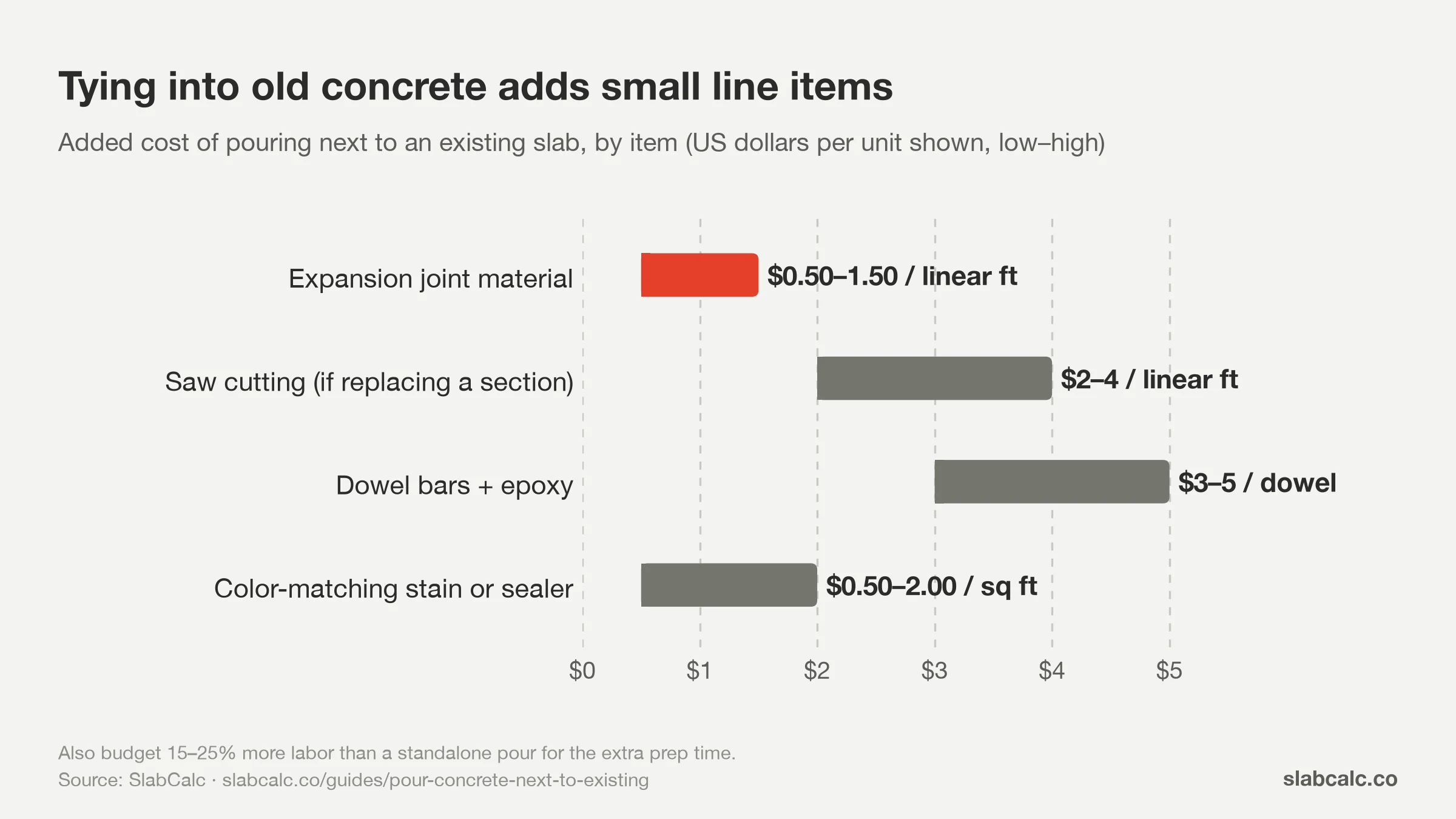
For how to pour concrete in general, costs apply to the new section. Additional costs for working next to existing:
| Item | Estimated Cost |
|---|---|
| Expansion joint material | $0.50-1.50/linear ft |
| Dowel bars + epoxy | $3-5 per dowel installed |
| Saw cutting (if replacing a section) | $2-4/linear ft |
| Color-matching stain or sealer (both sections) | $0.50-2.00/sq ft |
| Additional prep time vs. standalone pour | 15-25% more labor |
Key Takeaways
- Always use a 1/2-inch expansion joint between old and new concrete--never bond side-by-side slabs together
- New concrete will be darker than old for 6-12 months; staining or sealing both sections is the most reliable color-matching strategy
- Match the existing slab's thickness, reinforcement, and base preparation in the new section
- For section replacement on driveways, dowel bars maintain alignment across the joint
- Never feather concrete thinner than 2 inches--it will break off
- Set forms using the existing slab as a grade reference to prevent trip hazards
For more project guidance, browse our complete library of concrete guides and tutorials.