

Concrete Project Guides: Driveways, Patios, Garage Floors, and More
Planning a specific concrete project? These guides cover everything from spec and thickness requirements to drainage, reinforcement, and finishing — for driveways, patios, garage floors, retaining walls, and indoor slabs.
Featured Projects
Concrete Slab: Types, Thickness, and How They're Built
A concrete slab is a flat, continuous layer of poured concrete used as a floor, foundation, or paved surface, typically 4-6 inches thick for residential work and cast from 3,000-4,000 PSI concrete. Slabs are the single most common concrete structure — patios, driveways, garage floors, sheds, and most single-story home foundations all start as some version of a slab. This guide covers the types, how thick each one needs to be, what goes underneath, and how reinforcement and joints keep it from cracking apart.
Read Guide →Slab-on-Grade Foundations: Monolithic, Floating, and Frost-Protected
A slab-on-grade foundation is a single concrete slab, typically 4 inches thick in the field and thickened to 8-12 inches at the perimeter, poured directly on prepared ground with no crawlspace or basement beneath it. The thickened edge (or an integral footing) carries the wall load, while the flat field of the slab serves as the finished floor. It's the cheapest and fastest residential foundation type in climates without deep frost, and the most common foundation for single-story homes in the southern half of the United States.
Read Guide →Complete Guide to Concrete Driveways (Planning to Pouring)
A concrete driveway done right lasts 25-30 years with minimal maintenance. Done wrong—with inadequate thickness, poor base preparation, or premature use—it cracks within 5-10 years and costs thousands to replace.
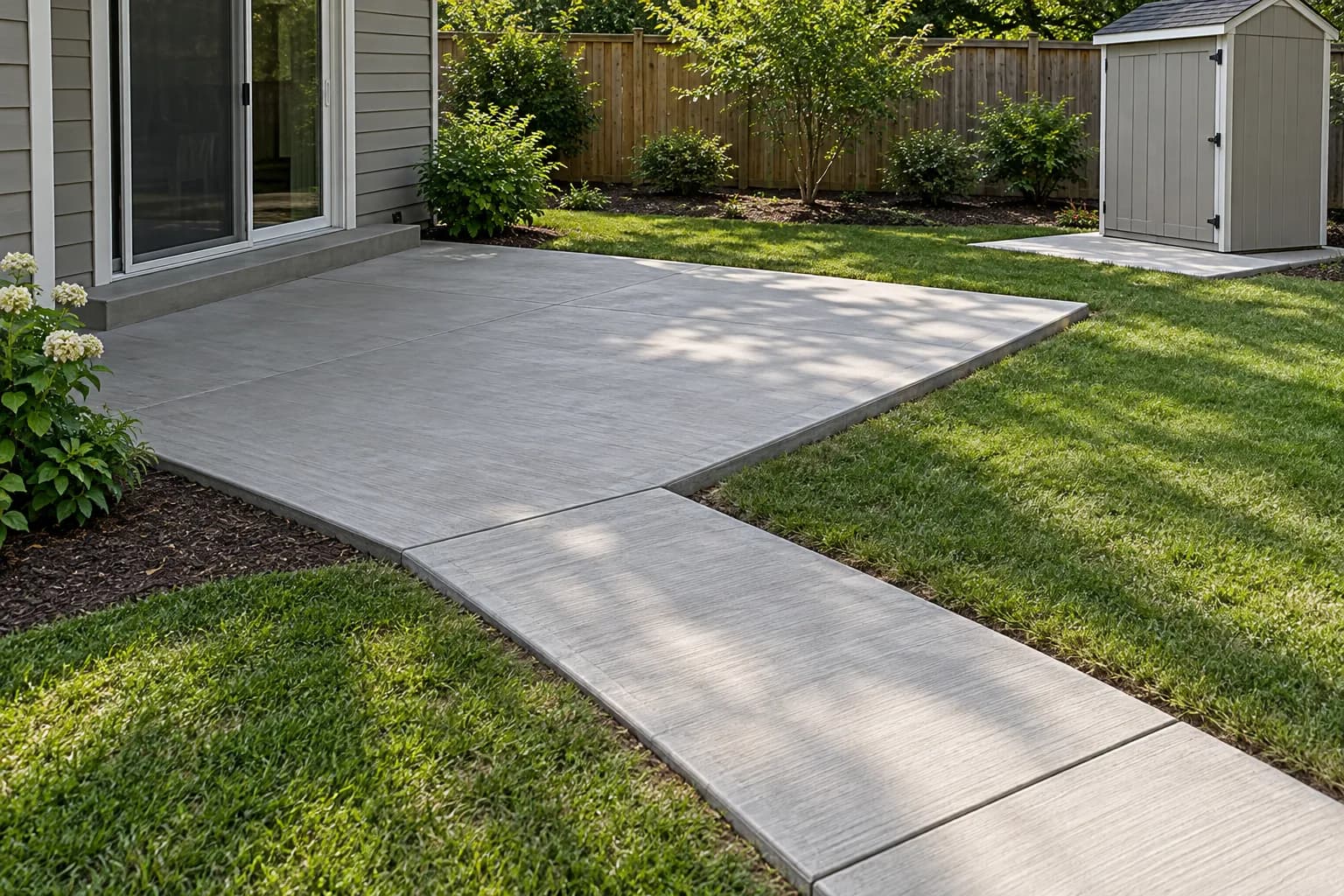
Read Guide →Complete Guide to Concrete Patios (Design to Finish)
A concrete patio is one of the most achievable DIY concrete projects—and one of the best returns on your outdoor investment. Unlike driveways, patios don't bear vehicle weight, which means 4 inches of concrete is genuinely sufficient. Unlike large slabs, a typical patio is small enough for a motivated DIYer to complete in a weekend.
Read Guide →Outdoor Projects
Concrete Retaining Walls: Planning, Footings and DIY Feasibility
A concrete retaining wall holds back earth and manages slope on your property. Done right, it lasts 50+ years. Done wrong, it leans, cracks, and eventually fails--potentially causing property damage, liability issues, and a very expensive fix. The critical question most homeowners skip: is your wall a DIY project or does it require engineering? The answer depends almost entirely on height.
Concrete for Fence Posts: Post Hole Concrete Done Right
Setting fence posts in concrete is one of the most common small concrete projects--and one of the most frequently botched. Too little concrete and the post wobbles. Too much water in the mix and it never sets right. Wrong hole depth and frost heave pushes it out of the ground in the first winter. Here's how to get fence post concrete right the first time, including exactly how much you need per hole.
Concrete Driveway Drainage: Slope, Grading and Water Management
Water pooling on your driveway isn't just annoying--it accelerates surface damage, creates ice hazards in winter, and can direct water toward your foundation. Proper drainage starts with the right slope during construction, but there are fixes for existing driveways too. Whether you're planning a new pour or solving pooling on an existing slab, this guide covers the slope requirements, drain options, and grading solutions that keep water moving off your concrete.
Concrete Steps and Porch Repair: Patching, Resurfacing and Replacement
Crumbling front steps are more than an eyesore--they're a safety hazard and a red flag for home inspectors. Concrete steps take a beating from foot traffic, freeze-thaw cycles, deicing salt, and constant exposure. The edges crumble first, then the tread surfaces deteriorate, and eventually the steps pull away from the house. The good news: most step damage can be repaired without full replacement if you catch it early enough.
Pouring Concrete Next to Existing Concrete: Joints, Bonding and Matching
Extending a patio, replacing a driveway section, or adding a sidewalk next to an existing slab? The joint between old and new concrete is where most problems happen. Skip the expansion joint and the new slab cracks. Use the wrong bonding approach and it separates. Ignore color matching and it looks like a patch job forever. Here's how to connect new concrete to existing concrete properly.
Cutting and Drilling Concrete: Tools, Techniques and What to Rent
Whether you're adding a plumbing line, removing a damaged section, or installing anchors, cutting and drilling concrete is something most homeowners face eventually. The tools are powerful and the material is unforgiving--wrong technique means cracked slabs, burned-out blades, or a trip to the ER. Here's how to cut and drill concrete safely with the right tools for each job.
Thickness & Specs
How Thick Should a Concrete Driveway Be? (Complete Guide)
Your driveway needs 5-6 inches of concrete minimum—not 4 inches. While 4 inches may meet code in many areas, it's inadequate for vehicle traffic and will crack prematurely. The difference in cost is minimal; the difference in lifespan is 10-15 years.
How Thick Should a Concrete Patio Be?
4 inches is the standard thickness for concrete patios—and it's genuinely sufficient. Unlike driveways, patios only support foot traffic, so you don't need the extra thickness required for vehicles. This is one area where the standard recommendation actually matches what you need.
Concrete Sidewalk Thickness Requirements
A residential concrete sidewalk is poured 4 inches thick. That is common practice for foot traffic, bicycles, wheelbarrows and mowers. Pour 5-6 inches where a car or truck crosses the walk. Make it 36-48 inches wide, cut control joints every 4-5 feet and at least 1 inch deep, and slope it 1/4 inch per foot across its width so water runs off toward the lawn.
Garage Floor Concrete Thickness: 4 Inches Standard, 5–6 for Heavy Use
A garage floor slab should be 4 inches thick for normal car parking and 5-6 inches for workshops, heavy equipment or a car lift. The building code minimum is 3.5 inches (IRC R506.1), but 4 inches is the standard pour. Standard vehicle parking works fine with 4 inches. Workshops with heavy equipment, car lifts, or stored heavy items benefit from 5-6 inches. Think about how you'll actually use your garage—not just today, but years from now.
4 Inch vs 6 Inch Concrete: When to Go Thicker
Use 4 inches for foot traffic (patios, sidewalks). Use 5-6 inches for vehicles (driveways, garage floors). That's the core rule. The extra thickness costs roughly $0.50-1.00 per square foot—worth it where needed, wasted money where it isn't.
4-Inch vs 5-Inch vs 6-Inch Concrete Slab: Thickness Guide
Use 4 inches for patios and walkways, 5 inches for most residential driveways and workshop garage floors, and 6 inches for heavy vehicles, RV pads, or commercial use. The 5-inch option is the right call for the majority of homeowners but gets skipped in most guides. This article covers all three thicknesses with real cost numbers so you can make the right call before you pour. See how thick should concrete be for a broader framework.
How Much Does Concrete Weigh? (Per Bag, Yard, and Foot)
A bag of concrete weighs what its label says dry (40, 50, 60 or 80 lbs) and about 7-10% more once mixed: an 80-lb bag comes to roughly 86 pounds of wet concrete. By volume, concrete weighs approximately 4,050 pounds per cubic yard or 150 pounds per cubic foot when freshly mixed. This weight matters for transport planning, structural load calculations, and understanding what you're working with when mixing bags by hand.
Indoor & Garage
Garage Floor Epoxy Coating: Prep, Application and Failure Prevention
Garage floor epoxy promises a showroom finish for a few hundred dollars. The reality: about half of DIY epoxy jobs fail within two years--peeling, hot tire pickup, yellowing, or bubbling. The product isn't the problem. The prep is. A properly prepared and coated garage floor lasts 10-15 years and transforms the space. A rushed job peels in the first summer. Here's how to get it right.
Vapor Barrier for Garage Floors: What You Need to Know
Garage floors are the most frequently skipped vapor barrier application—and among the most consequential to skip. If you ever plan to apply an epoxy coating, moisture vapor transmission will cause it to delaminate. If the garage is attached and conditioned or semi-conditioned, you have moisture-in-living-space problems. The cost of installing a vapor barrier during the pour is negligible. The cost of not having one shows up later.
Concrete Floor Problems: Soft Spots, Coatings and Moisture Issues
Indoor concrete floors have problems that outdoor slabs don't. Moisture trapped beneath coatings causes peeling. Pet urine soaks deep into unsealed pores. Soft spots develop where the subgrade settles under foot traffic. These issues need different solutions than outdoor concrete because you're dealing with enclosed spaces, finished surfaces, and higher expectations for appearance. Here's how to diagnose and fix the most common indoor concrete floor problems.
Self-Leveling Compound: How Much You Need and How to Apply It
Your concrete floor dips, slopes, or has high spots that make flooring installation impossible. Self-leveling compound fixes unevenness up to 1.5 inches in a single pour by flowing to find its own level--no troweling skill required. But it's less forgiving than it sounds. Miss the primer, misjudge the volume, or work too slowly and you get a worse problem than you started with. Here's how to use it correctly.
Concrete Countertops: Realistic DIY Assessment and Common Failures
DIY concrete countertops look stunning on Pinterest and terrible in half the kitchens that attempt them. The gap between inspiration and reality is enormous--pinholes, cracking, uneven color, staining, and sealing failures are common. This isn't to discourage you, but to set honest expectations. Concrete countertops are among the most difficult DIY concrete projects, and understanding where others fail gives you the best chance of succeeding.
Commercial & Structures
Parking Garage Concrete Slab: Thickness, Strength and Reinforcement Specification
Parking garage slabs range from 150 mm (6 in) for passenger vehicles to 200 mm+ for elevated decks, with minimum compressive strength of 28–35 MPa (4,000–5,000 PSI) depending on exposure class. This reference covers thickness by load class, reinforcement, cover, and joint spacing per ACI 318-19 and ACI 362.1R.
Parking Garage Slab Thickness by Load Class
Parking garage slab thickness is driven by load class, not just convention. The difference between a passenger-vehicle slab and a delivery-access or fire apparatus lane can be 50–100 mm (2–4 inches) of additional concrete — and the reinforcement specification changes with it.
Concrete Strength for Parking Structures: Compressive Strength and Exposure Class
Concrete strength in parking structures is a durability specification, not just a structural one. A slab can be structurally adequate at 4,000 PSI (28 MPa) and still fail within 10 years if the w/c ratio, air content, and exposure class are not correctly specified. This guide addresses the full durability specification for parking garage concrete.
Control Joints in Parking Garage Slabs: Spacing, Depth and Timing
Control joints in parking garage slabs require tighter spacing, specific sawcut depth, a narrow timing window, and chemical-resistant sealant — all more demanding than standard residential or commercial slab specifications. Unsealed or improperly spaced joints are the primary water infiltration pathway in parking structures and the single most common trigger for accelerated corrosion-induced spalling.
Multi-Deck vs Ground Level Parking Slabs: Structural and Specification Differences
Ground-level parking slabs and elevated parking decks are fundamentally different structural systems. The concrete specification, reinforcement, waterproofing requirements, and design responsibility diverge significantly based on whether the slab is supported by the ground or spanning between structural supports. This guide addresses the specification differences for engineers, developers, and specifiers.
Calculate Materials for Your Project
Use our free concrete calculator to get exact quantities, bag counts, and cost estimates before you start.
Looking for Weekend Projects?
Browse our collection of beginner-friendly DIY concrete projects — stepping stones, planters, fire pit pads, and more.
Browse DIY Projects →