

Garage Floor Epoxy Coating: Prep, Application and Failure Prevention
Garage floor epoxy promises a showroom finish for a few hundred dollars. The reality: about half of DIY epoxy jobs fail within two years--peeling, hot tire pickup, yellowing, or bubbling. The product isn't the problem. The prep is. A properly prepared and coated garage floor lasts 10-15 years and transforms the space. A rushed job peels in the first summer. Here's how to get it right.
Before starting, know your garage floor dimensions and condition. Our garage floor calculator helps you understand the slab you're working with. A standard two-car garage (400-500 sq ft) needs about $200-500 in materials for a quality two-part system.
Choose the Right Product
Not all "epoxy" products are actual epoxy. The term gets thrown around loosely. Here's what you're actually choosing between:
| Product Type | Components | Cure Time | Hot Tire Resistance | UV Stability | Cost/sq ft | Lifespan |
|---|---|---|---|---|---|---|
| Water-based epoxy (hardware store kits) | 1-part | 24-72 hrs | Poor | Fair | $0.30-0.60 | 2-5 years |
| Solvent-based epoxy | 2-part | 24-48 hrs | Good | Fair | $0.50-1.00 | 5-10 years |
| 100% solids epoxy | 2-part | 12-24 hrs | Excellent | Fair | $1.00-2.50 | 10-15 years |
| Polyurea | 2-part | 1-4 hrs | Excellent | Good | $1.50-3.00 | 15-20 years |
| Polyaspartic | 2-part | 2-6 hrs | Excellent | Excellent | $2.00-4.00 | 15-20 years |
The bottom line: Skip the $30-50 single-component kits. They're the primary reason DIY epoxy has a bad reputation. A quality two-part epoxy ($150-300 for a two-car garage) costs modestly more but lasts 3-5 times longer and resists hot tire pickup.
If your garage gets direct sunlight, choose polyaspartic or polyurea--standard epoxy yellows under UV exposure.
Surface Preparation: Why 80% of Failures Happen Here
The coating bonds mechanically to the concrete surface. If that surface is smooth, contaminated, or wet, nothing sticks.
Step 1: Moisture Test
This step is non-negotiable. Moisture vapor rising through the slab will push any coating off from below.
Tape a 2x2 foot piece of plastic sheeting to the floor in several locations. Wait 24-48 hours. If condensation forms under the plastic, you have a moisture problem that must be addressed before coating.
For a definitive test, use a calcium chloride kit (ASTM F1869). If moisture emission exceeds 3 lbs per 1,000 sq ft per 24 hours, apply a moisture-mitigating primer before the epoxy, or address the concrete floor moisture issues first.
Step 2: Clean and Degrease
Remove everything from the floor. Then:
- Scrape off any paint, adhesive, or loose material
- Apply a concrete degreaser to the entire floor, concentrating on oil-stained areas. For stubborn oil stains, see our stain removal guide.
- Scrub with a stiff bristle push broom
- Rinse thoroughly and let dry completely
The water bead test: Sprinkle water on the cleaned floor. If it beads up, there's still contamination or an existing sealer. The water should absorb into the concrete within a few seconds.
Step 3: Create a Surface Profile
The concrete needs tooth--a rough texture for the coating to grip. Smooth concrete won't hold a coating no matter how well you clean it.
Option A: Acid etching. Mix muriatic acid 1:3 with water (or use a pre-mixed concrete etch product). Apply, scrub, neutralize with baking soda solution, rinse thoroughly. The surface should feel like fine sandpaper when dry. Cost: $20-40 in materials.
Option B: Diamond grinding. Rent a floor grinder ($100-200/day) with 16-30 grit diamond tooling. This is the more reliable method and works on sealed or very smooth floors where acid etching isn't effective. The floor should have a uniform scratched appearance.
Grinding is better for most situations. Acid etching is adequate for bare, porous concrete that's never been sealed.
Step 4: Repair Cracks and Damage
Fill cracks with epoxy crack filler (not latex caulk--it's incompatible with epoxy coatings). Patch spalled areas with a polymer-modified repair mortar. Let all repairs cure per manufacturer's instructions before coating. Understanding garage floor thickness helps assess whether damage is structural or surface-level. For a full breakdown of garage floor crack types and repair methods, see the garage floor cracks guide.
Application
Timing Matters
- Temperature: Concrete between 50-90 degrees F. Air above 50 degrees F.
- Apply in late afternoon when the slab temperature is stable or falling. Morning application on a warming slab causes outgassing--tiny air bubbles form in the coating.
- Low humidity preferred. Over 85% humidity slows cure and can cause blushing (milky appearance).
- No rain expected for 24 hours if the garage is open.
Application Steps
-
Mix the two parts according to manufacturer's instructions. Most two-part epoxies have an induction time (10-30 minutes after mixing before application). Don't skip this.
-
Cut in the edges with a brush or small roller. Work around walls, columns, and door frames first.
-
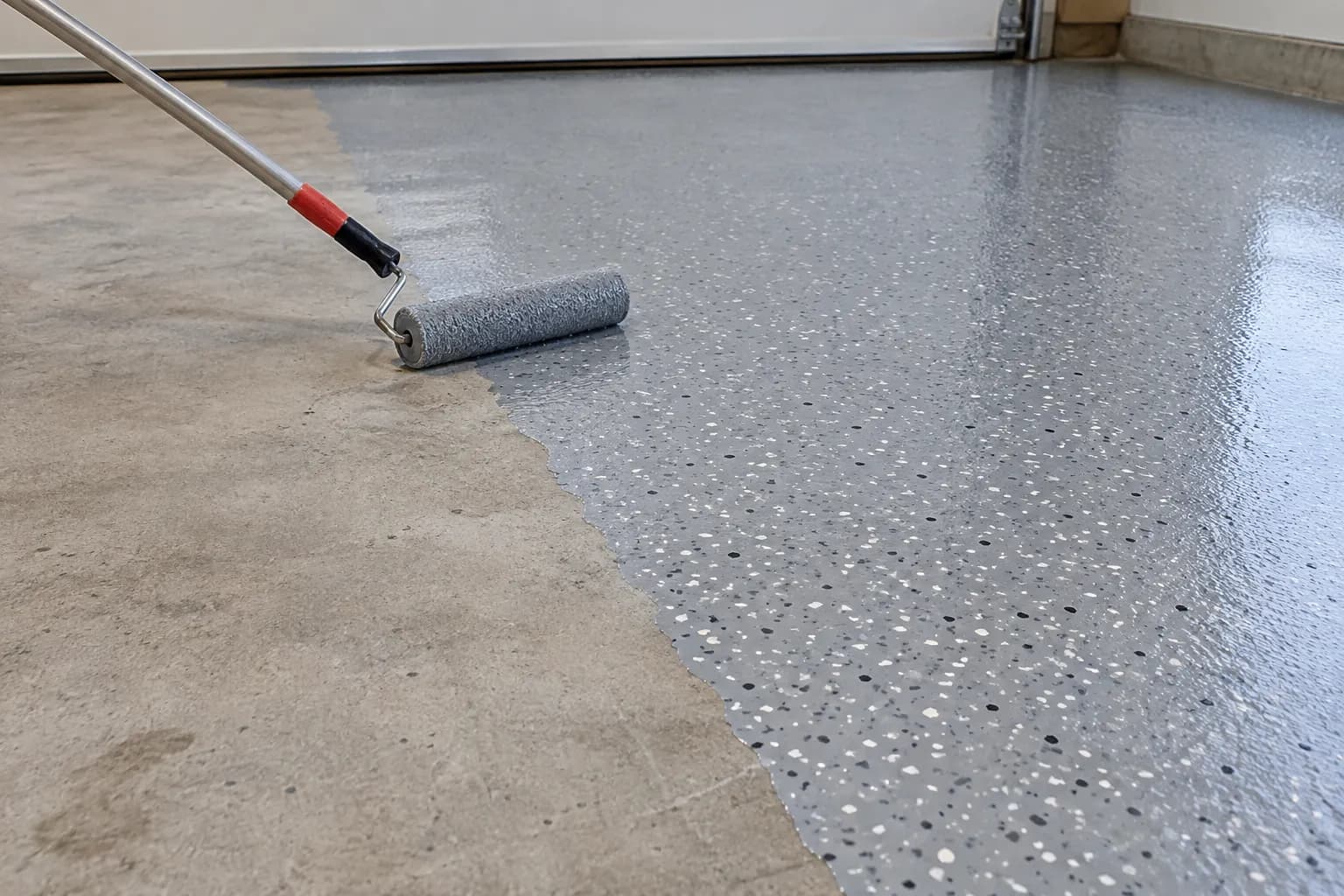
Roll the main area with a 3/8-inch nap roller. Work in sections, maintaining a wet edge. Apply at the manufacturer's specified coverage rate--thicker is not better and causes curing problems.
-
Broadcast decorative flakes (if using) into the wet coating immediately after rolling each section. Throw upward and let them flutter down for even distribution.
-
Allow full cure. Foot traffic: 24 hours minimum. Vehicle traffic: 72 hours minimum (some products require 7 days). Hot tire contact: wait the full cure time or longer.
Optional Clear Topcoat
A polyurethane or polyaspartic clear coat over the epoxy adds:
- UV protection (prevents yellowing)
- Chemical resistance
- Easier cleaning
- Additional abrasion resistance
- 3-5 extra years of lifespan
Cost: $50-150 for a two-car garage. Worth it for any epoxy system, especially if you chose decorative flakes.
Common Failure Modes and Prevention
| Failure | What It Looks Like | Cause | Prevention |
|---|---|---|---|
| Peeling | Sheets lifting off the floor | Moisture, poor profile, or contamination | Moisture test + proper grinding |
| Hot tire pickup | Coating pulls up where tires sit | Cheap single-component product | Use two-part epoxy minimum |
| Bubbles | Tiny bumps across surface | Outgassing from warming slab | Apply in afternoon on cooling slab |
| Yellowing | Floor turns amber/yellow | UV exposure on standard epoxy | Use polyaspartic topcoat |
| Fish eyes | Circular bare spots | Silicone contamination on surface | Thorough degreasing before coating |
Cost Breakdown: Two-Car Garage (450 sq ft)
| Item | DIY Cost | Professional Cost |
|---|---|---|
| Surface prep materials | $40-80 | Included |
| Grinder rental | $100-200 | Included |
| Quality 2-part epoxy kit | $150-300 | $300-600 (materials) |
| Clear topcoat | $50-150 | $100-200 |
| Decorative flakes | $30-60 | $50-100 |
| Labor | Your time (2 days) | $800-1,500 |
| Total | $370-790 | $1,250-2,400 |
For a comprehensive look at what goes wrong with concrete floors generally--including issues that should be fixed before coating--see our indoor floor problems guide.
A well-applied sealer is the lower-cost alternative if you want protection without the full epoxy treatment.
Key Takeaways
- Skip single-component kits--they're the main reason DIY epoxy gets a bad reputation
- Moisture test before anything else: tape plastic to the floor and check for condensation after 24-48 hours
- Surface prep (grinding or etching) is 80% of the job--the actual coating application is the easy part
- Apply in late afternoon when the slab is cooling to prevent outgassing bubbles
- Budget $370-790 for a quality DIY job on a two-car garage, or $1,250-2,400 for professional installation
- A clear topcoat adds UV protection and 3-5 years of extra lifespan for $50-150
For more project guidance, browse our complete library of concrete guides and tutorials.