

Garage Floor Cracks: Identification, Repair & Prevention Guide
Garage floors crack more often than any other residential slab — and for good reason. Most are unreinforced, subject to vehicle point loads, exposed to wide temperature swings, and attacked by de-icing salts, oil, and chemicals that interior slabs never see. This guide covers the four types of garage floor cracks, how to diagnose which you have, and the repair path for each.
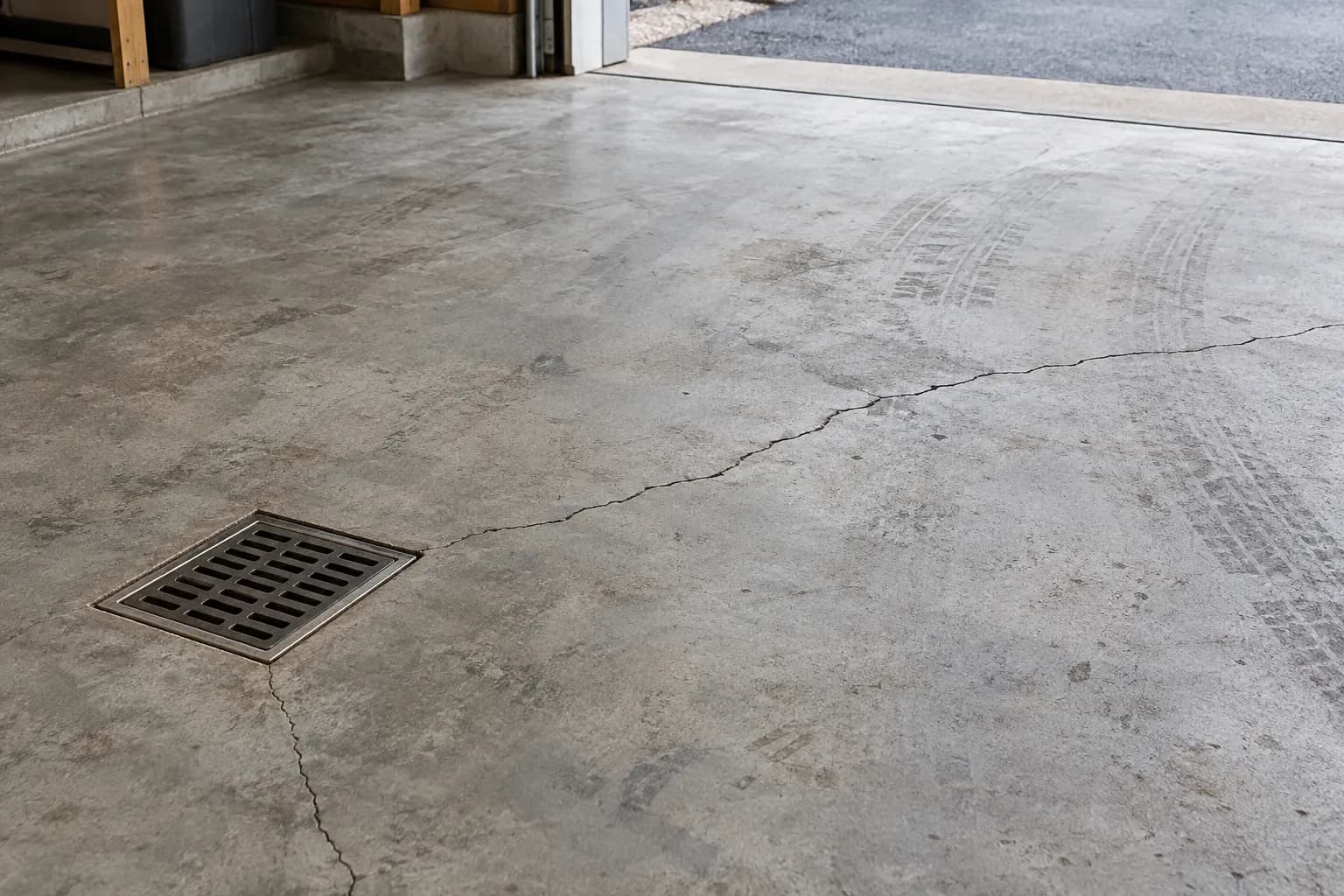
What Are Garage Floor Cracks?
Garage floor cracks are fractures in the concrete slab that forms the garage floor — ranging from hairline shrinkage lines to displaced settlement cracks to surface deterioration from chemical exposure. While cracking occurs in all concrete slabs, garage floors are uniquely vulnerable for five reasons:
No reinforcement. Most residential garage slabs are poured without rebar or welded wire mesh. Without steel to distribute tensile stress, the concrete cracks wherever shrinkage or loading exceeds its tensile capacity — typically 300–500 PSI for a standard 4,000 PSI mix.
Vehicle point loads. A 4,000-pound vehicle concentrates its weight through four tire contact patches, each roughly 25–35 square inches. While this produces only 30–40 PSI at the tire — well within the slab's capacity — the dynamic loading from driving in and out creates fatigue stress that static interior slabs never experience. Jack stands and hydraulic lifts create even higher point loads.
Thermal cycling. An unheated garage in a cold climate can see temperature swings of 60°F or more between a summer afternoon and a winter night. Concrete expands approximately 5.5 millionths per degree Fahrenheit, which translates to roughly 1/8 inch of movement per 20 feet of slab over a 60°F swing. Without adequate control joints, this movement produces cracks.
No air entrainment. Many garage slabs are poured with standard concrete that lacks the intentional air void system (4–7% entrained air) required for freeze-thaw durability. Without microscopic air voids to accommodate ice crystal expansion, the paste fractures when saturated concrete freezes — causing surface scaling and spalling.
Chemical exposure. De-icing salts tracked in on tires, motor oil, battery acid, gasoline, and brake fluid all attack concrete. Calcium chloride de-icers are particularly destructive — they create expansive chemical byproducts (calcium oxychloride) within the paste that cause surface scaling even in air-entrained concrete. Oil penetration prevents future adhesion of sealers and coatings.
The four primary crack types in garage floors are shrinkage, settlement, frost heave, and chemical attack. Each has a distinct cause, appearance, and repair path.
What Causes Garage Floor Cracks?
Shrinkage
The most common crack type in any concrete slab. As the concrete cures and loses moisture over the first 28 days, the paste contracts. Without reinforcement to distribute this tension, cracks form — typically in a random map or web pattern. Contributing factors specific to garages:
- Late-cut or missing control joints. Control joints should be cut within 6–12 hours of finishing at intervals no greater than 8–12 feet (2–3× the slab thickness in feet). Many garage slabs have joints only at the perimeter, leaving 20+ feet of unjointed slab.
- High water-to-cement ratio. Contractors sometimes add water to improve workability in the confined garage space. Every gallon of added water per cubic yard increases shrinkage by roughly 10%.
- Rapid drying. Garages with open doors during warm, windy conditions lose surface moisture faster than interior slabs, increasing plastic shrinkage risk.
Settlement
One section of the slab sinks below the adjacent section, cracking at the boundary. The crack typically runs parallel to the foundation wall or diagonally from a corner. Causes:
- Poorly compacted backfill. The soil backfilled against the foundation after construction often settles 2–6 inches over the first 3–5 years. If the garage slab was poured over this fill without adequate compaction, the slab edge settles with it.
- Utility trenches. Water, sewer, or electrical lines running under the slab create narrow zones of disturbed soil that compact differently from the surrounding undisturbed ground.
- Water erosion. Poor grading or gutter discharge near the garage can wash soil from beneath the slab, creating voids. The slab bridges the void initially, then cracks and drops when vehicle loads exceed its unsupported span capacity.
Frost Heave
The opposite of settlement — a section of the slab is pushed upward by expanding frozen soil beneath it. Most common in unheated garages in cold climates (USDA zones 3–6). The crack runs along the boundary between the heaved and stationary sections, with the heaved side visibly higher.
- Shallow footing depth. If the garage footing is above the frost line, the footing itself can heave, lifting the connected slab edge.
- Moisture accumulation. Water pooling under the slab — from poor vapor barrier installation, high water table, or interior drainage failure — freezes and creates ice lenses that lift the slab.
- Unheated space. The frost line extends deeper under unheated garages than under heated homes, increasing heave potential.
Chemical Attack
Surface deterioration — scaling, pitting, and spalling — rather than traditional cracking. The top 1/4 to 1/2 inch of concrete delaminates and flakes away, often in patches near the garage door (where de-icer exposure is highest).
- De-icing salts. Calcium chloride and magnesium chloride de-icers create destructive chemical reactions within the concrete paste. The first winter is the most vulnerable — concrete under 12 months old should never be exposed to chemical de-icers.
- Oil and gasoline. Petroleum products penetrate the porous concrete surface and dissolve the cement paste binder over time. The weakened surface then fails under tire abrasion.
- Battery acid. Sulfuric acid from leaking batteries dissolves the calcium compounds in concrete, leaving a soft, powdery surface.
How to Identify Your Crack Type
| Feature | Shrinkage | Settlement | Frost Heave | Chemical Attack |
|---|---|---|---|---|
| Pattern | Map/web or random parallel | Single line, often along wall | Single line, section raised | Surface scaling/pitting |
| Displacement | None | Down — one side lower | Up — one side higher | None (surface loss) |
| Width | Under 1/16 inch | 1/8 to 1/2 inch | 1/8 to 1/2 inch | N/A — surface damage |
| Timing | First 1–28 days | Months to years after pour | Winter months | After first winter or chemical exposure |
| Location | Anywhere on slab | Near walls, corners, utility runs | Near exterior walls in cold zones | Near garage door, parking area |
Key diagnostic: displacement direction. Settlement displacement goes down (the unsupported section drops). Heave displacement goes up (frozen soil pushes the section higher). No displacement means shrinkage or chemical attack. Use a 4-foot level across the crack to determine direction.
Not sure what you're seeing? Upload a photo to the concrete crack analyzer for an instant AI classification.
Severity Assessment
| Type | Width / Damage | Displacement | Severity | Action |
|---|---|---|---|---|
| Shrinkage | Under 1/16 inch | None | 1 | DIY seal |
| Shrinkage | 1/16–1/4 inch | None | 2 | DIY fill + seal |
| Settlement | Any width | Under 1/4 inch | 2 | Monitor, fill crack |
| Settlement | Any width | 1/4–1 inch | 3 | Foam lifting + fill |
| Settlement | Any width | Over 1 inch | 4 | Professional evaluation |
| Heave | Any | Any upward | 3 | Address drainage/insulation |
| Heave | Active / recurring | Over 1/2 inch | 4 | Engineer evaluation |
| Chemical | Light scaling | None | 2 | Clean + seal |
| Chemical | Deep spalling, aggregate exposed | None | 3 | Resurface or overlay |
Most garage floor cracks fall in the severity 1–2 range (shrinkage) and are straightforward DIY repairs. Settlement and heave push to 3–4 because they indicate soil problems that surface repair alone won't solve.
How to Repair Garage Floor Cracks
Shrinkage Cracks (Severity 1–2)
The simplest repair. Clean the crack with a wire brush and vacuum, then fill:
- Hairline (under 1/32 inch): Apply penetrating concrete sealer directly — it wicks into fine cracks by capillary action. No filler needed.
- 1/32 to 1/8 inch: Use a polyurethane crack filler applied with a caulking gun. Slightly overfill, then scrape flush with a putty knife.
- 1/8 to 1/4 inch: Use a two-part epoxy crack filler for a rigid repair, or polyurethane for flexibility. Backer rod may be needed for cracks over 3/16 inch deep.
Settlement Cracks (Severity 2–4)
Surface-filling a settlement crack without addressing the void underneath is a temporary fix — the crack will reopen. The repair sequence:
- Confirm the void. Tap the slab on both sides of the crack with a hammer. A hollow sound indicates a void beneath the lower section.
- Foam injection (slab lifting). A polyurethane foam contractor drills small holes (5/8 inch) through the settled section and injects expanding foam to fill the void and lift the slab. Typical cost: $500–$2,500. Effective for settlement up to 2 inches.
- Fill the surface crack after lifting. Use polyurethane filler for flexibility, as some future movement is possible.
For settlement over 2 inches or affecting more than one-third of the slab, partial or full replacement is more cost-effective than repeated lifting.
Frost Heave Cracks (Severity 3–4)
Frost heave is a symptom of a moisture and temperature problem. Repairing the crack without addressing the cause guarantees recurrence every winter.
- Eliminate the moisture source. Install or repair perimeter drainage, extend downspouts away from the garage, and ensure the garage floor slopes toward the door (1/8 inch per foot minimum).
- Insulate if practical. Rigid foam insulation (2 inches of XPS, R-10) along the interior perimeter of the footing reduces frost penetration under unheated garages.
- Install a vapor barrier. If rebuilding or overlaying, a 10-mil polyethylene vapor barrier under the slab prevents ground moisture from reaching the concrete.
- Repair the surface only after the heave cause is corrected and you've observed one freeze-thaw cycle without recurrence.
Chemical Attack (Severity 2–3)
- Clean contamination thoroughly. Degrease oil stains with TSP or a dedicated concrete degreaser. Acid-etch de-icer-damaged areas to remove weakened paste. Rinse and allow 48 hours to dry.
- Fill any cracks that developed alongside the surface damage.
- Apply protective coating. An epoxy or polyurea floor coating system seals the surface against future chemical attack. This is both a repair and a prevention measure. See the garage floor epoxy guide for coating selection and application.
DIY vs. Professional
Most garage floor cracks are DIY-appropriate. Here's where to draw the line:
DIY (severity 1–2):
- Shrinkage cracks of any length, up to 1/4 inch wide, with no displacement
- Light chemical scaling (surface sealer application)
- Crack filling before an epoxy coating project
Professional (severity 3–4):
- Settlement cracks with confirmed voids requiring foam lifting
- Frost heave requiring drainage correction or footing insulation
- Widespread spalling requiring full resurfacing or overlay
- Any crack with displacement over 1/4 inch
- Full slab replacement
Epoxy Coating as Prevention and Treatment
A garage floor epoxy or polyurea coating serves double duty — it conceals existing hairline cracks and prevents future chemical and moisture damage. But coating is not a universal fix.
When coating works:
- Over sealed shrinkage cracks with no active movement
- As a chemical barrier against de-icers, oil, and road salt
- On stable slabs with no settlement or heave issues
- After all cracks have been properly filled and cured
When coating fails:
- Over active cracks that are still widening — the rigid coating will crack through
- Over settlement voids — the unsupported coating section will fracture under tire loads
- On oil-saturated concrete that hasn't been thoroughly degreased — the coating won't bond
- On concrete less than 28 days old — moisture migration causes delamination
For a detailed breakdown of coating types, preparation, and application, see the garage floor epoxy guide. For thickness recommendations for new pours, see the garage floor thickness guide.
Prevention
The best time to prevent garage floor cracks is during construction. If you're pouring a new garage floor or replacing an existing one:
Control joints at proper spacing. Cut joints at intervals no greater than 8–10 feet (2–2.5× slab thickness in feet for a 4-inch slab). A two-car garage (20×20 feet) needs a minimum of one joint in each direction, creating four panels. Joints should be cut 1 inch deep (1/4 of slab thickness) within 6–12 hours of finishing.
Compact the subgrade. The single most important step for preventing settlement. Compact all fill material in 6-inch lifts to 95% Modified Proctor density. Pay special attention to backfill zones against the foundation and any utility trenches.
Install a vapor barrier. A 10-mil (or thicker) polyethylene sheet under the slab prevents ground moisture from migrating upward. Overlap seams 6 inches minimum and tape with vapor barrier tape. This also reduces the moisture available for frost heave.
Specify air-entrained concrete in freeze zones. For garages in USDA hardiness zones 3–6, specify 5–7% entrained air in the concrete mix. This creates microscopic air voids that accommodate ice crystal expansion without damaging the paste. Cost premium is minimal — approximately $3–5 per cubic yard.
Avoid de-icers the first winter. New concrete is most vulnerable to chemical de-icer damage during its first winter. Use sand for traction instead of salt. After 12 months of curing, a sealed slab can tolerate most de-icers — though calcium chloride should always be avoided on concrete.
Cure properly. Apply a curing compound immediately after finishing, or cover with wet burlap and plastic sheeting for a minimum of 7 days. Proper curing reduces shrinkage cracking by 50% or more compared to uncured concrete.
Cost Estimates
| Repair | Cost Range | Notes |
|---|---|---|
| DIY crack filling | $15–$50 | Polyurethane caulk + crack filler |
| Professional crack filling | $200–$500 | 2-car garage, multiple cracks |
| Epoxy floor coating (DIY kit) | $150–$400 | Single-coat kit for 2-car garage |
| Epoxy floor coating (professional) | $1,500–$6,000 | Multi-coat system, $3–$12/SF |
| Foam slab lifting | $500–$2,500 | Per settled section |
| Concrete overlay | $3–$8/SF | Resurfacing without full replacement |
| Full slab replacement | $8–$15/SF | Includes old slab removal and disposal |
For detailed local pricing, use the garage floor cost calculator or see concrete cost estimates by city.
Key Takeaways
- Most garage floor cracks are normal shrinkage — hairline width, no displacement, severity 1–2, and fully DIY-repairable.
- Displacement direction is the key diagnostic: down = settlement (void below), up = frost heave (frozen soil below), none = shrinkage or chemical.
- Settlement cracks need the void addressed before surface repair — foam lifting is the standard fix for settlement up to 2 inches.
- Frost heave cracks will recur every winter until the moisture source and insulation are addressed.
- Avoid chemical de-icers on garage floors less than 12 months old — use sand instead.
- Epoxy coating prevents future chemical damage and conceals repaired cracks, but fails over active cracks and unsupported voids.
- A properly constructed garage slab (compacted subgrade, control joints, vapor barrier, air entrainment, proper curing) dramatically reduces cracking.
Next Steps
- Diagnose your crack: Upload a photo to the concrete crack analyzer for an instant AI classification.
- Plan an epoxy coating: Read the garage floor epoxy guide for coating selection and application.
- Estimate costs: Use the garage floor calculator to estimate material quantities and costs.
- Assess severity: See the severity guide to understand the 1–5 scale and when professional help is needed.