

Concrete Countertops: Realistic DIY Assessment and Common Failures
DIY concrete countertops look stunning on Pinterest and terrible in half the kitchens that attempt them. The gap between inspiration and reality is enormous--pinholes, cracking, uneven color, staining, and sealing failures are common. This isn't to discourage you, but to set honest expectations. Concrete countertops are among the most difficult DIY concrete projects, and understanding where others fail gives you the best chance of succeeding.
A successful concrete countertop requires precision in mixing, forming, casting, curing, and finishing. Skip or rush any step and it shows permanently. If you're considering this project, use our concrete calculator to estimate material quantities and understand the scope before committing.
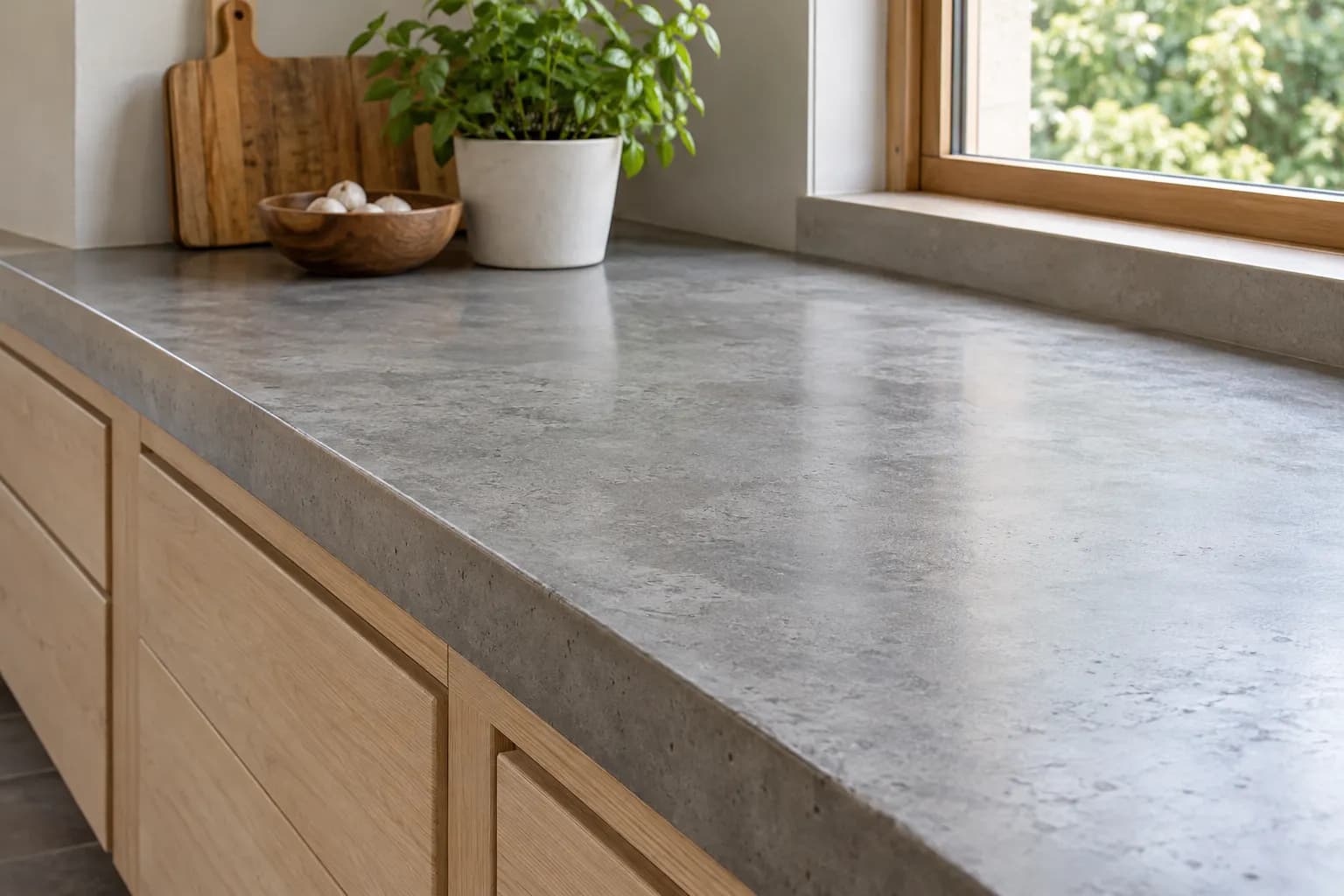
What Makes Countertops Different from Other Concrete Work
Concrete driveways, patios, and slabs are forgiving. Countertops are not. Here's why:
- Tolerances are tight. A 1/16-inch imperfection on a driveway is invisible. On a countertop at eye level, it's obvious.
- The surface is functional. It must resist stains, heat, scratches, and food acids daily.
- Weight matters. At 25 lbs per sq ft (at 2-inch thickness), cabinets may need reinforcement.
- Edges are visible. Unlike slabs where edges are buried, countertop edges are on display and must be finished perfectly.
- Sealing is critical. A poorly sealed countertop absorbs stains within minutes in a kitchen environment.
Common Failures and How to Avoid Them
1. Pinholes (Bug Holes)
The problem: Tiny holes scattered across the surface from trapped air bubbles. This is the most common complaint with DIY concrete countertops.
Why it happens: Air gets trapped in the mix during pouring. On slabs, bubbles rise to the surface (which becomes the bottom). On countertops cast face-down, the form face traps bubbles against what becomes the visible surface.
Prevention:
- Vibrate the form thoroughly after pouring. A palm sander held against the form sides works as a makeshift vibrating table.
- Use a concrete mix designed for countertops (higher cement, smaller aggregate, better flowability)
- Pour in thin lifts (1/2-inch layers), vibrating between each
- Tap the form sides repeatedly for 5-10 minutes after each layer
Fix after the fact: Fill pinholes with a color-matched slurry of cement and water, rubbed into the holes with a rubber float. Sand smooth after curing. See our concrete finish problems guide for more surface defect repairs.
2. Cracking
The problem: Hairline to visible cracks appear during curing or after installation.
Why it happens: Concrete countertops are thin relative to their span. Long unsupported lengths, sink cutouts (stress concentrators), and improper reinforcement all lead to cracking.
Prevention:
- Reinforce every countertop with wire mesh or rebar grid placed in the middle of the slab thickness
- Use fiber-reinforced concrete mix for additional crack resistance
- Minimum thickness of 1.5 inches, preferably 2 inches
- Add extra reinforcement around sink and cooktop cutouts (the corners of cutouts are where cracks start)
- Cure slowly--cover with plastic for 3-5 days to prevent rapid moisture loss
3. Staining
The problem: Wine, coffee, lemon juice, oil, and other kitchen liquids stain the surface within minutes.
Why it happens: Concrete is porous. Even sealed concrete can stain if the sealer isn't the right type or has worn through.
Prevention:
- Apply a food-safe epoxy or polyurethane sealer (not just a penetrating sealer--it's not enough for kitchen use)
- Apply 2-3 coats per manufacturer's instructions
- Reseal annually
- Wipe spills immediately, especially acidic liquids (citrus, vinegar, wine)
The reality: Concrete countertops require more maintenance than granite or quartz. If you want a set-and-forget surface, concrete isn't it. For sealer product guidance, see our guide on how to seal concrete.
4. Color Inconsistency
The problem: Blotchy, uneven color across the surface or between sections.
Why it happens: Inconsistent mixing between batches, different water ratios, uneven curing, or applying integral color unevenly.
Prevention:
- Mix all the concrete for one piece in a single batch if possible
- Measure water precisely--even small variations affect color
- If using integral color, measure pigment by weight (not volume) for consistency
- Cure uniformly--cover the entire piece, not just parts of it
5. Sealer Failure
The problem: Sealer peels, bubbles, turns cloudy, or stops protecting.
Why it happens: Applying sealer over moisture (concrete not fully cured), wrong sealer type, inadequate surface preparation, or incompatible products layered together.
Prevention:
- Wait a full 28 days before sealing
- Test moisture with a plastic sheet test before sealing
- Use a sealer specifically rated for countertop/food-safe use
- Follow manufacturer's recoat schedule exactly
The Casting Process (Overview)
Method 1: Cast Face-Down (Recommended for Beginners)
Build a form (melamine-coated MDF is ideal) with the visible surface facing down. The form's smooth bottom becomes the countertop's finished face.
Advantages: Smooth, consistent surface. Easier to create edges. No troweling skill needed for the visible surface.
Disadvantages: You can't see the surface during pouring. Air bubbles get trapped against the form face (hence pinholes). Heavier items (sinks) are harder to accommodate.
Method 2: Cast Face-Up (In-Place)
Pour directly on the cabinets or on a separate table with the visible surface on top.
Advantages: You can see and work the surface during finishing. Easier to embed items.
Disadvantages: Requires troweling skill to get a smooth, defect-free surface. Messy if poured in-place. Surface imperfections from troweling are permanent.
Material Requirements
| Material | Purpose | Cost Estimate |
|---|---|---|
| Countertop-specific concrete mix (or high-strength mix + additives) | The slab itself | $50-120 |
| Melamine-coated MDF (for forms) | Form construction | $30-60 |
| Silicone caulk | Form seams (prevents leaks and creates edge profile) | $10-15 |
| Wire mesh or rebar | Reinforcement | $20-30 |
| Integral color pigment (optional) | Color | $15-40 |
| Food-safe concrete sealer (epoxy or polyurethane) | Protection | $40-80 |
| Sandpaper/polishing pads (various grits) | Surface finishing | $30-50 |
| Total for 25 linear feet | $195-395 |
For precise water ratios when mixing, the mix consistency for countertops needs to be wetter than standard slab concrete to flow into form details, but not so wet that it weakens.
Honest Cost Comparison
| Material | Cost per Sq Ft (Installed) | DIY Possible? | Maintenance |
|---|---|---|---|
| DIY concrete | $8-15 (materials only) | The whole point | High (annual seal, careful cleaning) |
| Professional concrete | $65-135 | No | Moderate (professional sealer lasts longer) |
| Butcher block | $25-65 | Yes | Moderate (oil regularly) |
| Granite | $50-200 | Rarely | Low (seal every 1-2 years) |
| Quartz | $75-200 | No | Very low |
| Laminate | $15-40 | Yes | Low |
Concrete is the cheapest material but the most labor-intensive and highest-maintenance option. The real cost is your time: expect 2-4 full days of work for a kitchen, plus a 5-7 day cure period before installation.
Is This Project Right for You?
Good candidates:
- Experienced with concrete work (this is NOT a good first concrete project)
- Comfortable with precision work and patient during curing
- Willing to maintain and reseal annually
- Want a unique, custom look and enjoy the aging patina
- Have the workspace for casting (garage or workshop)
Think twice if:
- This would be your first concrete project--start with a simpler pour first
- You expect a low-maintenance surface
- You need perfect color consistency
- You're on a tight timeline (curing takes time)
- Your cabinets may not support the weight (verify load capacity)
The DIY vs. contractor question is especially relevant for countertops. A failed countertop wastes $200-400 in materials and days of labor. Professional concrete countertops cost more but eliminate the risk of common DIY failures.
Key Takeaways
- Concrete countertops are one of the hardest DIY concrete projects--not for beginners
- Pinholes, cracking, staining, and color inconsistency are the most common failures
- Budget $200-400 in materials for a typical kitchen; professional installation runs $65-135/sq ft
- Standard thickness is 1.5-2 inches; verify cabinets can handle 25 lbs/sq ft
- Food-safe epoxy or polyurethane sealer is mandatory--penetrating sealers aren't enough for kitchen use
- Reseal annually; concrete countertops require more maintenance than granite or quartz
For more project guidance, browse our complete library of concrete guides and tutorials.