

How Much Water per Bag of Concrete: Exact Amounts by Brand and Bag Size
The most common DIY concrete failure starts with water. Too much makes concrete weak and crumbly. Too little makes it unworkable and full of voids. The frustrating part: bag instructions say 'add water' without telling you exactly how much. This guide gives you the exact water quantities for every major brand, plus what to do if you've already added too much or too little.
How Much Water per Bag of Concrete (Quick Answer)
A 60-lb bag of Quikrete Concrete Mix takes 4 to 7 pints (2 to 3.5 quarts) of water, and an 80-lb bag takes 6 to 9 pints (3 to 4.5 quarts). The lower number is Quikrete's starting amount and the higher one is the maximum expected; start low and add water only until the mix is workable. Sakrete lists 2.5 quarts for a 60-lb bag and 3.5 quarts for an 80-lb bag.
| Bag Size | Quikrete Concrete Mix (4,000 PSI), start to max | Sakrete High-Strength (4,000 PSI) |
|---|---|---|
| 40 lb | 3-4.5 pints (1.5-2.25 qt, 1.4-2.1 L) | 1.75 qt (3.5 pints, 1.7 L) |
| 50 lb | 3.5-5.5 pints (1.75-2.75 qt, 1.7-2.6 L) | not listed |
| 60 lb | 4-7 pints (2-3.5 qt, 1.9-3.3 L) | 2.5 qt (5 pints, 2.4 L) |
| 80 lb | 6-9 pints (3-4.5 qt, 2.8-4.3 L) | 3.5 qt (7 pints, 3.3 L) |
| 90 lb | 7-10 pints (3.5-5 qt, 3.3-4.7 L), regional | 4.25 qt (8.5 pints, 4.0 L) |
Sources: Quikrete figures are Table 2 of the Quikrete Concrete Mix (No. 1101) data sheet, which lists a starting water content and a maximum expected water content for each bag size. Sakrete figures are from the High-Strength Concrete Mix technical data sheet.
Before you start mixing, figure out how many bags you actually need with our concrete calculator. Getting the material quantity right saves you from rushed decisions mid-pour, which is exactly when water mistakes happen.
Water Ratios by Brand and Bag Size
Every brand formulates its mix slightly differently. Aggregate size, cement content, and additives all affect how much water the mix absorbs. Here are the target water amounts based on manufacturer specifications.
| Brand | Bag Size | Water (Quarts) | Water (Liters) | Yield (cu ft) |
|---|---|---|---|---|
| Quikrete Standard | 40 lb | 1.5-2.25 | 1.4-2.1 | 0.30 |
| Quikrete Standard | 60 lb | 2-3.5 | 1.9-3.3 | 0.45 |
| Quikrete Standard | 80 lb | 3-4.5 | 2.8-4.3 | 0.60 |
| Quikrete Standard | 90 lb | 3.5-5 | 3.3-4.7 | 0.675 |
| Quikrete 5000 | 60 lb | 2.5 | 2.4 | 0.45 |
| Quikrete 5000 | 80 lb | 3.4 | 3.2 | 0.60 |
| Sakrete High-Strength | 40 lb | 1.75 | 1.7 | 0.30 |
| Sakrete High-Strength | 60 lb | 2.5 | 2.4 | 0.45 |
| Sakrete High-Strength | 80 lb | 3.5 | 3.3 | 0.60 |
| Sakrete High-Strength | 90 lb | 4.25 | 4.0 | 0.66 |
| Rapid Set Cementall | 55 lb | 2.75 | 2.6 | 0.45 |
These are starting points, not exact prescriptions. Humidity, aggregate moisture, temperature, and altitude all shift the real number. For Quikrete, start at the lower number of the range; for the single-number brands, start with about 80% of the listed amount. Mix thoroughly and add the rest gradually.
For a deeper comparison of the two most popular brands, see Quikrete vs Sakrete.
The Golden Rule: Start Low, Add Slow
Every experienced contractor follows the same process:
- Add 75-80% of the target water first. For an 80-lb bag of Quikrete, that means starting with 3 quarts (6 pints), Quikrete's own starting amount, and stopping well short of the 4.5-quart maximum.
- Add all the dry mix and blend for 2-3 minutes. Get the dry pockets incorporated before judging the consistency.
- Add remaining water in small splashes. A quarter cup at a time. Mix for 30 seconds between additions.
- Stop when the consistency is right. Not when the "correct" amount of water is used.
The target consistency matters more than hitting an exact water measurement. You are adjusting to conditions, not following a laboratory formula.
For the full step-by-step mixing process, read our how to mix concrete guide.
How to Judge Consistency (The Visual Guide)
Forget measuring cups. After the initial water addition, your eyes and hands are the best instruments. Here is what each consistency looks like and what it means.
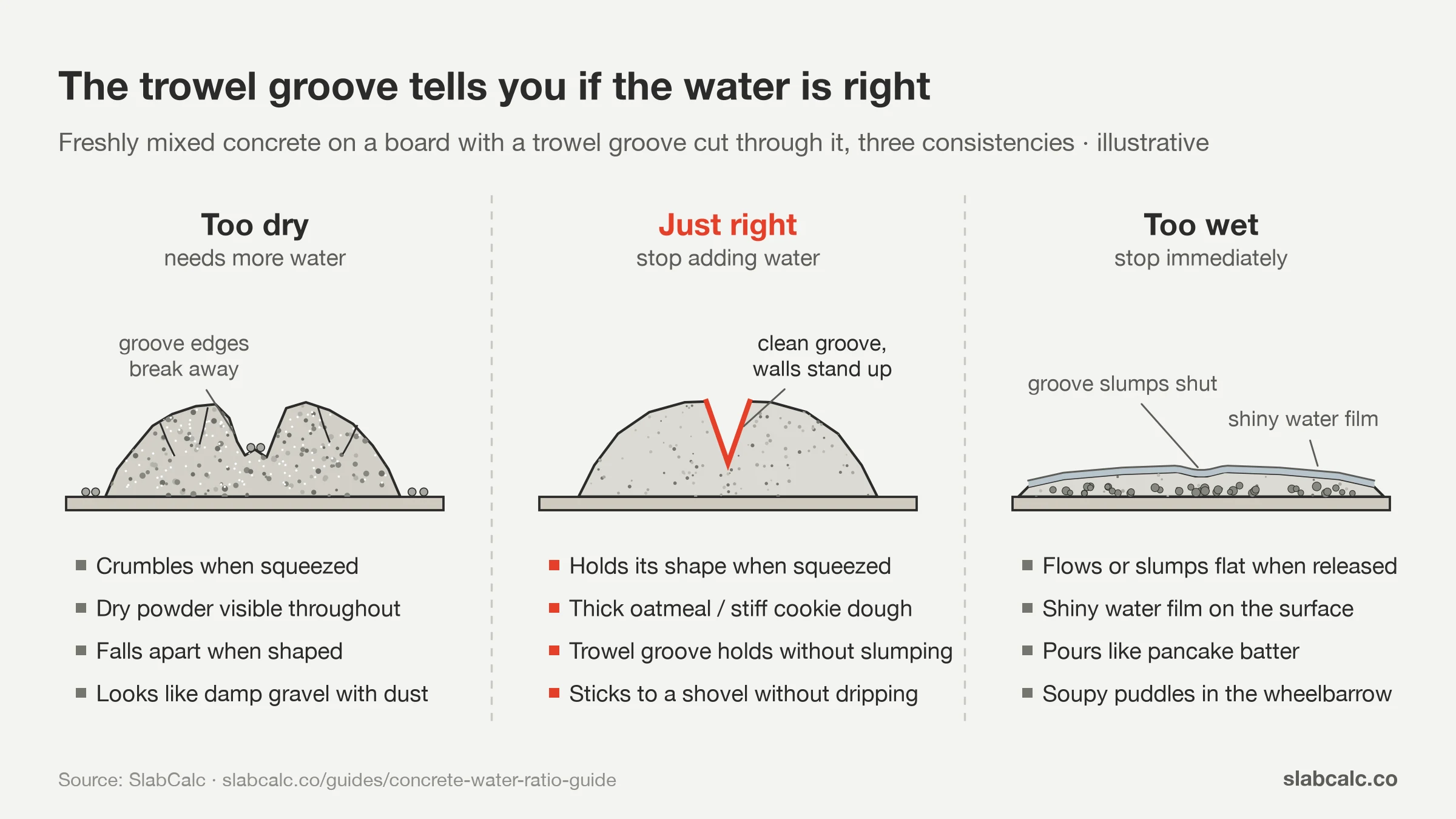
Too dry (needs more water):
- Crumbles when squeezed in your hand
- Dry powder visible throughout the mix
- Falls apart when shaped
- Looks like damp gravel with dust
Just right (stop adding water):
- Holds its shape when squeezed, with moisture on the surface of the ball
- Consistency of thick oatmeal or stiff cookie dough
- A trowel groove holds its shape without slumping
- Smooth, uniform color with no dry streaks
- Sticks to a shovel without dripping off
Too wet (stop immediately):
- Flows or slumps flat when released
- Shiny water film on the surface
- Pours like pancake batter
- Aggregate sinks to the bottom when left still
- Soupy puddles form in the wheelbarrow
The squeeze test: Grab a handful of mixed concrete and squeeze it. Open your hand. It should hold its shape like a snowball but feel heavy and dense. If water drips from your fist, it is too wet. If the ball falls apart, it is too dry.
Why Water Ratio Matters More Than Anything Else
The water-to-cement ratio is the single biggest factor in concrete strength. This is not an opinion. It is physics.
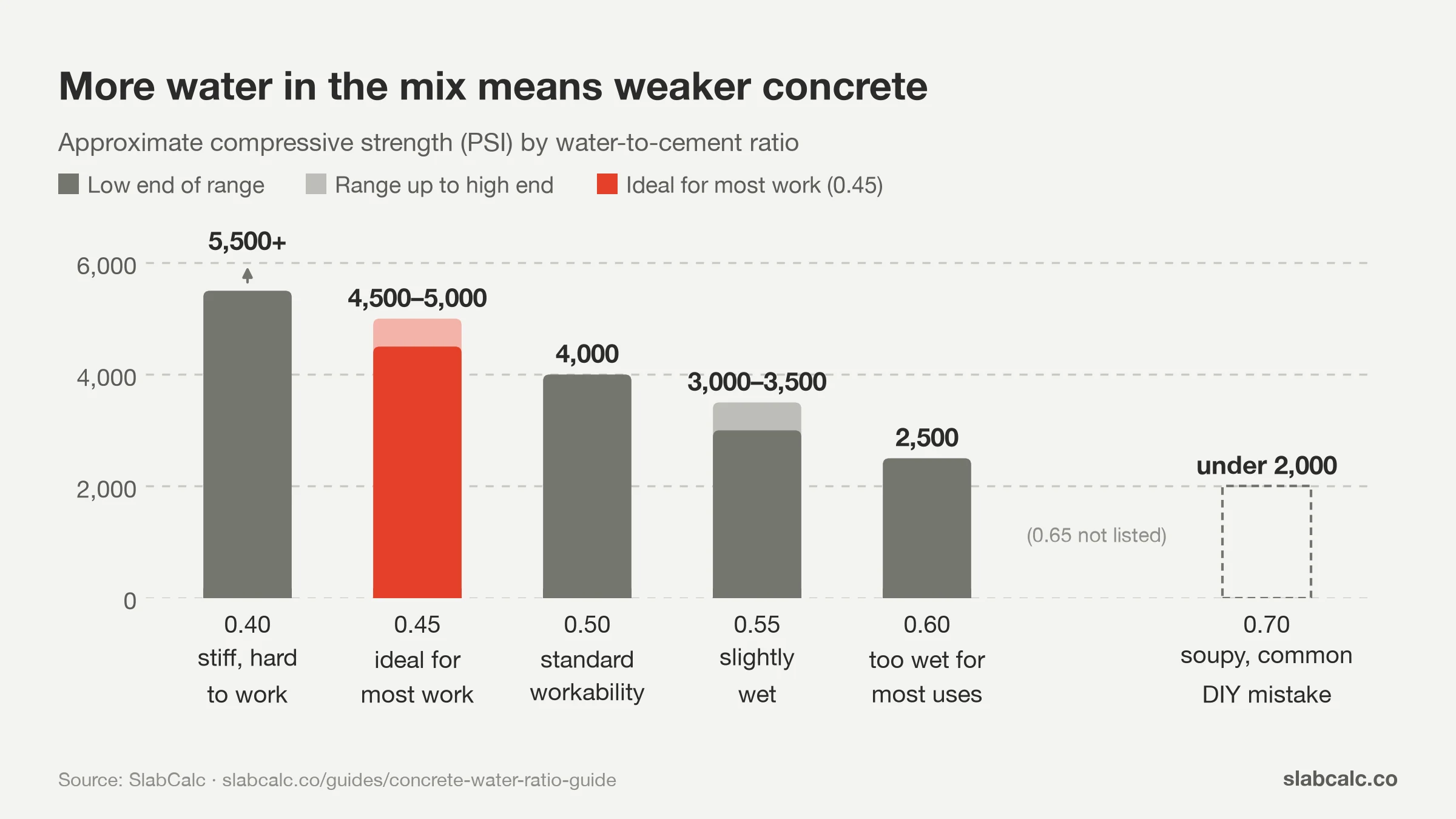
| Water-to-Cement Ratio | Approximate Compressive Strength |
|---|---|
| 0.40 (stiff, hard to work) | 5,500+ PSI |
| 0.45 (ideal for most work) | 4,500-5,000 PSI |
| 0.50 (standard workability) | 4,000 PSI |
| 0.55 (slightly wet) | 3,000-3,500 PSI |
| 0.60 (too wet for most uses) | 2,500 PSI |
| 0.70 (soupy, common DIY mistake) | Under 2,000 PSI |
Each 0.01 increase in the water-to-cement ratio drops strength measurably. A mix that is 10% over the target water amount can lose 25% or more of its designed strength.
Quikrete's data sheet targets a 2 to 3 inch slump for its Concrete Mix. Water past the maximum expected amount for the bag pushes the mix beyond that and costs strength you cannot get back.
To understand how much material you need and avoid waste, check how many bags of concrete your project requires.
How to Fix a Mix That Is Too Wet
You added too much water. It happens. Here is what to do depending on how bad it is.
Slightly too wet (pourable but not soupy):
- Add dry mix in half-cup scoops. Not just cement. The full concrete mix, straight from the bag.
- Mix thoroughly after each addition. Give it 30 seconds to absorb before judging.
- Repeat until the consistency thickens to cookie dough.
Significantly too wet (flows freely, aggregate separating):
- Add dry mix more aggressively, a full scoop or two at a time.
- You will use more material than planned. Accept it.
- If you run out of dry mix, do not add straight Portland cement. It changes the cement-to-aggregate ratio and creates a brittle result.
Already poured and too wet:
- Do not overwork the surface. Excess troweling brings water and fines to the top, creating a weak, dusty layer.
- Do not sprinkle dry cement on top. This creates a thin crust that flakes off.
- Let it cure longer than normal. Overwatered concrete takes more time to reach usable strength.
- If the mix was drastically overwatered (sloshing around like soup), consider breaking it out and starting over. Weak concrete under a structure is worse than no concrete.
How to Fix a Mix That Is Too Dry
Too dry is easier to fix than too wet. But add water carefully, because "too dry" becomes "too wet" in about two splashes.
Slightly dry (stiff but holds together):
- Add water a tablespoon at a time. Seriously, a tablespoon.
- Mix for 30 seconds between additions. Dry mixes absorb water slowly.
- You are closer to the right consistency than you think.
Very dry (crumbling, won't hold shape):
- Add water a quarter cup at a time.
- Mix for a full minute between additions. Dry pockets hide inside the mix and release later.
- Once the outside looks right, keep mixing for another minute to catch hidden dry spots.
The common mistake: People add a full cup of water to a dry mix because it "looks like it needs a lot." Sixty seconds later, the mix is soup. Small additions prevent this.
Adjustments for Weather and Conditions
The numbers on the bag assume moderate conditions. Real-world pours happen in real weather.
Hot weather (above 85F):
- Water evaporates faster from the mix. You may need 10-15% more water.
- Mix smaller batches. Working time drops to 20 minutes.
- Pre-wet your wheelbarrow and tools so they do not absorb water from the concrete.
Cold weather (below 50F):
- Use slightly less water. Cold concrete sets slowly and retains moisture longer.
- Use warm water (not hot) to improve workability without adding excess volume.
- Protect fresh concrete from freezing for at least 48 hours.
High humidity:
- Aggregate in the bag may already contain moisture. Start with 10-15% less water than the table suggests.
- This is especially true for bags stored outdoors or in damp garages.
Dry, windy conditions:
- The surface dries faster than the interior. The mix may seem dry on top while being perfect underneath.
- Mix an extra 30 seconds before adding water.
- Keep a spray bottle handy during finishing to prevent surface drying.
If this is your first project, our first concrete pour guide walks through the entire process from start to finish, including how to handle weather surprises.
Brand-Specific Notes
Quikrete Standard (4,000 PSI): The most widely available bagged concrete in North America. Forgiving on water ratios. If you overshoot by a quarter cup per bag, the strength loss is minimal.
Quikrete 5000 (5,000 PSI): Slightly finer aggregate and more cement per bag. More sensitive to water. Follow the lower end of the range and keep the mix stiff.
Sakrete High-Strength (4,000 PSI): Sakrete's everyday mix, despite the name. Nearly identical in performance to Quikrete Standard. Water ratios are within a quarter cup of each other. Use whichever is in stock.
Sakrete 5000 Plus (5,000 PSI) and MAXIMIZER (5,500 PSI): Sakrete's higher-strength mixes. Follow the water amount printed on the bag and keep the mix on the stiff side; extra water costs these mixes their strength advantage first.
Fast-setting mixes (Quikrete Fast-Setting, Sakrete Fast-Setting): These set in 20-40 minutes. Get the water right on the first try because you will not have time to adjust. Mix smaller batches.
For what each of these mixes costs and how to budget your project, see concrete cost per yard.
Key Takeaways
- Start with 75-80% of target water and add the rest gradually. You can always add more. You cannot remove it.
- Quikrete 80 lb: 3-4.5 quarts. Quikrete 60 lb: 2-3.5 quarts. Sakrete 80 lb: 3.5 quarts, 60 lb: 2.5 quarts. Start at the low end; the high end is a ceiling, not a dose.
- Consistency matters more than measurement. Thick oatmeal or stiff cookie dough. If it pours, it is too wet.
- Too wet? Add dry mix, not cement. Half-cup scoops, mixed thoroughly between additions.
- Too dry? Add water a tablespoon at a time. The gap between "too dry" and "too wet" is smaller than you think.
- High-strength mixes are more sensitive to water. Keep Quikrete 5000, Sakrete 5000 Plus and MAXIMIZER on the stiff side.
For the full mixing process, see how to mix concrete. For help planning your project from the ground up, browse all concrete guides.