

Parking Garage Concrete Slab: Thickness, Strength and Reinforcement Specification
Parking garage slabs range from 150 mm (6 in) for passenger vehicles to 200 mm+ for elevated decks, with minimum compressive strength of 28–35 MPa (4,000–5,000 PSI) depending on exposure class. This reference covers thickness by load class, reinforcement, cover, and joint spacing per ACI 318-19 and ACI 362.1R.
Standard parking garage slabs are 150 mm (6 in) thick for passenger vehicles, 175–200 mm (7–8 in) for light commercial loads, and 200 mm+ for elevated decks or fire apparatus access. Minimum compressive strength is 28 MPa (4,000 PSI) at F0/C0 exposure, rising to 35 MPa (5,000 PSI) at F2/C2 (freeze-thaw with deicing salts). The table below consolidates minimum requirements per ACI 318-19, ACI 362.1R, and IBC exposure class provisions. Local jurisdiction and structural engineer of record always govern.
Table: Parking Garage Slab Specification by Use Type
| Use Type | Slab Thickness | Min Compressive Strength | w/c Ratio | Primary Rebar | Cover (Top) | Cover (Bottom) | Joint Spacing |
|---|---|---|---|---|---|---|---|
| Ground-level, passenger vehicles | 150 mm (6 in) | 28 MPa (4,000 PSI) | ≤ 0.45 | #5 @ 300 mm (12 in) o.c. | 50 mm (2 in) | 75 mm (3 in) | 5–6 m (15–20 ft) |
| Ground-level, light commercial / delivery | 175–200 mm (7–8 in) | 31 MPa (4,500 PSI) | ≤ 0.45 | #5 @ 300 mm (12 in) o.c. | 50 mm (2 in) | 75 mm (3 in) | 5–6 m (15–20 ft) |
| Ground-level, fire apparatus access | 200–250 mm (8–10 in) | 35 MPa (5,000 PSI) | ≤ 0.40 | #6 @ 300 mm (12 in) o.c. | 50 mm (2 in) | 75 mm (3 in) | 4.5–5 m (15 ft) |
| Elevated deck, passenger vehicles | 200 mm (8 in) min | 35 MPa (5,000 PSI) | ≤ 0.40 | Per structural design | 50 mm (2 in) | 38 mm (1.5 in) | Per structural design |
| Elevated deck, post-tensioned flat plate | 175–225 mm (7–9 in) | 35 MPa (5,000 PSI) | ≤ 0.40 | PT strands + mild steel per design | 50 mm (2 in) | 25 mm (1 in) | Continuous (PT controls cracking) |
| Ramp (transitional) | +25–50 mm above adjacent slab | 35 MPa (5,000 PSI) | ≤ 0.40 | Increase rebar one size or reduce spacing | 50 mm (2 in) | 75 mm (3 in) | Reduce 20% from adjacent bays |
Exposure class note: Parking structures in freeze-thaw climates with deicing salt exposure are classified F2/C2 under ACI 318. These are the most aggressive exposure conditions for horizontal concrete elements. See Concrete Strength for Parking Structures for full exposure class treatment.
Slab-on-Grade: Ground-Level Parking
Ground-level parking slabs are supported by compacted subgrade and subbase. The subgrade controls differential settlement; the concrete specification controls durability.
Minimum thickness: 150 mm (6 in) for passenger vehicle loads under ACI 360R. Many specifiers default to 175 mm (7 in) in commercial applications to account for subgrade variability and to gain joint spacing flexibility.
Subbase requirement: 100–150 mm (4–6 in) of compacted granular material minimum. Subbase modulus directly affects required slab thickness under design vehicle loads. A well-prepared subbase is not a substitute for minimum thickness, but a poorly prepared subbase is the most common cause of premature failure in ground-level parking.
Deicing salt exposure in northern climates pushes the minimum compressive strength to 4,500 PSI (31 MPa) with air entrainment (5–7% for 19 mm nominal aggregate in severe exposure) even for ground-level applications. ACI 318 Table 19.3.3 is the controlling reference.
→ Full thickness specification by load class: Parking Garage Slab Thickness by Load Class
Dead Loads
Parking garage dead loads range from 3.6 kPa (75 psf) for a 150 mm slab-on-grade to 6.0+ kPa (125+ psf) for a 250 mm elevated deck with topping and membrane. Dead load determines column sizing, foundation design, and seismic weight — underestimating it cascades through every downstream structural calculation. Component-level dead load includes the slab self-weight, topping/overlay, waterproofing membrane, mechanical/electrical services, and fireproofing where required.
→ Full dead load benchmarks: Parking Garage Dead Loads by Slab Type
Elevated Decks
Elevated parking decks are structural spanning systems, not slabs-on-grade. The slab is part of the structural system and must be designed by a licensed structural engineer. Minimum specification values below are absolute floors, not design targets.
Minimum thickness: 200 mm (8 in) for a conventionally reinforced flat plate. Post-tensioned flat plates may reach 175 mm (7 in) with appropriate design but require careful punching shear verification at columns.
Critical exposure difference: Elevated deck top surfaces receive direct deicing salt application; undersides are exposed to water containing chlorides that drain from above. Both faces are in exposure class C2. This double-sided chloride exposure is the primary reason elevated decks deteriorate faster than ground-level slabs of equivalent specification.
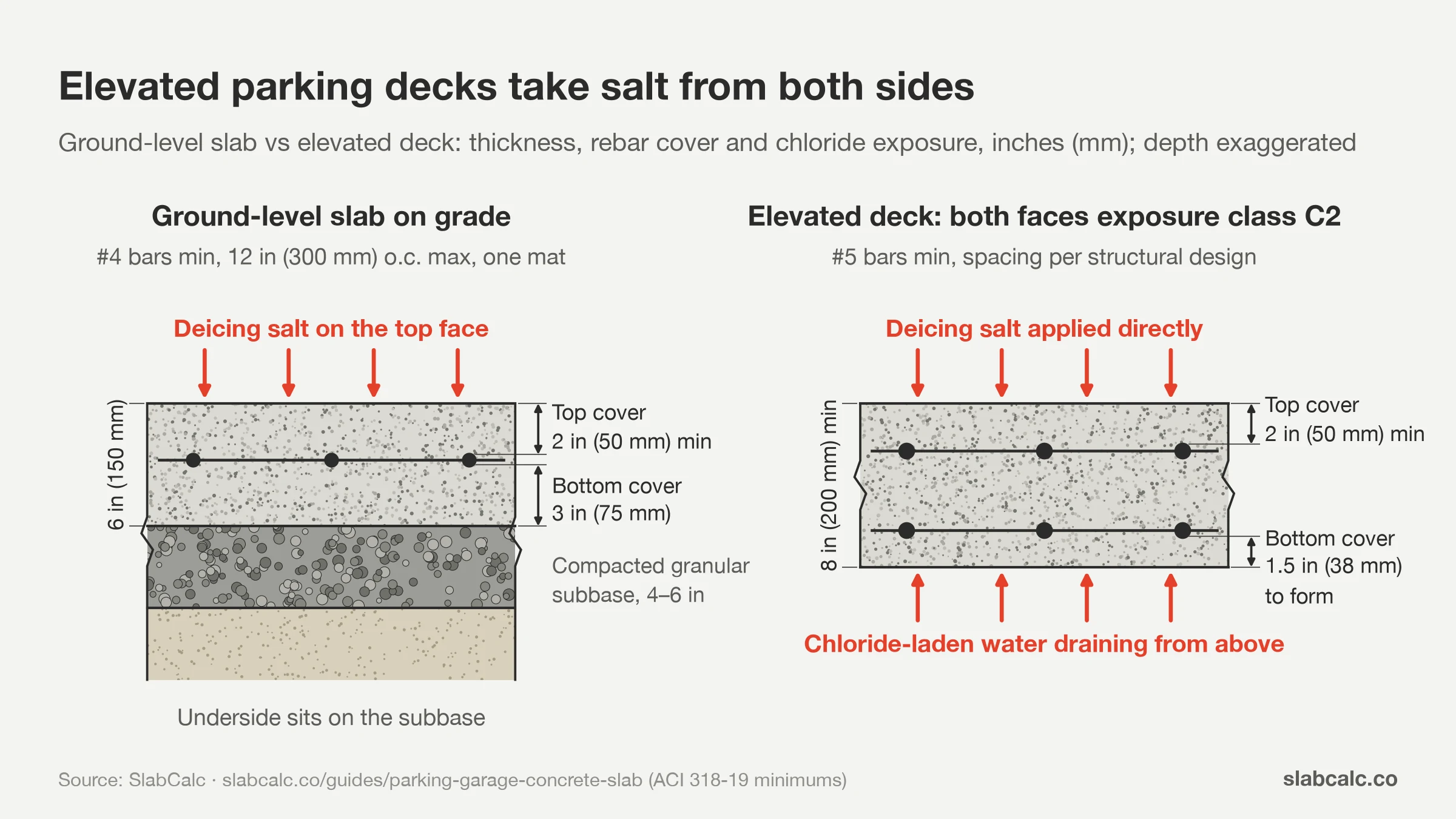
Waterproofing requirement: A traffic-bearing waterproof membrane system is standard on elevated decks. The concrete specification does not substitute for the membrane — both are required. Ground-level slabs rely on the concrete itself for moisture management.
→ Post-tensioned flat plate design: Post-Tensioned Parking Garage Slabs
→ Full comparison: Multi-Deck vs Ground Level Parking Slabs
Concrete Volume per Parking Space
Feasibility-level concrete volume estimation runs 0.7–1.2 m³ (0.9–1.6 yd³) of structural concrete per parking space for a ground-level slab, and 1.5–2.5 m³ (2.0–3.3 yd³) per space for a multi-level structure (including columns, beams, and ramps prorated per space). These ranges vary significantly by structural system, span layout, and whether the structure is above-grade or below-grade.
→ Volume estimation by garage type: Concrete Volume per Parking Space
Compressive Strength and Exposure Class
Table: Compressive Strength and Exposure Class Requirements (ACI 318)
| Exposure Class (ACI 318) | Conditions | Minimum f'c | Max w/c |
|---|---|---|---|
| F0 | No freeze-thaw exposure | 24 MPa (3,500 PSI) | — |
| F1 | Moderate freeze-thaw, no deicing chemicals | 28 MPa (4,000 PSI) | 0.45 |
| F2 | Freeze-thaw with deicing chemical exposure | 31 MPa (4,500 PSI) | 0.40 |
| C0 | No chloride exposure | No additional req. | — |
| C1 | Dry or protected, low chloride risk | 28 MPa (4,000 PSI) | 0.45 |
| C2 | Wet environment, deicing salts, or marine exposure | 35 MPa (5,000 PSI) | 0.40 |
Parking structures in northern climates are typically specified at F2/C2 — the most demanding combination. Specifying to F1/C1 for a parking structure that will receive deicing salt is a specification defect.
Air entrainment is mandatory for F1 and F2 exposure. Target: 5–7% for 19 mm (3/4 in) NMSA in F2 exposure. Air content reduces with increasing concrete strength, so air content verification at placement is essential.
→ Full exposure class treatment, w/c ratio mechanics, and SCM upgrade options: Concrete Strength for Parking Structures
Rebar and Reinforcement
Parking garage reinforcement serves two distinct functions: structural (carrying design loads) and corrosion protection (maintaining adequate cover over steel to delay chloride-induced corrosion).
Table: Reinforcement and Cover Requirements by Slab Type
| Parameter | Ground-Level | Elevated Deck |
|---|---|---|
| Minimum bar size | #4 | #5 (mild steel supplement to PT strands) |
| Maximum spacing | 300 mm (12 in) o.c. each way | Per structural design |
| Top cover (deicing salt exposure) | 50 mm (2 in) minimum | 50 mm (2 in) minimum |
| Bottom cover | 75 mm (3 in) | 38 mm (1.5 in) to form |
| Epoxy coating | Required in C2 exposure or per EOR | Required on elevated decks in deicing salt zones |
Cover note: ACI 318 Table 20.6.1.3.1 requires 50 mm (2 in) cover for #6 and smaller bars in slabs exposed to deicing chemicals. Many parking structure designers specify 60–75 mm (2.5–3 in) to provide additional service life margin.
Epoxy-coated rebar: Required in many parking structure specifications for top mat steel in deicing salt environments. ASTM A775 epoxy-coated bars or ASTM A1035 (MMFX) corrosion-resistant steel are common alternatives to standard black bar.
For reinforcement selection basis, see When to Use Rebar.
Underground Retaining Walls
Below-grade parking structures require reinforced concrete retaining walls sized for lateral earth pressure, surcharge loads, and hydrostatic pressure. Wall thickness typically ranges from 250 mm (10 in) for single-level structures to 400 mm+ (16 in+) for three or more below-grade levels. Waterproofing is a separate system from the structural wall — the concrete alone does not provide a reliable moisture barrier at depth.
→ Full wall sizing specification: Underground Parking Garage Wall Thickness
Control Joints
Freeze-thaw cycling and thermal loading in parking structures create more aggressive joint requirements than standard slabs.
Table: Control Joint Spacing by Slab Thickness
| Slab Thickness | Max Joint Spacing (ft) | Max Joint Spacing (m) | Sawcut Depth |
|---|---|---|---|
| 150 mm (6 in) | 15 ft | 4.5 m | 38 mm (1.5 in) minimum |
| 175 mm (7 in) | 17 ft | 5.2 m | 44 mm (1.75 in) minimum |
| 200 mm (8 in) | 20 ft | 6.0 m | 50 mm (2 in) minimum |
Sawcut timing: 4–12 hours after pour completion, depending on mix temperature, ambient temperature, and set rate. Delay beyond this window increases risk of uncontrolled intermediate cracking.
Joint sealant in parking structures must resist fuel, deicing chemicals, and thermal cycling. Polyurethane sealants (ASTM C920 Type M, Grade P, Class 25) are standard for vehicle-traffic joints.
→ Full control joint specification: Control Joints in Parking Garage Slabs
Repair and Maintenance
Parking garage concrete deteriorates through a predictable sequence: deicing salt infiltration → chloride threshold at rebar → corrosion initiation → expansive corrosion product → spalling → structural exposure. The rate depends on specification quality, joint maintenance, and surface coating.
Repair minimum patch thickness: 38 mm (1.5 in) for polymer-modified mortars per ACI 546R. Thin-section overlays below this threshold have poor bond durability under vehicle loading.
→ Patching specification, material selection, and facility management guidance: Parking Garage Concrete Repair
Preliminary Spec Calculator
Input your garage type, exposure class, and loading to generate a preliminary spec summary with ACI code references.
SlabCalc.co — Parking Garage Concrete Spec
Above-Grade Deck · F1/C1 — Moderate freeze-thaw, low chloride · Passenger Vehicles · Conventional RC · October 23, 2026
Volume per Space
2.81 yd³(midpoint estimate)
Slab Thickness
7.9–8.9 in
ACI 362.1R-12 §4.4
Min Compressive Strength (f'c)
4,500 PSI
ACI 318-19 Table 19.3.3
Max w/c Ratio
≤ 0.45
Air Entrainment Target
4.5%
Required (F1) · ACI 318-19 Table 19.3.3
Primary Reinforcement
#5 @ 12 in o.c.
Not required (C1 exposure) · ACI 318-19 §9.6.1
Concrete Cover
Top: 2 in / Bottom: 1.5 in
ACI 318-19 Table 20.6.1.3.1
Dead Load Range
100.2–125.3 psf
Values are minimums per ACI 318-19 / ACI 362.1R for preliminary estimation. Structural engineer of record governs final design.
Related Calculators
Use the Concrete Cost Calculator to estimate material and placement costs for new construction or resurfacing. For structural sizing of columns and foundations supporting elevated decks, the Concrete Foundation Calculator provides preliminary sizing reference.