

Concrete Steps and Porch Repair: Patching, Resurfacing and Replacement
Crumbling front steps are more than an eyesore--they're a safety hazard and a red flag for home inspectors. Concrete steps take a beating from foot traffic, freeze-thaw cycles, deicing salt, and constant exposure. The edges crumble first, then the tread surfaces deteriorate, and eventually the steps pull away from the house. The good news: most step damage can be repaired without full replacement if you catch it early enough.
Before you start, assess the full scope of damage. Patching a few crumbled edges is a $50-150 weekend project. Rebuilding steps that have settled away from the foundation is a $1,500-4,000 job. Use our concrete steps calculator to estimate material quantities if you're facing replacement.
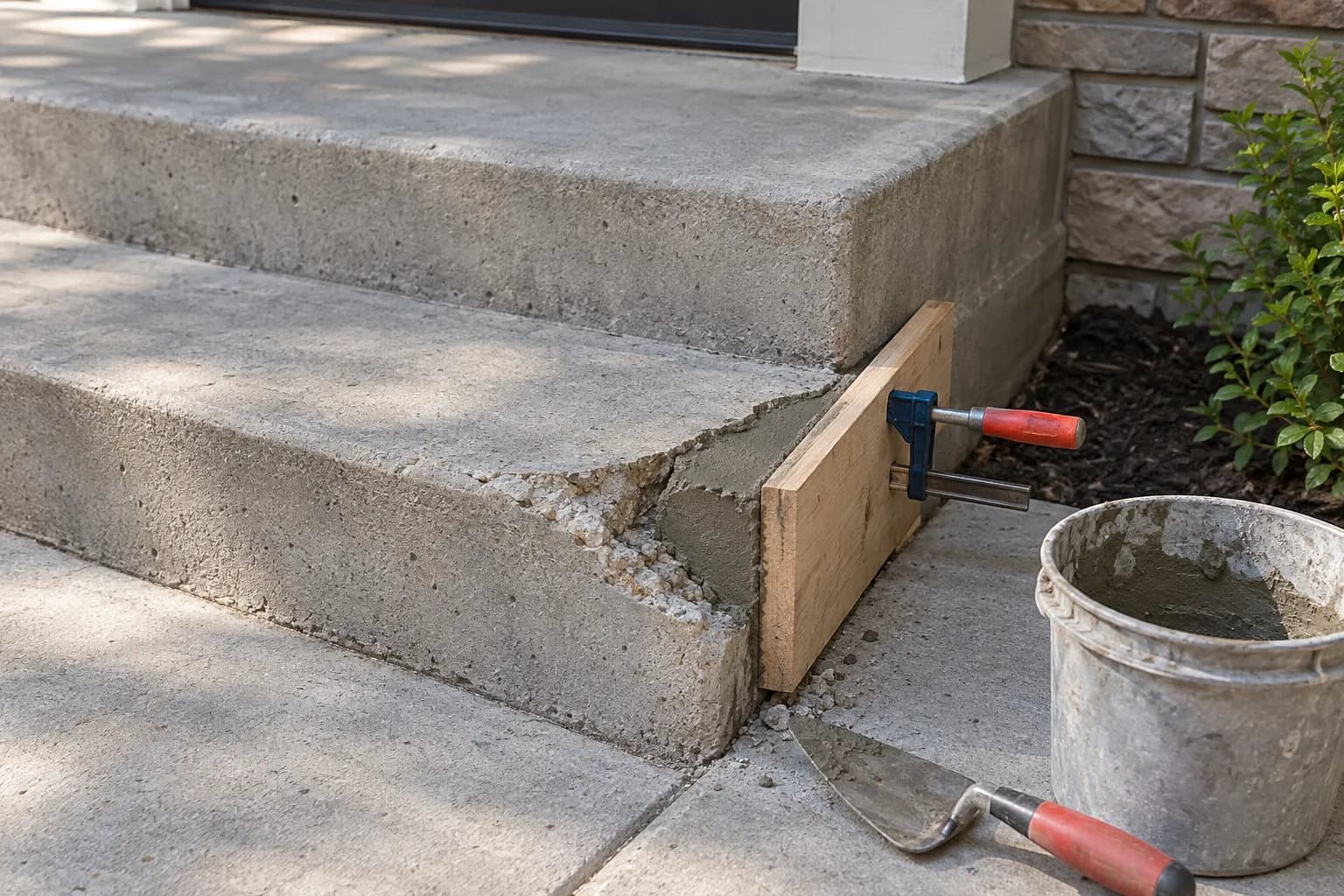
Assessing the Damage
Walk through a systematic inspection before choosing a repair method. What looks like simple surface damage sometimes indicates deeper problems.
Surface-Level Damage (Repairable)
- Crumbling edges (nosings): The front edge of each tread is the first to fail. Chips and crumbling on edges are the most common step repair.
- Surface scaling: The top layer flakes off, exposing aggregate. Common after salt use in winter.
- Small cracks: Hairline to 1/4-inch cracks in the tread or riser surface.
- Pitting: Small holes across the surface from freeze-thaw damage.
Structural Damage (May Need Replacement)
- Steps pulling away from the house: A visible gap between the steps and the foundation wall. This is settlement.
- Large cracks through the full step depth: Indicates structural failure, not surface wear.
- Rebar exposure or rust staining: Corroding reinforcement means the structural integrity is compromised.
- Heaving or tilting: The entire step structure has moved, creating uneven treads or a lean.
For a comprehensive evaluation method, see our damage assessment guide.
Edge and Corner Repair
The most common repair. Step edges crumble because they're the thinnest part of the step and take the most impact from foot traffic.
Materials
Use polymer-modified repair mortar (not standard Portland cement mortar). Polymer-modified products bond to existing concrete and resist cracking. Good products: Quikrete Vinyl Concrete Patcher, Sakrete Top 'N Bond, Sika Repair.
Do NOT use standard concrete mix for thin patching. It won't bond and will crack off within a year. Minimum application thickness for standard concrete is 2 inches--repair mortars can go as thin as 1/4 inch.
Step-by-Step Edge Repair
-
Remove loose material. Chisel off all crumbling concrete to reach solid material. Undercut the edge slightly (cut inward at the top so the patch has a ledge to grip).
-
Clean the area. Wire brush and vacuum all dust and debris. The bonding surface must be clean.
-
Dampen the concrete. Mist with water so the surface is damp but not standing wet. Dry concrete sucks moisture from the patch, causing poor bond.
-
Apply bonding agent (if the repair mortar requires it). Some products are self-bonding; others need a liquid bonding agent applied first.
-
Build a form for the edge. Use a straight board held against the riser, flush with the tread surface. Clamp or brace it in place. Without a form, the mortar slumps off the edge before it sets.
-
Apply the mortar. Press firmly into the repair area, slightly overfilling. Compact with a margin trowel to eliminate air voids.
-
Shape and finish. Match the existing tread texture (broom finish for traction). Round the nose edge slightly--sharp 90-degree edges are more prone to chipping.
-
Cure. Keep the repair damp for 24-48 hours. Cover with plastic or mist periodically. Don't walk on it for at least 24 hours.
Tips for Lasting Edge Repairs
- Temperature matters. Apply when temperatures are 50-80 degrees F. Cold weather prevents proper curing; hot weather causes rapid drying and cracking.
- Seal after curing. Apply a penetrating sealer 7 days after repair to protect the patch.
- Don't feather edges. Repair mortar thinner than 1/4 inch will crack and pop off. If the damage is shallow, chisel deeper to get a minimum 1/4-inch repair depth.
Full Step Resurfacing
When surface damage covers more than just the edges--the entire tread is pitted, scaled, or rough--resurfacing the full step provides a new surface over the existing structure.
When Resurfacing Works
- The step structure is solid and stable (no settlement, no structural cracks)
- Surface damage covers 25-75% of the tread area
- Edges can be rebuilt as part of the resurfacing process
Resurfacing Process
- Remove all loose material by chipping and grinding
- Clean thoroughly with a pressure washer (3,000+ PSI)
- Build forms for any edges that need rebuilding
- Apply bonding primer to the entire surface
- Apply polymer-modified resurfacing product at 1/4 to 1/2 inch thickness across the full tread and riser
- Finish with a broom texture for traction
- Cure for 24-48 hours under plastic
For detailed resurfacing guidance, our resurfacing and overlay guide covers product selection and technique. For surface failure diagnosis, see our guide on spalling and scaling repair.
Cost: $200-500 in materials for a standard 3-4 step entry (DIY). Professional resurfacing runs $500-1,500.
When to Replace Instead of Repair
Repair makes sense when the structure is sound and damage is surface-level. Replacement is the better investment when:
- Steps have settled or pulled away from the house (gap between steps and foundation wall)
- More than 30% of the surface area is damaged (repair cost approaches replacement cost)
- Structural cracks extend through the full step depth
- Rebar is exposed and corroding (patching over corroding rebar is temporary at best)
- Steps are more than 30 years old with multiple previous patches (diminishing returns)
Replacement Cost
| Component | DIY Cost | Professional |
|---|---|---|
| Demolition and removal | $100-300 | $200-500 |
| New footing (if needed) | $100-250 | $300-600 |
| Forms and reinforcement | $100-200 | Included |
| Concrete (typically 0.5-1.5 cu yd) | $150-400 | $300-600 |
| Finishing | Your time | $200-500 |
| Total (3-4 step entry) | $450-1,150 | $1,500-4,000 |
Steps replacement is a moderately challenging DIY project. The forms are complex (each step is a different height) and the pour requires good finishing timing. If you're comfortable with concrete work, it's doable. If it's your first project, consider having a contractor handle it.
Preventing Future Damage
After repair or replacement:
- Seal with a penetrating sealer. Apply after the concrete has cured (28 days for new, 7 days for repairs). Reapply every 3-5 years.
- Avoid deicing salt on new concrete. Use sand for traction during the first two winters. After that, use calcium magnesium acetate (CMA) instead of rock salt if possible.
- Maintain drainage. Ensure water flows away from the steps, not pooling at the base. Clear gutters and downspouts near the entry.
- Repair small chips early. A $10 tube of concrete repair caulk on a small chip prevents a $200 edge rebuild later.
Key Takeaways
- Crumbling edges are the most common step repair--use polymer-modified repair mortar, not standard concrete
- Never apply patches thinner than 1/4 inch--they'll crack off within a year
- Resurfacing ($200-500 DIY) works when the structure is sound but the surface is widely damaged
- Replace when steps have settled, have structural cracks, or more than 30% of surface is damaged
- Full replacement costs $450-1,150 DIY or $1,500-4,000 professional for a standard entry
- Seal steps after repair to prevent the same damage from recurring
For more project guidance, browse our complete library of concrete guides and tutorials.