

4-Inch vs 5-Inch vs 6-Inch Concrete Slab: Thickness Guide
Use 4 inches for patios and walkways, 5 inches for most residential driveways and workshop garage floors, and 6 inches for heavy vehicles, RV pads, or commercial use. The 5-inch option is the right call for the majority of homeowners but gets skipped in most guides. This article covers all three thicknesses with real cost numbers so you can make the right call before you pour. See [how thick should concrete be](/guides/how-thick-should-concrete-be) for a broader framework.
Quick Comparison
| 4 Inch | 5 Inch | 6 Inch | |
|---|---|---|---|
| Typical applications | Patios, walkways, sidewalks, shed pads | Residential driveways, garage floors, pool surrounds | RV pads, heavy truck areas, commercial driveways, loading areas |
| Cost vs 4" baseline (per 100 sqft) | - | ~+$45 | ~+$95 |
| Typical PSI spec | 3,000 PSI | 3,000-4,000 PSI | 4,000 PSI |
| Rebar | Optional | Recommended | Required |
| Max vehicle weight suited for | Foot traffic, bikes, wheelbarrows | Passenger cars, SUVs, light trucks (up to ~10,000 lbs) | Heavy trucks, RVs, equipment (10,000+ lbs) |
| Common code use | Patios, sidewalks | Residential driveways | Commercial, RV storage |
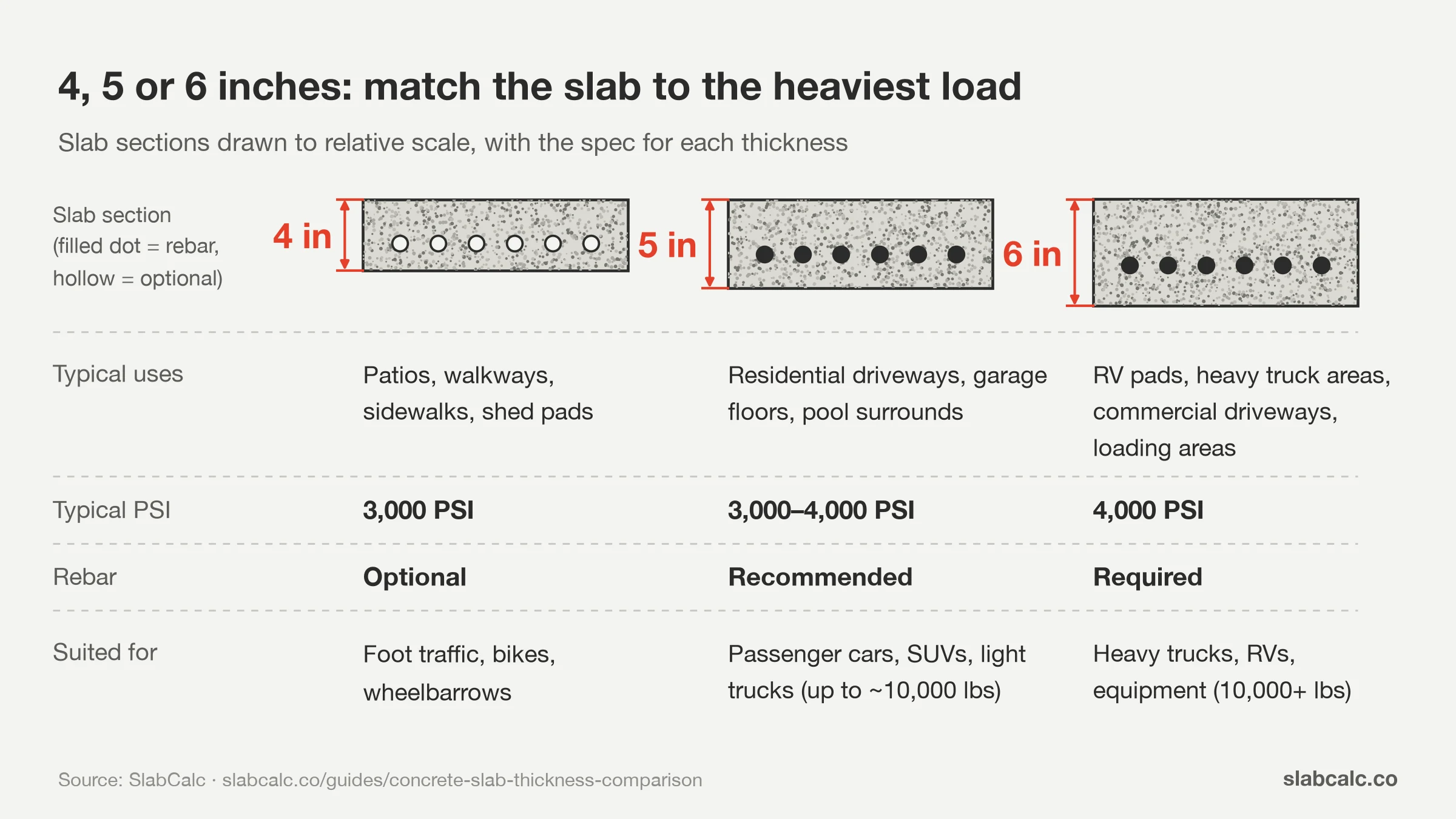
Bottom line: Most residential driveways should be 5 inches. Most patios should be 4 inches. Reserve 6 inches for genuinely heavy loads.
Is 4 Inches of Concrete Enough?
For foot traffic and parked cars, yes. For a working driveway, usually not. A 4-inch slab is the standard residential pour for patios, walkways, shed pads, and garage floors, and it clears the IRC R506.1 floor-slab minimum of 3.5 inches. Where it falls short is repeated wheel loads: a 4-inch driveway flexes under daily traffic, and flexing is what starts edge and corner cracks.
Two things to check before accepting a "4-inch" quote:
- Is it really 4 inches? A slab formed with 2x4 lumber is 3.5 inches thick, the bare code minimum. A true 4-inch slab needs the subgrade finished 4 inches below the form top: use 2x6 forms, or dig the grade half an inch below the bottom edge of 2x4 forms.
- What crosses it? Bending strength scales with thickness squared, so going from 4 to 5 inches adds about 56% capacity and 4 to 6 inches adds about 125%, for 25% and 50% more concrete.
Concrete Slab Thickness Chart by Project
| Project | 4" | 5" | 6" |
|---|---|---|---|
| Patio | correct | overkill | overkill |
| Sidewalk | correct | overkill | overkill |
| Pool surround | correct | fine | overkill |
| Shed slab | correct | fine | overkill |
| Residential driveway | too thin | correct | fine |
| Garage floor (parking only) | correct | better | fine |
| Workshop floor | too thin | correct | fine |
| Commercial driveway | too thin | too thin | correct |
| RV pad | too thin | too thin | correct |
| Loading dock | too thin | too thin | correct |
Residential Slab Thickness: Code Minimum vs Standard Practice
| Slab | Code Minimum | Standard Pour | Upgrade When |
|---|---|---|---|
| House floor slab (slab-on-grade) | 3.5 in (IRC R506.1) | 4 in | Point loads, thickened under bearing walls |
| Garage floor | 3.5 in (IRC R506.1) | 4 in | 5-6 in for workshops, 6 in+ for car lifts |
| Driveway | Set by local code, commonly 4 in | 5 in | 6 in for RVs, boats, loaded work trucks |
| Patio | None for most patios | 4 in | 5 in if a vehicle could ever drive on it |
| Sidewalk / walkway | Local code, commonly 4 in | 4 in | 6 in where it crosses a driveway apron |
For garage-specific loads see the garage floor thickness guide; for driveways, the driveway thickness guide maps vehicle weight to thickness.
4 Inches: When It's Right
4-inch slabs handle everything where loads are light and traffic is on foot. Patios, sidewalks, walkways, garden paths, and shed pads all fall here.
Where people go wrong: Pouring a driveway at 4 inches because it meets local code minimums. Code is the legal floor, not a recommendation. A 4-inch driveway under daily vehicle traffic will show edge cracks within 5-10 years and need replacement within 15. The 4 vs 6 inch guide covers this failure pattern in detail.
On garage floors, 4 inches is the standard pour for basic car parking on a well-compacted subgrade. Workshop use, jack stands, heavy pickups, or equipment push you into 5-inch territory, and a car lift needs 6 inches or more.
Where it's fine: Any slab that will never see a vehicle. Foot traffic exerts negligible stress on concrete. A well-prepared 4-inch patio will outlast the homeowner.
5 Inches: The Underused Middle Option
This is the spec that most residential driveways should use, and it gets surprisingly little attention.
Here's the situation: when a homeowner asks a contractor for a driveway, the quote often comes back as either 4 inches (low bid) or 6 inches (upsell). The 4-inch bid is cutting corners. The 6-inch bid adds cost that most residential jobs don't need. 5 inches is the correct answer for a standard driveway with passenger cars, SUVs, and light trucks.
Why 5 inches specifically? A car or SUV weighs 3,000-5,000 lbs. That load distributes across four tire contact patches, each about the size of your hand. 5-inch concrete has enough section depth to distribute that point load without flexing. 4 inches flexes - and flexing is what creates cracks. 6 inches handles much heavier loads, but you're paying for capacity you'll never use.
See the driveway thickness guide for more detail on how vehicle weight maps to thickness requirements.
Rebar in a 5-inch slab: Recommended, not optional. Use rebar or wire mesh for any slab that will carry vehicles. The when to use rebar guide covers placement and spacing.
PSI spec for a 5-inch driveway: 4,000 PSI. At that compressive strength, the concrete itself won't be the weak point - the subgrade preparation and rebar placement matter more.
Form boards: use 2x6 lumber (actual dimension 5.5 inches) for a 5-inch slab. Set them carefully and check with a level. Contractors skipping to 2x4 forms (3.5 inches) are the main source of undersized residential driveways.
6 Inches: When It's Genuinely Needed
6 inches is the right call when:
- RVs or boat trailers park regularly. Class A motorhomes run 30,000-40,000 lbs, well past the roughly 10,000 lbs a 5-inch slab is suited for, so pour 6 inches.
- Heavy pickup trucks or work vehicles with loaded beds or trailer hitches use the area frequently. A fully loaded F-350 with a gooseneck trailer can exceed 20,000 lbs.
- Commercial driveways with delivery vehicles.
- Loading docks or equipment pads where forklifts or heavy machinery operate.
- Workshop floors where a hydraulic car lift will be installed (point loads from lift pads require 6+ inches).
When 6 inches is overkill: Most residential driveways. If you park passenger cars and the occasional rental truck, 5 inches does the job and costs less. The durability difference between 5 and 6 inches for typical residential vehicle loads is marginal - both will last 25+ years on a well-prepared subgrade.
Cost Difference: Real Numbers
These figures use $150/cubic yard for ready-mix, which is a reasonable baseline for many US markets. Your local rate may vary.
20x20 Slab (400 sqft) - Example Driveway
| Thickness | Concrete volume | Material cost | vs 4" baseline |
|---|---|---|---|
| 4" | 4.94 yd3 | ~$741 | - |
| 5" | 6.17 yd3 | ~$926 | +$185 |
| 6" | 7.41 yd3 | ~$1,111 | +$370 |
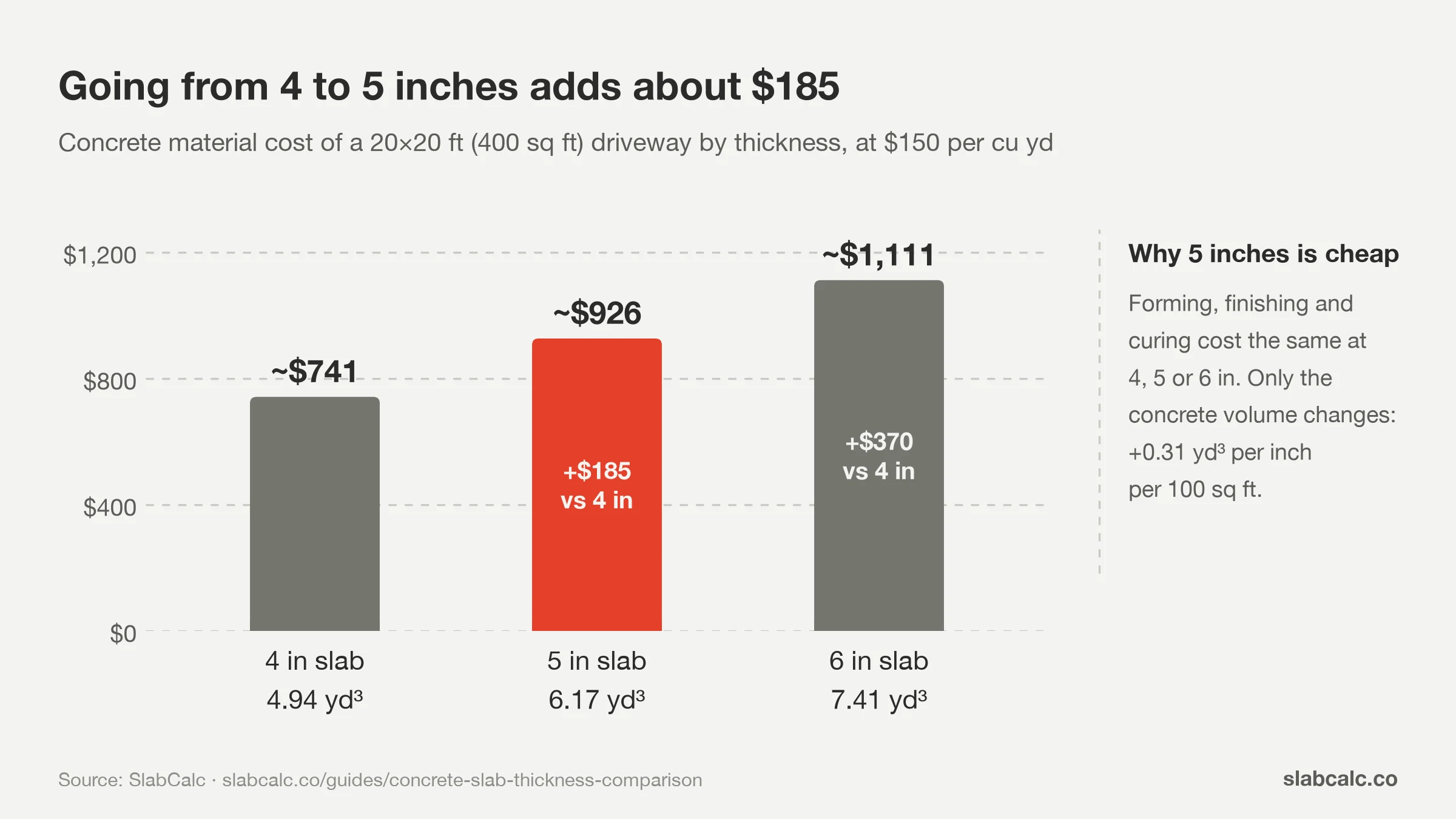
Going from 4" to 5" on this size slab adds about $185 in concrete material. Going from 4" to 6" adds about $370.
The Per-Yard Math
Every inch of thickness on a 100-sqft slab equals roughly 0.31 cubic yards of concrete. So:
- 4" to 5": +0.31 yd3 per 100 sqft, roughly +$46 at $150/yd
- 4" to 6": +0.62 yd3 per 100 sqft, roughly +$93 at $150/yd
Use the concrete slab calculator to get exact volumes for your dimensions at each thickness.
Standard Concrete Slab Sizes: Cubic Yards at 4, 5, and 6 Inches
Volumes below are exact geometry (length x width x thickness / 27); order about 10% extra for waste and subgrade variation.
| Slab Size | Area | 4 in | 5 in | 6 in |
|---|---|---|---|---|
| 10 x 10 ft | 100 sq ft | 1.23 yd3 | 1.54 yd3 | 1.85 yd3 |
| 10 x 12 ft | 120 sq ft | 1.48 yd3 | 1.85 yd3 | 2.22 yd3 |
| 12 x 12 ft | 144 sq ft | 1.78 yd3 | 2.22 yd3 | 2.67 yd3 |
| 10 x 20 ft | 200 sq ft | 2.47 yd3 | 3.09 yd3 | 3.70 yd3 |
| 20 x 20 ft (2-car pad) | 400 sq ft | 4.94 yd3 | 6.17 yd3 | 7.41 yd3 |
| 24 x 24 ft (2-car garage) | 576 sq ft | 7.11 yd3 | 8.89 yd3 | 10.67 yd3 |
| 30 x 30 ft | 900 sq ft | 11.11 yd3 | 13.89 yd3 | 16.67 yd3 |
Labor Cost is the Same
Forming, finishing, and curing cost the same at 4", 5", or 6". The only variable is concrete volume. That makes the upgrade from 4" to 5" one of the cheapest durability improvements available on any concrete project.
Key Takeaways
- 4 inches is correct for patios, sidewalks, walkways, parking-only garage floors, and any slab with foot traffic only; the IRC floor-slab minimum is 3.5 inches
- 5 inches is the right spec for most residential driveways and workshop garage floors - it's under-specified in practice
- 6 inches is for heavy vehicles, RV pads, commercial use, and equipment lifts
- Going from 4" to 5" costs roughly $185 in material on a 20x20 driveway - a small price for significantly longer service life
- Code minimums and contractor defaults often land at 4" for driveways; push back on this
- Rebar is recommended at 5" and required at 6" for any vehicle-loaded slab
- Subgrade preparation affects performance at every thickness - a poorly compacted base will cause problems regardless of how thick you pour
Next Steps
- Calculate exact concrete volume: Concrete Slab Calculator
- Driveway-specific estimates: Concrete Driveway Calculator
- Full driveway thickness guidance: Driveway Thickness Guide
- Rebar requirements: When to Use Rebar
- Full thickness decision framework: How Thick Should Concrete Be
- 4" vs 6" in depth: 4 Inch vs 6 Inch Concrete
- All guides: Concrete Guides