

New Concrete Cracking: What's Normal vs. What's a Problem
Your new concrete has cracks and you're wondering if something went wrong. Here's the reality: all concrete cracks. The question isn't whether your concrete will crack—it's whether those cracks are cosmetic (normal) or structural (a problem). This guide gives you a timeline-based assessment so you can tell the difference.
The short answer: hairline cracks under 1/16 inch that appear within the first month are almost always normal shrinkage. Cracks wider than 1/4 inch, cracks with one side higher than the other, or cracks that keep growing signal a real problem. Everything in between depends on when the cracks appeared, how they look, and whether they're changing. If you're planning a new pour and want to get quantities right from the start, use our concrete calculator to avoid ordering issues that lead to cold joints and cracking.
When Cracks Appear Tells You What They Mean
Timing is your best diagnostic tool. The same crack that's perfectly normal at four weeks would be a red flag at four hours. Here's what to expect at each stage.
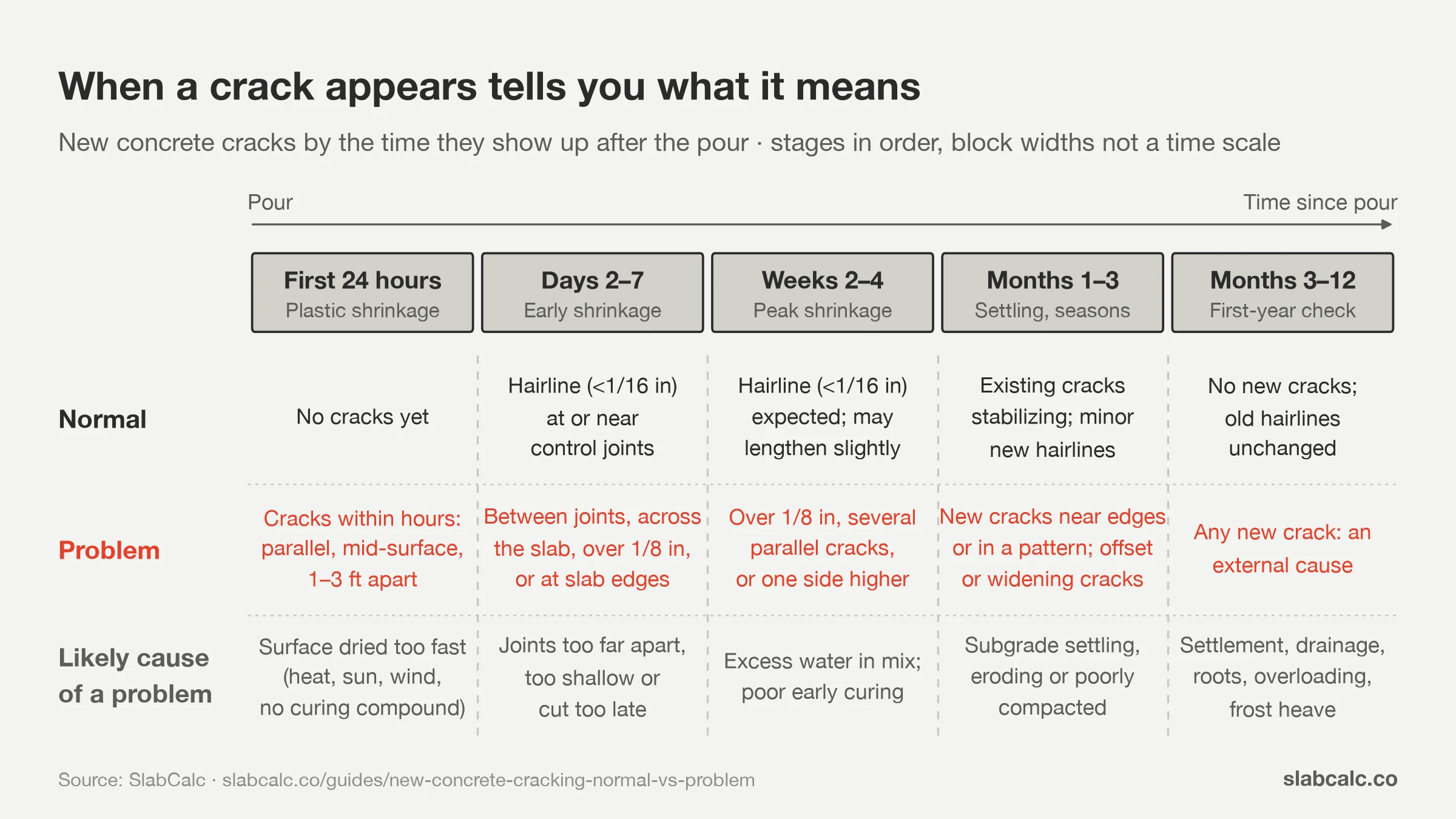
First 24 Hours: Plastic Shrinkage Cracks
Normal: No cracks yet. Concrete is still curing and gaining strength.
Problem: Cracks appearing within hours of the pour--especially mid-surface, running parallel to each other, roughly 1-3 feet apart. These are plastic shrinkage cracks caused by the surface drying faster than the interior.
What went wrong: The concrete lost moisture too fast. Hot weather, direct sun, wind, or failure to apply curing compound immediately after finishing. If the crew poured in these conditions without protection, that's a workmanship issue. Rain can also cause problems during this window--see our guide on rain on fresh concrete.
Severity: Plastic shrinkage cracks are typically shallow (top 1-2 inches) and don't compromise structural integrity. But they look bad and can widen over time.
Days 2-7: Early Shrinkage Cracks
Normal: Fine hairline cracks (under 1/16 inch) appearing at or near control joints. This is the concrete shrinking as it cures and cracking where it's supposed to--at the joints.
Problem: Cracks appearing between control joints, especially if they run across the full width of the slab. Also concerning: cracks wider than 1/8 inch this early, or cracks at the slab edges.
What went wrong: Control joints may be spaced too far apart, cut too shallow, or cut too late. Joints should be cut within 6-18 hours of pouring and spaced at 2-3 times the slab thickness in inches, expressed in feet (8-12 feet for a 4-inch slab). Understanding why concrete cracks helps you evaluate whether the contractor followed proper practices.
Severity: Moderate. Mid-panel cracks that form this early usually indicate a joint layout problem. They're not structural, but they shouldn't have happened.
Weeks 2-4: Peak Shrinkage Period
Normal: This is when most shrinkage cracks appear. Hairline cracks under 1/16 inch are expected, even on well-placed concrete. Cracks at control joints may become visible. Existing cracks may lengthen slightly.
Problem: Cracks wider than 1/8 inch. Multiple parallel cracks suggesting the slab is under stress. Any crack showing displacement (one side higher than the other).
What went wrong: Excessive water in the mix is the most common cause of heavy shrinkage cracking. Every gallon of extra water per cubic yard increases shrinkage significantly. Proper curing practices also matter--concrete that dried out in the first week will crack more.
Severity: Width is the key. Hairline cracks at this stage are cosmetic. Anything over 1/8 inch deserves monitoring; over 1/4 inch deserves a call to your contractor.
Months 1-3: Settling and Seasonal Movement
Normal: Existing cracks stabilizing. Minor new hairline cracks may still appear as curing continues (concrete reaches about 90% strength at 28 days but continues curing for months).
Problem: New cracks appearing that weren't there at 30 days, especially if they're near edges or follow a pattern (all running the same direction). Cracks with vertical displacement. Existing cracks widening.
What went wrong: These cracks usually indicate subgrade issues--the soil beneath the slab is settling, eroding, or wasn't properly compacted. Depending on your region, the first seasonal temperature swing can also reveal weaknesses.
Severity: Settlement cracks are more serious than shrinkage cracks because they indicate an ongoing problem. The soil won't stop settling just because you ignore it.
Months 3-12: First Year Assessment
Normal: No new cracks. Existing hairline cracks unchanged or slightly tighter (concrete continues to hydrate and gain micro-strength).
Problem: New cracks appearing after 3 months almost always indicate external causes: settlement, drainage problems, tree roots, overloading (parking something too heavy on a 4-inch slab), or frost heave during the first winter.
What went wrong: These are rarely workmanship issues from the pour itself. They point to site conditions, subgrade preparation, or design problems (slab too thin for the load). For a thorough evaluation, refer to our concrete damage assessment guide.
Severity: Depends entirely on the cause. Freeze-thaw cracks in the first winter can be minor. Settlement cracks with displacement are serious and progressive.
Normal Cracks vs. Problem Cracks: Quick Reference
| Feature | Normal (Cosmetic) | Problem (Structural) |
|---|---|---|
| Width | Under 1/16 inch | Over 1/4 inch |
| Displacement | Both sides level | One side higher |
| Growth | Stable after 30-60 days | Getting wider or longer |
| Location | At or near control joints | Mid-panel, random |
| Pattern | Isolated, random | Parallel or radiating |
| Depth | Surface (1-2 inches) | Through the full slab |
Cracks between 1/16 inch and 1/4 inch fall in a gray zone. Monitor them monthly with dated photos. If they stay stable for 3-6 months, they're cosmetic. If they grow, investigate.
What to Do About Each Type
Hairline Cracks (Under 1/16 Inch)
Action: Nothing required. These are cosmetic and don't affect performance. You can seal them with a concrete crack sealer if they bother you visually, but it's optional.
Small Cracks (1/16 to 1/4 Inch)
Action: Seal with polyurethane caulk or self-leveling sealant to prevent water infiltration. This is especially important in freeze-thaw climates where water entering the crack will cause damage over winter. See our full crack repair guide for product recommendations and step-by-step instructions.
Medium to Large Cracks (Over 1/4 Inch)
Action: Document and investigate before repairing. These cracks need a cause diagnosis. If they're stable shrinkage cracks (unlikely at this width), fill with polyurethane caulk over a backer rod. If they're growing or show displacement, get a professional assessment.
Cracks with Displacement
Action: Do not attempt cosmetic repair. One side being higher than the other means the slab is moving, and filling the crack only hides the problem. You need a professional to evaluate the subgrade and determine if mudjacking, polylifting, or replacement is needed.
Contractor Accountability: When to Call and What to Say
Document First
Before calling anyone, build your evidence:
- Dated photos. Take close-up photos of every crack with a ruler or coin for scale. Photograph the same cracks weekly to show progression (or stability).
- Measurements. Record crack widths, lengths, and any displacement.
- Timeline. Note when you first noticed each crack and how it's changed.
- Weather records. If cracks appeared early, look up the weather on pour day and the following week. Extreme heat, wind, or rain supports a workmanship claim.
When Your Contractor Is Responsible
Your contractor should address cracks caused by:
- Improper joint layout (joints too far apart, too shallow, or cut too late)
- Adding excess water to the mix on-site
- Failure to apply curing compound or protect from rapid drying
- Inadequate subgrade preparation (no gravel base, poor compaction)
- Wrong concrete mix for the application
- Pouring in unsuitable conditions without precautions
Good contractors know that proper form building and site preparation prevent most of these issues. If your contractor cut corners on the basics, the cracks are on them.
When It's Not the Contractor's Fault
Don't blame the contractor for:
- Normal hairline shrinkage cracks (under 1/16 inch)
- Cracks at control joints (that's where they're supposed to go)
- Damage from overloading the slab beyond its design capacity
- Settlement caused by plumbing leaks, drainage changes, or tree root growth after the pour
- Freeze-thaw damage on unsealed concrete after the first year
When to Demand Tear-Out and Replacement
Tear-out is the nuclear option, and it's justified when:
- Cracks wider than 1/2 inch appear within the first 30 days across multiple areas
- Significant displacement (over 1/4 inch vertical difference) develops within 6 months
- The slab fails to meet specified thickness (contractor poured 3 inches instead of 4)
- Testing reveals the concrete didn't reach design strength (typically 3,000-4,000 PSI for residential)
- More than 25-30% of the slab surface shows cracking beyond normal shrinkage
Most states require concrete contractors to warranty their work for 1-2 years. Check your contract and local regulations.
Plan Your Next Pour Right
Cracking problems often start before the concrete truck arrives. Ordering the right amount prevents cold joints from partial pours. Specifying the correct thickness prevents overload cracking. Getting the subgrade right prevents settlement.
Use our concrete calculator to get accurate quantities for your project. For complete project planning--from subgrade prep to curing--browse our concrete guides.
Key Takeaways
- Hairline cracks under 1/16 inch appearing within the first month are normal shrinkage--no action needed
- Timing matters: cracks within hours suggest workmanship problems; cracks after 3 months suggest site or subgrade issues
- Width is the key metric: under 1/16 inch is cosmetic, 1/16 to 1/4 inch needs sealing, over 1/4 inch needs investigation
- Displacement (one side higher) always signals a real problem--don't just fill the crack
- Document everything with dated photos and measurements before contacting your contractor
Not sure if your crack is normal? Upload a photo to the AI crack analyzer for a free severity rating and failure mode classification. Browse all crack type identification guides for detailed visual references.