

How to Patch Small Holes and Chips in Concrete
Small holes, chips, and surface pitting in concrete are common — and fixable in an afternoon without professional help. The key is using the right patching material, properly preparing the damaged area, and following the curing steps. This guide covers the complete process for DIY concrete patching.
To patch a hole or chip in concrete, chisel out all loose material to solid concrete with square edges, vacuum the hole clean, and mist it damp. Then press in vinyl concrete patcher at least 1/4 inch thick, strike it flush, and keep it covered for 24–72 hours. Most patches are walkable in 24 hours and can be sealed after 28 days. The whole job takes an afternoon and costs one or two bags of patcher. Linear cracks and widespread scaling need different repairs, covered below.
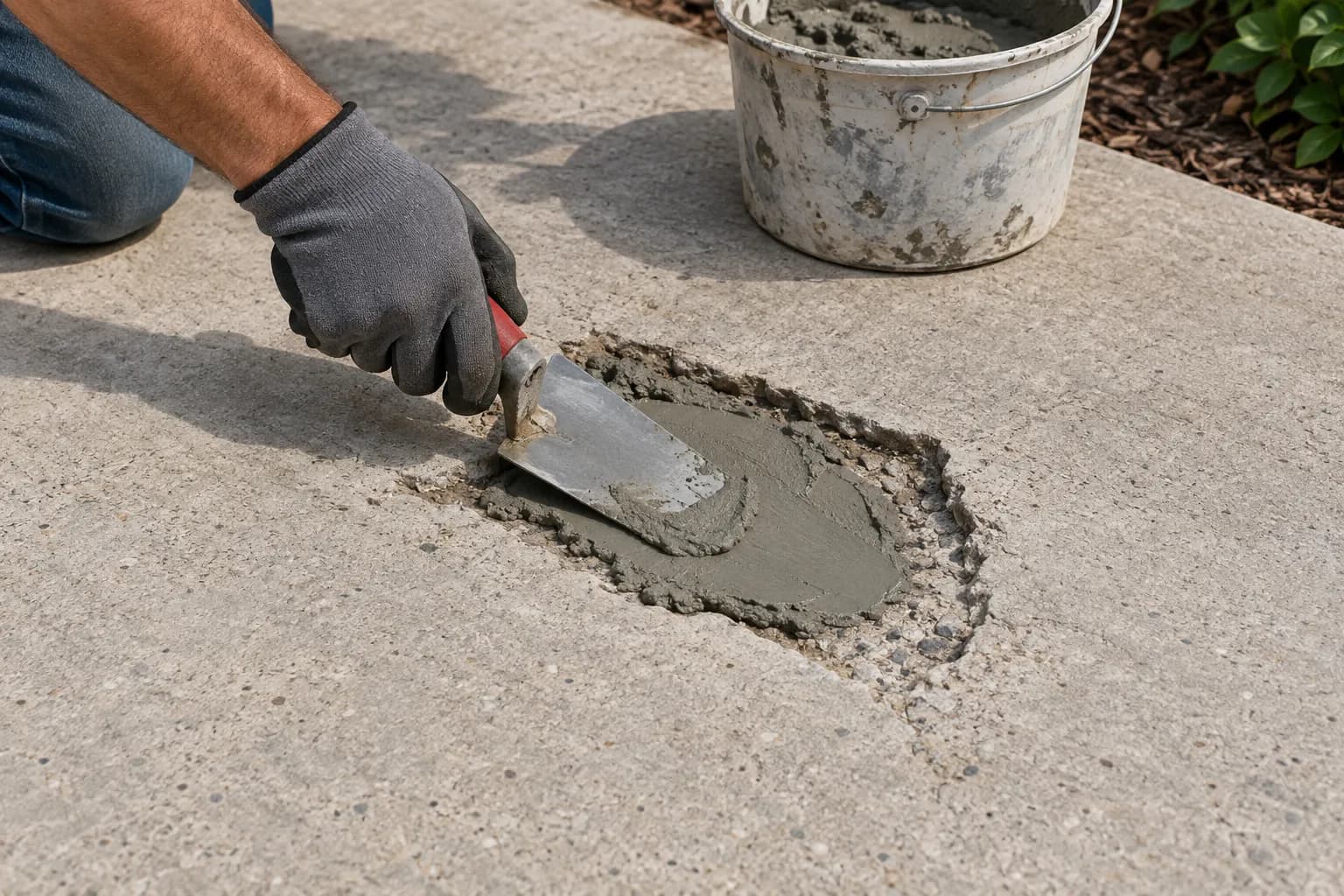
Patching vs. Crack Repair — What's the Difference?
Patching applies to:
- Spalled or chipped surface areas (chunks missing, surface pitting)
- Small holes (from bolts, anchors, or freeze damage)
- Pop-outs where aggregate pulled from the surface
Crack repair is different — it involves filling linear cracks, which may still be moving. A patch won't hold across an active crack. For cracks, see how to repair cracks in concrete.
For widespread surface scaling or spalling over large areas, read concrete spalling and scaling repair — that's a different scope of work.
Choosing the Right Patching Material
| Material | Best For | Notes |
|---|---|---|
| Vinyl concrete patcher | Most small holes and chips | Best all-around choice; bonds well |
| Hydraulic cement | Wet areas, leaking cracks | Sets in seconds; stops water flow |
| Polymer-modified mortar | Larger areas, structural patches | Stronger bond; more expensive |
| Epoxy patching compound | High-traffic areas, garage floors | Very strong; harder to work |
| Sand mix (bagged) | Patches thicker than 1.5 inches | Don't use for thin surface repairs |
For most homeowners patching a driveway chip or a patio hole, vinyl concrete patcher is the right call. It's available at any hardware store, mixes easily, and feathers to thin edges.
For exterior or load-bearing repairs, look for a bag labeled as meeting ASTM C928, the standard for rapid-hardening cementitious repair materials. ACI 546R, the concrete repair guide, and ICRI 310.2R, which defines surface roughness profiles, both stress that bond depends on a rough, clean, sound substrate. That is why the prep steps below matter more than the product you pick.
How Much Patching Material You Need
Patch volume is area × depth. A 40-lb bag of sanded patching mortar yields roughly 0.3 cubic feet (check the yield line on your bag, since products vary):
| Patch Depth | Area Covered per 0.3 cu ft Bag |
|---|---|
| 1/4 inch | ~14 sq ft |
| 1/2 inch | ~7 sq ft |
| 1 inch | ~3.5 sq ft |
| 2 inches | ~1.8 sq ft |
A 6×6-inch hole, 1 inch deep, uses only 0.02 cubic feet, so one bag handles dozens of small chips. Buy one extra bag for shaping and waste on larger repairs.
Patch, Resurface, or Replace?
Patching fixes isolated damage. It is the wrong repair when the slab itself has failed. Use these rules of thumb:
| What You See | Right Repair |
|---|---|
| Isolated holes, chips, pop-outs under ~2 in deep | Patch (this guide) |
| Linear cracks, especially ones that are still moving | Crack repair |
| Scaling or pitting over a large share of an otherwise sound slab | Resurfacing overlay |
| Exposed or rusting rebar, deep spalls | Partial-depth repair per ACI 546R (often a contractor job) |
| Sunken, heaved, or broken-through slab sections | Removal and replacement |
If the damage keeps coming back in the same spot, look for the cause first: drainage, deicing salts, or freeze-thaw exposure. See concrete spalling and scaling repair.
What You Need
- Vinyl concrete patcher or patching product of choice
- Cold chisel and hammer (or angle grinder with diamond blade)
- Wire brush or stiff broom
- Shop vacuum or leaf blower
- Water (hose with mist setting, or spray bottle)
- Margin trowel and putty knife
- Plastic sheeting for curing
Step-by-Step Patching Process
Step 1: Define the Repair Area
Use a cold chisel and hammer to chip away all loose, crumbling, or delaminated concrete around the damaged area. Don't patch over loose material — it will pop off and take your repair with it.
The goal is to get down to solid, firm concrete. The edges of the repair area should be as vertical as possible (not tapered), which gives the patch more surface area to grip.
If using a grinder, cut a 1/4-inch deep perimeter cut around the repair area. This creates a clean, square edge that holds the patch better than a feathered edge on the existing concrete.
Step 2: Clean Thoroughly
Remove all dust, loose particles, and debris. A shop vacuum works best. For outdoor repairs, a leaf blower works too. The patching material needs clean concrete to bond to — any dust or debris acts like a bond breaker.
Step 3: Dampen (Don't Saturate) the Area
Mist the repair area with water until the concrete is evenly damp. This prevents the dry concrete from pulling moisture out of your fresh patch before it can bond. The surface should look dark and damp, but no standing water — if you see water pooling, wait a few minutes and try again.
Step 4: Mix the Patching Material
Follow the bag instructions for water ratio. Mix to a stiff, dough-like consistency — similar to peanut butter. A patch that's too wet will shrink, crack, and separate.
Step 5: Apply the Patch
Press the patching material firmly into the hole using a margin trowel, working it into all corners and edges. Apply in layers if the hole is deeper than 1 inch — let each layer firm up for 15–20 minutes before adding the next.
For the final layer, slightly overfill the hole. Then use your trowel to strike off the excess, working from the surrounding concrete surface inward. The goal is a patch that's flush with or very slightly proud of the surrounding concrete.
Feathering edges: Vinyl concrete patcher is formulated to feather to thin edges (as thin as 1/8 inch). Use a trowel or putty knife to blend the edges smoothly into the surrounding concrete.
Step 6: Texture the Surface
If the surrounding concrete has a broom finish, drag a broom lightly across the fresh patch to match the texture. A smooth trowel finish on a broom-finished surface will look out of place and may be slippery when wet.
Step 7: Cure the Patch
Cover the repair with plastic sheeting immediately after finishing. This keeps moisture in and prevents the patch from drying too fast (which causes shrinkage cracks). Keep it covered for at least 24 hours; 3 days is better.
Don't let the patch dry in direct sun or hot, dry wind without covering — rapid moisture loss is the #1 cause of patch failure.
Common Patching Mistakes
Using regular bagged concrete mix. Standard concrete mix needs at least 2 inches of thickness to cure properly. It also doesn't bond well to existing concrete without a bonding agent. Always use a purpose-made patching product.
Skipping surface prep. This is the most common failure. Even if the surface looks fine, loose particles will prevent bonding. Always chisel, wire-brush, and vacuum.
Applying too thin. Patches less than 1/4 inch almost always delaminate within a season. If the damage is shallow, use a featheredge patching compound rated for thin applications.
Not dampening the surface. Dry concrete sucks moisture out of fresh patches almost immediately. A slightly damp surface gives the patch enough moisture to cure properly.
After the Repair
For driveways and garage floors, consider sealing the entire slab after repairs are complete. The patched area will have different porosity than the original concrete, and a penetrating sealer evens this out while protecting against future freeze-thaw damage. For the sealing decision, see do you need to seal concrete.
Related Guides
- How to Repair Cracks in Concrete — Linear crack repair is different from patching holes
- Concrete Spalling and Scaling Repair — For widespread surface damage beyond spot repairs
- Concrete Maintenance Guide — Keep repaired concrete looking good long-term