

Vapor Barriers Under Concrete: When You Need One and How to Install
"Do I need plastic under my slab?" is one of the most common questions in concrete planning--and the answer matters more than most people think. Skip the vapor barrier under a basement floor and you get perpetual moisture problems, mold, and flooring failures. Install one incorrectly and you can actually create problems that wouldn't exist otherwise. This guide covers when a vapor barrier is necessary, what type to use, and how to install it right.
Yes, you need a vapor barrier under any concrete slab that will have flooring, coatings, or enclosed space above it. That covers basements, living spaces, heated slabs, and garages you might epoxy. Use 10-mil polyethylene at minimum and 15-mil or an ASTM E1745 Class A membrane for basements and heated floors. Lay it on top of the compacted gravel, directly under the concrete, with seams lapped 6–12 inches and taped. Outdoor slabs such as patios, driveways, and sidewalks don't need one.
A vapor barrier is a sheet of low-permeance material placed between the ground and the concrete slab. Its job is to block moisture vapor from migrating upward through the concrete. Material choice, placement, and seam sealing decide whether it actually works. If you're planning a new slab, use our concrete slab calculator to size the project and plan materials.
What a Vapor Barrier Does
Ground moisture doesn't only move as liquid. It also moves as vapor through soil and through concrete. Even a well-drained subgrade releases moisture vapor year-round, and that vapor diffuses upward through the slab toward the drier air above. Without a barrier, the concrete acts as a wick.
The barrier interrupts that path before the moisture reaches the slab. The consequences of skipping it show up above the concrete: delaminating epoxy, cupped wood floors, failed vinyl adhesive, and musty air in finished basements.
When You Need a Vapor Barrier
Required (Don't Skip)
- Any slab that will have flooring installed over it. Carpet, vinyl, tile, hardwood--all fail when moisture vapor passes through the slab. This includes basements, finished garages, and living spaces.
- Heated slabs (radiant floor heating). Moisture vapor interferes with heat transfer and can damage heating elements.
- Below-grade slabs (basements). These are surrounded by soil moisture on all sides. Without a vapor barrier, moisture transmission is constant and often leads to the problems described in our basement concrete problems guide.
- Any slab over high water table or wet soil. If the soil is saturated, hydrostatic pressure drives moisture through the concrete aggressively.
Recommended
- Garage floors you might coat or finish later. Easier to install during construction than to mitigate moisture after.
- Slabs on clay soil. Clay retains water and releases it slowly, maintaining constant moisture contact with the slab.
- Any enclosed slab. If the space above will be enclosed (walls and roof), moisture entering through the floor has nowhere to evaporate except into the living space.
Optional
- Outdoor slabs (patios, driveways, sidewalks). These dry from the top naturally and aren't enclosed. A vapor barrier isn't harmful but provides little benefit.
- Detached shed foundations with good drainage and ventilation.
What the Codes and Standards Say
Five documents govern under-slab vapor barriers in the US. Your local code amendments override them, so check before ordering.
| Source | What It Requires or Recommends |
|---|---|
| IRC R506.2.3 (residential code) | 6-mil (0.006 in) polyethylene or an approved vapor retarder between the slab and the base course, joints lapped at least 6 inches. Exempt: detached garages, unheated accessory buildings, carports, and driveways, walks, and patios |
| ACI 302.1R (floor and slab construction) | Minimum 10-mil thickness for the vapor retarder |
| ACI 302.2R (slabs receiving moisture-sensitive flooring) | Place the vapor retarder in direct contact with the underside of the slab, with no sand layer |
| ASTM E1745 (product standard) | Permeance of 0.1 perms or less for all classes; Class A, B, and C set puncture and tensile minimums |
| ASTM E1643 (installation standard) | Lapped and sealed seams, sealed penetrations, and repair of all damage before the pour |
The practical upshot: the IRC still accepts 6-mil for homes, but the concrete industry's own guidance calls for 10-mil or thicker, and flooring warranties often require more.
Vapor Barrier Types Compared
Not all plastic sheeting is a vapor barrier. The key number is permeability, measured in perms: how much water vapor passes through the material. Lower is better.
| Perm Rating | Classification | Meaning |
|---|---|---|
| Under 0.1 | Vapor barrier (ASTM E1745 limit for all classes) | Near-impermeable |
| 0.1–1.0 | Vapor retarder | Slows but doesn't stop vapor |
| Above 1.0 | Not a barrier or retarder | Minimal moisture resistance |
| Material | Typical Perm | Puncture Resistance | Best For | Cost/sq ft |
|---|---|---|---|---|
| 6-mil polyethylene | ~0.08–0.12 | Poor | IRC minimum only; not recommended | $0.03–0.06 |
| 10-mil polyethylene | ~0.04–0.05 | Moderate | Budget residential, garages | $0.05–0.10 |
| 15-mil polyethylene | ~0.01–0.03 | Good | Standard residential, basements | $0.08–0.15 |
| Reinforced polyethylene | ~0.01–0.02 | Very good | Heavy construction traffic, complex rebar | $0.09–0.18 |
| Class A retarder (Stego Wrap, etc.) | Under 0.01 (typical product spec; ASTM E1745 caps all classes at 0.1) | Excellent | High-moisture, heated slabs, strict codes | $0.15–0.30 |
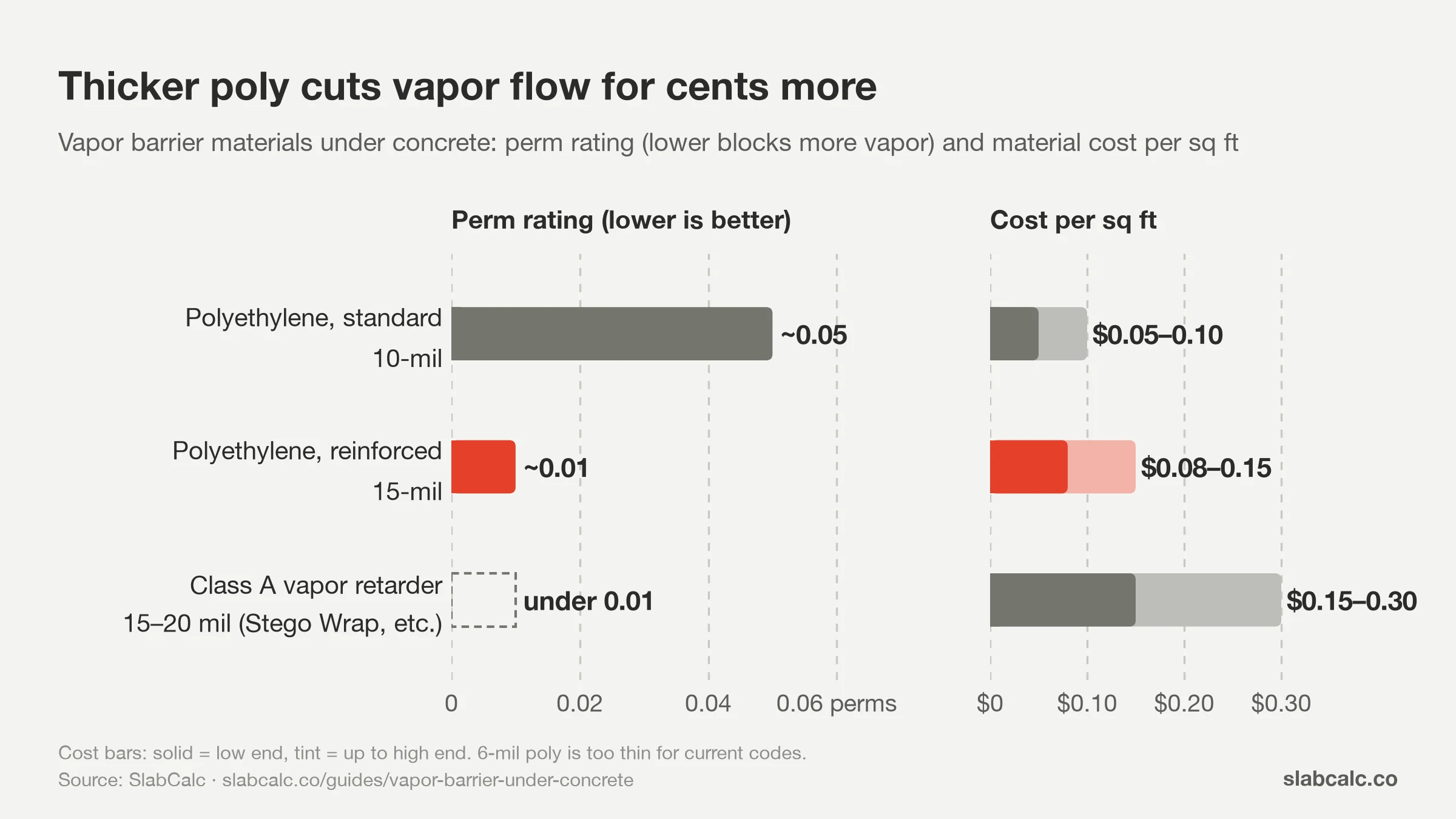
ASTM E1745 Classes A, B, and C
ASTM E1745 grades under-slab vapor retarders by strength, not by perm rating. Every class must be at 0.1 perms or less after conditioning.
| Class | Puncture Resistance | Tensile Strength |
|---|---|---|
| A | 2,200 g | 45 lbf/in |
| B | 1,700 g | 30 lbf/in |
| C | 475 g | 13.6 lbf/in |
"Reinforced" describes construction (a woven scrim between poly layers), not certification. A reinforced sheet may or may not meet Class A, so check the product data sheet for ASTM E1745 compliance rather than trusting the label.
What NOT to Use
- 6-mil poly as your only protection under finished space: It meets the IRC minimum but tears easily during rebar placement and foot traffic, and it falls short of ACI 302.1R's 10-mil recommendation. A torn barrier isn't a barrier.
- Roofing felt / tar paper: Not a vapor barrier. It's a moisture retarder at best and degrades when in constant contact with moist soil.
- Recycled or reclaimed plastic: Unknown perm ratings and inconsistent thickness. Not worth the risk.
Which Type to Choose by Project
| Project | Recommended Barrier |
|---|---|
| Patio, driveway, sidewalk | None needed (10-mil if you want one) |
| Detached shed with good drainage | Optional; 10-mil |
| Garage floor staying bare | 10-mil |
| Garage floor you may epoxy within 5–10 years | 15-mil or reinforced |
| Basement or enclosed living space | 15-mil minimum; Class A if flooring specs require it |
| Radiant heated floor | Class A, no exceptions |
| Commercial work | Class A with certification documents |
The cost difference between 10-mil and Class A on a 400 sq ft slab is roughly $40–80. That's small next to replacing failed flooring.
Vapor Barrier vs. Vapor Retarder
The two terms get used interchangeably, but codes and product sheets treat them differently. A material under 0.1 perms is commonly called a vapor barrier; one between 0.1 and 1.0 perms is a vapor retarder. Flooring adhesive manufacturers usually specify the lower number, and using a higher-perm product where a barrier is specified can void the flooring warranty.
When a spec sheet or inspector says "vapor barrier," verify the perm rating of the product you're buying. For how to read product labels and perm classes, see vapor barrier vs. vapor retarder.
How to Install a Vapor Barrier Under a Concrete Slab
Proper installation matters as much as the material itself. A barrier with gaps, tears, or unsealed seams is a barrier that doesn't work.
What You'll Need
- Vapor barrier sheeting (10-mil minimum; 15-mil or Class A for enclosed spaces and basements)
- Vapor barrier seaming tape (3M 8086, Stego Tape, or the manufacturer's equivalent; not duct tape)
- Pipe boots or sleeve seals for penetrations, plus compatible sealant
- Flat-base rebar chairs
- Utility knife, tape measure, chalk line
Quantity: Order 10–15% more material than the slab area to cover overlaps and edge turn-ups. A 20×20 slab (400 sq ft) needs about 440–460 sq ft of sheeting.
The Correct Position
The vapor barrier sits on top of the gravel base, directly under the concrete.
Your layer stack from bottom to top:
- Compacted subgrade (native soil, excavated and compacted)
- Gravel base (4-6 inches of compacted crushed stone)
- Vapor barrier (on top of gravel)
- Concrete slab
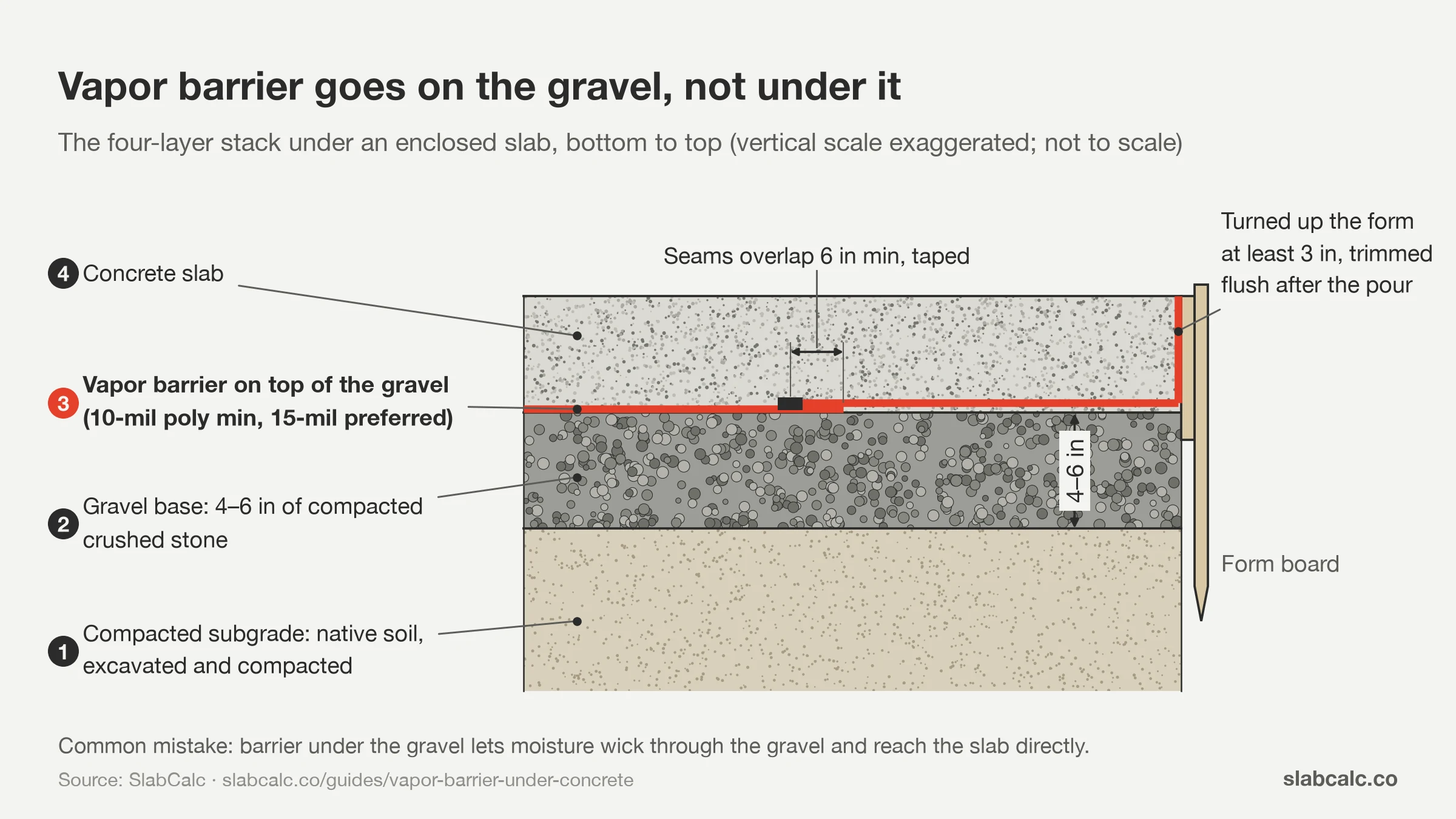
Wrong: subgrade → vapor barrier → gravel → concrete. Placing the barrier under the gravel lets moisture wick through the gravel and pool against the bottom of the slab.
Installation Steps
-
Prepare the gravel. Compact it to depth (4–6 inches for most slabs), rake it smooth, and pull or flatten any sharp stones. The sheet conforms to whatever it's laid on, so ruts and points become puncture sites. See concrete subgrade preparation for base specs.
-
Roll out the barrier. Start at one wall and unroll across the full width in parallel strips, perpendicular to the pour direction where possible. Unroll in place rather than dragging the sheet, which stretches and tears it. Leave 6 inches of extra material at all edges to turn up against foundation walls or forms.
-
Lap the seams. Overlap adjacent sheets by at least 6 inches (IRC R506.2.3); 12 inches is better practice and the extra material is negligible.
-
Tape every seam. Use vapor barrier tape, not duct tape or packing tape, which lose adhesion in sustained moisture. Tape the full seam length rather than spot-taping, and press out bubbles and lifted edges. This is the step most installers rush--and where most barriers fail.
-
Seal penetrations. Plumbing pipes, electrical conduit, radon mitigation pipes, and rebar chairs all penetrate the barrier. Wrap pipes with a tight tape collar or a pipe boot. Standard metal rebar chairs have pointed feet that poke through the poly: use flat-base chairs, or tape a square of scrap barrier under each foot.
-
Turn up at edges. Bring the barrier up the foundation walls or form boards at least 3 inches. Cut and fold corners to lie flat, then tape the cuts.
-
Inspect before the pour. After rebar placement and before calling for concrete, walk the entire surface. Look for tears from foot traffic, partially taped seams, open penetrations, and edges pulled away from forms. Patch every problem with tape or a patch piece. Five minutes here prevents repairs that cost thousands later.
-
Pour and trim. Place concrete directly on the barrier. Don't drag screeds or rakes hard across the turned-up edges or pull the turn-up into the pour. After the slab sets, trim the excess flush with the slab edge. For the full pour process, see how to pour concrete.
Common Installation Mistakes
Placing the barrier under the gravel. This allows moisture to wick through the gravel and contact the slab directly. The barrier goes on top of the gravel, under the concrete.
Not taping seams. Untaped overlaps allow vapor to pass through. The entire point of the barrier is eliminated if seams aren't sealed.
Using duct tape on seams. Duct tape fails in sustained moisture contact. Use vapor barrier seaming tape.
Using rebar chairs that puncture the barrier. Standard metal rebar chairs have pointed feet that poke through the poly. Use chairs with flat bases or place small squares of plywood under each chair.
Tearing and not patching. Construction traffic on the gravel inevitably tears the barrier in spots. Walk the entire surface before pouring and tape every tear.
The Sand Layer Debate
Some builders place a thin layer of sand (1-2 inches) between the vapor barrier and the concrete. The theory is that the sand allows bleed water to escape downward during curing, preventing surface crusting.
The case against sand: Sand between the barrier and the concrete creates a reservoir that traps water against the slab bottom. This can actually increase moisture transmission over time.
Current best practice: Place the vapor barrier directly under the concrete with no sand layer. Modern concrete mix designs and proper subgrade preparation manage bleed water without needing a sand cushion. ACI 302.2R recommends direct contact between the vapor barrier and concrete.
Garage Floors
Garage floors are the most commonly skipped application--and one of the most consequential. The IRC exempts detached garages from the vapor retarder requirement, but if you ever plan to epoxy the floor, the decision made at pour time determines whether the coating lasts. Moisture vapor pushes epoxy off the slab, and a coating that looks perfect on day one can bubble within a year. Retrofitting a topside moisture barrier later adds $1–3 per sq ft. For attached vs. detached and heated vs. unheated garages, see vapor barrier for garage floors.
Retrofitting Moisture Protection on Existing Slabs
If your slab was poured without a vapor barrier and you need moisture control for flooring installation:
Topside moisture-mitigating systems:
- Epoxy moisture barriers (Mapei Planiseal, Ardex MC Rapid): Applied to the slab surface, they block moisture from above. Cost: $1-3 per sq ft.
- Sheet membrane systems: Roll-on or peel-and-stick barriers between the slab and flooring. Cost: $0.50-2.00 per sq ft.
Test first: Use a calcium chloride test (ASTM F1869) or relative humidity probe (ASTM F2170) to measure actual moisture emission before choosing a mitigation system. Some flooring products tolerate moderate moisture; others fail at very low levels. If moisture is causing visible surface problems, our concrete floor problems guide covers diagnosis and repair options.
Calculate Before You Order
Size the slab first, then add 10–15% to the slab area for your barrier order.
Includes 10% waste factor
Key Takeaways
- Use minimum 10-mil polyethylene (15-mil or Class A for basements and heated floors) for any slab that will have flooring, coatings, or enclosed space above it
- The IRC allows 6-mil, but ACI 302.1R recommends 10-mil minimum, and 6-mil tears easily during construction
- Place the vapor barrier on top of the gravel base, directly under the concrete--not under the gravel, and with no sand layer
- Tape every seam, overlap by 6-12 inches, and seal every penetration
- Outdoor slabs (patios, driveways) don't need a vapor barrier
- Existing slabs without barriers can be retrofitted with topside epoxy moisture systems ($1-3/sq ft)
- Check local building codes--requirements vary by jurisdiction
For more project guidance, browse our complete library of concrete guides and tutorials.