

DIY Concrete Forms: Bracing, Setup and Preventing Blowouts
A form blowout mid-pour is one of the most expensive DIY concrete mistakes. Wet concrete pushes outward with surprising force—a 4-inch slab exerts about 50 pounds per square foot at the base of the forms, and a 6-inch pour about 75. If your stakes and braces can't handle the pressure, forms bow, shift, or blow out entirely, and you've got a mess that hardens before you can fix it.
Before you start bracing, you need to know how much concrete you are working with. Use our concrete slab calculator to figure your volume, then come back here to make sure your forms can actually hold it.
Why Forms Fail
Most blowout failures come down to three problems:
- Stakes too far apart — gaps between stakes let the form board flex outward under load
- Stakes too shallow — soft or loose soil lets stakes lean and pull free
- No diagonal bracing — vertical stakes resist sideways movement but not outward tipping
Understanding the forces involved helps you plan bracing correctly. Concrete weighs about 150 pounds per cubic foot. A 4-foot stretch of form on a 6-inch slab carries roughly 75 pounds of static lateral load, and dumping, screeding and vibrating the concrete add impact loads well beyond that. Your stakes and braces need to absorb all of it without shifting.
If you are building forms from scratch, start with our guide on how to build concrete forms for the full setup process, then use this article to dial in your bracing plan.
Stake Spacing by Form Height
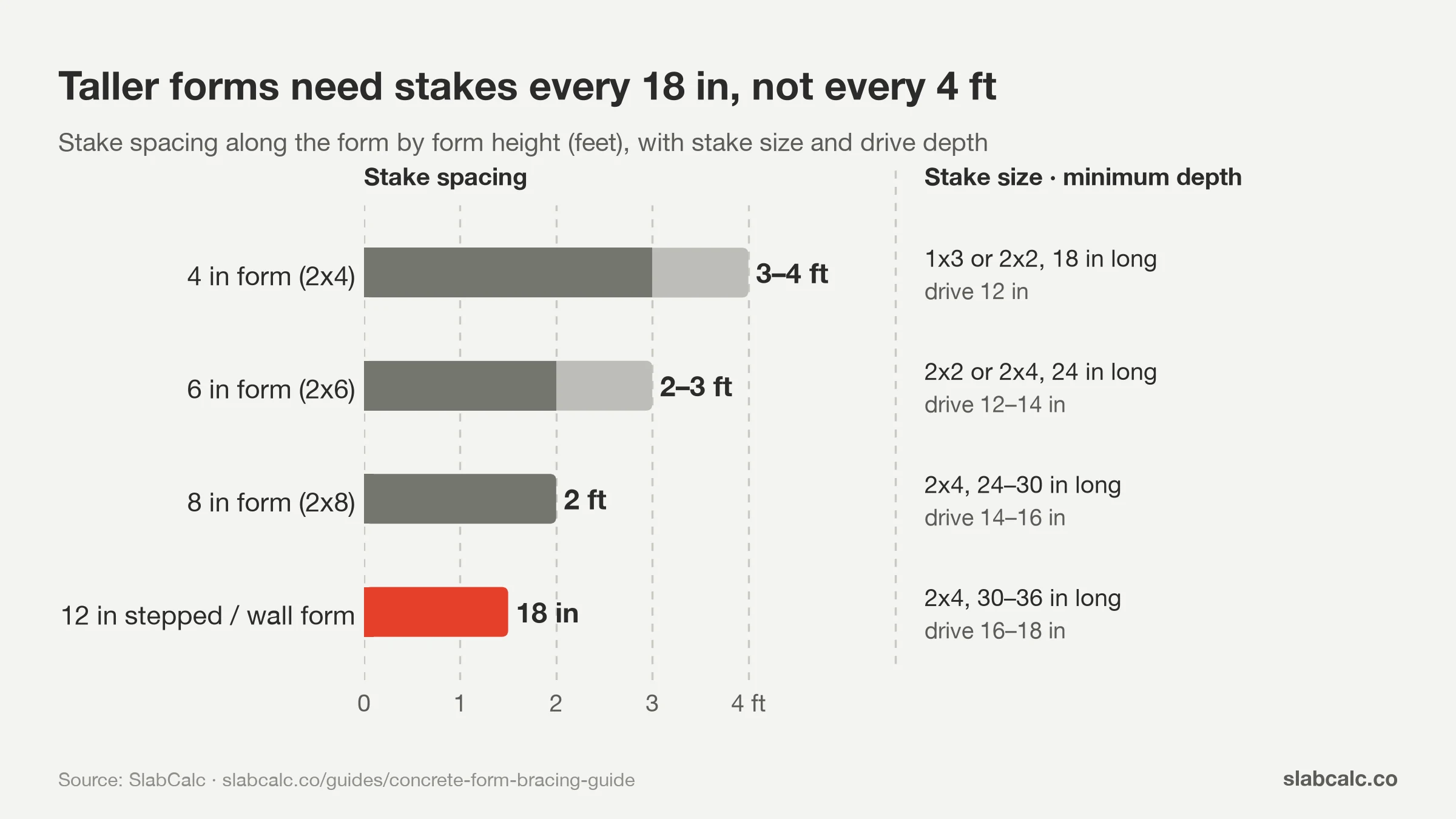
Stake spacing depends on the height of your form boards and the thickness of your pour. Taller forms take more pressure, and the leverage increases because force is applied higher up the board.
| Form Height | Stake Spacing | Stake Size | Minimum Depth |
|---|---|---|---|
| 4 inches (2x4 forms) | 3-4 feet | 1x3 or 2x2, 18" long | 12 inches |
| 6 inches (2x6 forms) | 2-3 feet | 2x2 or 2x4, 24" long | 12-14 inches |
| 8 inches (2x8 forms) | 2 feet | 2x4, 24-30" long | 14-16 inches |
| 12 inches (stepped or wall forms) | 18 inches | 2x4, 30-36" long | 16-18 inches |
Always tighten spacing at these points:
- Corners (stake both sides, within 6 inches of the joint)
- Board joints where two form boards meet end-to-end
- Any location where the ground is soft, sandy, or recently backfilled
- Mid-span on boards longer than 8 feet
For a standard 10x10-foot patio at 4 inches thick, you will need roughly 20-24 stakes around the perimeter. That might feel like overkill until you watch concrete push against under-staked forms.
Stake Types and When to Use Each
Wooden Stakes
The most common choice for residential work. Cut your own from 2x4 lumber or buy pre-made pointed stakes at the hardware store.
- Pros: Cheap, easy to cut to length, screws hold well in wood
- Cons: Can split when driven into hard ground, weaker than steel
- Best for: Standard 4-inch slabs in normal soil
Sharpen the bottom end with a circular saw or hatchet to make driving easier. Blunt stakes push soil sideways and are harder to drive straight.
Steel Stakes
Available at tool rental centers and concrete supply yards. Typically 18-36 inches long with pre-drilled holes for nails or wire ties.
- Pros: Stronger, reusable, easier to drive in hard or rocky soil
- Cons: More expensive, harder to attach form boards (requires nails through holes or wire ties)
- Best for: 6-inch or thicker pours, hard soil, reusable form setups
Rebar Stakes
Short lengths of #3 or #4 rebar driven into the ground and wired to form stakes or boards. These work as supplemental anchors, not primary stakes.
- Best for: Adding holding power behind wooden stakes in soft soil
Diagonal Braces (Kickers)
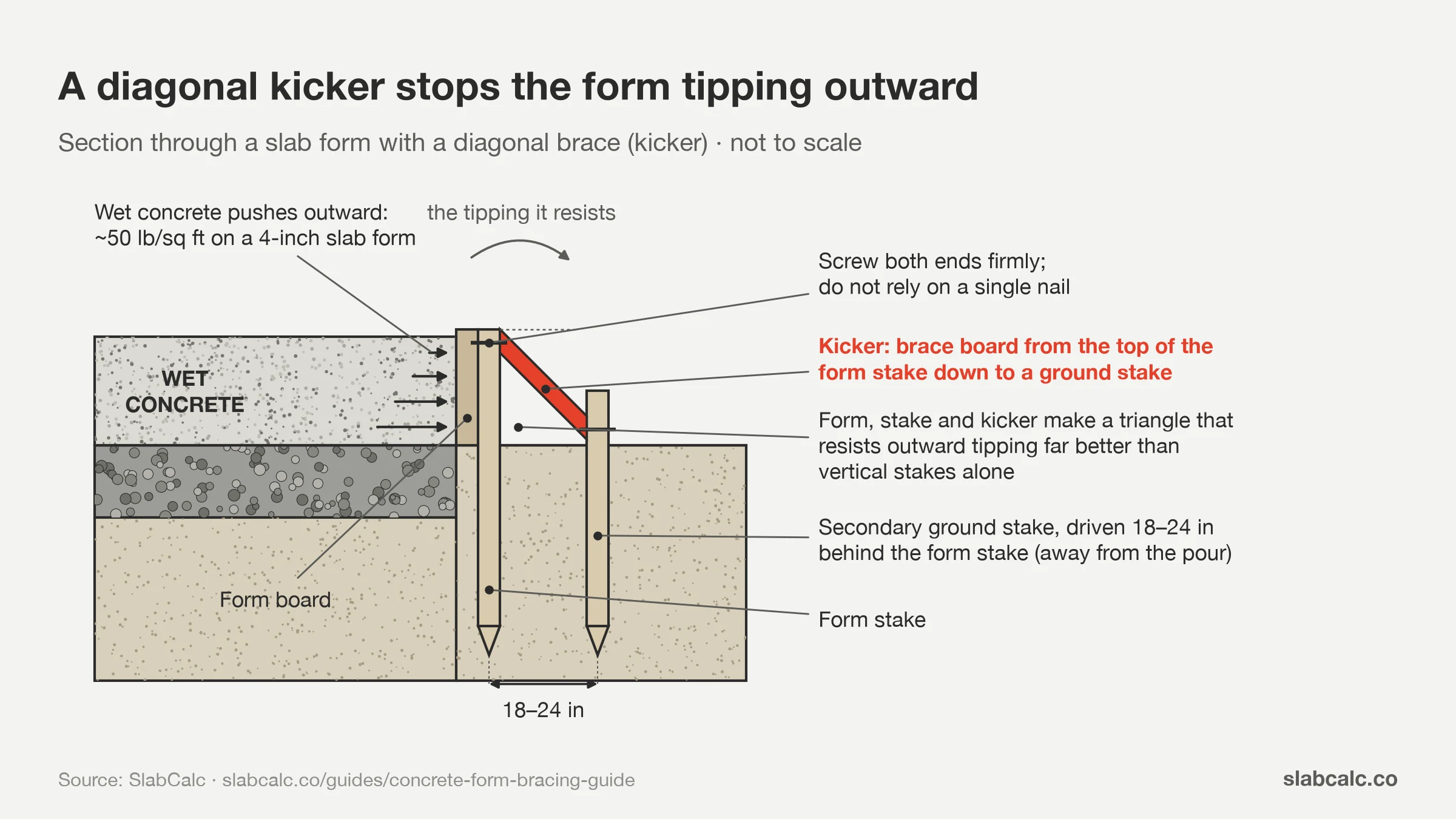
Vertical stakes resist the form sliding sideways but do little to prevent the form from tipping outward. That is where diagonal braces come in.
When You Need Them
- Any pour over 4 inches thick
- Form runs longer than 8 feet without a corner
- Soft or wet soil conditions
- Sloped ground where gravity works against the stakes
How to Install Kickers
- Drive a secondary stake 18-24 inches behind the form stake (away from the pour)
- Cut a brace board to span diagonally from the top of the form stake down to the ground stake
- Screw both ends firmly — do not rely on a single nail
- The triangle formed by the form, the vertical stake, and the kicker resists outward tipping far better than vertical stakes alone
For a 6-inch slab on a 20-foot straight run, plan for kickers every 4 feet — that is 5 diagonal braces per side in addition to your regular stakes.
Bracing Curved Forms
Curves require special attention because the concrete pushes outward on every inch of the bend. Straight boards cannot follow a curve, so most DIY builders use flexible form material, thin plywood strips (1/4 inch or 3/8 inch), or metal flex forms.
Stake spacing on curves:
- Reduce spacing to 12-18 inches on the outside of the curve
- Inside curves (concave) need less bracing because concrete pressure pushes the form inward against the fill
- Outside curves (convex) need the most bracing — concrete pushes outward and the curved form wants to straighten
Tips for curved bracing:
- Use two layers of thin plywood (1/4 inch each) rather than one thick layer for smoother bends
- Pre-bend plywood by wetting it 24 hours before forming
- Add a continuous horizontal stiffener (a strip of plywood screwed along the top edge of the form) to prevent the top from rolling inward or outward
If your project involves reinforcement inside these curved forms, see our guide on rebar vs. mesh vs. fiber to choose the right option for the shape.
Blowout Prevention Checklist
Run through this list after setting forms and before ordering concrete. Every item matters.
Structural
- Stakes driven at least 12 inches into solid ground
- Stake spacing matches the table above for your form height
- Extra stakes at every corner and board joint
- Diagonal kickers installed for any form over 4 inches tall
- All screws tight — no loose connections between stakes and form boards
Alignment
- Forms are plumb (vertical, not leaning in or out)
- Top of stakes flush with or below the top edge of the form board
- No bows or bulges in the form line when sighting down the length
Ground Conditions
- Soil around stakes is firm and compacted
- No soft or muddy areas behind stakes
- Backfill packed tight against the outside base of forms to prevent concrete from leaking underneath
Connections
- Form board joints are backed by a stake on each side
- Corner joints are screwed (not just butted together)
- No gaps at the base that could let concrete escape and undermine the form
If anything on this checklist fails, fix it now. Once the truck arrives or you start mixing bags, there is no time to re-stake. Planning your first concrete pour is stressful enough without form problems adding to it.
Emergency Mid-Pour Fixes
Even with good preparation, forms sometimes move. Soft pockets in the soil, an unexpected surge of concrete, or a missed stake can cause problems. Here is what to do.
If a Form Starts Bowing
- Stop pouring at that section immediately. Redirect concrete to the opposite side.
- Drive an emergency stake directly behind the bulge from the outside.
- Screw or clamp the stake to the form board and pull the board back to alignment.
- Add a kicker behind the new stake for extra holding power.
- Resume pouring only after the form is secure.
If a Stake Pulls Free
- Drive a new stake 6 inches to either side of the failed one.
- Screw it to the form board with at least two screws.
- If the ground is too soft for stakes, place a heavy object (cinder block, bag of concrete mix, even a vehicle tire) against the outside of the form as temporary ballast.
If a Corner Joint Opens
- Clamp the joint closed with a C-clamp or bar clamp.
- Drive stakes on both sides of the corner, tight against the boards.
- Add a screw through the joint from the outside.
Speed matters. You have 30-60 minutes of working time depending on temperature. Every minute spent fixing forms is a minute less for screeding and finishing. For a complete walkthrough of the pour itself, read how to pour concrete.
Bracing for Common Projects
Different projects have different bracing demands. Here is a quick reference.
| Project | Typical Thickness | Stake Spacing | Kickers Needed? |
|---|---|---|---|
| Patio | 4 inches | 3-4 feet | No, unless over 12 feet long |
| Sidewalk | 4 inches | 4 feet | No |
| Driveway | 5-6 inches | 2-3 feet | Yes |
| Garage slab | 6 inches | 2 feet | Yes |
| Retaining wall footing | 8-12 inches | 18 inches | Yes, every 4 feet |
If you are unsure whether your project is a good DIY candidate or better left to a contractor, our DIY vs. contractor guide breaks down the decision by project type and complexity.
Key Takeaways
- Match stake spacing to form height — 3-4 feet for 4-inch slabs, 2-3 feet for 6-inch, 2 feet for 8-inch, and 18 inches for 12-inch forms
- Always add diagonal kickers for pours over 4 inches thick
- Double up stakes at corners, joints, and soft soil — these are where blowouts start
- Curved forms need 12-18 inch stake spacing on the outside of the bend
- Run the full checklist before pouring — there is no fixing weak bracing once concrete is flowing
- Have emergency supplies ready — extra stakes, screws, clamps, and a drill at the pour site
Proper bracing is the difference between a clean pour and an expensive mess. Take the time to over-brace rather than under-brace — extra stakes cost a few dollars, while a blowout costs you the entire project. Browse more practical guides in our concrete guides library and use the concrete slab calculator to get your material quantities dialed in before pour day.