

Weather Impact on Concrete Finishing
Weather is the single largest variable in concrete finishing — more influential than mix design, tool selection, or operator skill. A slab poured at 60 degrees F in calm conditions gives you a 90-minute finishing window. The same slab at 95 degrees F with 15 mph wind may give you under 20 minutes before the surface is unworkable. This guide quantifies those effects with risk tables and scheduling guidance so you can plan pours around conditions, not hope for the best.
Use the finishing timing estimator to model your specific pour conditions and get a projected finishing window, or start with the concrete calculator to estimate material quantities. For a detailed walkthrough of how to read the bleed water cues and timing tests, see our concrete finishing timing guide.
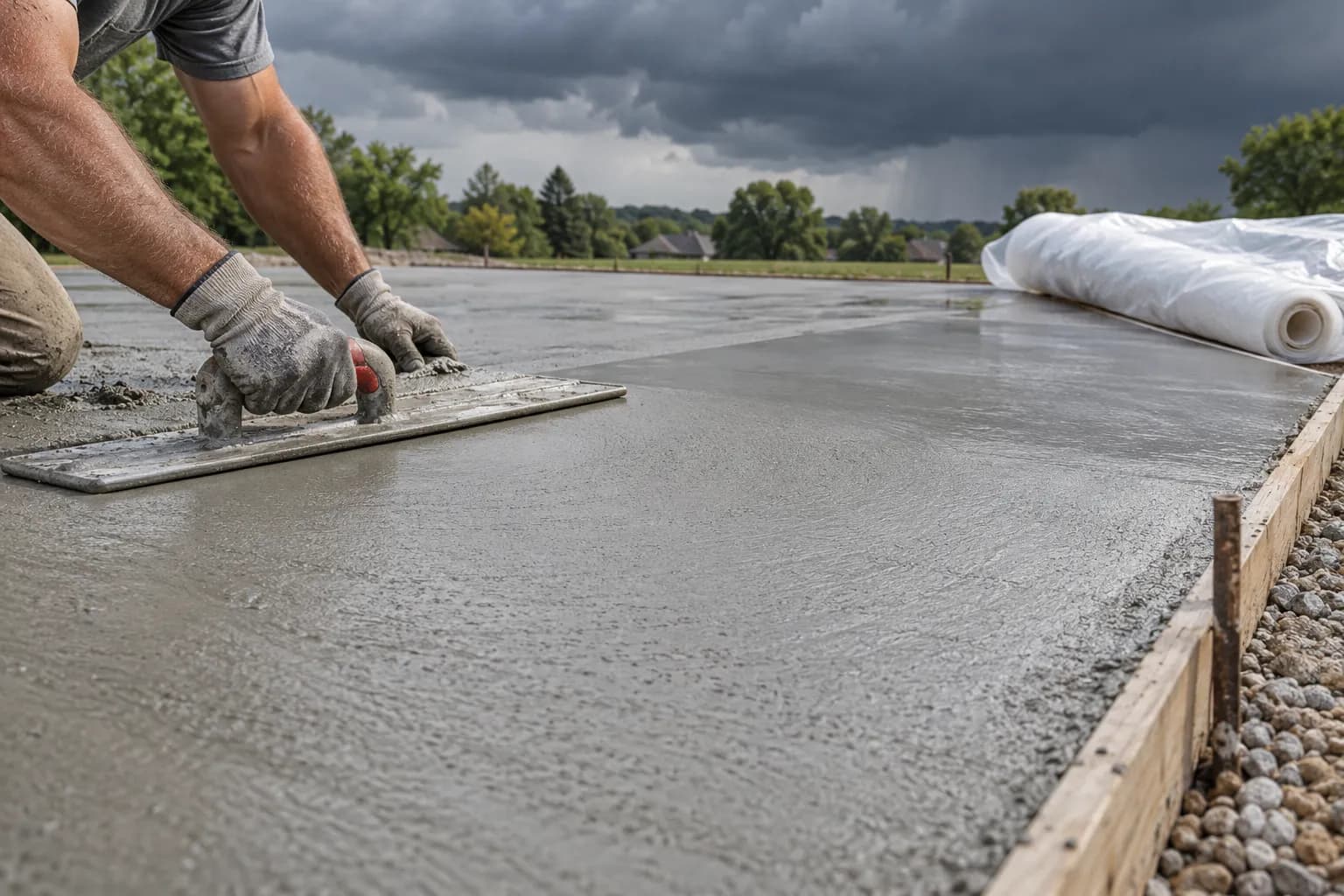
Temperature Effects on Finishing Windows
Temperature controls the rate of cement hydration and bleed water evaporation — the two factors that determine when your finishing window opens and how long it stays open.
| Air Temperature | Bleed Water Duration | Finishing Window Opens | Finishing Window Duration | Risk Level |
|---|---|---|---|---|
| Under 40 degrees F | 3-5+ hours | 4-6+ hours after pour | Wide (2-3 hours) but freeze risk | High |
| 40-50 degrees F | 2-3 hours | 2-4 hours after pour | Wide (2-3 hours) | Moderate |
| 50-65 degrees F | 60-90 minutes | 1-2 hours after pour | Comfortable (60-90 minutes) | Low |
| 65-80 degrees F | 30-60 minutes | 45-90 minutes after pour | Moderate (45-75 minutes) | Low-Moderate |
| 80-90 degrees F | 15-30 minutes | 30-60 minutes after pour | Tight (30-45 minutes) | Moderate-High |
| Over 90 degrees F | 10-20 minutes | 20-40 minutes after pour | Very tight (15-25 minutes) | High |
The 50-75 degree F sweet spot: This range provides the most workable finishing conditions for residential projects. Bleed water clears at a predictable rate, hydration proceeds steadily, and the finisher has enough time to work the surface without rushing. The concrete temperature guide covers how temperature affects not just finishing but the entire pour and curing process.
Hot Weather Risk Factors
Temperatures above 80 degrees F create compounding problems:
- Accelerated hydration shortens the total working time before initial set
- Rapid bleed water evaporation can mask the surface readiness cues (the surface looks matte but the interior is still plastic)
- Surface crusting occurs when the top 1/8 inch dries and stiffens while concrete below remains soft — a leading cause of delamination
- Plastic shrinkage cracking develops when evaporation outpaces bleed water migration to the surface
Mitigation strategies: Use retarding admixtures (adds 1-2 hours of working time), schedule pours before 7 AM, increase crew size to finish faster, and have misting equipment ready. On extreme days (over 95 degrees F), consider postponing the pour entirely — the risk of surface failure is very high. See the finishing mistakes guide for what these failures cost to repair.
Cold Weather Risk Factors
Temperatures below 50 degrees F create a different set of problems:
- Extended bleed water period means long waits before finishing can begin (sometimes 3+ hours)
- Slow hydration means the concrete remains vulnerable to damage longer
- Freeze-thaw risk to fresh concrete if overnight temperatures drop below 32 degrees F
- Condensation can form on the surface in cold, humid conditions, mimicking bleed water
Mitigation strategies: Use accelerating admixtures or Type III (high-early) cement, use heated mix water, protect fresh concrete with insulating blankets, and never pour if temperatures will drop below 25 degrees F within 24 hours of placement. For cold-weather damage repair, see the winter concrete damage guide.
Humidity and Evaporation Rate
Humidity determines how fast moisture leaves the concrete surface. Combined with temperature and wind, it creates the evaporation rate — the single most useful metric for predicting finishing conditions.
| Relative Humidity | Evaporation Effect | Finishing Impact |
|---|---|---|
| Over 80% | Very slow surface drying | Extended bleed water wait; forgiving window |
| 60-80% | Moderate drying | Normal finishing timeline |
| 40-60% | Faster drying | Shortened window; monitor surface closely |
| Under 40% | Rapid surface drying | High crusting risk; misting likely needed |
Critical threshold: When the evaporation rate exceeds 0.2 lb/sq ft/hour, the concrete surface loses moisture faster than bleed water can replenish it. This leads to plastic shrinkage cracking and surface crusting. The evaporation rate depends on the combined effects of temperature, humidity, wind speed, and concrete temperature.
Evaporation Rate Risk Matrix
This matrix shows approximate evaporation rates (lb/sq ft/hour) based on common condition combinations.
| Conditions | Under 5 mph Wind | 5-10 mph Wind | 10-15 mph Wind | Over 15 mph Wind |
|---|---|---|---|---|
| 60 degrees F, 70% RH | 0.05 | 0.10 | 0.15 | 0.20 |
| 70 degrees F, 50% RH | 0.10 | 0.15 | 0.25 | 0.35 |
| 80 degrees F, 40% RH | 0.20 | 0.30 | 0.40 | 0.50+ |
| 90 degrees F, 30% RH | 0.30 | 0.45 | 0.55+ | 0.65+ |
| 95 degrees F, 20% RH | 0.40+ | 0.55+ | 0.65+ | 0.80+ |
Red zone (over 0.20): Any combination producing an evaporation rate above 0.20 requires active mitigation — misting, wind barriers, evaporation retarder spray, or scheduling changes. Without intervention, surface defects are highly likely.
Wind: The Most Underestimated Variable
Wind accelerates evaporation disproportionately. A 15 mph breeze on a moderate day can push evaporation rates into the danger zone even when temperature and humidity seem manageable.
| Wind Speed | Effect on Finishing Window | Required Action |
|---|---|---|
| Under 5 mph | Minimal impact | Standard procedure |
| 5-10 mph | Window shortened 15-25% | Monitor surface closely |
| 10-15 mph | Window shortened 30-50% | Wind barriers recommended; misting on standby |
| 15-20 mph | Window shortened 50-70% | Wind barriers essential; misting active |
| Over 20 mph | Severe — window may be under 15 minutes | Postpone pour if possible |
Wind barriers: Temporary plywood screens or tarps staked upwind of the pour area can reduce effective wind speed by 60-80%. Position barriers within 3-4 feet of the slab edge and extend them at least 2 feet above the surface. This is inexpensive insurance against a ruined finish.
Gusting vs steady wind: Gusty conditions are worse than steady wind because the finisher cannot maintain a consistent pace. Surface drying is uneven, making it difficult to judge the finishing window. If gusts exceed 20 mph, strongly consider postponing.
Scheduling Pours Around Weather
Planning the pour date and time based on weather conditions is the most effective risk mitigation strategy — and it costs nothing.
Best pour times by season:
| Season | Recommended Pour Time | Why |
|---|---|---|
| Spring (50-65 degrees F) | 8 AM - 12 PM | Moderate temps; rising warmth aids curing |
| Summer (80-95 degrees F) | 5 AM - 8 AM | Avoids peak heat; maximizes finishing window |
| Fall (55-70 degrees F) | 8 AM - 11 AM | Similar to spring; watch for afternoon wind |
| Winter (35-50 degrees F) | 10 AM - 1 PM | Warmest part of day; maximizes curing time before nightfall |
The 48-hour forecast rule: Check the weather forecast at 48 hours and again at 24 hours before the scheduled pour. You need acceptable conditions not just during the pour but for 24-48 hours afterward during initial curing. Rain within 4-6 hours of finishing can damage an unprotected surface — see our rain on fresh concrete guide for emergency response steps. Freezing temperatures overnight can destroy the slab. For more on curing protection, see the how to finish concrete guide.
Weather-Related Failure Costs
Weather-induced finishing failures are among the most expensive to repair because they typically affect the entire slab surface, not just a localized area.
| Weather Failure | Cause | Visible Symptom | Repair Cost (per sqft) |
|---|---|---|---|
| Plastic shrinkage cracking | High evaporation rate | Irregular surface cracks within hours | $2-4 (overlay) |
| Surface crusting/delamination | Wind and heat drying surface prematurely | Flaking, peeling within months | $3-6 (grind and resurface) |
| Freeze damage | Below-32 degrees F exposure within 24 hours | Spalling, scaling, surface disintegration | $4-8 (demolish and repour) |
| Rain damage | Unprotected surface hit by rain before set | Pitted, rough, weakened surface | $2-5 (overlay or resurface) |
| Discoloration | Uneven curing due to partial shade/sun | Blotchy light and dark patches | $1-3 (stain or overlay) |
Every one of these failures is preventable through proper scheduling, condition monitoring, and the willingness to postpone when conditions turn unfavorable. The cost of postponing a pour (typically $200-400 for a rescheduled concrete delivery) is always less than the cost of repairing weather-related surface damage.
For project-level cost planning across finish types, see the concrete finish type cost comparison. If you are weighing whether to DIY or hire a pro given your local conditions, the DIY vs professional finishing guide includes a risk-adjusted savings model. To estimate material quantities before scheduling, use the concrete calculator.
Key Takeaways
- Temperature drives the finishing timeline. At 50-75 degrees F you get 60-90 minutes; above 90 degrees F you may get under 20 minutes.
- Wind is the most underestimated risk factor — a 15 mph breeze can halve your finishing window regardless of temperature.
- Evaporation rates above 0.20 lb/sq ft/hour require active mitigation (misting, wind barriers, evaporation retarder).
- Schedule pours around weather, not around convenience. Early morning pours in summer and midday pours in winter align your work with the best conditions.
- The cost of postponing a pour ($200-400) is always less than repairing weather-related surface failure ($800-3,000+).
For the complete finishing timing sequence, read the concrete finishing timing guide. For help deciding whether to handle finishing yourself or hire a professional, see DIY vs professional finishing. Browse all planning resources at the guides hub.