
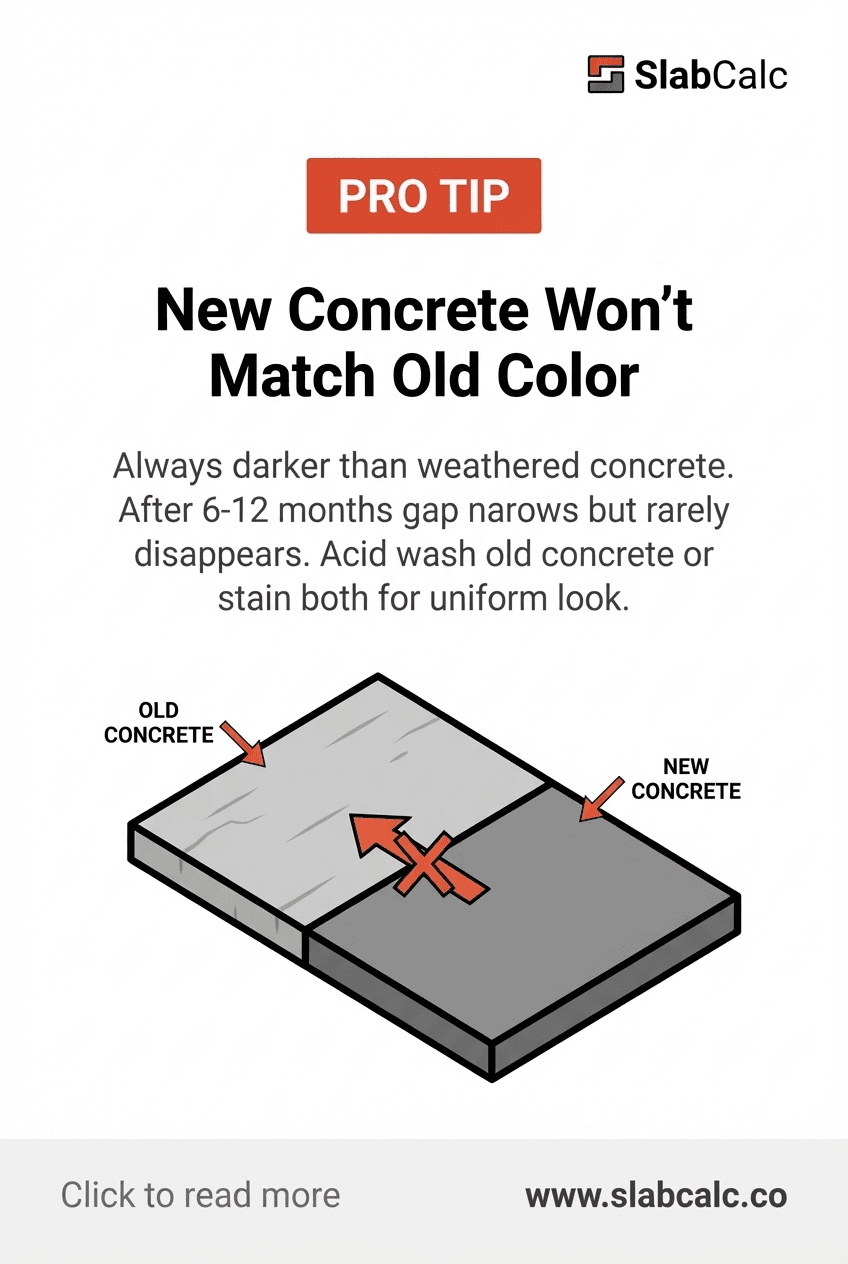
New Concrete Won't Match Old Color
The Color Shock Nobody Expects
You finish pouring new concrete beside your existing patio, and the moment it cures, you're staring at a two-tone eyesore. Your fresh section looks charcoal-dark while the original slab appears pale gray. This is the #1 aesthetic complaint homeowners make when extending driveways or patios—and it's completely normal, but totally preventable.
Why New Concrete Darkens Differently
The color difference isn't a flaw in your concrete mix or application. It's chemistry. Fresh concrete contains moisture deep within its structure. As water evaporates over the first 6–12 months, the surface lightens gradually. Existing concrete finished years ago has already lost that moisture, so it displays its final weathered color.
New concrete also reflects light differently while curing. The cement paste hasn't fully carbonated yet, making it appear darker than it will eventually become. Additionally, weathered concrete develops a chalk-like surface layer from UV exposure and atmospheric CO₂—this patina is much lighter than unexposed cement.
Even with identical mix designs and finishing techniques, expect your new pour to be 2–3 shades darker initially. The gap narrows over time but rarely disappears completely without intervention.
The Professional Fix: Acid Washing or Staining
Rather than wait a year hoping nature fixes it, professionals use two proven solutions:
Acid Washing (Budget: $0.50–$1.50 per sq. ft.)
Acid washing removes the top layer of cement paste, exposing aggregate underneath and creating a uniform matte finish across both old and new concrete. Wait 7–14 days after pouring before applying.
Steps:
- Sweep away loose dust and debris
- Mix 1 part muriatic acid to 10 parts water in a plastic bucket (never reverse the ratio)
- Apply with a stiff-bristled brush, working in 4×4-foot sections
- Let sit 10–15 minutes until fizzing stops
- Scrub vigorously and rinse thoroughly with a pressure washer (1,500 PSI maximum)
- Repeat if color isn't uniform
Staining (Budget: $1.50–$3.00 per sq. ft.)
Acid-based or water-based stains penetrate concrete and oxidize the cement, creating lasting color. Stains work on both new and old concrete, so you can color-match perfectly.
Apply stain 14 days after pouring new concrete. Acid stains are more durable but require careful pH management. Water-based stains are easier for DIYers. Multiple thin coats beat one heavy coat—two to three applications create richer, more even color.
Best Timing Strategy
If you pour new concrete in summer, acid wash both the new section and 2 feet of the adjacent old concrete in fall (6–8 weeks later). This ensures both surfaces are at similar weathering stages. For year-round projects, staining gives you color control immediately without waiting for weathering.
Your calculator estimates material volume, but factor in $300–$800 for staining or acid washing a 300-sq.-ft. addition. That cost disappears when the entire surface looks like one unified slab.