
Control Joints: Space 2-3× Slab Thickness
Control Joints: Space 2-3× Slab Thickness
Control joints are deliberate cuts or grooves in fresh concrete that give the material a designated place to crack as it cures and shrinks. The ACI (American Concrete Institute) 302.1R standard and most local building codes require control joints to prevent random, uncontrolled cracking that weakens slabs and looks unprofessional.
The Spacing Formula
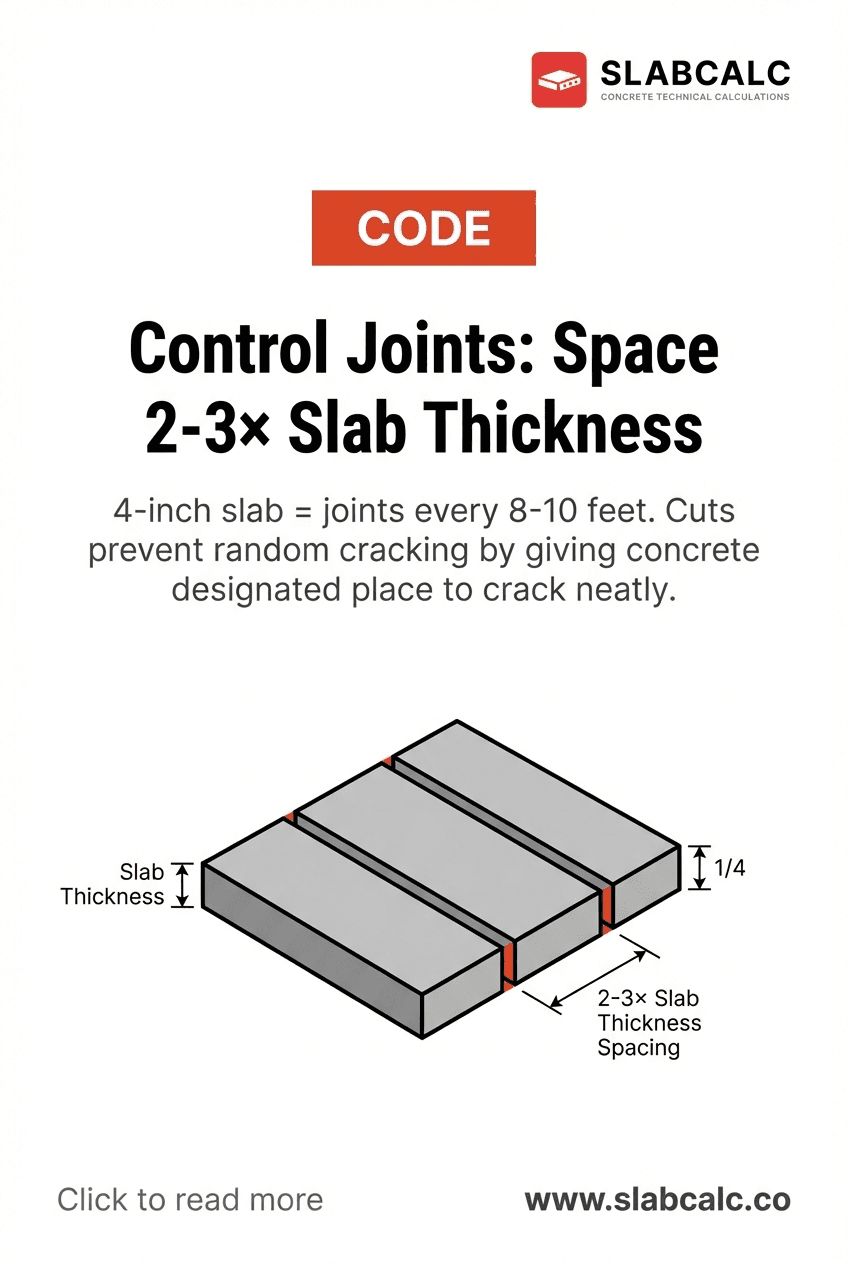
The standard rule is simple: space control joints at distances equal to 2–3 times the slab thickness.
For a 4-inch slab, this means joints every 8–10 feet. For a 6-inch slab, space them 12–18 feet apart. For a 3-inch slab, joints go every 6–9 feet.
This isn't arbitrary. Concrete shrinks as it cures—about 0.5 inches per 100 feet in ideal conditions. Without control joints, that stress releases unpredictably, creating jagged cracks that run in random directions. Control joints channel that stress into clean, vertical cracks that are easier to seal and far less visible.
Practical Installation
Control joints should be cut 1/4 to 1/3 the depth of your slab. For a 4-inch slab, that's 1 to 1.5 inches deep. Use a concrete groover tool during the finishing stage, after edging but before final troweling—typically 20–60 minutes after the pour, depending on temperature and humidity.
The timing matters. Cut too early and the concrete tears rather than grooves cleanly. Cut too late and the surface hardens, making grooves rough and difficult. The concrete should feel firm but not fully set—you should be able to press a finger into it, but it should resist slightly.
For larger slabs, consider both length and width. A 20-foot × 30-foot slab needs grid-pattern joints running both directions, not just parallel lines. This creates rectangles of 8–10 feet per side, preventing stress concentration in corners.
Common Violations and Costs
Many DIYers skip control joints entirely, assuming they'll never crack or planning to hide cracks with stain. This is a false economy. Uncontrolled cracks typically appear within the first year and expand over time, especially in freeze-thaw climates. Repairing a cracked slab costs $500–$2,000 per area, depending on severity and location.
Contractors sometimes space joints too far apart—every 15 or 20 feet on a 4-inch slab—to reduce labor time. This violates code and guarantees cracking. Local inspectors often flag this during pours.
Temperature Considerations
In hot weather (above 80°F), concrete sets faster, so you'll need to groove sooner. In cold weather, you have a wider window—sometimes 2–3 hours. Wind and low humidity accelerate drying, tightening your timeline. This is why experienced finishers watch the concrete, not the clock.
Control joints are one of the cheapest insurance policies in concrete work. A professional-grade groover costs $40–$80, and the 10 extra minutes per joint prevents thousands in future repairs. The ACI standards exist because contractors learned this lesson the hard way, decades ago. Follow the formula, respect the timing, and your slab will stay crack-free for decades.