
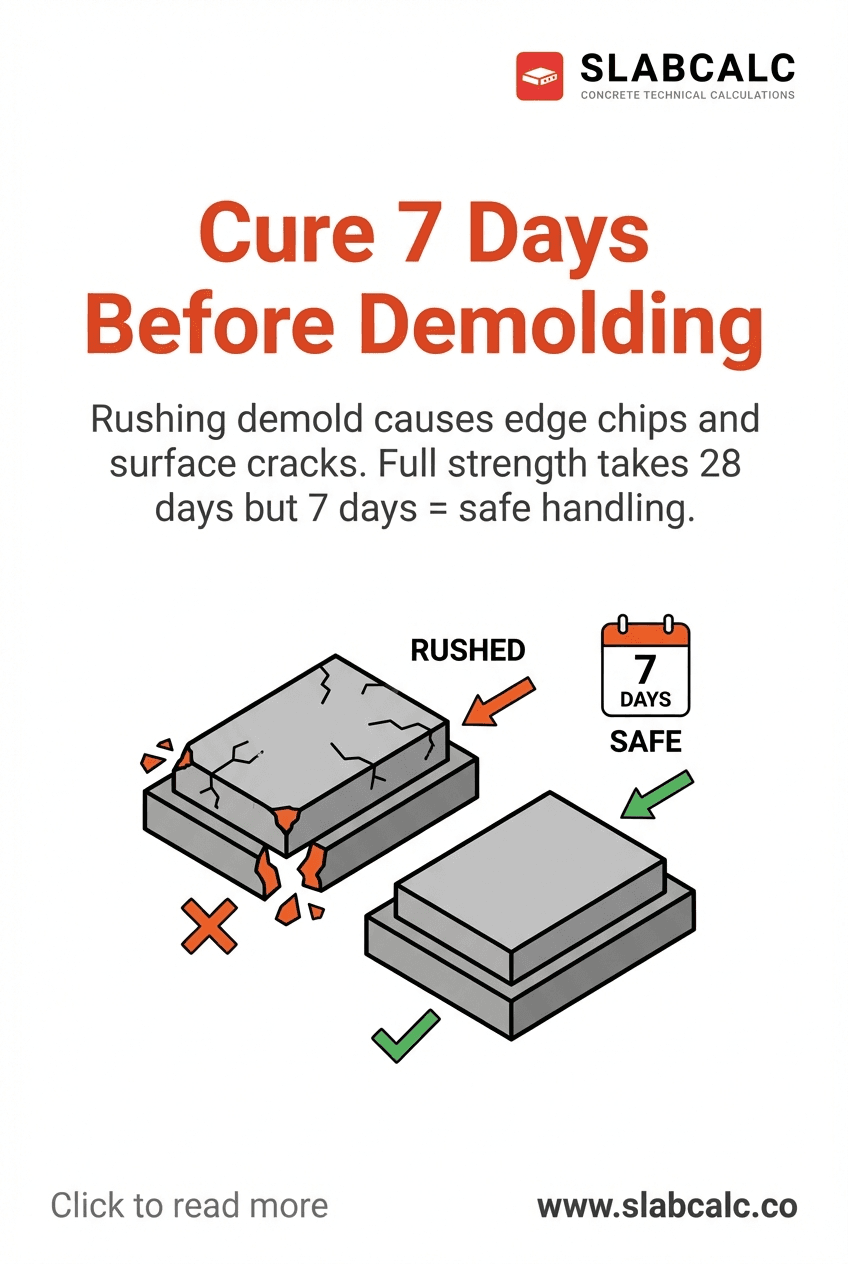
Cure 7 Days Before Demolding
The 7-Day Rule: Non-Negotiable for Countertops
The material specification is simple: Do not remove forms or demold concrete countertops before 7 days of continuous curing. This isn't arbitrary advice—it's based on concrete chemistry and structural reality. At 7 days, concrete reaches approximately 70% of its 28-day compressive strength. For decorative pieces like countertops where visible surfaces and edges matter, this threshold is the minimum safe point for handling.
Impatience here costs money. Demolding too early—at 24 or 48 hours—causes edge spalling (chips breaking away), hairline surface cracks, and color inconsistencies where the form released unevenly. These flaws are permanent and visible every day. Repairing them after the fact is expensive and often impossible to match seamlessly.
Why Countertops Are Different
Unlike driveway concrete that cures in place and hides edges, countertops are cast horizontally and then lifted vertical. The bottom face—cast against the form—becomes the visible top surface. This inverted approach creates unique stress points: edges and corners bear the most strain during handling, and they're also the most visible.
At 7 days, the concrete has developed enough tensile strength to resist the stress of form removal without spalling. Before day 7, the surface and edges remain relatively fragile. A single crack or chip at this stage compromises both aesthetics and long-term durability.
Strength Progression: What the Numbers Tell You
Concrete strength doesn't follow a straight line. Here's the typical development schedule:
- 24 hours: 20–25% strength (barely safe to walk on, not safe to move)
- 7 days: 65–70% strength (safe to demold and handle with care)
- 14 days: 85–90% strength (full handling and light use acceptable)
- 28 days: 100% strength (design strength achieved; safe for full kitchen use)
For countertops specifically, waiting until day 7 rather than rushing to day 2 or 3 prevents the majority of visible damage. The extra five days is insurance against a lifetime of looking at repairs.
Temperature Matters
Ambient temperature affects curing speed significantly. Concrete cures faster in warm conditions (70–80°F) and slower in cool conditions (50–60°F). Cold temperatures can extend the 7-day minimum to 10–14 days. If you're casting in winter or a cool basement, add buffer time. Use a concrete thermometer or weather data to track actual curing conditions rather than guessing.
Practical Timing for Your Project
Plan your project schedule assuming the full 7-day cure. Don't count on "it might be done by day 5." Build in the extra days for finishing work, which shouldn't begin until you've removed forms and inspected the surface.
If you're sealing the countertop, wait until day 14 minimum. Sealing too early traps moisture inside the concrete and causes discoloration and adhesion problems.
The bottom line: Seven days isn't negotiable. It's the difference between a countertop you'll admire and one you'll regret.