
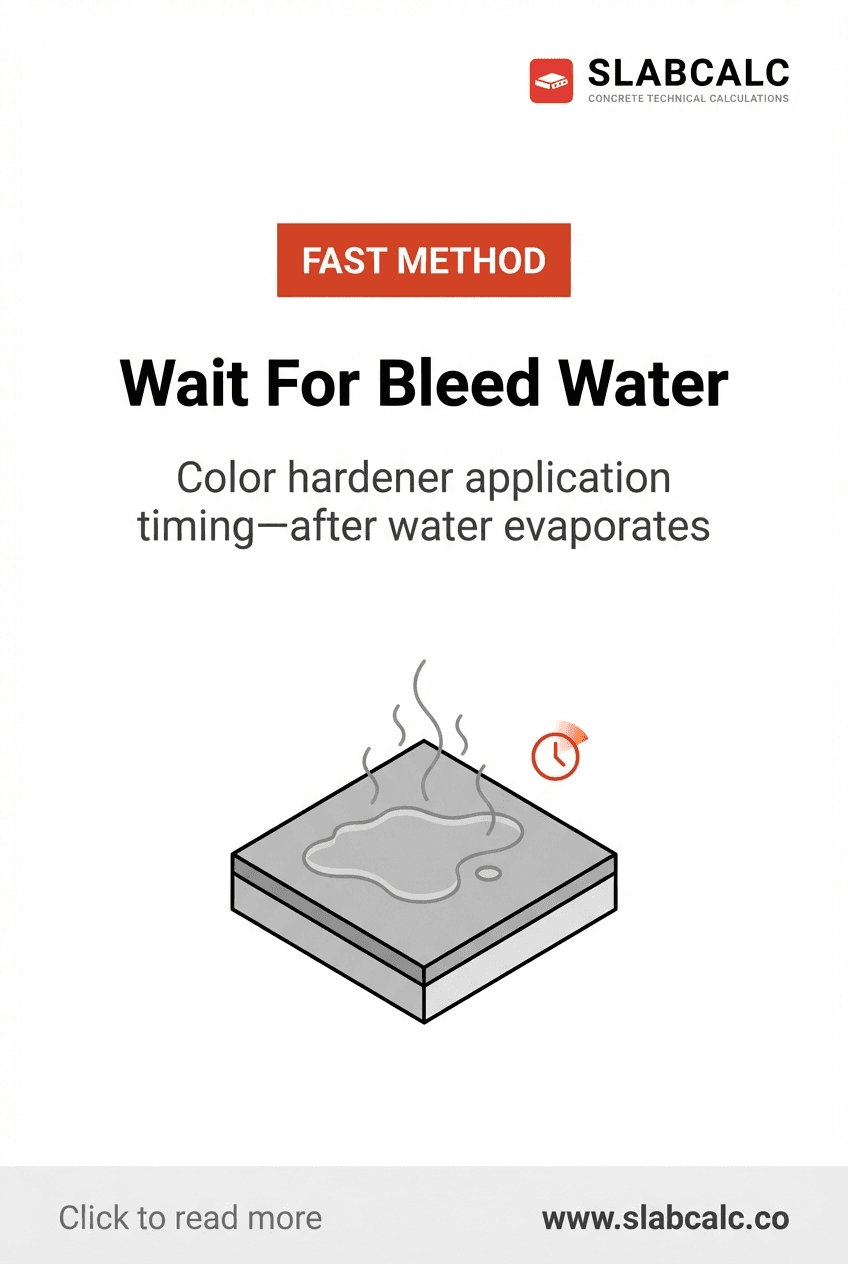
Wait For Bleed Water
The Timing Problem That Kills Color
Most DIYers apply color hardener the moment concrete is placed and screeded flat. That's the slow, mistake-laden way. Professionals wait 30 minutes to 2 hours for bleed water to evaporate first. That single decision determines whether your colored concrete looks vibrant and lasts 20+ years—or develops mottled patches, weak spots, and faded streaks within 2–3 years.
The slow way: Apply color hardener wet → bleed water traps pigment unevenly → uneven color, potential adhesion failure, softer surface.
The fast way: Let bleed water evaporate → apply color hardener to dry surface → uniform color, excellent bond, maximum hardness and durability.
Understanding Bleed Water
Bleed water is the excess moisture that rises to the concrete surface during and immediately after pouring. It's natural—concrete mix contains more water than the cement chemically needs. That water migrates upward and collects on the surface as a thin, glossy film.
Applying color hardener over this film is like painting over condensation. The pigment sits on moisture instead of bonding to the concrete, resulting in uneven color absorption and weak mechanical adhesion. UV exposure and foot traffic expose the failures within months.
Waiting for evaporation ensures the color hardener bonds directly to the concrete surface, creating a dense, colored layer 1/8 inch deep with superior wear resistance.
The Timing Window
Cool, humid weather (55–65°F, high humidity): 2–4 hours. Bleed water rises slowly and evaporates slowly. Monitor the surface continuously; look for a matte finish instead of a wet shine.
Warm, dry weather (70–85°F, low humidity): 30 minutes to 1.5 hours. Bleed water evaporates rapidly. Start checking the surface after 20 minutes.
Hot, very dry conditions (85°F+): 15–45 minutes. Bleed water vanishes quickly, but the concrete surface also cures faster—don't rush. The surface should feel dry to the touch but the concrete itself is still curing.
Concrete still setting at 4 hours post-pour is still acceptable; color hardener can be applied up to 6–8 hours after finishing if needed.
Tools You'll Need
- Moisture indicator: A smooth metal trowel or gloved hand. When the surface no longer feels wet or slick, it's ready.
- Color hardener: 60–80 lbs per 100 square feet for standard color depth (two applications recommended for rich color).
- Push broom or soft brush: For dry-broadcast method, broadcast hardener evenly, then trowel it in.
- Magnesium or aluminum trowel: Finish the surface after color hardener sets (30–60 minutes).
- Spray bottle: Light misting to activate the hardener if surface dries too fast.
Pro Application Sequence
- Broadcast color hardener dry over the entire surface.
- Wait 5–10 minutes for the pigment to absorb moisture from the concrete.
- Trowel lightly to embed the hardener and close the surface.
- Mist lightly with water if absorption is slow.
- Finish trowel after 30–60 minutes for desired texture.
A second application 24–48 hours later doubles color depth and durability. Cost: $2–4 per square foot adds $200–400 to a 100 sq ft patio, but extends the color's vibrancy by 15+ years.