
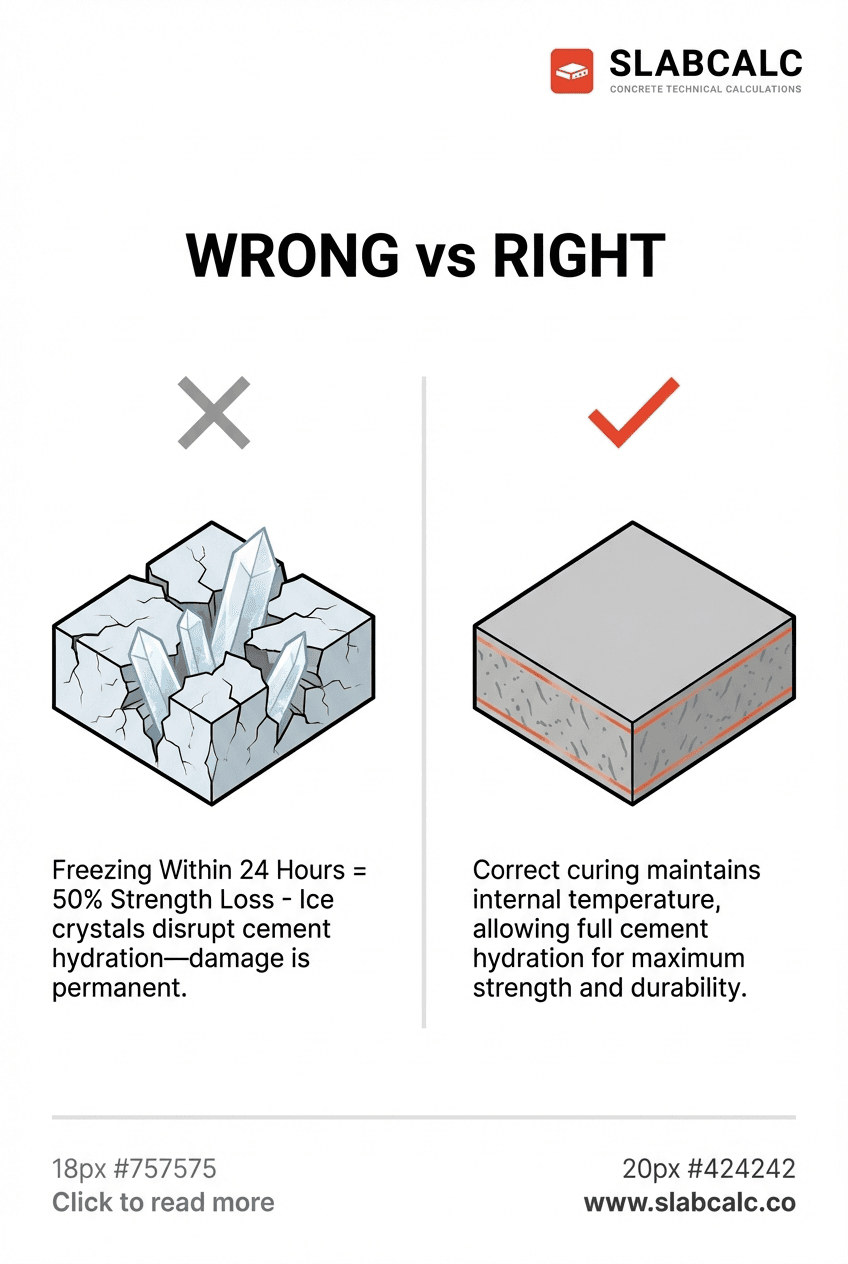
Freezing Within 24 Hours = 50% Strength Loss
The Math: $2,000 to $6,000 in Avoidable Damage
Pouring concrete when a freeze is within 24 hours costs you far more than simple protection. A typical 400-square-foot residential slab ($2,000–$3,000 in materials and labor) loses 50% of its design strength when ice crystals form during hydration. That's not a minor compromise—it means your slab will fail prematurely, crack under normal weight, and require costly removal and replacement. A 1,000-square-foot driveway or patio replacement runs $4,000–$6,000. Thermal protection before the pour costs $200–$600. The decision is mathematically simple.
How Freezing Destroys Concrete
Concrete gains strength through hydration—a chemical reaction between water and cement. This process is fragile below 50°F and effectively stops at 32°F. If the concrete surface freezes before it reaches 500 psi (typically 24–48 hours into the cure), expanding ice crystals rupture the cement paste from the inside. The damage is permanent. Once thawed, the concrete never fully recovers that lost strength. You cannot reheat it and expect a second chance.
Cheap vs. Expensive Protection Strategies
Budget Approach ($200–$300):
- Insulated blankets or tarps: $80–$150 for a 400 sq ft slab
- Accelerating admixture: $40–$80 per cubic yard
- Straw or fiberglass insulation: $60–$100
This combination keeps surface temperature above freezing for 24 hours. It works for shallow freezes (28–32°F nights) and buys your slab critical cure time. Installation takes 1–2 hours.
Mid-Range Approach ($400–$700):
- Heated enclosure (plastic sheeting + space heater): $250–$450
- Accelerating admixture: $40–$80
- Curing compound: $50–$100
- Temperature monitoring: $50–$120
This method maintains 50°F+ inside the enclosure, nearly doubling cure speed and eliminating freeze risk entirely. Requires daily monitoring and fuel costs ($10–$20 for a 48-hour window).
Expensive Approach ($800–$2,000+):
- Professional heated tent rental: $600–$1,200
- Concrete blankets (heavy-duty, reusable): $300–$500
- Curing blankets with thermostatic controls: $500–$1,500
- Calcium chloride accelerator: $100–$200
This approach is for critical slabs (commercial, structural) or extreme cold (below 20°F). Most DIYers and homeowners never need this tier.
Decision Framework
Postpone if:
- Temperature will drop below 25°F within 36 hours
- You lack time or budget for protection
- A hard freeze is forecasted
Protect with budget methods if:
- Temps will stay between 28–35°F overnight
- You have 4+ hours before the freeze
- Your slab is under 500 square feet
Use mid-range protection if:
- You're pouring a driveway or foundation (critical structural use)
- Temps will drop to 20–30°F for multiple nights
- You want to maintain normal curing speed
Check your local forecast 7 days out, then again 48 hours before the pour. A 24-hour window is your cutoff for safe scheduling. One cold night isn't worth $4,000–$6,000 in replacement costs.