
45 Bags = 1 Cubic Yard
The Magic Number: 45 Bags per Cubic Yard
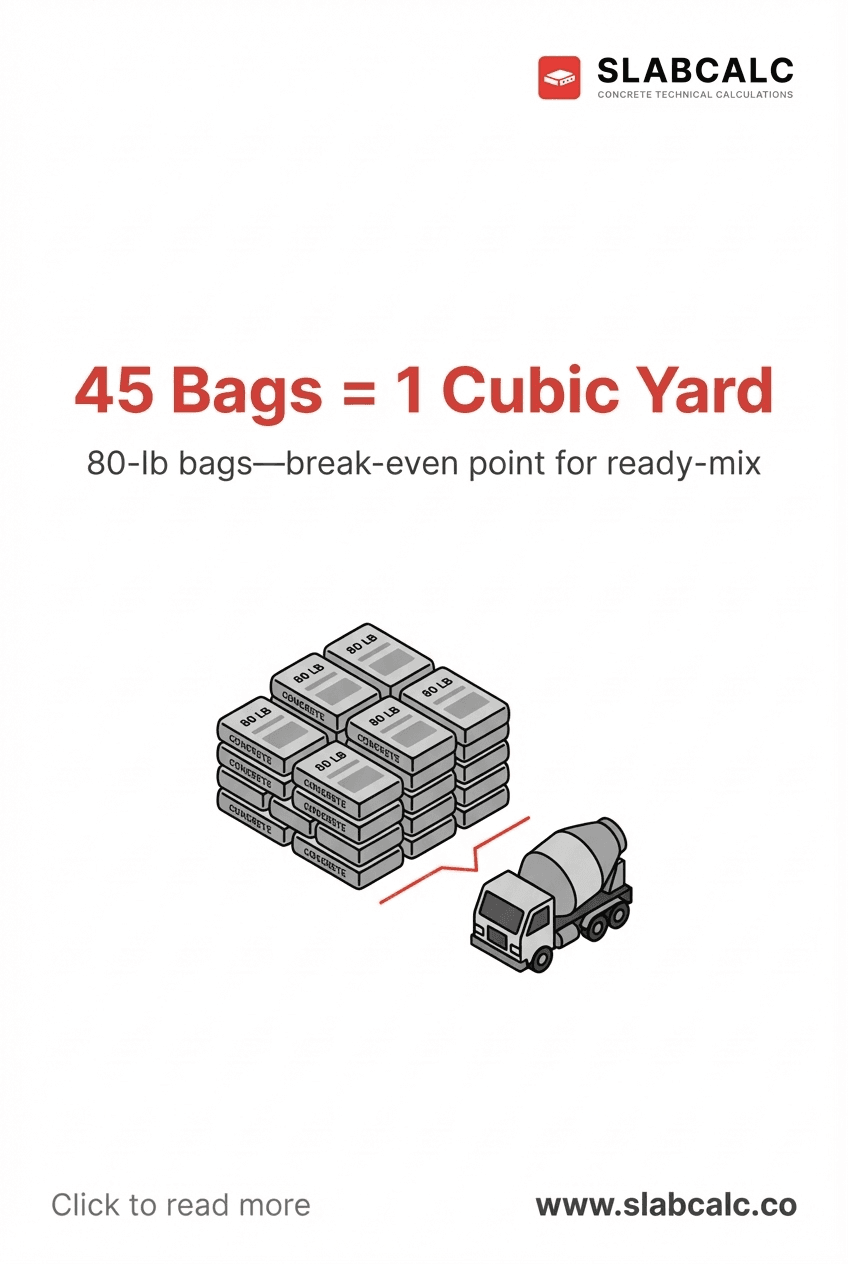
One cubic yard of concrete equals 45 bags of 80-pound bagged concrete mix. This is your critical break-even point for deciding whether to buy bags or order ready-mix.
Why 80-pound bags? Because they're the industry standard for DIY projects. A single 80-lb bag yields approximately 0.6 cubic feet when mixed with water. Multiply 0.6 × 45 bags = 27 cubic feet, which is exactly one cubic yard (3 feet × 3 feet × 3 feet).
Understanding this ratio prevents costly mistakes. Order too few bags, and you'll have a partially finished pour. Order too many, and you're left with hardened concrete taking up garage space.
When Bagged Concrete Makes Sense
Bagged concrete wins for small projects under 1 cubic yard.
Projects ideal for bagging:
- Concrete pads under 50 square feet
- Post holes (typically 0.5–1.5 cubic feet each)
- Small patios or stepping stone bases
- Repairs and spot work
Cost advantage: At $4–6 per 80-lb bag, a full cubic yard costs $180–270 in materials alone. Add labor mixing—typically 10–15 minutes per batch for two people—and bagged concrete becomes feasible for DIYers.
Durability: Bagged mixes meet ASTM C387 standards. When properly mixed and cured, they're equally as strong as ready-mix. The difference isn't strength; it's control and convenience.
Ready-Mix Advantage: The 45-Bag Threshold
Ready-mix becomes cheaper at 2 cubic yards and up.
A typical ready-mix truck delivery costs $150–200 regardless of volume, plus $60–80 per cubic yard. For 2 yards, you're paying roughly $270–360 total—cheaper than 90 bags at $180–270 per yard.
Ready-mix advantages beyond cost:
- No mixing labor: The truck mixer does the work
- Consistent quality: Professional batching eliminates water-ratio errors
- Speed: Pour an entire driveway in hours instead of days
- Finishing time: You get 90–120 minutes of workability, not 45 minutes
Ready-mix comes in strength grades: 3000 PSI (standard slabs), 3500 PSI (driveways), and 4000 PSI (heavy-load pads). Bagged mixes typically come in 4000 PSI formulations—overkill for most residential work but unnecessary expense.
Smart Sourcing Tips
For bagged concrete:
- Buy from big-box retailers (Home Depot, Lowes) for consistent pricing
- Check expiration dates; hydrated bags lose strength over time
- Purchase 10% extra for waste and overfill
- Store in a dry location; moisture degrades bagged mix
For ready-mix:
- Call three suppliers for quotes; prices vary 15–25%
- Order early morning or mid-week for better availability
- Confirm minimum order (usually 1 yard); some charge for partial loads
- Have your site prepped and forms set before the truck arrives—demurrage fees ($3–5/minute) apply for delays
The Real Question: Labor vs. Material
At exactly 45 bags per yard, you're indifferent on pure cost. But factor in your time. Mixing 45 bags takes 3–4 hours for two people. If you value your time at $25/hour, that's $150–200 in labor—suddenly ready-mix looks smart even for small projects.
For projects between 0.5 and 1.5 cubic yards, weigh your schedule against the convenience premium. Ready-mix costs more per cubic yard but saves a full afternoon of physical labor.