
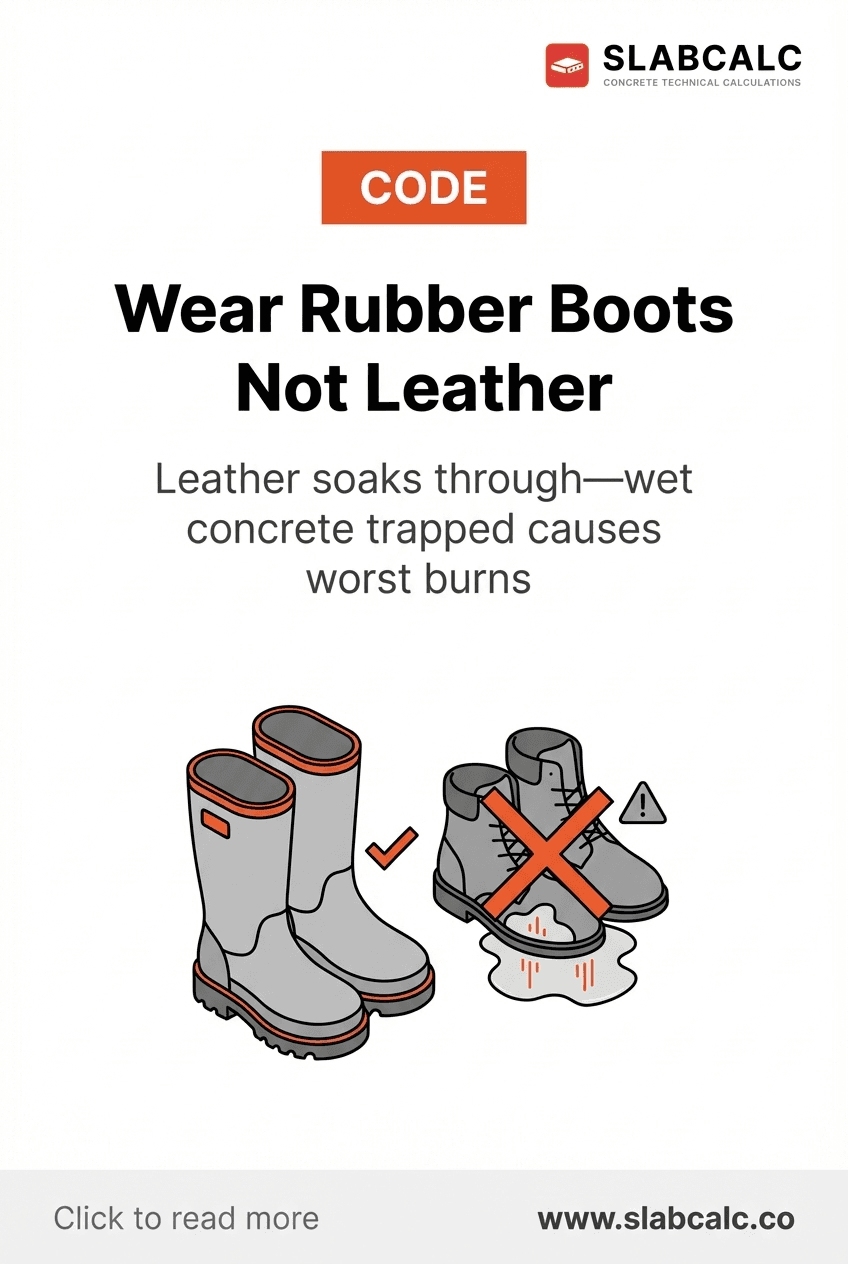
Wear Rubber Boots Not Leather
The Code Requirement Behind Boot Choice
The American Concrete Institute (ACI) and OSHA both mandate that workers in contact with wet concrete wear protective equipment rated for chemical exposure. While they don't explicitly ban leather, ACI 301-20 specifies that protective gear must prevent "prolonged contact between skin and portland cement slurry." Leather fails this test catastrophically. Rubber passes. Local building codes often reference these ACI standards, making rubber boots the practical legal standard on job sites.
Why Leather Absorbs and Traps Wet Concrete
Leather is porous. Its fibers naturally absorb moisture—that's why leather jackets darken when wet. Wet concrete soaks into leather boots through the upper seams, sides, and laces within minutes. Once inside, the concrete doesn't drain. It sits trapped against your skin, held in place by the boot's snug fit around your ankle and foot.
Rubber, by contrast, is non-porous. Water and concrete slurry bead up on the surface and run off. Wet concrete cannot penetrate rubber. This fundamental material difference is why a $25 pair of rubber boots offers better protection than a $150 leather work boot.
The Delayed Burn Problem
Portland cement creates calcium hydroxide with a pH of 12-13—equivalent to household bleach. This alkaline solution doesn't immediately hurt. Most people feel no pain for 2-8 hours while the chemical gradually destroys deeper skin layers. By the time your foot starts burning, severe tissue damage has already occurred.
A leather boot holds concrete against your skin for hours without drainage. A rubber boot allows you to rinse the concrete away immediately because it sits on the surface. You can wash your foot in the first 10 minutes—the critical window for preventing burns. With leather, the damage is already locked in.
Practical Violations You'll See on Sites
Many DIYers and contractors wear regular work boots or leather construction boots during pours because they "already own them" or think "a little concrete won't hurt." This is the most common violation. Others wear canvas sneakers or cotton-based boots—equally problematic because both materials absorb water.
The correct choice: dedicated rubber boots rated for concrete work, typically neoprene or PVC construction. Cost runs $30-60 per pair. Buy new ones for each project if needed—that's cheaper than treating a second-degree chemical burn.
Protect Your Entire Lower Leg
Pair rubber boots with rubber gloves (nitrile alone isn't thick enough) and long pants or coveralls. Concrete splatters up your shins during mixing and pouring. If it lands on skin, you have minutes to rinse it away. If it soaks into fabric touching your skin, the burn develops while you finish the pour.
Before your next concrete project, upgrade your footwear. Your skin's health depends on a material that keeps cement away from your body, not one that traps it. Use our concrete calculator to estimate your project scope, then invest in proper protection before your pour date.