

Freeze-Thaw Spalling in Concrete: Causes, Assessment & Repair Guide
Freeze-thaw spalling is the progressive flaking and scaling of concrete surfaces caused by repeated cycles of freezing and thawing. Water trapped in the concrete's pore structure expands by approximately 9% when it freezes, generating internal hydraulic pressure that exceeds the concrete's tensile strength and breaks away surface material. This damage is most severe in northern climates, near slab edges, and on surfaces exposed to de-icing salts.
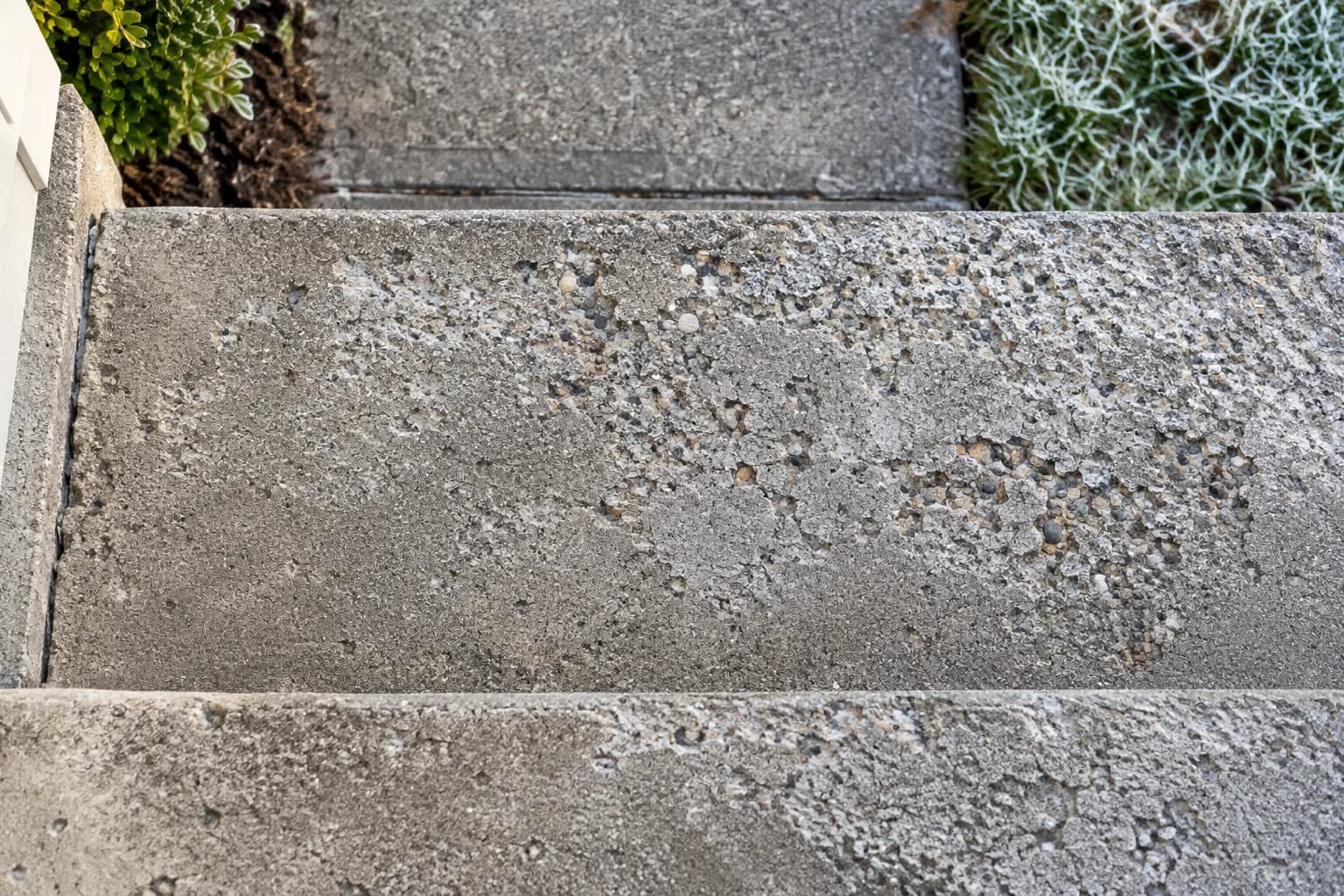
What Is Freeze-Thaw Spalling?
Freeze-thaw spalling is the deterioration of concrete surfaces caused by repeated cycles of water freezing and thawing within the material's pore network. Each cycle chips away more surface material, progressing from light roughening to deep pitting that exposes aggregate and, eventually, reinforcing steel.
The underlying physics were first described by T.C. Powers in his landmark 1949 paper for the Portland Cement Association. Powers' hydraulic pressure theory explains the mechanism: concrete contains a network of capillary pores ranging from 0.01 to 10 microns in diameter. When water in these pores freezes, it expands by approximately 9% in volume. In a confined space, this expansion generates hydraulic pressures that can reach 30,000 PSI — far exceeding concrete's tensile strength of 300 to 700 PSI. The excess pressure forces unfrozen water through the pore network toward the nearest free surface. If the travel distance is too great or the pore structure too tight, the pressure fractures the surrounding cement paste.
Three distinct types of freeze-thaw damage occur in concrete, and they are often confused:
Scaling is the loss of surface mortar paste, typically the top 1/16 to 1/8 inch. The surface becomes rough and pitted, with fine aggregate grains becoming visible. Scaling is the earliest and most common form of freeze-thaw damage.
Spalling involves the loss of larger fragments of concrete, typically 1/4 inch or deeper and several inches across. Spalls often break along planes of weakness such as the interface between the surface paste and coarse aggregate. Spalling represents a more advanced stage of deterioration.
Pop-outs are conical fragments that break out of the surface, typically 1 to 3 inches in diameter. They are caused by individual aggregate particles that absorb water and expand on freezing, pushing out the concrete above them. Certain aggregates — particularly some cherts, shales, and limestones with high porosity — are prone to causing pop-outs.
The standard laboratory test for freeze-thaw resistance is ASTM C666, "Standard Test Method for Resistance of Concrete to Rapid Freezing and Thawing." In this test, concrete specimens are subjected to 300 rapid freeze-thaw cycles (from 40 degrees F to 0 degrees F and back) while submerged in water. The relative dynamic modulus of elasticity is measured after each set of cycles. A durability factor of 60 or higher (out of 100) is generally considered acceptable performance. Companion test ASTM C672 specifically evaluates surface scaling resistance by ponding salt solution on horizontal surfaces through 50 freeze-thaw cycles.
Understanding which type of damage is present — and how deep it extends — determines whether the concrete can be repaired or must be replaced entirely.
What Causes Freeze-Thaw Spalling?
Freeze-thaw damage is never caused by a single factor. It results from the interaction between environmental exposure, concrete mixture properties, and construction practices. The following subsections address each contributing cause.
The Freeze-Thaw Mechanism
Ice formation in concrete does not happen all at once. Water in the largest pores freezes first, beginning at approximately 32 degrees F (0 degrees C). As temperatures drop further, water in progressively smaller capillary pores freezes — some pore water may not freeze until temperatures reach 0 degrees F or lower due to surface tension effects and dissolved salts.
The critical concept is critical saturation. Research by Fagerlund (1977) established that concrete can tolerate freezing as long as its pore network is less than approximately 91.7% saturated. Below this threshold, the air-filled portion of the pore space can accommodate the 9% expansion of freezing water. Above this threshold, hydraulic pressure has nowhere to go, and damage occurs.
The cumulative number of freeze-thaw cycles matters more than any single freeze event. Each cycle that exceeds the critical saturation threshold removes a thin layer of surface material. A single winter in Minneapolis or Chicago delivers 60 to 80 freeze-thaw cycles at the concrete surface. Over a 5-year period, that is 300 to 400 cycles of progressively deepening damage. Northern-tier states such as Minnesota, Wisconsin, and Michigan can see 80 to 100 cycles per year, while transition-zone states like Missouri or Virginia experience 20 to 40.
The rate of freezing also affects damage severity. Rapid freezing generates higher internal pressures because water cannot migrate to relief points fast enough. Thin concrete sections — such as sidewalk edges and slab corners — freeze faster than the interior of a thick slab, which explains why damage consistently appears first at edges and joints.
De-Icing Salts
De-icing salts are the single most damaging external factor for concrete freeze-thaw durability. Their effect goes beyond simply lowering the freezing point of water.
Sodium chloride (NaCl), the most common road salt, causes damage through several mechanisms. It creates osmotic pressure gradients that draw additional water into the concrete. As salt concentration varies with depth and across the surface, water migrates toward areas of higher concentration, increasing the degree of saturation above the critical threshold. Research by the Portland Cement Association found that a 3–4% NaCl solution (the concentration on a typical salted surface) produces more scaling damage than either pure water or higher salt concentrations.
Calcium chloride (CaCl2) is a more aggressive de-icer. In addition to the osmotic effects shared with sodium chloride, calcium chloride reacts chemically with the calcium hydroxide in cement paste to form calcium oxychloride — a compound that occupies more volume than its reactants, generating expansive pressure within the paste independent of freezing. This chemical attack can damage concrete even without freeze-thaw cycling.
Magnesium chloride (MgCl2), increasingly popular because it works at lower temperatures, is the most chemically aggressive common de-icer. It reacts with calcium silicate hydrate (C-S-H) — the primary binding compound in hardened cement paste — converting it to non-cite magnesium silicate hydrate with substantially lower strength. This fundamentally weakens the concrete matrix.
The practical guidance is straightforward: avoid all chloride-based de-icers on residential concrete whenever possible. Sand provides traction without chemical damage. Calcium magnesium acetate (CMA) is a chloride-free alternative, though it costs roughly 20 times more than rock salt.
Inadequate Air Entrainment
Air entrainment is the most effective defense against freeze-thaw damage, and its absence is the most common cause of premature spalling in concrete placed in cold climates.
ACI 318, "Building Code Requirements for Structural Concrete," Table 19.3.3.1 specifies required air content based on exposure class and nominal maximum aggregate size. For concrete with 3/4-inch aggregate in severe freeze-thaw exposure (Exposure Class F2 or F3), the target air content is 6%, with an acceptable range of 4.5% to 7.5%. For 1-inch aggregate, the target drops to 5.5%. For 1.5-inch aggregate, it is 4.5%.
The air voids must be properly distributed. The spacing factor — the average maximum distance from any point in the paste to the nearest air void — must not exceed 0.008 inches (0.20 mm) per PCA guidelines. This ensures that hydraulic pressure generated at any point in the paste can reach a relief void before exceeding the tensile strength. ASTM C457, "Standard Test Method for Microscopical Determination of Parameters of the Air-Void System in Hardened Concrete," is used to verify spacing factor in hardened concrete.
Non-air-entrained concrete exposed to freeze-thaw conditions typically begins showing surface scaling within 1 to 3 winters. Air-entrained concrete with proper void spacing can endure hundreds of freeze-thaw cycles with minimal surface damage. Studies by the PCA have documented that non-air-entrained concrete has approximately 5 times the scaling rate of properly air-entrained concrete under identical exposure conditions.
Common reasons for inadequate air entrainment in field concrete include: the admixture being omitted from the mix order, overdosing of water reducers that destabilize the air void system, excessive vibration during placement that drives out entrained air, or use of fly ash or other pozzolans that reduce air content without compensating admixture adjustments.
Poor Finishing Practices
Finishing practices directly affect the durability of the concrete surface layer — the first material to be attacked by freeze-thaw cycling.
Overfinishing (excessive troweling) densifies the surface paste, closing off bleed channels and pore connections to entrained air voids. The result is a thin, paste-rich surface layer with minimal air void access that is extremely vulnerable to scaling. Steel troweling flatwork that will be exposed to freeze-thaw conditions is generally discouraged; a broom or float finish is preferred for exterior concrete.
Premature finishing occurs when finishers work the surface before bleed water has fully risen to the top and evaporated. The bleed water gets trapped beneath the finished surface, creating a weak, high water-cement ratio layer with poor paste quality. This layer scales off in the first winter, sometimes dramatically. The correct practice is to wait until the bleed water sheen disappears and the concrete can support the weight of a finisher on kneeboards before any finishing operations.
Adding water to the surface during finishing (sometimes called "blessing" the surface) raises the local water-cement ratio and produces the same weak surface layer as premature finishing. This practice should never be used.
Insufficient Curing
Concrete placed in late fall is particularly vulnerable to freeze-thaw damage because it may not achieve sufficient strength and hydration before the first freeze. The critical threshold is 500 PSI compressive strength — ACI 306R, "Guide to Cold Weather Concreting," specifies this as the minimum strength before concrete can withstand one cycle of freezing and thawing.
Standard concrete under normal curing conditions reaches 500 PSI within approximately 24 hours and 3,500 PSI within 7 days. However, at lower curing temperatures, strength development slows dramatically. At 50 degrees F, concrete develops strength at roughly half the rate it does at 70 degrees F. At 40 degrees F, the rate drops further. Below 25 degrees F, hydration effectively stops.
Concrete that freezes before reaching 500 PSI can lose up to 50% of its potential 28-day strength and will have permanently compromised freeze-thaw durability. Protection measures for late-season pours include insulating blankets, heated enclosures, and the use of Type III (high-early-strength) cement or accelerating admixtures to reach 500 PSI faster.
How to Identify Freeze-Thaw Damage
Freeze-thaw damage follows a predictable visual progression. In the first winter, the surface develops a rough, sandpaper-like texture as the top layer of paste erodes. By the second or third winter, fine aggregate becomes visible and the surface begins to pit. In subsequent years, coarse aggregate is exposed, larger pieces spall off, and delamination planes develop beneath the surface. Left untreated, the damage reaches reinforcing steel within 5 to 10 years, at which point corrosion begins and the deterioration accelerates.
Damage is consistently worst at slab edges, expansion joints, and areas where water pools. These locations have the highest moisture saturation and freeze first due to three-sided heat loss. The center of a well-drained slab is often the last area affected.
The following diagnostic table helps distinguish freeze-thaw spalling from other concrete defects that may look similar at first glance:
| Feature | Freeze-Thaw Spalling | Shrinkage Cracking | ASR Damage |
|---|---|---|---|
| Appearance | Surface flaking, pitting | Fine crack lines | Map cracking + white gel |
| Pattern | Worst at edges, joints, pooling areas | Random across surface | Uniform across surface |
| Depth | Surface to 1" progressive | Hairline; can be full depth (no offset) | Throughout section |
| Season | Worsens each winter | Stable after cure | Year-round progression |
| Sound test | Hollow (delaminated areas) | Solid | Solid or dull |
A hammer sounding test is the most reliable field diagnostic for delamination. Tap the surface systematically with a 2-pound ball-peen hammer or drag a heavy chain across it. Sound concrete produces a clear, ringing tone. Delaminated concrete — where an internal fracture plane has separated the surface layer from the substrate — produces a distinctly hollow, drumming sound. Mark all hollow areas with chalk; these zones must be removed entirely before any repair.
Not sure what's causing your concrete damage? Upload a photo to the AI crack analyzer
Severity Assessment
Freeze-thaw spalling severity determines the appropriate repair strategy. The following table provides assessment criteria, recommended actions, and estimated costs for a typical residential slab (400 to 600 square feet).
| Severity | Description | Depth | Area | Recommended Action | Est. Cost |
|---|---|---|---|---|---|
| 1 | Surface roughening only | <1/16" | Small spots | Seal to prevent progression | $25–$75 |
| 2 | Light scaling, paste loss visible | 1/16"–1/8" | <25% of surface | DIY resurfacer + sealer | $50–$200 |
| 3 | Moderate — aggregate exposed | 1/8"–1/4" | 25-50% | Professional overlay | $1,500–$3,500 |
| 4 | Severe — deep spalling, delamination | >1/4" | >50% | Full replacement | $3,000–$9,000 |
| 5 | Structural compromise — rebar exposed | Full depth | Major sections | Emergency replacement | $5,000–$15,000+ |
Full 1–5 severity scale explained
The critical boundary is between severity 2 and severity 3. Severity 1 and 2 damage is cosmetic and can be addressed with surface treatments that are well within DIY capability. Severity 3 marks the transition to structural concern — once coarse aggregate is exposed, the damage extends through the wearing surface into the body of the slab, and surface resurfacers alone will not provide a lasting repair. Severity 4 and 5 generally require full or partial slab replacement.
When assessing severity, check the worst area of the slab, not the average. A slab that is mostly severity 2 but has severity 4 damage at the garage apron joint needs professional attention at that joint — the severity 2 areas can be addressed separately.
How to Repair Freeze-Thaw Damage
The repair approach depends entirely on damage depth and extent. The following step-by-step process covers the full range from light scaling to deep spalling.
Step 1: Assess the damage depth. Measure exposed aggregate depth with a ruler or depth gauge. Tap the surface with a hammer or chain-drag to identify delaminated areas that sound hollow. Mark all affected zones with chalk or spray paint. Document the extent for material estimation — you will need to know both the area and the average depth of repair.
Step 2: Remove loose material. Use a cold chisel and hammer to remove all loose, flaking concrete back to sound material. For large areas, a rotary hammer with a scaling chisel attachment significantly speeds the work. A concrete scarifier (milling machine) is the most efficient option for extensive surface scaling across large areas. The critical requirement is removing all material that is not firmly bonded to the substrate — do not leave loose or crumbling edges.
Step 3: Prepare the surface. Clean the prepared area with a pressure washer at 3,000 PSI or higher to remove dust, debris, and any remaining loose particles. Allow the surface to dry to SSD (saturated surface dry) condition — damp throughout but with no standing water. For deep repairs, apply a concrete bonding agent per the manufacturer's instructions. The substrate must be clean, sound, and properly profiled for the repair material to bond.
Step 4: Apply repair material. Material selection depends on repair depth:
- For depths under 1/2 inch, use a polymer-modified concrete resurfacer. Mix to a pourable consistency and spread with a long-handled squeegee. Work in sections small enough to finish before the material begins to set (typically 10 to 20 minutes depending on temperature).
- For depths of 1/2 inch to 2 inches, use a polymer-modified repair mortar. Trowel into the prepared cavity, slightly overfilling, then strike off level with the surrounding surface.
- For depths over 2 inches, use standard concrete with a bonding agent. Form edges as needed and place in lifts no thicker than 2 inches, allowing each lift to reach initial set before placing the next.
Apply in lifts no thicker than the manufacturer's specified maximum — typically 1/2 inch per lift for resurfacers and 1 inch for repair mortars. Exceeding the maximum lift thickness causes shrinkage cracking and delamination of the repair.
Step 5: Cure and seal. Moist-cure the repair for a minimum of 24 hours by covering with plastic sheeting or wet burlap. Do not allow the repair to dry out during the initial cure period. After 7 days of curing, apply a penetrating silane or siloxane sealer to the entire slab surface — not just the repaired areas. This prevents moisture from re-entering the concrete and causing future damage. Reapply the sealer every 3 to 5 years for ongoing protection.
Repair Products Comparison
| Product Type | Best For | Coverage | Approx. Cost | Durability |
|---|---|---|---|---|
| Concrete resurfacer (polymer-modified) | Light scaling, <1/2" depth | 40 sq ft/bag | $25–$40/bag | 3–5 years |
| Repair mortar (polymer-modified) | Deeper spalls, 1/2"–2" | Varies | $15–$30/bag | 10+ years |
| Micro-topping system | Contractor-applied overlay | 100+ sq ft/kit | $3–$6/sq ft installed | 5–10 years |
| Penetrating sealer (silane/siloxane) | Prevention + post-repair | 200–300 sq ft/gal | $30–$60/gal | 5–10 years |
A note on bonding: the most common reason for repair failure is poor bond between the new material and the existing concrete. The substrate must be clean, sound, at proper moisture condition, and profiled. Applying repair material over dust, standing water, or loose concrete guarantees failure regardless of product quality.
DIY vs. Professional
The decision between DIY repair and hiring a professional depends on damage severity, total area, and whether structural concerns exist.
DIY is appropriate for severity 1 and 2 damage — surface roughening and light scaling where damage is limited to the top 1/8 inch and affects less than 25% of the slab surface. The required tools (pressure washer, mixing drill, squeegee, trowel) are available at rental centers, and resurfacer products from major manufacturers are widely available at home improvement stores. Total material cost for resurfacing a 400-square-foot driveway at severity 2 is typically $100 to $250, plus $30 to $60 for sealer.
Professional repair is recommended for severity 3 damage — moderate spalling with exposed aggregate covering 25% or more of the surface. Professional concrete overlay systems provide better performance than retail resurfacers for deeper damage. Contractors have access to commercial-grade polymer-modified mortars, spray-applied micro-toppings, and the equipment to prepare large areas efficiently. Expect to pay $3 to $6 per square foot for a professional overlay, or $1,500 to $3,500 for a typical driveway.
Full replacement is the practical choice for severity 4 and above — deep spalling with delamination covering more than 50% of the surface. At this point, the cost of overlay repair approaches the cost of replacement, and the overlay's lifespan on a severely damaged substrate is unpredictable. Replacement provides a fresh slab with proper air entrainment, correct finishing, and a full service life. Budget $8 to $15 per square foot for removal and replacement, or $3,200 to $9,000 for a 400 to 600 square foot slab.
Cost Comparison Summary
| Approach | Severity Range | Typical Cost (400-600 sq ft) | Expected Lifespan |
|---|---|---|---|
| DIY resurfacer + sealer | 1–2 | $100–$300 | 3–5 years |
| Professional overlay | 2–3 | $1,500–$3,500 | 5–10 years |
| Partial replacement | 3–4 (localized) | $2,000–$5,000 | 20–30 years |
| Full slab replacement | 4–5 | $3,200–$9,000 | 25–40 years |
The key economic insight: DIY resurfacing is a cost-effective way to buy time (3 to 5 years) while planning and budgeting for eventual replacement. It is not a permanent fix for concrete with fundamental freeze-thaw vulnerability due to absent air entrainment.
Prevention Strategies
Preventing freeze-thaw spalling is far more cost-effective than repairing it. The following measures, listed in order of effectiveness, apply to both new construction and existing concrete.
Specify air-entrained concrete. For any exterior concrete in freeze-thaw climates, specify air content of 4% to 7% per ACI 318 Table 19.3.3.1. Verify air content at the job site with an ASTM C231 pressure meter before placement. Air entrainment adds approximately $2 to $4 per cubic yard to the concrete cost — a trivial amount relative to premature replacement. This single measure is responsible for more freeze-thaw durability than all other factors combined.
Cure properly. Maintain concrete at 50 degrees F or above for a minimum of 7 days after placement (ACI 308R). For late-season pours, use insulating blankets, heated enclosures, or Type III high-early-strength cement. Never allow fresh concrete to freeze before it reaches 500 PSI compressive strength. Proper curing produces a denser, less permeable surface with better resistance to moisture intrusion.
Avoid chloride-based de-icers. Use sand, kitty litter, or calcium magnesium acetate (CMA) for winter traction on residential concrete. If chloride de-icers are unavoidable (municipal road treatment, for example), apply a penetrating sealer to reduce chloride and water absorption. Never apply de-icers to concrete less than one year old — the surface is not yet mature enough to resist the chemical and physical effects.
Apply penetrating sealer every 3 to 5 years. Silane and siloxane sealers penetrate into the concrete pore structure and chemically react with the paste to create a hydrophobic barrier. This reduces water absorption by up to 95% without changing the surface appearance or creating a film. Apply to clean, dry concrete at the manufacturer's recommended coverage rate (typically 200 to 300 square feet per gallon). Two coats are recommended for maximum protection. Unlike film-forming sealers, penetrating sealers do not peel, bubble, or create a slippery surface.
Ensure proper drainage. Concrete flatwork should slope a minimum of 1/8 inch per foot (1% grade) away from structures and toward drainage points. Water that pools on concrete surfaces maintains high saturation levels and dramatically increases freeze-thaw damage. Check that downspouts discharge away from slabs, that grade around the slab directs water away, and that joint sealant is intact so water does not infiltrate through joints.
Do not finish before bleed water evaporates. Educate your contractor (or yourself) that premature finishing traps bleed water and creates a weak surface layer. The surface should not be troweled until the bleed water sheen has completely disappeared. For exterior concrete in freeze-thaw climates, a broom finish or float finish provides better durability than a hard trowel finish.
For more on sealer selection, see our guide to concrete sealer types. For ongoing maintenance schedules, see the concrete maintenance guide.
Climate Risk by Region
Not all US regions face equal freeze-thaw risk. The critical variable is the number of freeze-thaw cycles per year at the concrete surface, which depends on both the climate and the degree of moisture exposure.
Wet-freeze zones (highest risk): The Great Lakes states, Upper Midwest, and Northeast experience the most damaging conditions. Cities such as Minneapolis, Milwaukee, Chicago, Detroit, Cleveland, Buffalo, and Boston see 60 to 100 freeze-thaw cycles per year, combined with high precipitation and widespread road salt usage. Concrete in these areas requires air entrainment, proper finishing, and regular sealer application to achieve a normal service life.
Dry-freeze zones (moderate risk): The northern Mountain West — Denver, Salt Lake City, Boise — sees frequent freezing but lower precipitation. With fewer cycles of water saturation followed by freezing, concrete lasts longer here than in the wet-freeze belt, though air entrainment is still essential. These areas typically experience 40 to 60 freeze-thaw cycles annually.
Transition zones (lower risk): The Mid-Atlantic states, central Plains, and Pacific Northwest see 10 to 40 cycles per year. Cities like Kansas City, St. Louis, Nashville, and Portland experience enough freeze-thaw cycling to damage non-air-entrained concrete over time, but the rate of deterioration is slower. Sealing is beneficial; air entrainment is recommended but not as critical as in the northern tier.
Minimal freeze-thaw zones: The Deep South, Desert Southwest, and Southern California experience fewer than 10 freeze-thaw cycles annually. Concrete spalling in these regions is almost always caused by factors other than freeze-thaw — typically corrosion of embedded steel, alkali-silica reaction, or sulfate attack.
The USDA Plant Hardiness Zone map correlates roughly with freeze-thaw risk: Zones 3 through 5 (northern tier) face the highest concrete damage rates, Zones 6 through 7 (transition) face moderate risk, and Zones 8 and above face minimal freeze-thaw concern.
Cost Estimates
The following table consolidates all repair and prevention costs for freeze-thaw spalling on a typical residential slab (400 to 600 square feet).
| Option | Scope | Material Cost | Installed Cost | Expected Life |
|---|---|---|---|---|
| Penetrating sealer (prevention) | Entire slab | $30–$60 | $150–$400 (professional) | 3–5 years per application |
| DIY concrete resurfacer | Light scaling, severity 1–2 | $100–$250 | N/A (DIY) | 3–5 years |
| Professional overlay | Moderate spalling, severity 2–3 | — | $1,500–$3,500 | 5–10 years |
| Partial slab replacement | Localized severe damage | — | $2,000–$5,000 | 20–30 years |
| Full slab replacement | Widespread severity 4–5 | — | $3,200–$9,000 | 25–40 years |
| Full replacement + sealer program | New slab + ongoing sealer | — | $3,500–$9,500 | 40+ years |
The most cost-effective long-term strategy for severely damaged concrete is full replacement with air-entrained concrete followed by a regular sealer program every 3 to 5 years. This provides a 40-year or longer service life for a total cost (replacement plus 8 to 10 sealer applications) of approximately $4,000 to $10,000.
For a detailed breakdown of concrete costs in your area, use the concrete cost calculator.
Key Takeaways
- Freeze-thaw spalling is caused by water freezing and expanding 9% within concrete pores, generating pressures up to 30,000 PSI that exceed the material's tensile strength.
- Air entrainment (4–7% per ACI 318) is the single most effective prevention measure, reducing damage rates by approximately 5x compared to non-air-entrained concrete.
- De-icing salts — especially calcium chloride and magnesium chloride — dramatically accelerate spalling through osmotic pressure and direct chemical attack on cement paste.
- Damage severity determines the repair approach: DIY resurfacing for severity 1–2, professional overlay for severity 3, and full replacement for severity 4–5.
- Penetrating silane/siloxane sealers reduce water absorption by up to 95% and should be applied every 3 to 5 years on all exterior concrete in freeze-thaw climates.
- Overfinishing, premature finishing, and insufficient curing create a weak surface layer that is highly susceptible to first-winter scaling.
- The wet-freeze zones of the Great Lakes, Upper Midwest, and Northeast average roughly 60 to 100 air freeze-thaw cycles per year. The highest counts in the US are not there but in the high-altitude interior West, where a large day-night temperature swing crosses freezing on most winter days — Carson City, Nevada averages 174 cycles a year against St. Paul, Minnesota's 81. See the SlabCalc Freeze-Thaw Index for the figure in your city.
Next Steps
- Upload a photo for AI damage analysis to get a severity rating and repair recommendation for your specific slab.
- Concrete spalling repair guide for detailed repair procedures with product recommendations.
- Winter concrete damage repair guide for cold-weather-specific repair scheduling and materials.
- Concrete sealer types compared to choose the right sealer for your climate and concrete condition.
- Concrete slab calculator to estimate material quantities for partial or full replacement.
- Concrete cost calculator for per-square-foot pricing in your metro area.
- SlabCalc Freeze-Thaw Index to look up how many freeze-thaw cycles your city records each year and the air content that exposure calls for.