36-48 Inches Wide Standard
The Common Width Mistake
Most homeowners default to narrow sidewalks—sometimes just 24 or 30 inches wide—thinking they'll save money and materials. The result? A walkway that feels cramped, forces two people to shuffle single-file, and may not meet local accessibility codes. Within a year or two, family and visitors are stepping onto your lawn to pass each other. You've saved concrete but created an awkward, unusable space.
The Professional Standard: 36 to 48 Inches
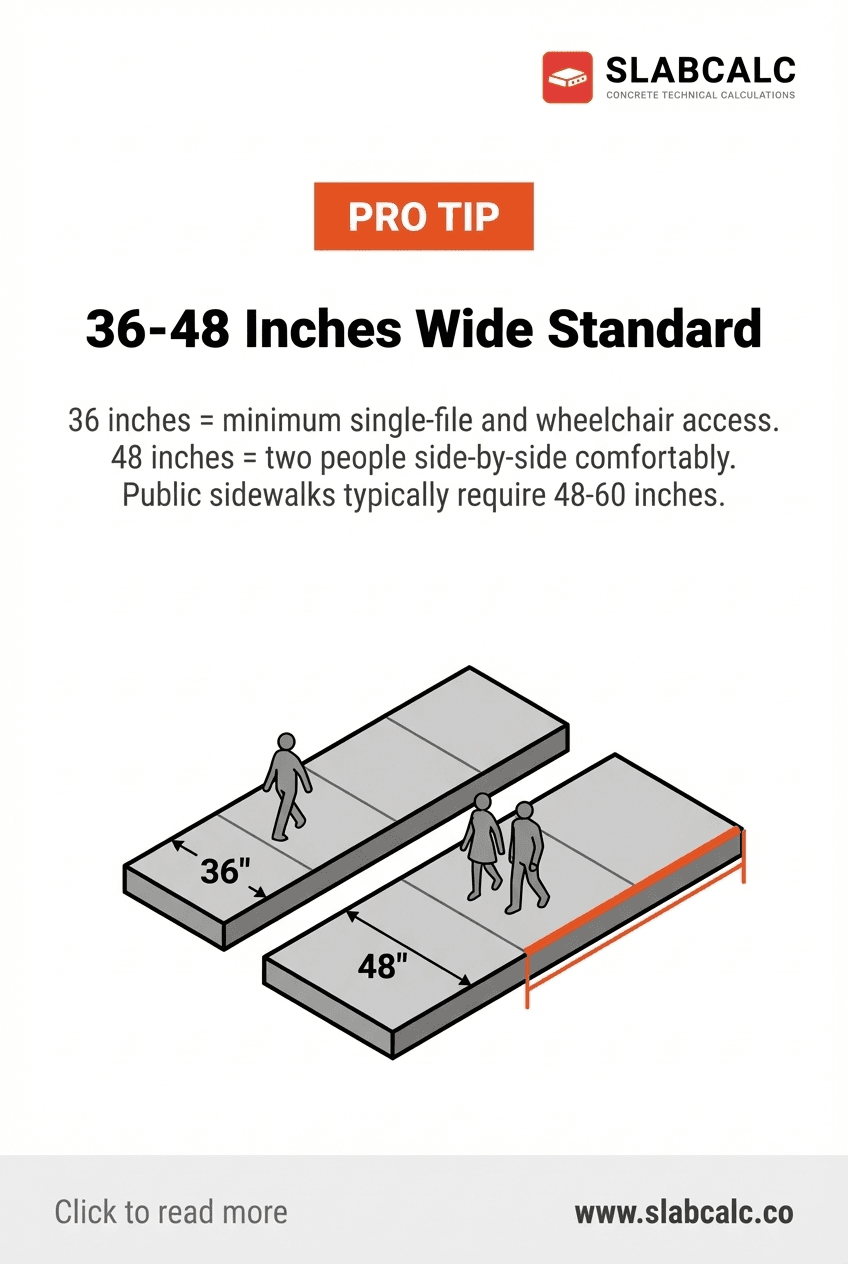
Here's what contractors know: 36 inches is the absolute minimum for residential sidewalks, and 48 inches is the comfortable standard.
Why the range? Because it depends on how the sidewalk will be used:
- 36 inches provides single-file passage and meets wheelchair accessibility requirements (ADA minimum is 36 inches). This works for side yards or narrow spaces.
- 48 inches allows two adults to walk side-by-side comfortably without brushing shoulders. This is ideal for primary routes, front walkways, and high-traffic areas.
Public sidewalks and municipal standards typically demand 48–60 inches because they anticipate heavier foot traffic and universal accessibility.
Why Width Matters More Than You Think
A narrow sidewalk forces behavior changes. Visitors instinctively step off to let others pass. Children on bikes must dismount or risk collision. Delivery personnel struggle with hand trucks. Over time, people create alternate paths—wearing grass, compacting soil, and eventually creating mud in wet weather.
A properly sized sidewalk (48 inches) eliminates these problems entirely. The cost difference between 36 and 48 inches is minimal: roughly 33% more material for the same thickness and length. For a 50-foot walkway at 4 inches thick, you're talking about an extra 50-60 square feet of concrete—perhaps $30–$50 in material.
The functional improvement is enormous.
Step-by-Step Width Selection
1. Determine the sidewalk's primary function. Is it a main entry path, secondary route, or side-yard passage?
2. Check local codes. Some jurisdictions mandate minimum widths. Review your town's sidewalk specifications before designing.
3. Measure your space. Can you physically accommodate 48 inches, or are you constrained by property lines, utilities, or landscaping?
4. Plan for accessibility. If elderly relatives, wheelchair users, or families with strollers will use the sidewalk, 48 inches is non-negotiable.
5. Build slightly wider if possible. Future-proofing your sidewalk with an extra 6–12 inches costs little now but pays dividends forever.
The Bottom Line
Don't cheap out on width. A 36-inch sidewalk is code-compliant but feels cramped. A 48-inch sidewalk is the professional choice—it's comfortable, accessible, and worth the minimal extra cost. Public sidewalks often exceed 48 inches (reaching 60 inches), and there's a reason: width creates usability.
When you're at SlabCalc calculating concrete needs, plug in 48 inches for your primary walkways. Your future self—and everyone who walks there—will thank you.