
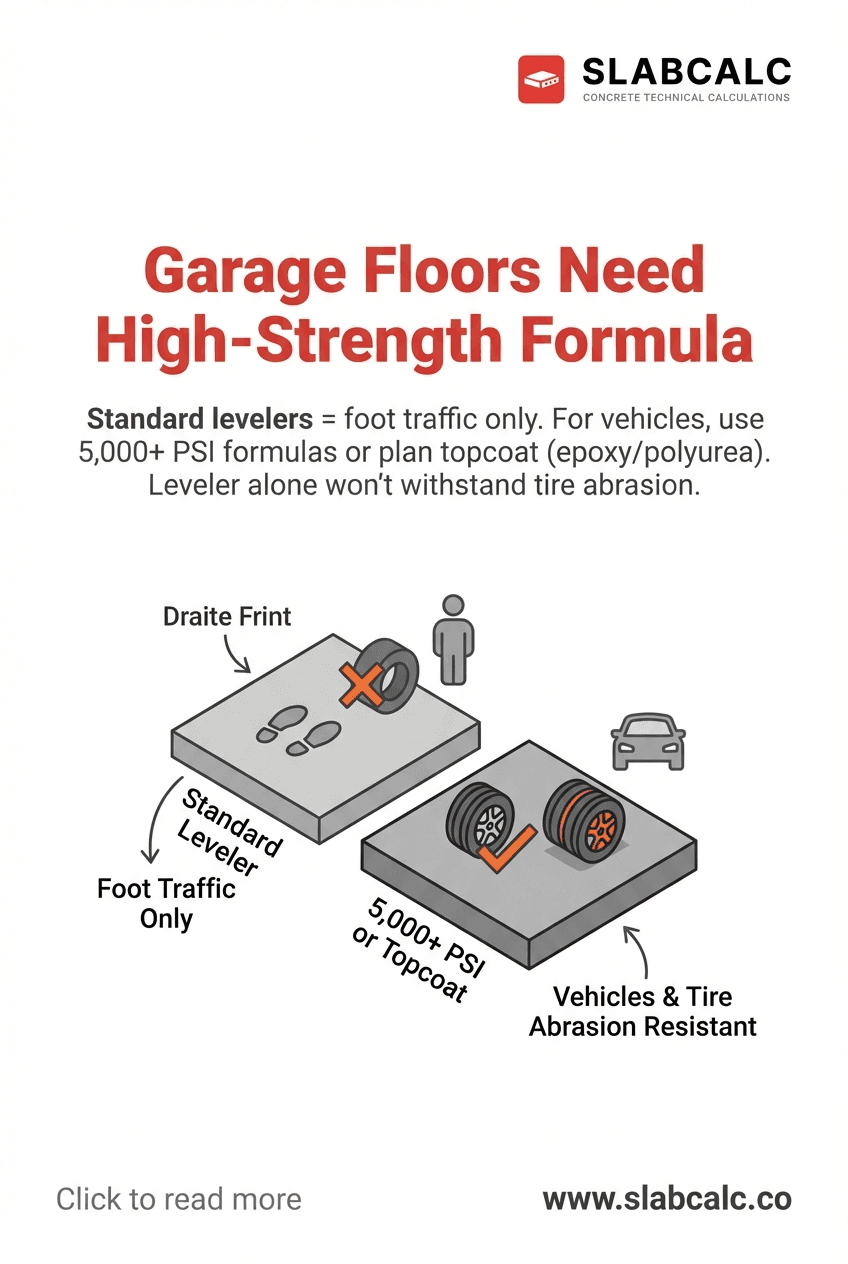
Garage Floors Need High-Strength Formula
The Costly Mistake: Powder Under Your Tires
Within 6–12 months, you'll notice white or gray dust tracking across your garage. Your car tires are grinding standard self-leveling compound into powder. By year two, surface spalling (flaking and pitting) becomes visible, and the leveler begins separating from the base concrete. A full replacement costs $800–$1,500 for a two-car garage. This mistake is 100% preventable.
Why Standard Levelers Fail
Standard self-leveling compounds are engineered for foot traffic only. They typically achieve 3,500–4,500 PSI compressive strength—adequate for residential floors under rugs, tile, or vinyl. However, a car tire concentrates 300–500 pounds per square inch of force on a contact patch just 2–3 inches wide. Over thousands of parking cycles, this repetitive grinding abrades the leveler surface and causes micro-fracturing below.
The root cause: manufacturers optimize standard levelers for flow and workability, not durability under vehicle abuse. Adding the cement and aggregate needed for 5,000+ PSI strength increases viscosity, making the product harder to self-level and pour flush.
How to Spot the Problem Early
Before installing: Check the product label. If it lists 3,500–4,500 PSI, it's standard-duty. You need 5,000 PSI minimum for any garage that will hold vehicles. Common standard-strength products include Ardex K-301 and Henry 555 LevelPro—both excellent for living spaces, wrong for garages.
After installation (first 3 months): Walk your garage on a cloudy day with side-lighting. If you see fine dust or hairline cracks in the leveler surface, moisture is entering micro-fractures. This progression accelerates once vehicles start parking.
Prevention Checklist
Material selection:
- Specify high-strength or rapid-set levelers rated 5,000–7,000 PSI
- Recommended brands: Sika Level-125 (5,500 PSI), Custom LevelQuik RS (6,000 PSI), Mapei Novoplan 2 Plus (5,200 PSI)
- Cost difference: $10–$20 per bag vs. standard formulas—a $50–$100 premium for a 2-car garage
Application best practices:
- Apply leveler in depth increments no deeper than 1 inch per layer; wait 24 hours between coats
- Ensure base concrete is clean, dry, and primed (use concrete primer for porous surfaces)
- Maintain 50–85°F ambient temperature during cure (standard levelers need 48–72 hours full strength)
Long-term protection:
- After leveler cures fully, apply epoxy or polyurea topcoat (adds another 5–10 years of protection)
- Two-part epoxy ($150–$300 for 2-car garage) creates a wear layer that shields the leveler from tire abrasion
- Polyurea is faster-curing but more expensive ($300–$500)
The Bottom Line
Don't assume all self-leveling compounds work for garages. Standard formulas are designed for interior finishes, not vehicles. Spend an extra $50–$100 on high-strength leveler, and you'll avoid a $1,500 replacement five years later. If budget is tight, use standard leveler but commit to an epoxy topcoat immediately after cure. Either path beats the dust and cracking you'll face with a standard formula alone.