
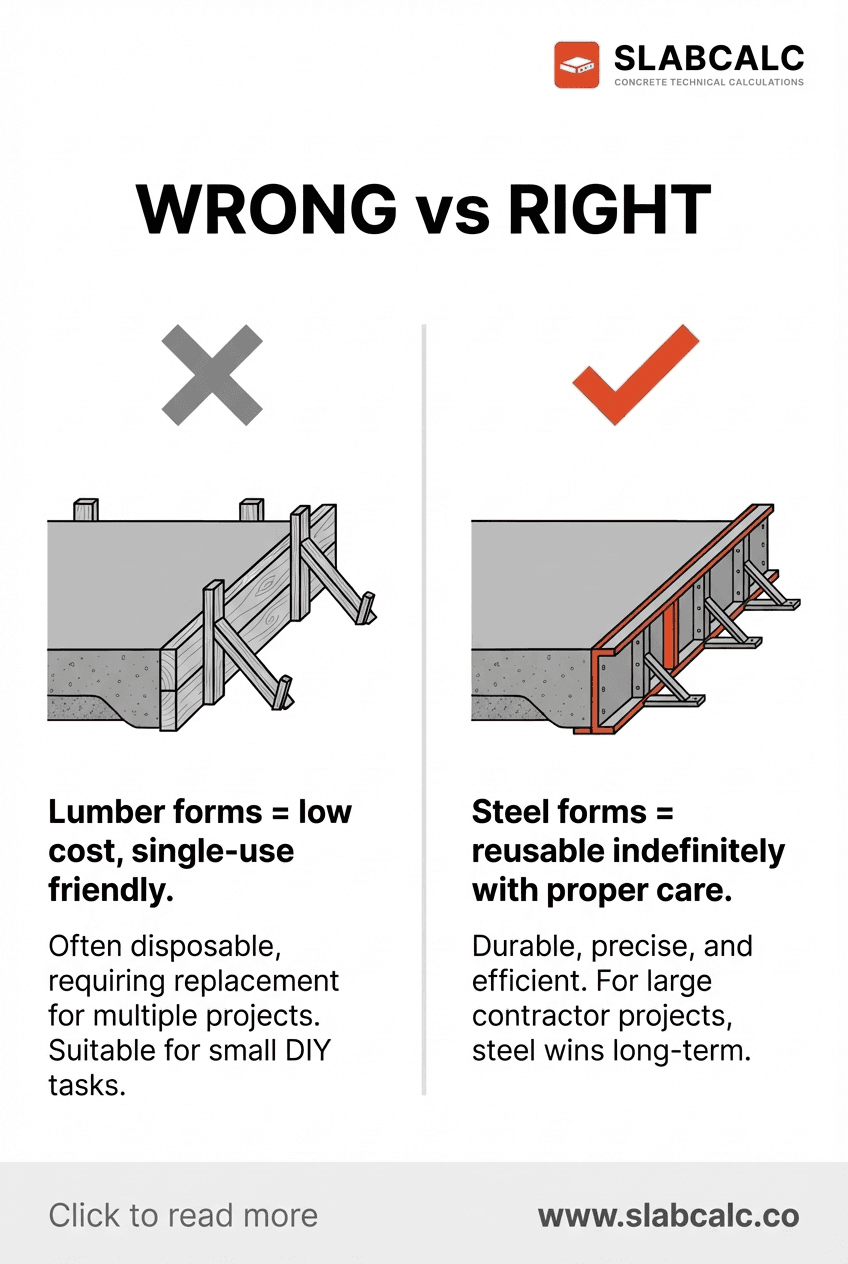
Lumber vs Steel Forms
The Quick Decision Tree
Are you pouring one slab? → Use lumber forms. Buy 2×4s or 2×6s, use them once, recycle or repurpose the boards. Cost per project: $80–$150.
Planning 3+ projects over 2–3 years? → Consider steel forms. Rental costs $200–$400 per month; ownership pays back after 4–5 pours.
Running a contracting business? → Steel forms are non-negotiable. Reusable indefinitely with maintenance, faster setup, zero warping.
Why Lumber Forms Work for DIY Projects
Dimensional lumber is the standard for residential concrete work because it's forgiving and cheap. A 4-inch slab needs 2×4 form boards (3.5" actual thickness), which cost $3–$8 per 8-foot board depending on lumber prices and your region.
Advantages:
- Minimal upfront investment
- Available at any big-box retailer
- Easy to cut, modify, and adjust on-site
- No rental agreements or return deadlines
- Wood stakes hold forms securely with basic staking
Critical limitation: Lumber warps. Even pressure-treated 2×4s absorb moisture and bow over time. A warped form board creates a permanent wave in your concrete edge. Always sight down boards before purchase and use the straightest material available.
For a typical 10×12-foot patio slab (4 inches thick), expect to spend roughly $120 on form lumber, plus $40 on stakes and fasteners. That's a one-time cost for a 24-hour job.
When Steel Forms Make Financial Sense
Steel forms don't warp, don't rot, and last decades. A basic aluminum or steel form system rents for $200–$400 monthly, or you can buy used systems for $800–$2,000.
Advantages:
- Perfectly straight, every time
- Setup is faster (15 minutes vs. 45 minutes)
- Reusable 50+ times with zero degradation
- Easier to adjust height and alignment
- Professional appearance; meets code requirements without debate
The math: If you're paying $300/month to rent steel forms and you pour 5 slabs per year, your annual rental cost is $1,500. A $1,200 purchase breaks even in 10 months, then generates profit on every subsequent pour.
Contractors doing 2+ slabs per month absolutely buy steel forms. The time savings alone ($40–$60 per setup hour) pays for the equipment in weeks.
The Edge Cases Nobody Mentions
Temperature swings: Lumber shrinks in dry climates. In Arizona, a 16-foot form board can lose ¼ inch over the course of a season. Steel is dimensionally stable.
Curved or irregular shapes: Lumber works fine for straight edges. For curved borders or non-rectangular layouts, you'll need either flexible form board ($2–$4/foot) or custom steel benders—lumber can't bend without breaking.
Concrete weight: A 4-inch slab exerts 50 pounds per square foot sideways force on forms. For small residential projects (under 200 sq. ft.), properly staked lumber handles this easily. Commercial slabs or tall walls require steel.
The Final Recommendation
Choose lumber if this is your first pour, your slab is under 300 square feet, and you're not repeating the project. Spend the $120, pour the slab, donate or recycle the boards. No regrets.
Invest in steel if you've done this before, plan another project within 18 months, or value speed and perfect edges. Rental makes sense at $300–$400 for a single use; buying makes sense if you're doing 4+ pours.
The difference between a good slab and a great slab often comes down to form quality. Don't cheap out on straight, reliable forms—your finished concrete depends on it.