
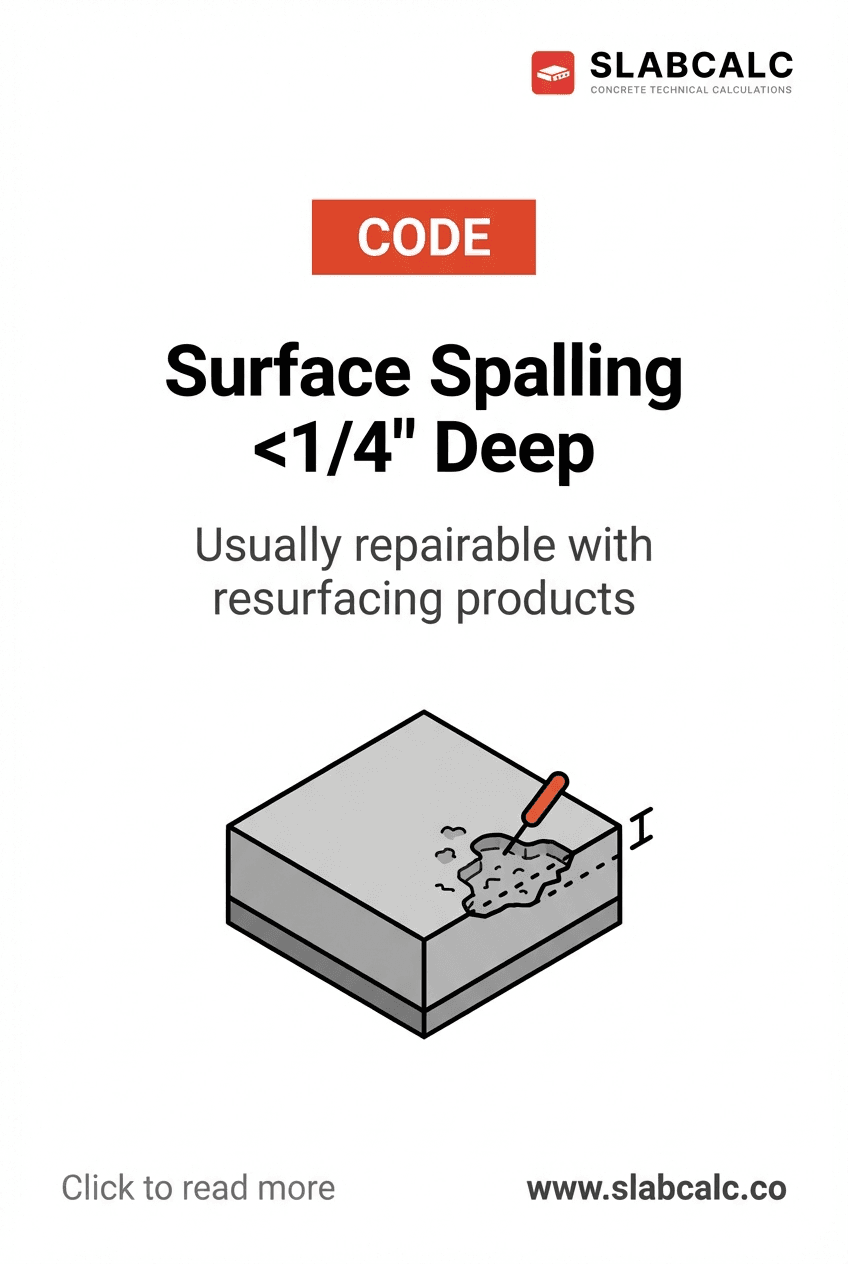
Surface Spalling Under 1/4 Inch Deep
Code Authority: ACI 546 Standard
The American Concrete Institute's ACI 546 Standard governs concrete repair, including surface spalling. For shallow spalls under 1/4 inch deep, ACI 546 classifies these as Class C repairs — structural members with marginal deterioration. The code requires that repaired surfaces achieve bond strength of at least 50 psi when tested by adhesion pull-off testing (ASTM C1583).
Most jurisdictions adopting the International Building Code (IBC) reference ACI 546 for concrete repair specifications. This means your local inspector likely expects repairs to meet these standards, regardless of whether it's explicitly stated in your permit.
What the Code Actually Requires
In plain language, ACI 546 demands three things:
-
Proper surface preparation — The spalled area must be cleaned to sound concrete, typically using wire brushing, pressure washing, or light grinding. Loose material cannot remain.
-
Compatible repair material — The resurfacer or patching product must chemically bond to existing concrete. This means using products specifically rated for concrete repair, not generic caulks or DIY fillers.
-
Adequate bond verification — For permitted repairs on structural slabs (like basements or garage floors), inspectors may require bond testing or at minimum manufacturer documentation proving the product meets adhesion standards.
Resurfacing Products for under 1/4" Spalls
For shallow spalling, concrete resurfacers are the code-approved solution. These products cost $15–$40 per gallon and can cover 25–50 square feet per gallon depending on depth.
Common compliant products:
- Concrete bonding agents (primers): $20–$30/gallon
- Self-leveling resurfacers: $25–$45/gallon
- Epoxy or polyurethane overlays: $40–$80/gallon
The repair process is straightforward:
- Clean the spalled area thoroughly with a wire brush or pressure washer
- Apply concrete bonding primer and let cure per manufacturer instructions (usually 2–4 hours)
- Fill with resurfacer and feather edges flush with surrounding concrete
- Cure for 24–48 hours before foot traffic
Common Code Violations
Inspectors most frequently cite these violations:
- Using caulk instead of resurfacer — Silicone or polyurethane caulk does not meet ACI 546 bond requirements and will fail within 1–2 winters.
- Skipping surface prep — Repairing over dirt, loose concrete, or previous sealant violates the adhesion requirement. This is the #1 reason repairs fail.
- Wrong product for the depth — Using thin coating products on deep spalls, or vice versa.
- No primer application — Bonding primers are mandatory for code compliance, even if the product claims "self-bonding."
Budget and Durability
A DIY resurfacing repair for a 10×10 foot spalled area runs $60–$150 in materials and takes one weekend. Properly executed, ACI-compliant resurfacing extends concrete life by 10–15 years.
When spalling exceeds 1/4 inch or covers more than 20% of the slab surface, full patching or overlay systems become necessary — a different cost category entirely.
Check with your local building department before starting. Some jurisdictions require a permit for concrete repair, and inspectors will verify material selection against ACI 546 requirements.