
Fix Water Erosion First
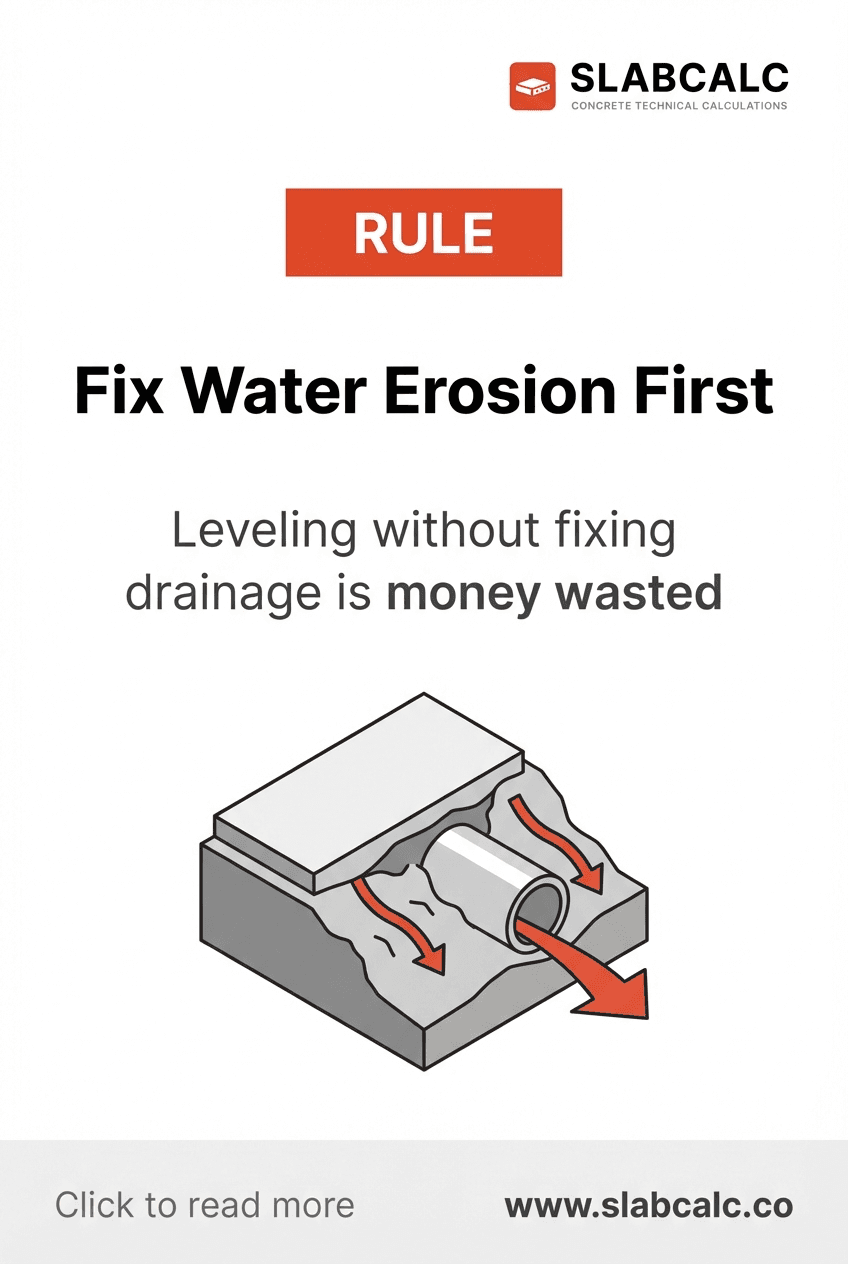
Concrete settlement looks straightforward—the slab sinks, you level it, problem solved. But if water erosion caused the settlement, releveling without fixing drainage is throwing money into a hole you'll dig again in 18 months. Here's the decision framework that professionals use to avoid wasting $3,000–$8,000 on a repair that won't stick.
The Decision Tree
If your slab has settled AND you see:
- Standing water pooling nearby → Water erosion is likely the cause
- Downspout draining within 3 feet of the slab → Water erosion is the culprit
- Cracks that radiate outward with a depression in the center → Classic void-collapse pattern from soil washout
Then: Fix drainage first, before spending on leveling.
If your slab has settled AND:
- The slab sits on dry, stable soil
- Settlement is uniform (the whole slab dropped the same amount)
- No water sources or pooling water nearby
- The slab is structurally sound (no major cracks or crumbling)
Then: Leveling alone is likely a permanent fix.
Why Water Erosion Defeats Leveling
Downspouts, poor grading, and leaking pipes wash soil out from beneath the concrete. The slab drops into the void. When you relevels without stopping the water, the erosion continues. In 12–24 months, new voids form and the slab settles again. You've now paid twice for the same problem.
Real example: A homeowner spent $6,500 on mudjacking in year one. A downspout still drained beside the foundation. By year three, the slab had settled another 1.5 inches and needed releveling again.
The Three Settlement Causes and Your Options
Cause 1: Poor Soil Compaction (Most Common) The fill soil under the slab wasn't compacted before pouring. Over 5–10 years, the concrete's weight compresses it further. This stabilizes and rarely repeats. Leveling is a one-time fix.
- Action: Proceed with mudjacking or polyjacking.
- Cost: $1,500–$4,000 for a typical driveway.
Cause 2: Water Erosion (Most Costly If Ignored) Voids form where soil washes away. Settlement continues until drainage is fixed.
- Action: Redirect downspouts 4–6 feet away. Install drainage or regrade sloped soil away from the slab. Wait 3–4 months for soil to stabilize. Then level.
- Cost: $300–$1,200 for drainage work; $1,500–$4,000 for leveling after.
Cause 3: Organic Decomposition or Root Decay Topsoil, stumps, or tree roots under the slab rot or decompose. Voids form slowly over years.
- Action: This is a construction defect. Excavate, remove debris, compact clean fill. Then relevel.
- Cost: $2,000–$6,000 (excavation required).
The Overlooked Factor: Soil pH and Drainage Pattern
Many homeowners miss the fact that even grade-level concrete is vulnerable if water pools during heavy rain. Look at your property after a downpour. Does water stay within 3 feet of the slab for more than 2 hours? If yes, you have a drainage problem that will eventually cause settlement, even under new concrete.
Clear Recommendation
Before spending money on leveling, observe your slab during and after rain for one storm cycle. If water pools near the slab or downspouts drain within 3 feet, fix drainage first. This costs $300–$1,200 and saves $3,000–$5,000 in wasted releveling work. Once drainage is addressed and soil has stabilized for a few months, releveling becomes a genuine one-time fix.
Use our concrete settlement guide to confirm the cause, then budget accordingly.