
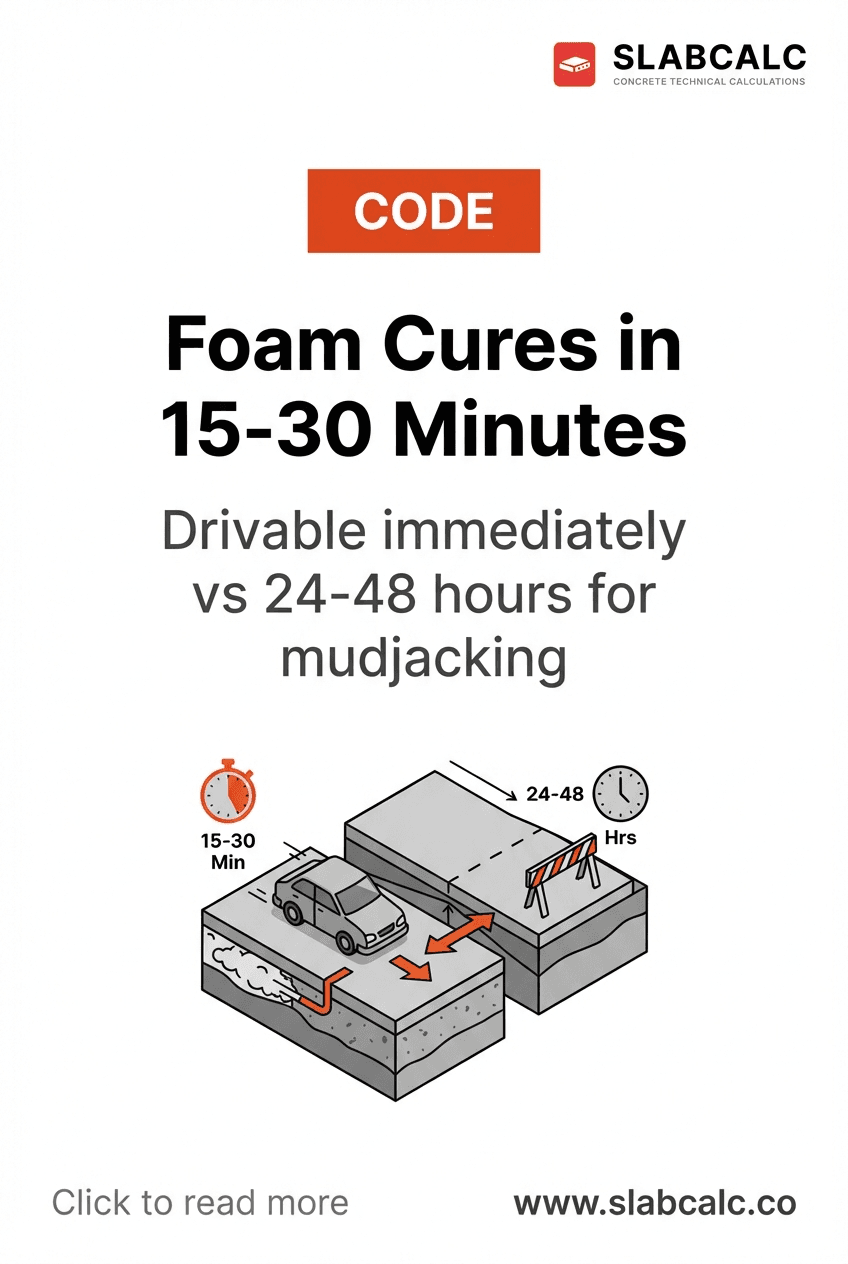
Foam Cures in 15-30 Minutes
Code Requirements for Concrete Leveling
The American Concrete Institute (ACI 330) and International Building Code (IBC Section 3206) establish minimum requirements for concrete slab repair and restoration. Both require that leveling compounds and lifting materials must achieve adequate strength gain before the slab returns to service—meaning foot traffic or vehicle load. The key difference between repair methods isn't just speed; it's when you can legally use the surface again under code compliance.
Most jurisdictions adopt IBC standards, which don't specify the repair method but do mandate that repaired slabs meet original design specifications for load-bearing capacity. This is where cure time becomes a practical legal issue: if you drive on foam-leveled concrete before full strength development, you risk voiding the repair warranty and potential liability.
The 15-30 Minute Foam Advantage
Polyurethane foam leveling (also called polyjacking or foam jacking) achieves initial set in 15-30 minutes at room temperature. This rapid cure allows foot traffic within hours and vehicle traffic within 24 hours on most residential applications. The foam expands to fill voids beneath your concrete, compresses soil, and hardens with minimal settling risk.
Real-world timeline:
- Injection and expansion: 30 seconds to 5 minutes per hole
- Initial cure (foot traffic safe): 2-4 hours
- Full cure and vehicle loading: 24 hours
- No waiting period required before resealing the access holes
The downside: foam leveling costs $8-15 per square foot, making a typical 400-square-foot driveway repair run $3,200–$6,000.
Mudjacking Takes 24-48 Hours
Traditional mudjacking (slabjacking) uses a water, sand, cement, and clay slurry pumped beneath settled concrete. This mixture hardens through hydration, similar to concrete curing. While the slurry gains initial strength in 24-48 hours, building to full load-bearing capacity requires 7 days to match pre-repair specifications under ACI 330.
Real-world timeline:
- Pumping and injection: 30 minutes to 2 hours
- Initial hardening: 24-48 hours (foot traffic only)
- Full cure for vehicle traffic: 7 days
- Waiting period before resealing: 48-72 hours minimum
Mudjacking costs $5-8 per square foot, making the same 400-square-foot driveway cost $2,000–$3,200—roughly half the price of foam.
Common Code Violations
The most frequent violation occurs when homeowners or impatient contractors allow traffic on newly mudjacked concrete before the 48-hour mark. This breaks the repair material before hydration completes, defeating the repair and leaving you liable for a second fix. Insurance may deny coverage if the repair fails due to premature loading.
With foam leveling, the violation pattern differs: driving immediately after injection (before the 24-hour full cure) can cause minor shifting if soil beneath is still settling from the foam's initial expansion force.
Which Should You Choose?
Choose foam if: You need immediate access to the driveway, parking area, or entryway. The premium cost is justified by eliminating downtime.
Choose mudjacking if: You can wait 48 hours for foot traffic and 7 days for vehicle traffic, and budget constraints matter. It's reliable when done correctly and cure time is observed.
Either method is code-compliant when installed by licensed contractors who follow manufacturer cure specifications. Always get written documentation of recommended wait times and include it in your project contract.