
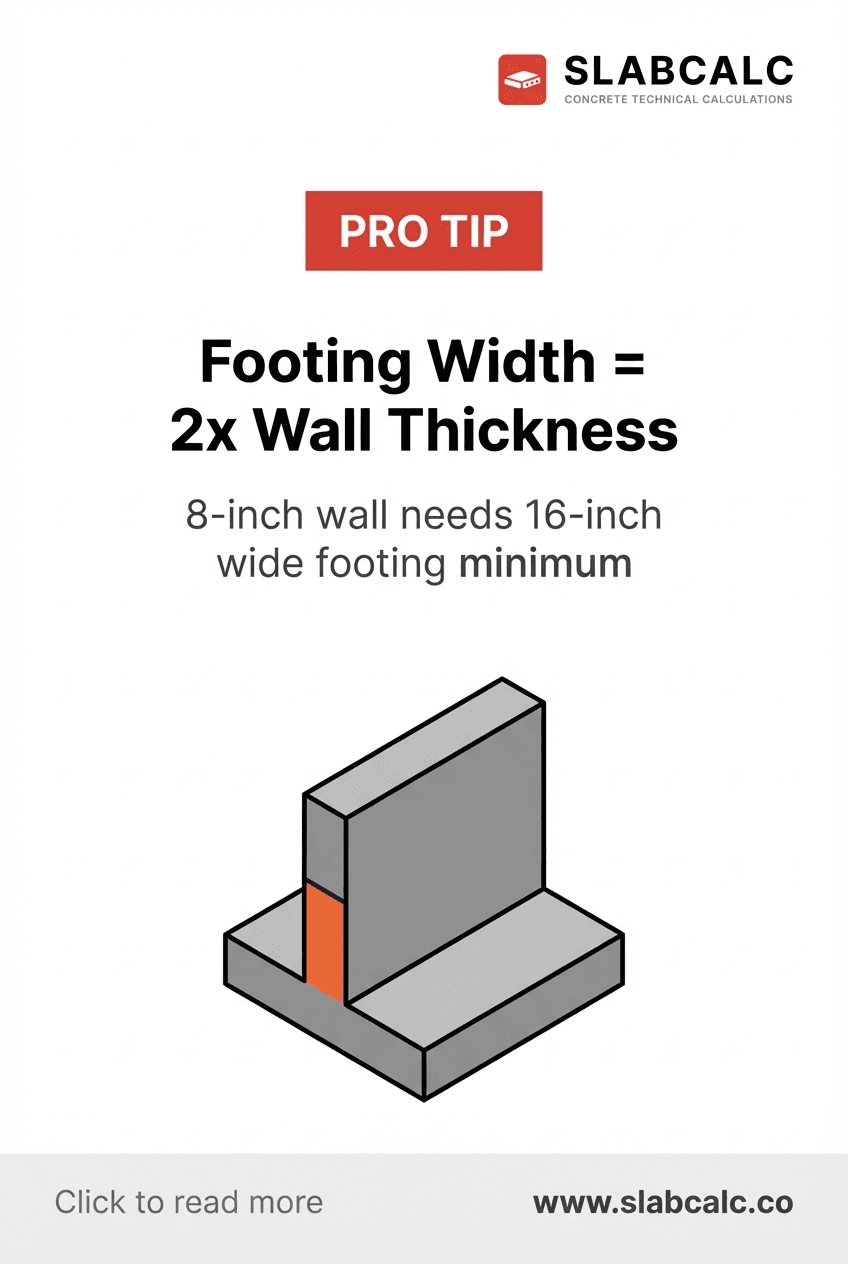
Footing Width = 2x Wall Thickness
The Most Common Footing Mistake
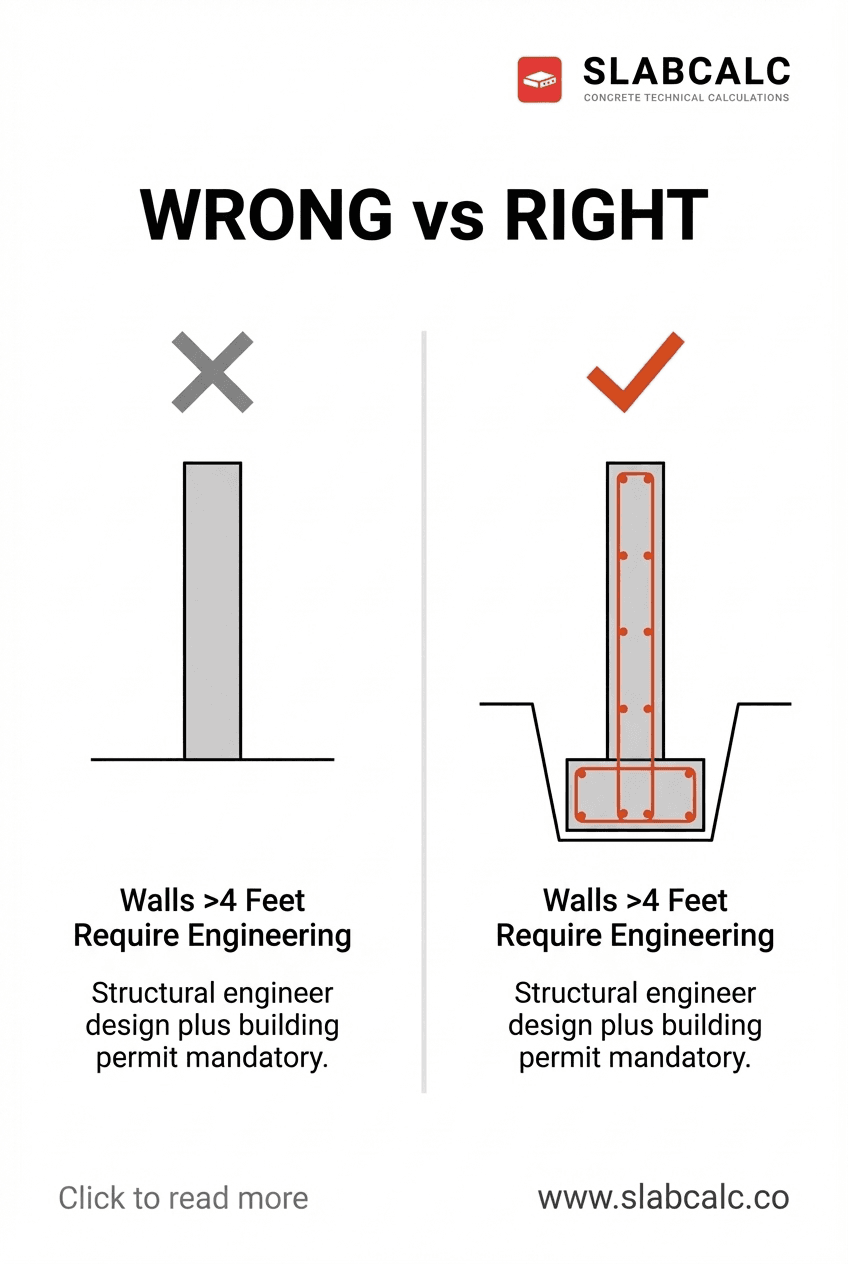
Most DIYers and even some contractors undersize the footing on retaining walls. They pour a footing that's barely wider than the wall itself—maybe 10 inches wide under an 8-inch wall. This looks efficient and saves concrete costs upfront. It fails catastrophically within 2–5 years. The wall tips inward, cracks appear, and backfill spills onto whatever (or whoever) is below. Rebuilding costs $3,000–$8,000.
The professionals know better. They follow a simple rule that prevents this: footing width must equal at least 2 times the wall thickness.
The Professional Rule Explained
For an 8-inch concrete block wall, the minimum footing width is 16 inches. For a 10-inch wall, it's 20 inches. For a 12-inch poured concrete wall, it's 24 inches.
This isn't arbitrary. A wider footing spreads the lateral (sideways) pressure from the retained soil over a larger base. Soil bearing capacity is measured in pounds per square foot. An average stable soil can handle 2,000–3,000 psf. A narrow footing concentrates all the wall's weight and the push from wet soil into a small area, exceeding the soil's capacity. A wider footing distributes that same force across more ground, keeping pressure within safe limits.
The relationship is direct: double the footing width, you roughly double the soil contact area. That's why the 2x rule exists—it provides the minimum margin that balances cost against safety for walls under 4 feet on typical conditions.
Why This Rule Works for DIY Walls
For walls up to 4 feet tall on stable, dry soil without surcharge loads, the 2x rule handles the job. It's conservative enough to account for minor soil variations and moisture changes (wet soil is heavier and pushes harder). It doesn't require a structural engineer to calculate. It keeps you within permitting limits in most jurisdictions.
Above 4 feet, soil bearing capacity, wall height, surcharge loads, and drainage all require professional engineering. But for your backyard slope stabilization or small retaining wall, this rule is your baseline.
How to Apply It
Step 1: Measure your wall thickness. Standard concrete blocks are 8 inches nominal.
Step 2: Multiply by 2. An 8-inch wall needs a 16-inch footing.
Step 3: Pour the footing to that width and at least 12 inches deep (below the frost line in your region; check local code—northern climates may need 36–48 inches).
Step 4: Center the wall on the footing. In an ideal world, the wall sits centered with 8 inches of footing on each side.
Step 5: Use our footing calculator to estimate concrete volume. A 50-foot wall on a 16-inch-wide, 12-inch-deep footing needs roughly 2.4 cubic yards of concrete.
This one rule prevents the most expensive failure mode in DIY retaining walls. It takes no extra skill to execute—just wider trenching and more concrete. Your wall will stand 30+ years instead of failing in 3.