
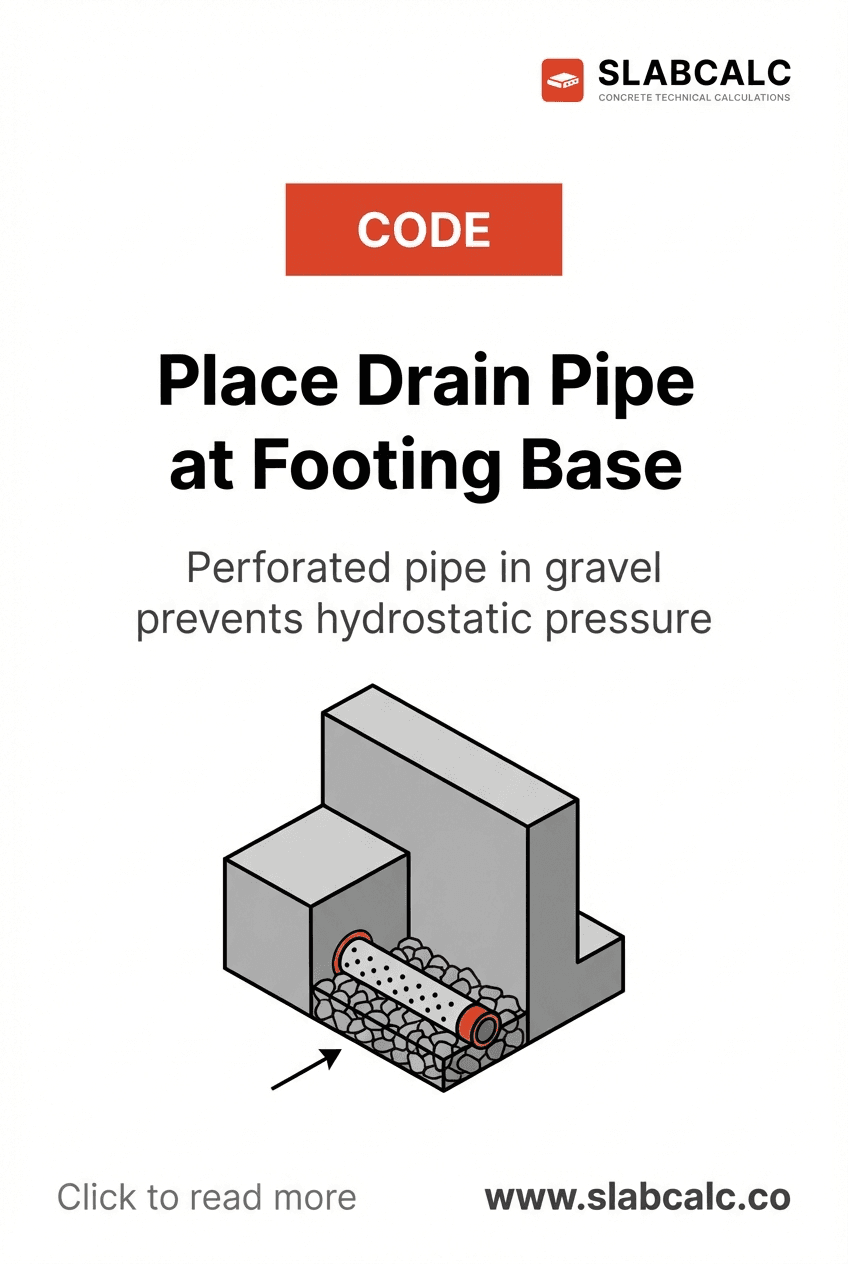
Place Drain Pipe at Footing Base
The Code Requirement
IRC Section 1805.5 and ACI 530 both mandate drainage systems for retaining walls. In plain language: if you're holding back soil with more than 3 feet of retained height, you must install a drainage system at the footing base. No exceptions. Most local building departments enforce this strictly—inspectors will fail your wall if drainage is missing during final inspection.
The requirement exists because water is your wall's worst enemy. Water trapped behind a retaining wall creates hydrostatic pressure—force that increases exponentially with depth. A wall retaining 6 feet of wet soil experiences roughly 1,800 pounds of additional lateral force per linear foot. That's equivalent to a truck pushing sideways on your wall constantly. Without drainage, concrete cracks, blocks shift, and the entire wall can fail within 2–5 years.
Why Perforated Pipe Works
Perforated drain pipe (typically 4-inch diameter) collects water seeping through the soil and channels it away before it accumulates. The pipe sits directly against the footing, wrapped in a geotextile filter fabric to prevent soil from clogging the perforations.
Gravel surrounds the pipe—typically 2 to 3 feet of drainage rock (½-inch to 1-inch clean stone). This gravel acts as a buffer zone, slowing water movement and allowing the pipe to capture it. The gravel extends from the footing base up to approximately 12 inches below the final grade level on the retained side.
Critical measurement: The pipe must slope toward an outlet at a minimum 0.5% grade (6 inches of drop per 100 feet of length). This ensures gravity drains water away rather than pooling it behind the wall.
Installation Steps
-
After footing placement, position your 4-inch perforated PVC pipe along the footing base on the retained-earth side.
-
Wrap the pipe with geotextile filter fabric (non-woven, at least 6 oz/sq yard). This prevents silt from entering perforations while allowing water through.
-
Backfill with drainage rock at least 2 feet wide and 2 feet high behind the pipe, extending the full length of the wall.
-
Slope the pipe outlet downhill, leading water at least 10 feet away from the wall foundation. Some codes require daylight drainage (visible discharge) or connection to a storm drain system.
-
Install a temporary surface slope during construction to shed surface water away from the retained area during the curing phase.
Common Violations
Many DIYers skip drainage entirely, assuming their wall "won't get that wet." Others install pipe but forget the geotextile, leading to clogging within 18 months. Some place the pipe too high or use non-perforated Schedule 40 PVC, which doesn't collect water effectively.
Inspectors catch these issues, and correcting them after backfilling is expensive—you'll excavate, reinstall, and refill at 3–5 times the original cost.
Budget drainage pipe, fabric, and gravel into your project from day one. For a 20-foot wall, expect $400–$700 in drainage materials. It's the cheapest insurance against catastrophic failure.