
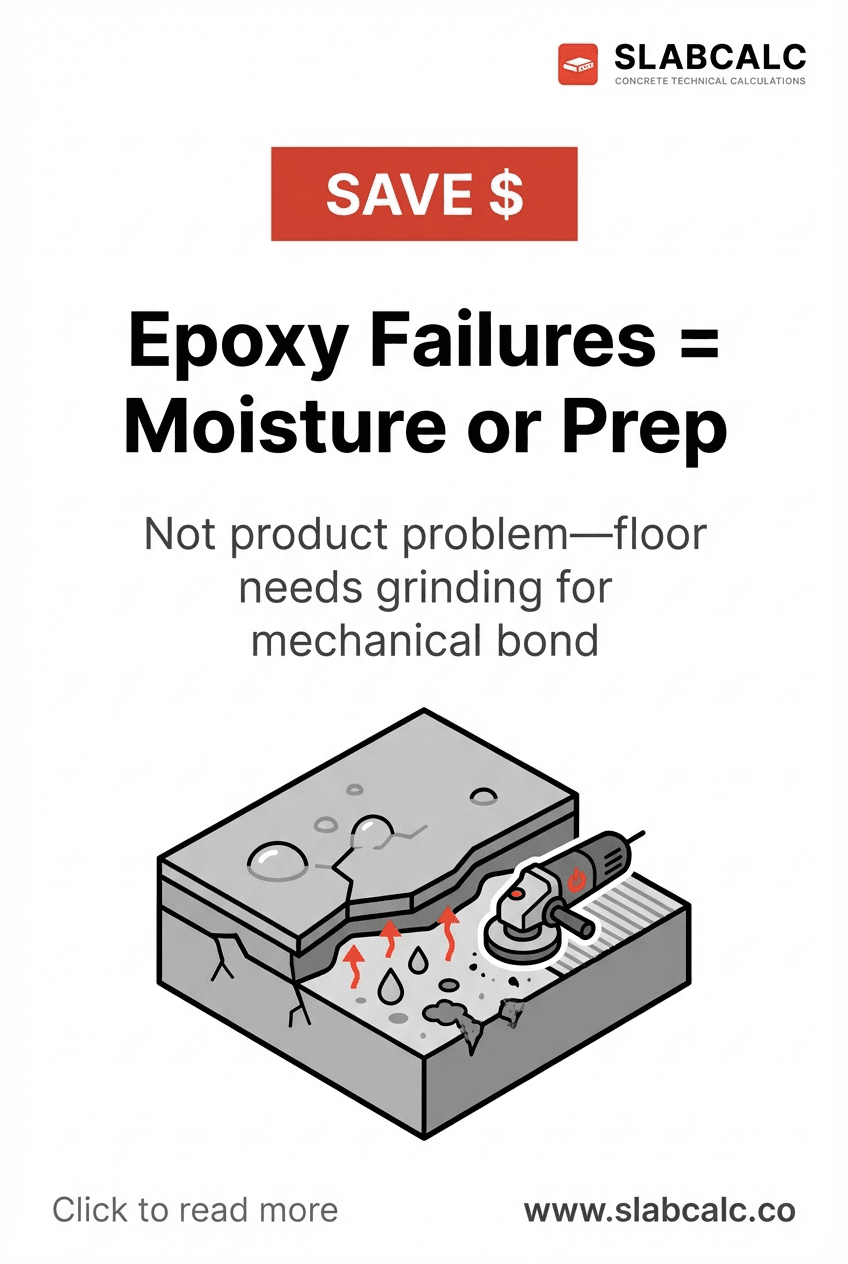
Epoxy Failures = Moisture or Prep
When homeowners invest in epoxy coatings for concrete floors, they expect durability. Yet many watch their investment peel, bubble, and fail within months. The culprit isn't usually the epoxy itself—it's moisture or inadequate surface preparation. Understanding this difference can save you $3,000 to $8,000 in premature failures.
The Real Cost of Shortcuts
A 500-square-foot garage floor costs roughly $1,500 to $2,500 for professional epoxy application. If that coating fails within two years due to moisture or poor prep, you're looking at $2,000 to $3,500 in removal and reapplication costs. Add floor drying time (24–72 hours of lost use), and the true cost climbs fast.
The math is simple: spending $200–$500 upfront on moisture testing and proper surface grinding prevents $4,000–$8,000 in failures later.
Moisture: The Silent Killer
Concrete is porous. Water vapor travels constantly through a slab via capillary action—the same process that draws water up a paper towel. Without a vapor barrier beneath the slab during construction, moisture never stops moving upward.
When epoxy seals the surface, trapped moisture underneath has nowhere to go. Pressure builds. The coating delaminates (separates) from the concrete, creating air pockets. Within weeks to months, adhesion fails completely.
How to test before coating:
Use the plastic sheet method: tape a 2×2-foot sheet of clear plastic to your floor and seal all edges. Wait 24–48 hours. If condensation appears on the underside, moisture is present. This test costs nothing and takes two minutes.
More precise testing uses calcium chloride kits ($20–$30) that measure moisture emission rates. Anything above 3 lbs per 1,000 square feet per 24 hours is too high for epoxy adhesion.
Surface Prep: Mechanical Bond Is Everything
Epoxy sticks through chemical bonding to properly prepared concrete. If the surface is dusty, sealed, or covered in old paint, that bond fails—regardless of epoxy quality.
Proper grinding costs $0.75–$1.50 per square foot, or $375–$750 for a 500-square-foot garage. It removes the top cement layer, exposing fresh aggregate, and creates micro-texture for mechanical adhesion.
Skipping this step to save $300 guarantees failure. You're replacing a $2,000 epoxy job in 18 months instead of enjoying a 10-year coating.
The Decision Framework
Before buying epoxy, ask three questions:
1. Is moisture present? Run the plastic sheet test. If condensation appears, install a dehumidifier or vapor mitigation system first ($500–$1,200). Don't coat until moisture is below 3 lbs per 1,000 sq ft per 24 hours.
2. Has the concrete been ground? If you can't see exposed aggregate, the surface hasn't been prepped. Demand grinding as part of any professional application.
3. Am I comparing cheap contractors to quality ones? A $1,200 quote for 500 square feet often means skipped steps. Professional-grade work runs $2,500–$3,500 and includes moisture testing and proper prep.
The most expensive epoxy product won't save a poorly prepped floor in a moist environment. The cheapest floor prep won't save an unglued coating fighting moisture. Both matter equally.
Invest the time and money upfront to diagnose your slab. The $200–$500 you spend testing and prepping properly is the cheapest insurance against the $5,000–$8,000 failure that's otherwise inevitable.