
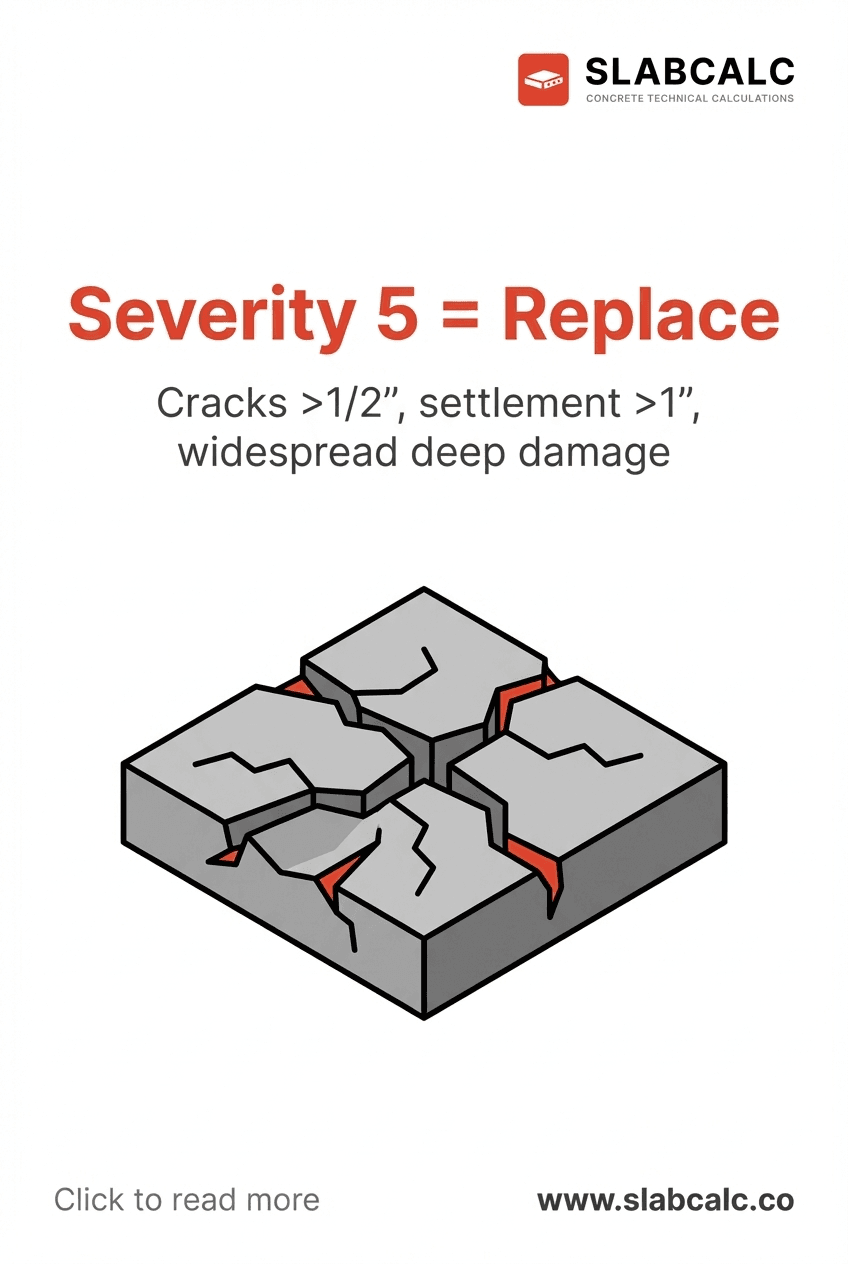
Severity 5 = Replace
Severity 5 = Replace
When concrete damage reaches Severity 5, repair patches and sealants won't save the slab. You're looking at replacement—typically a 4-to-6-inch depth of 4,000 PSI reinforced concrete with proper base preparation. Understanding why this specification matters and when to pull the trigger can save you years of worsening damage and thousands in compounded repair costs.
The Severity 5 Threshold
Severity 5 damage is characterized by three overlapping conditions:
- Cracks wider than 1/2 inch (12mm), especially if they run continuously or in structural patterns
- Vertical settlement exceeding 1 inch between slab sections, creating trip hazards and indicating foundation failure
- Widespread deep damage—spalling deeper than 1/2 inch across 40%+ of the slab surface, or multiple failing joints
When you measure and find even one of these conditions, the structural integrity of your slab is compromised. Unlike minor cracks that stabilize over time, these failures actively worsen. Water infiltrates deeper sections, freeze-thaw cycles accelerate damage, and the underlying base and subgrade shift further. A Severity 5 slab will cost more to manage temporarily than to replace outright.
Why 4,000 PSI Concrete Matters
Standard residential concrete is specified at 3,000–3,500 PSI (pounds per square inch of compressive strength). For replacement slabs in areas prone to freeze-thaw cycles, vehicle traffic, or heavy residential use, specifying 4,000 PSI concrete is the material baseline. This higher strength resists:
- Freeze-thaw cracking (critical in zones with winter temperatures)
- Surface spalling from de-icing salts
- Long-term load deflection and micro-cracking
- Settlement-induced stress concentration
The cost difference is modest: approximately $6–$12 per cubic yard over standard concrete. For a 500-square-foot driveway at 4 inches deep (61 cubic yards), this adds roughly $400–$700 to your total replacement cost—a worthwhile investment when replacing a slab you expect to outlast 30 years.
Reinforcement and Base Spec
Replacement slabs should include 6x6 W2.9xW2.9 welded wire mesh or #4 rebar on 18-inch centers. This prevents reflective cracking—where old damage patterns crack through fresh concrete—and distributes stress evenly. Budget an additional $1–$2 per square foot for reinforcement.
The subgrade is equally critical. Remove the old slab entirely and inspect the base. Compact the soil to 95% Proctor density, add 4 inches of compacted gravel base (typically 3/4-inch crushed stone), and verify drainage slope away from structures at minimum 2% grade. Base preparation costs $2–$5 per square foot but prevents rapid failure of the new slab.
Cost and Timing Reality
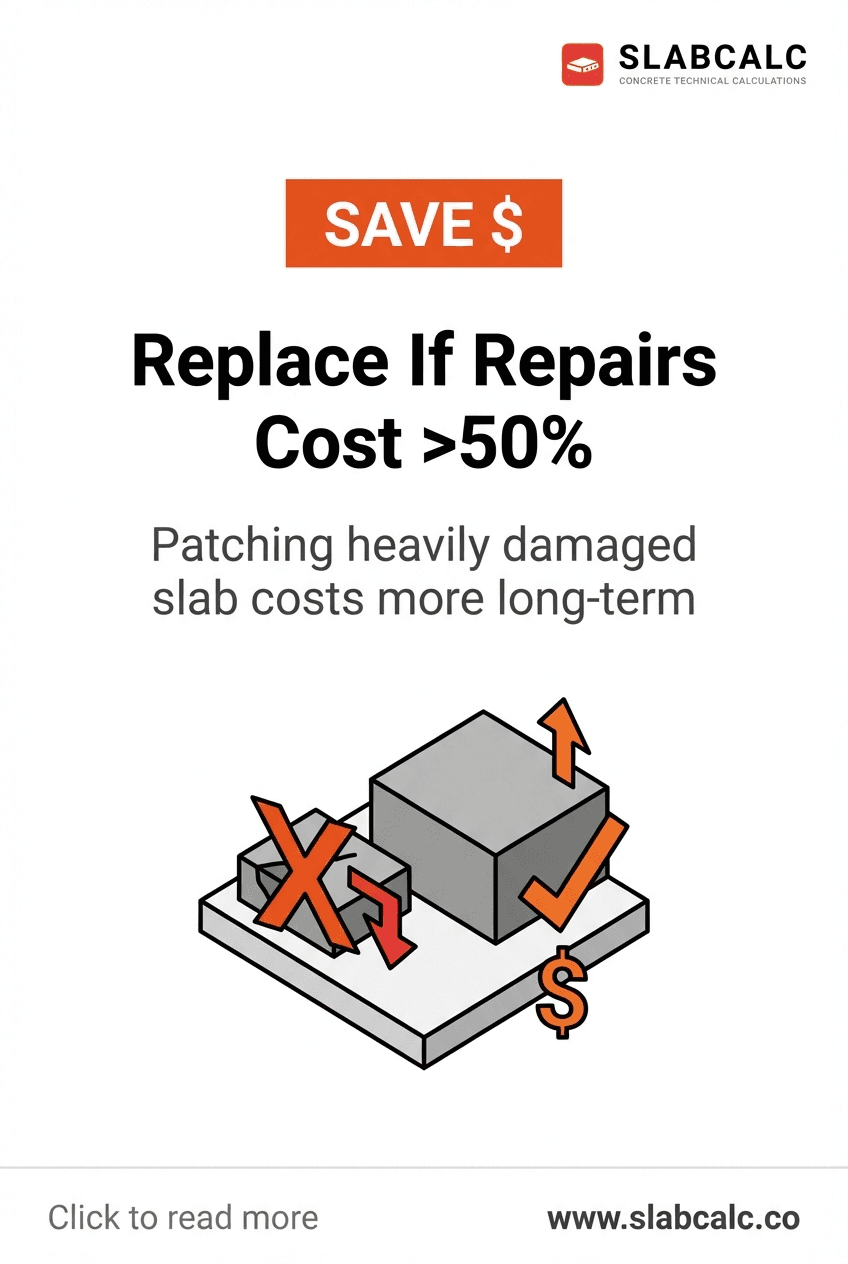
Full replacement of a typical 400-square-foot residential slab (driveway, patio, or basement floor) runs $3,200–$6,400 installed, or $8–$16 per square foot depending on region, site access, and old material removal. Patching a Severity 5 slab might cost $800–$1,500 initially but requires repeat work within 2–5 years.
The decision point: if damage is present now and you plan to stay in your home or property for 10+ years, replacement is economically rational. Document your Severity 5 assessment with photos and measurements, get three quotes specifying the 4,000 PSI reinforced concrete standard, and factor in concrete curing time (7 days minimum before foot traffic, 28 days before heavy loads).