

How to Make Concrete Pavers: DIY Molds & the Best Concrete Mix
To make concrete pavers, coat a plastic or wood mold with release oil, fill it 2 inches deep with a stiff 4,000-5,000 PSI bagged concrete (or sand/topping mix for detailed molds), cover it for 24 hours, demold, and cure the pavers 7 days before setting them on 1 inch of sand over a compacted gravel base. One 80-lb bag casts 3-4 pavers of 12x12 inches, so a 10x10 patio takes about 28 bags.
This guide covers the full process: choosing molds, mixing concrete, casting, curing, and setting pavers in a sand bed. For the underlying math on how much concrete you'll need, the calculator below handles it.
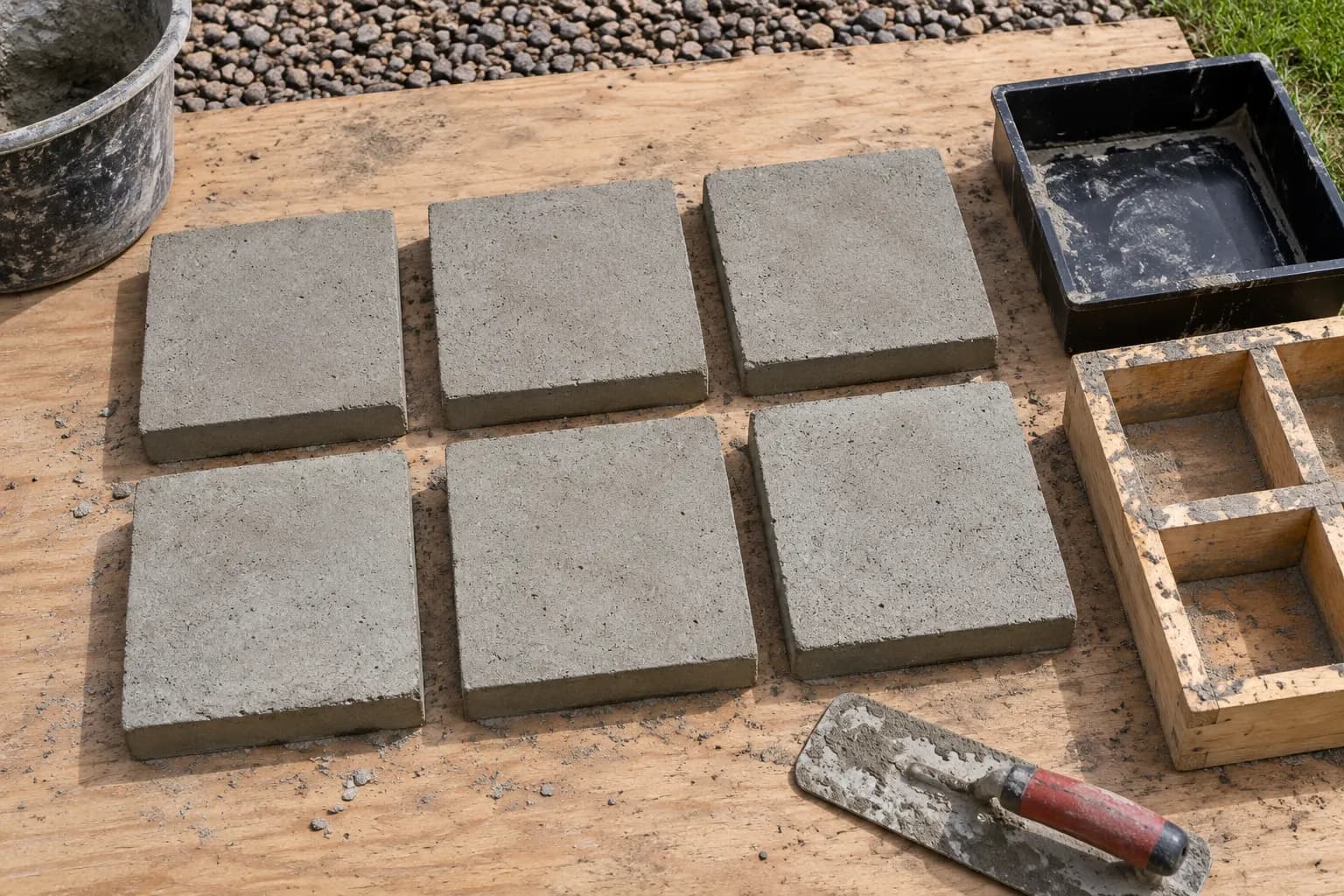
What You Need
Materials
| Item | Notes |
|---|---|
| 80-lb bagged concrete mix | 1 bag = ~3–4 standard pavers |
| Paver molds (plastic, 12"×12" or similar) | Reusable; buy 3–5 for batch production |
| Cooking spray or form release oil | Coat molds before every pour |
| Concrete pigment (optional) | Add to dry mix before water |
| Fiber reinforcement (optional) | 1/2 lb per 60-lb bag; reduces edge chipping |
| Coarse sand | For setting bed (1 inch under pavers) |
| Plastic sheeting | Curing cover |
Tools
- Wheelbarrow or mixing tub
- Concrete hoe or drill with paddle mixer
- Trowel
- Level
- Rubber mallet
- Screed board (straight 2×4)
Choosing Molds
| Mold Type | Cost | Reuses | Best For |
|---|---|---|---|
| Plastic paver mold (store-bought) | $5-25 each | 20-50 pours | Brick, cobble, and hexagon patterns; consistent size |
| DIY wood mold (plywood base + strips) | Scrap lumber | Many, if sealed | Custom sizes, square and rectangular pavers |
| Lift-off frame on plastic sheet | Scrap lumber | Many | Casting pavers in place or in quantity |
Pre-made plastic paver molds are available at home improvement stores and online for $5–25 each. They come in squares, rectangles, hexagons, and decorative brick patterns. Most are reusable 20–50 times.
Size consideration: Standard manufactured pavers are 4×8 inches (about 0.05 cubic feet at 2.5" thick). DIY pavers at 12×12 inches are more practical to cast in quantity at home — fewer mold fills to hit the same square footage.
How to Make DIY Concrete Paver Molds
A wood mold costs almost nothing and lets you pick any size. Build it so the cell depth equals your paver thickness: a 2x2 is only 1.5 inches tall, below the 2-inch pedestrian minimum, so rip strips 2 inches tall from a 2x4 instead.
- Cut a base from 3/4-inch plywood, about 30x30 inches for a 2x2 grid of 12x12 pavers
- Rip border strips 2 inches tall from 2x4 lumber (3.5 inches wide, so one rip per board)
- Screw the outer frame to the base, then screw in the divider strips to form 12x12-inch cells; screws, not glue, so you can take it apart if a paver sticks
- Seal the wood with a coat of paint, polyurethane, or packing tape so it doesn't wick water out of the mix
- Coat with form release or cooking spray before every pour
For a faster no-base version, build only the grid frame, set it on plastic sheeting, fill it, and lift it off after 24 hours. It is the same idea as the lift-off molds sold for "cast in place" walkways.
Best Concrete for Paver Molds
Any bagged concrete will make a paver; the right one depends on the mold detail and paver thickness. Strength figures are the manufacturers' 28-day ratings.
| Mix | 28-Day Strength | Best For | Notes |
|---|---|---|---|
| Quikrete 5000 / Sakrete 5000 Plus | 5,000 PSI | Standard 2 in pavers, anything a vehicle may cross | Best all-round choice for plain 12x12 or brick molds |
| Standard concrete mix (Quikrete, Sakrete) | 4,000 PSI | 2 in pedestrian pavers on a budget | Coarse gravel shows on the face if you don't vibrate well |
| Sand/topping mix (no gravel) | 5,000 PSI (Quikrete Sand/Topping) | Textured or detailed molds, pavers under 1.5 in | Smoothest face; fills fine detail |
| Crack-resistant (fiber) mix | 4,000 PSI | Thin or large pavers prone to edge chipping | Fibers can show on the face |
| Fast-setting post mix | 4,000 PSI | Not recommended | Sets in 20-40 min, before you can fill a batch of molds |
Why thickness matters for the mix: ACI 318 limits coarse aggregate to one-third of a slab's depth, so the larger stones in standard mix become a weak point as pavers get thinner. Below about 1.5 inches, or in molds with fine texture, switch to sand/topping mix. For brand-by-brand details, see Quikrete vs Sakrete vs generic.
How Much Concrete Do You Need?
Calculate your patio square footage, then add 10% for waste. Use this quick table for 12×12 pavers at 2-inch thickness:
| Patio Size | Pavers Needed | 80-lb Bags |
|---|---|---|
| 6×6 ft (36 sq ft) | 36 | 10 bags |
| 8×8 ft (64 sq ft) | 64 | 18 bags |
| 10×10 ft (100 sq ft) | 100 | 28 bags |
| 10×12 ft (120 sq ft) | 120 | 33 bags |
Includes 10% waste factor
Open the full Concrete Slab Calculator →
Step-by-Step: Casting Pavers
Step 1: Prepare Molds
Coat the interior of each mold with cooking spray or form release oil. Set molds on a flat, level surface — a sheet of plywood or your driveway works well. The bottom of the mold forms the visible face of the paver, so the surface you pour onto matters.
Step 2: Mix Concrete
Add water to the wheelbarrow first, then add dry mix. Blend until uniform and lump-free. Target a stiff consistency — the mix should hold shape when squeezed and not run off a shovel.
For colored pavers: Add dry pigment to the dry mix and blend thoroughly before adding water. This ensures even distribution. See the colored concrete guide for color ratios and options.
For the correct water-cement ratio that balances workability with strength, see our concrete water ratio guide.
Step 3: Fill Molds
Scoop concrete into each mold and press into corners with a trowel. Fill in two layers, tamping down each layer. Slightly overfill the mold, then screed the top flat with a straight board.
Tap the sides of the mold with your hand or a rubber mallet to release trapped air bubbles.
Step 4: Cure the Pavers
Cover filled molds immediately with plastic sheeting. After 24 hours, carefully flip each mold over and tap the back to release the paver. Set released pavers face-side up on a flat surface and cover again with plastic.
Cure for 7 full days before setting, with occasional misting if weather is hot or dry. Full compressive strength is reached at 28 days.
Step 5: Prepare the Setting Bed
For a patio or path, prepare the base before setting pavers:
- Excavate about 7 inches below finished height for 2-inch pavers (4 in base + 1 in sand + 2 in paver)
- Add 4 inches of compacted gravel base (crusher run / paver base), 4-6 inches on clay or poorly draining soil
- Add 1 inch of coarse sand, screeded flat and level
See our concrete subgrade preparation guide for base compaction details — a solid base prevents pavers from settling or rocking.
Step 6: Set the Pavers
Lay pavers on the sand bed with 1/4-inch gaps between them. Use a level to check each paver and tap into place with a rubber mallet. Fill gaps with polymeric sand (sand with a binding agent) and sweep into joints. Tamp lightly and mist with water to activate the binder.
Key Specs at a Glance
| Spec | Recommendation |
|---|---|
| Thickness (pedestrian) | 2 inches minimum |
| Thickness (light vehicle) | 3.5–4 inches |
| Concrete type | 5,000 PSI mix; sand/topping mix for detailed molds |
| Yield | 3-4 12x12x2 pavers per 80-lb bag |
| Cure time before setting | 7 days |
| Setting bed | 4" compacted gravel + 1" coarse sand |
| Joint spacing | 1/4 inch (fill with polymeric sand) |
Common Mistakes
Releasing molds too early. Pavers released before 24 hours often crack at corners and edges. Patience saves pavers.
Setting in soil instead of sand. Placing pavers directly on soil leads to uneven settling and tipping. A proper sand bed is what keeps a DIY patio looking level after years of use.
Inconsistent mix consistency. Batching concrete with slightly different water amounts batch to batch causes color variation across pavers. Mix one batch at a time and keep measurements consistent.
Related Guides
- DIY Concrete Stepping Stones — Similar casting process for garden paths
- Concrete Subgrade Preparation — How to properly prepare the base before laying
- Stamped Concrete Guide — Texture and pattern options for a finished surface