

Concrete Pool Deck: What Every Homeowner Needs to Know
A concrete pool deck is one of the most significant hardscape investments around a home — and one of the most frequently done wrong. The decisions you make about finish, color, joints, and drainage have a direct impact on safety, durability, and long-term maintenance cost.
This guide covers what homeowners need to understand before hiring a contractor or planning a DIY pool deck — finish options, slip resistance requirements, expansion joints, heat and color choices, and the resurfacing vs. replacement decision.
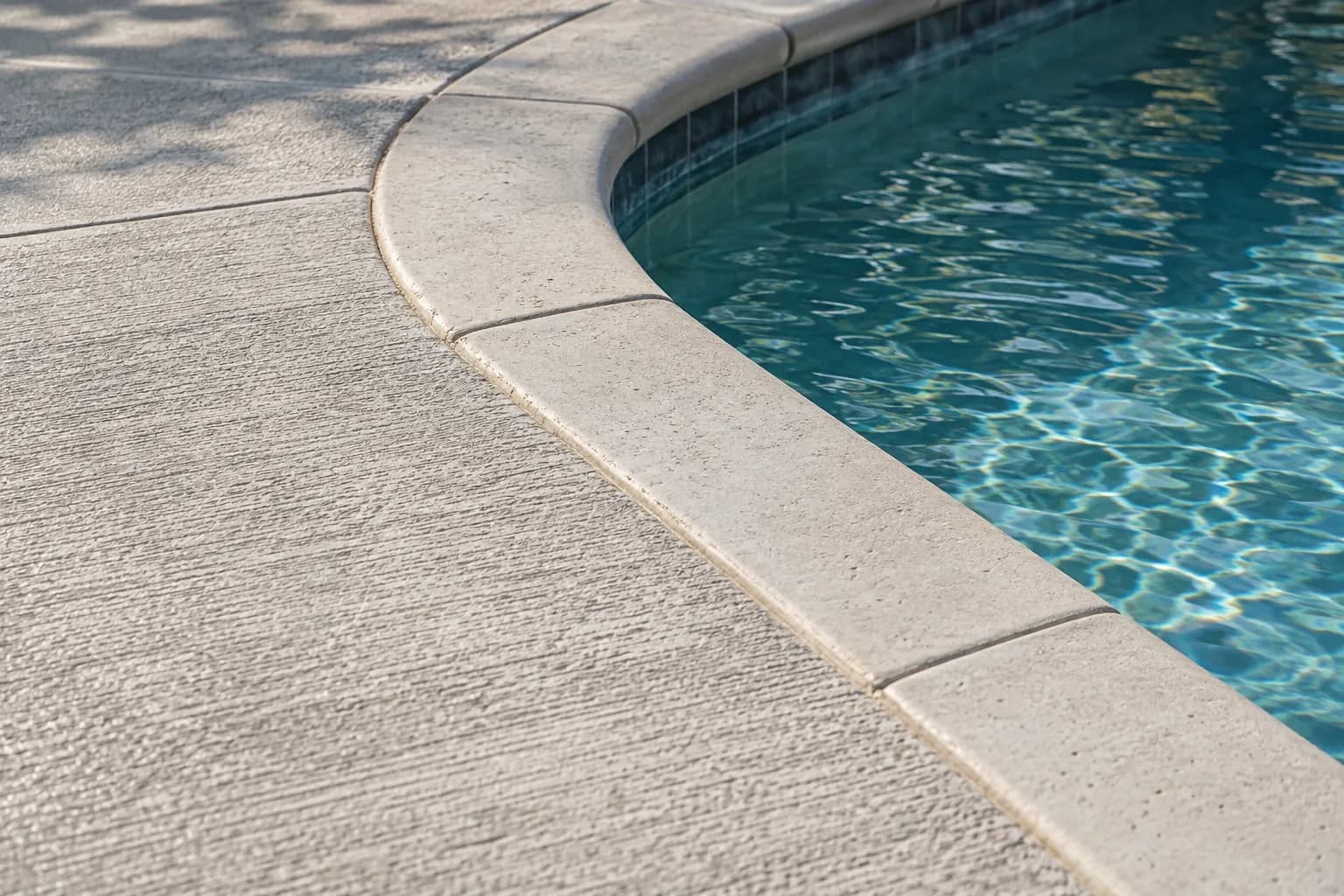
Finish Options: Pros and Cons
Broom Finish
The standard concrete finish — horizontal broom lines dragged across the surface for texture. It's the most common pool deck finish for a reason: reliable slip resistance, low cost, and durability.
Best for: Budget-conscious installs, functional utility decks, DIY projects.
Limitation: Plain appearance. Can be dressed up with color or a light exposed aggregate brushing.
Exposed Aggregate
After placement, the surface is seeded with decorative stone or the top layer of cement paste is washed away to reveal the aggregate below. The result is a textured, natural-looking surface with excellent grip.
Best for: Coastal and resort aesthetics, high-traffic pool areas, warm climates.
Limitation: Rough texture is uncomfortable on bare feet for some people. See our exposed aggregate guide for full detail.
Stamped Concrete
Rubber stamps pressed into fresh concrete create patterns mimicking stone, brick, or wood. Stamped concrete is visually stunning but requires periodic sealing — and the wrong sealer becomes dangerously slick when wet.
Best for: High-end aesthetic installs, covered pool areas, low wet-exposure zones.
Limitation: Sealed stamped concrete can be slippery when wet. Always use a non-slip sealer additive. See our stamped concrete guide for sealer options.
Spray Texture / Kool Deck
A popular finish in southern states — a thin polymer-modified coating with light aggregate texture sprayed over existing concrete. Provides heat reduction, slip resistance, and fresh appearance.
Best for: Resurfacing existing decks, hot climates where heat absorption is a concern.
Pool deck pricing tracks regional pool density and labor markets. See metro-specific cost data for Phoenix, Tampa, and Las Vegas.
Slip Resistance Requirements
ASTM C1028 (Static Coefficient of Friction) sets a minimum of 0.6 for pool decks. A broom finish on dry concrete typically measures 0.7–0.9. Sealed stamped concrete can fall to 0.3–0.5 wet — below safe thresholds.
If using a decorative finish with sealer, specify a non-slip additive (aluminum oxide or shark-skin additive mixed into the sealer). These are inexpensive and maintain texture over time.
Expansion Joints: The Most Important Detail
Concrete pool decks fail most commonly at one spot: the joint where the deck meets the pool coping or bond beam. This joint must allow differential movement between the deck (which expands and contracts with air temperature) and the pool shell (which moves with water temperature and structural loading).
Required at every location where deck meets pool:
- Fill joint gap with closed-cell foam backer rod
- Apply 2-part polyurethane or polysulfide joint sealant over the backer rod
- Never fill with rigid materials (concrete, mortar, or grout)
Expansion joints should also be cut or tooled across the deck field at intervals no greater than 10–12 feet in any direction. In sun-exposed pool decks, closer spacing (8 feet) is better.
If the deck meets the house foundation or pool equipment pads, those intersections also need isolation joints. See our complete guide to concrete joint problems for joint types and repair options.
Color and Heat Absorption
Light-colored concrete reflects sunlight; dark concrete absorbs it. In direct sun, dark gray concrete can reach 140–160°F surface temperature — painful on bare feet and damaging to pool vinyl liners from radiated heat.
Color guidance for pool decks:
- Light gray or white: Surface temperature 90–110°F in direct sun (comfortable)
- Medium tan/buff: 110–120°F
- Dark charcoal: 130–160°F (avoid for pool surrounds)
Integral pigments, acid stains, or spray coatings can lighten existing dark concrete. Colored concrete can be blended to match or complement pool tile and coping.
Drainage
Concrete pool decks must slope away from the pool edge at a minimum 1/4 inch per foot. Water on pool decks should drain to landscape areas, drains, or away from the house — not toward the pool (which introduces lawn chemicals and debris) and not toward any structure foundation.
A common mistake: sloping the deck flat or slightly toward the pool for aesthetic symmetry. This causes water to back-pond against the pool coping and erode the joint.
See our concrete driveway drainage guide for drainage slope principles that apply equally to pool decks.
Resurfacing vs. Replacement
| Condition | Recommendation |
|---|---|
| Surface spalling, staining, faded color | Resurface |
| Loss of slip resistance (smooth/polished) | Resurface or retexture |
| Cracks less than 1/4" wide, no movement | Repair cracks + resurface |
| Significant settlement, slab heaving | Replace |
| Cracks greater than 1/2" with movement | Replace |
| Hollow spots under slab (delamination) | Replace affected sections |
Resurfacing with a polymer overlay adds 5–10 years of life at 20–30% of replacement cost. See our concrete resurfacing guide for material options and durability expectations.
Key Specs
| Spec | Recommendation |
|---|---|
| Thickness | 4" minimum (5–6" for vehicle access) |
| Finish | Broom, exposed aggregate, or non-slip stamped |
| Pool edge joint | Isolation joint with backer rod + polyurethane sealant |
| Field joint spacing | 8–12 feet |
| Drainage slope | 1/4" per foot minimum, away from pool |
| Sealer | Penetrating sealer; add non-slip additive if decorative |
| Color | Light colors only for barefoot comfort in sun |
Common Mistakes
No isolation joint at the pool edge. This is the number one pool deck failure cause. Without a flexible joint, the deck cracks at the pool shell interface — often in a continuous line that lets water infiltrate under the slab.
Dark color in direct sun. Dark gray or charcoal concrete may look sophisticated but creates an uncomfortable, potentially hazardous surface in full sun. Test surface temperature with an infrared thermometer in summer before committing.
Sealing with a film-forming sealer only. Standard glossy sealers make concrete surfaces slippery when wet. Always use non-slip additives or specify a penetrating sealer for pool areas.
Related Guides
- Stamped Concrete Guide — Patterns, sealers, and finish options
- Exposed Aggregate Guide — Texture, appearance, and installation
- Concrete Resurfacing & Overlay Guide — When to resurface and which products to use
- How to Seal Concrete — Sealer types and non-slip options