
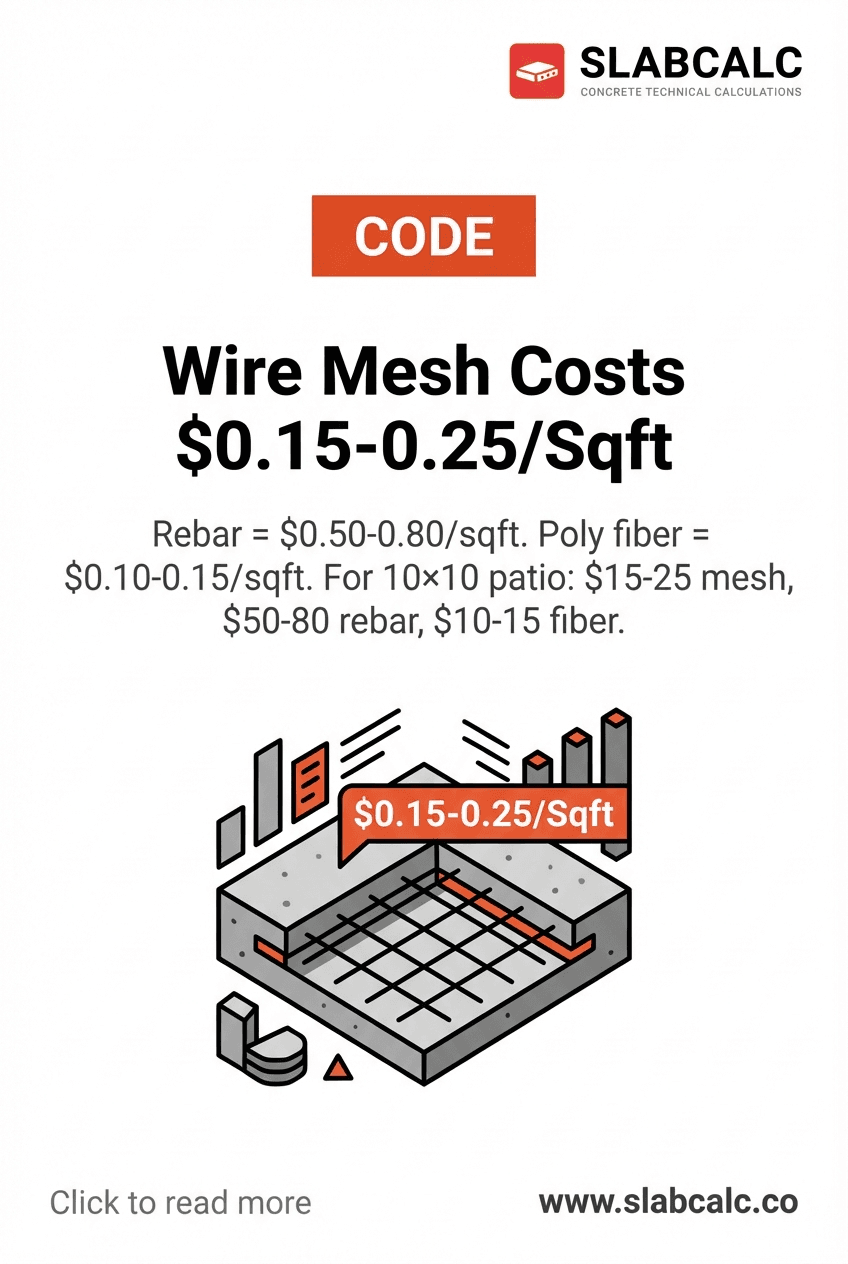
Wire Mesh Costs $0.15-0.25/Sqft
Code Requirements Drive Your Choice
The ACI 302 (Guide to Concrete Floor and Slab Construction) and IRC Section R506 establish when reinforcement is mandatory. Most jurisdictions follow these standards: concrete slabs supporting vehicles or attached to structures require structural reinforcement (rebar). Light-duty slabs like patios can use wire mesh or fiber. Your local building department's specific amendments may be stricter—always check before you pour.
The key distinction is structural capacity. Rebar provides it. Wire mesh and fiber do not. Building officials care about this difference because an under-reinforced driveway can crack, settle, or fail under vehicle weight.
Rebar: The Structural Standard
#4 rebar at 18-inch spacing both directions is the minimum spec for residential driveways in most codes. This costs roughly $0.50–0.80 per square foot installed. For a 10×10-foot driveway (100 sqft), expect $50–80 in rebar alone.
Rebar works because steel bars positioned mid-depth resist tensile stress—the pulling force that concrete naturally fights. When a vehicle parks on your driveway, the concrete bends slightly. Rebar bridges cracks and prevents failure.
Common violations: Rebar placed on the slab surface instead of suspended mid-depth loses 80% of its effectiveness. Many DIYers skip rebar chairs and let bars sink to the base. Building inspectors will catch this and require a do-over.
Wire Mesh: The Economy Option
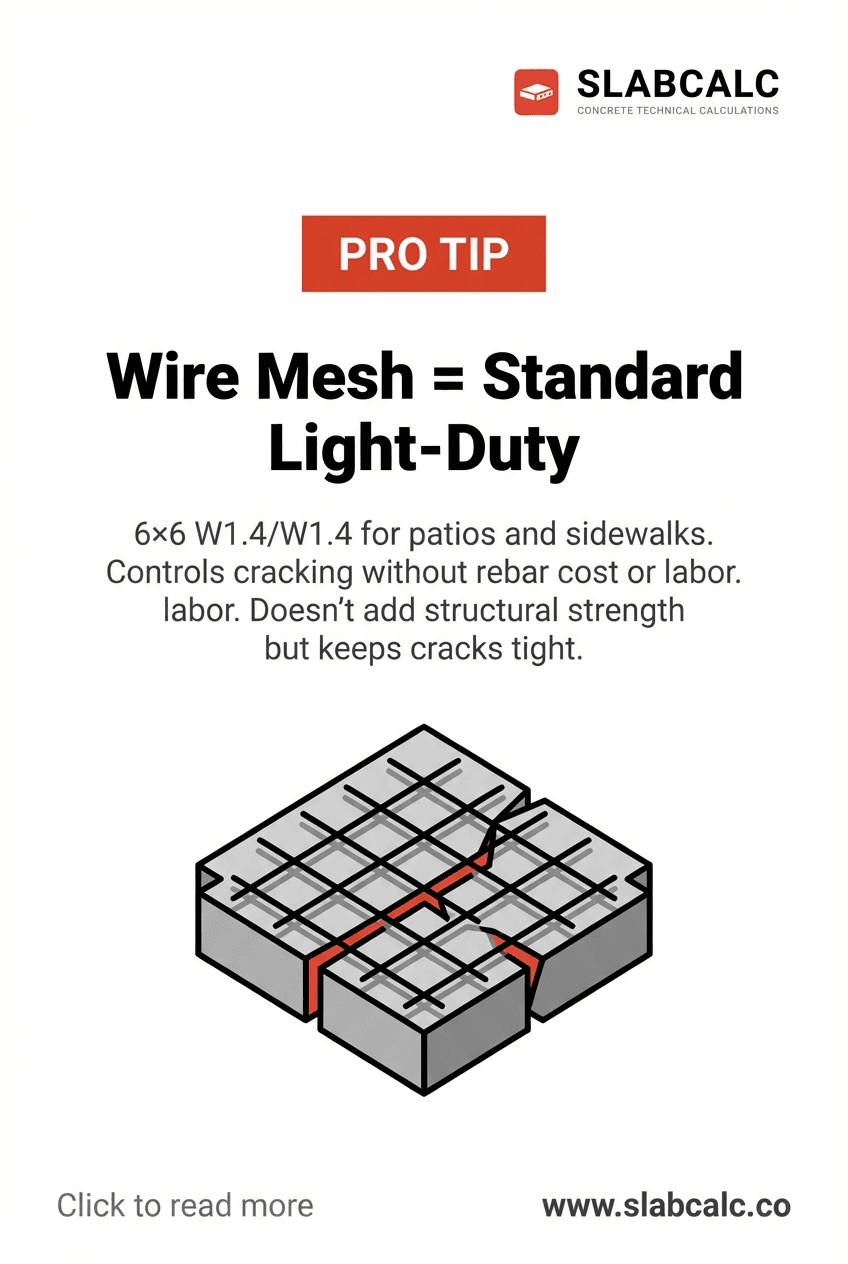
Wire mesh (6×6 grid, 10/10 gauge) costs $0.15–0.25 per sqft—roughly one-third the price of rebar. A 10×10 patio runs $15–25 total.
Wire mesh controls crack width, not structural capacity. It's appropriate for:
- Patios and sidewalks under 100 sqft
- Decorative slabs not supporting vehicles
- Shed floors and non-load-bearing interior slabs
The trade-off is real. Wire mesh is thinner steel with less cross-sectional area. It reduces crack propagation but cannot handle driveway or foundation loads. Inspectors will reject it for driveways in most jurisdictions.
Fiber Reinforcement: The Shrinkage Solution
Polypropylene fiber costs $0.10–0.15 per sqft and reduces shrinkage cracking during curing. Steel fiber costs $0.30–0.50 per sqft and handles microcracks better.
Fiber is never a structural replacement. It's additive—mixed directly into the concrete batch at the plant. Think of it as a secondary control layer that minimizes hairline cracks, not major structural cracks.
For a 10×10 patio, polypropylene fiber adds $10–15 to material costs and works well paired with light wire mesh.
Practical Takeaway
Driveways, garage floors, pool decks: Rebar only. Budget $0.50–0.80/sqft.
Patios, sidewalks, non-load areas: Wire mesh ($0.15–0.25/sqft) plus optional fiber ($0.10–0.15/sqft).
Always confirm code requirements with your building department before ordering materials. An inspector rejection after pouring costs far more than asking upfront.