
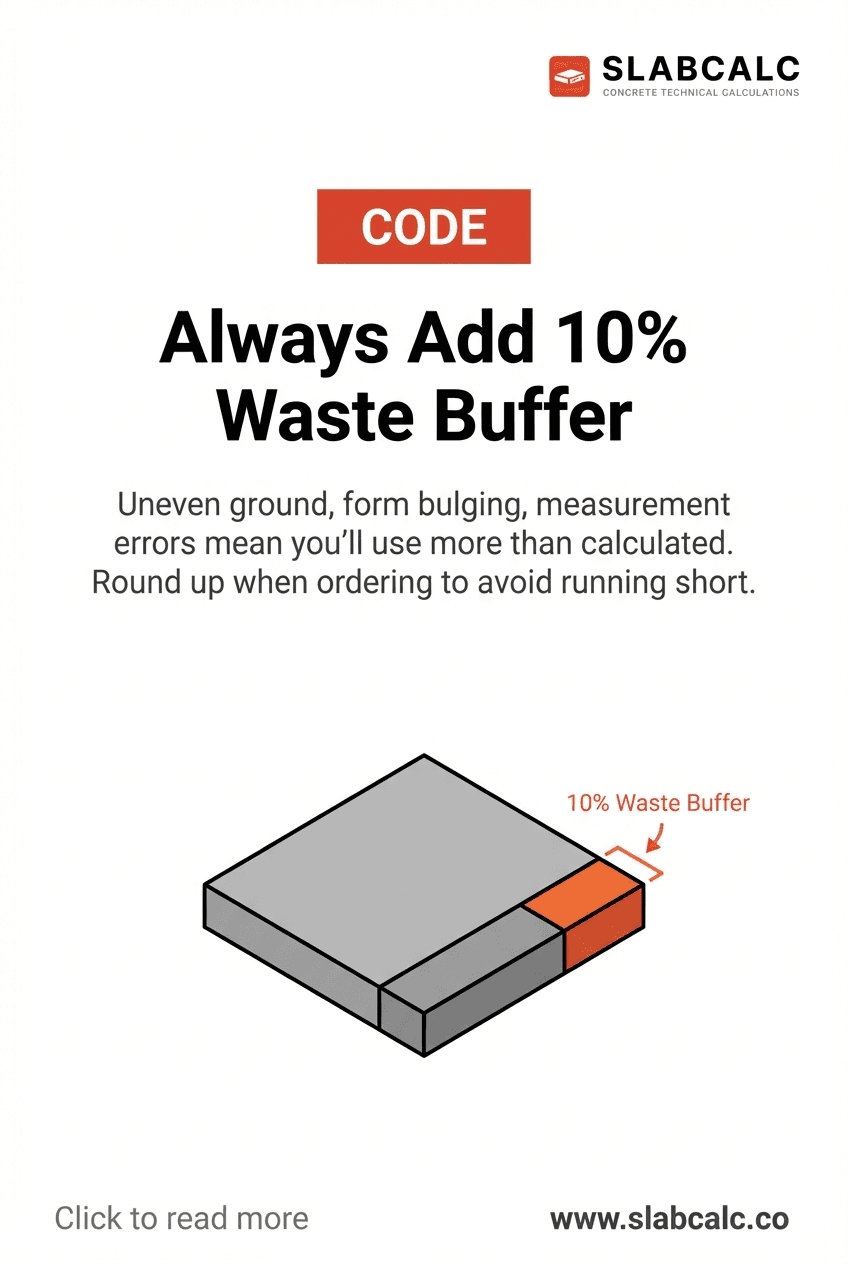
Always Add 10% Waste Buffer
Code-Mandated Waste Buffer
The American Concrete Institute (ACI) and most local building codes require contractors to add a 10% waste allowance to all concrete orders. This isn't optional—it's a safety and quality standard that protects your project. Building inspectors expect to see that 10% factored into your purchasing estimate, and many regional codes explicitly call this out in sections covering material delivery and placement procedures.
The reason is simple: concrete doesn't cooperate with perfect measurements. Uneven ground, form movement, spillage, and miscalculation are realities on every jobsite, from professional installations to backyard DIY work.
Why 10% Isn't Overkill
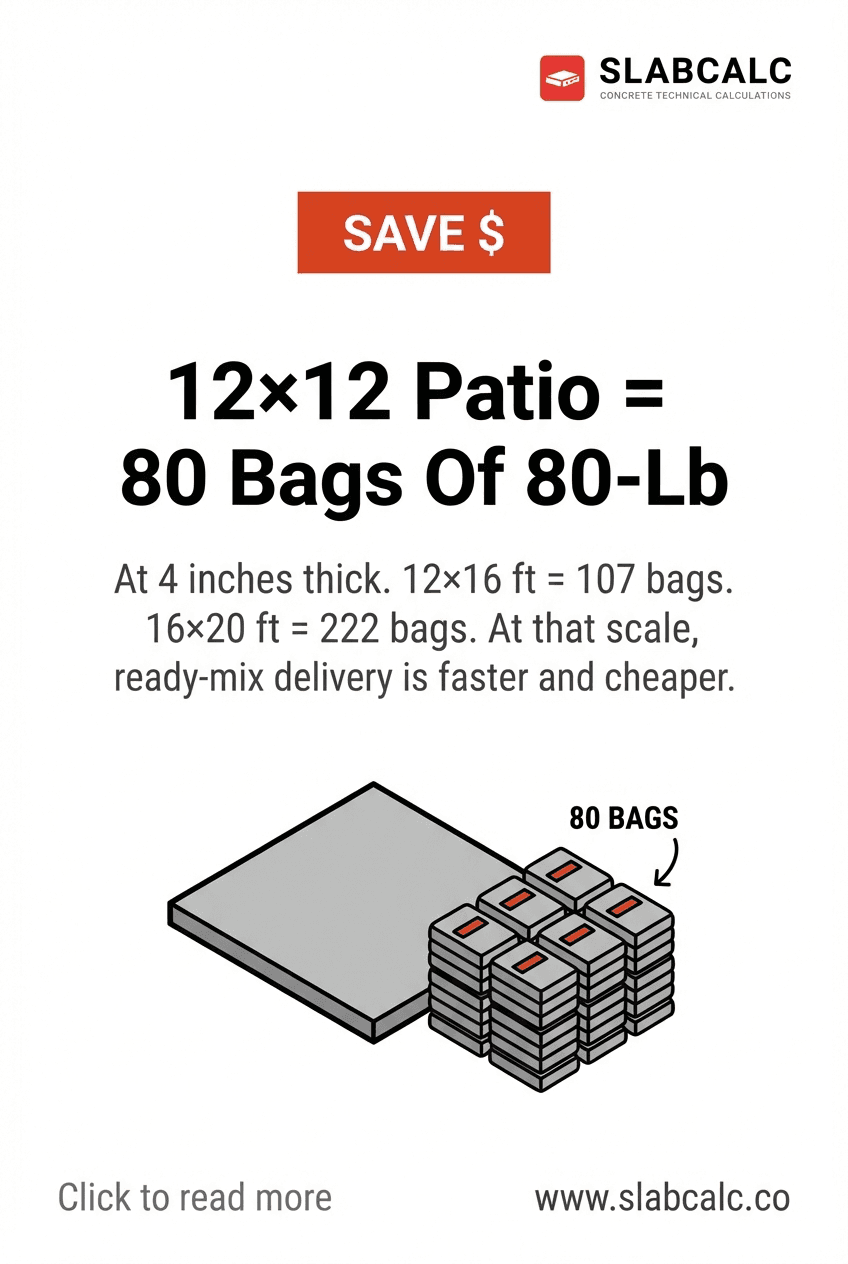
Consider a typical 12×12 ft patio at 4 inches thick. The base calculation yields 1.8 cubic yards. Without the buffer, you'd order exactly 1.8 yards and hope nothing goes wrong.
In practice, here's what eats up that concrete:
- Ground prep variance: Even after grading, soil settles unevenly. Low spots need filling, requiring 2–4 extra inches in places.
- Form bulging: Wet concrete pushes on wooden forms. Bowing means more volume than your straight-line math predicted.
- Spillage and waste: Concrete doesn't transfer cleanly from truck to wheelbarrow to slab. Drips, spills, and tooling cleanup consume 3–5% before placement.
- Measurement errors: A 12×12 slab measured with a tape measure might actually be 12.3×12.1 ft due to diagonal variance.
- Depth creep: Finishing contractors often add thickness in high-traffic areas for durability, bumping you from 4" to 4.3" average.
With a 10% buffer, your 1.8-yard order becomes 2.0 cubic yards—the difference between finishing the slab and running short mid-pour. Running out of concrete mid-project means a cold joint (weak seam), delayed delivery, or abandoning the job half-done.
The Cost of Running Short
Ordering short to save money creates expensive problems:
- Rejoin fees: A truck returning for a second pour typically costs $100–$300 in minimum delivery charges, plus $15–$25 per cubic yard.
- Cold joints: Concrete poured at different times creates visible lines and structural weak points prone to cracking under freeze-thaw cycles.
- Timeline delays: Waiting for a second delivery extends project completion by days or weeks.
- Structural failure risk: A finished slab that's too thin or incomplete can crack and settle prematurely, voiding warranties.
How to Apply the 10% Rule
Step 1: Calculate your base volume using the standard formula: Cubic yards = Length (ft) × Width (ft) × Thickness (ft) ÷ 27
Step 2: Multiply the result by 1.10 (adding 10%)
Step 3: Round up to the nearest half-cubic-yard or full unit
Example: Your 10×12 ft driveway at 5 inches calculates to 1.85 cubic yards. With 10% buffer: 1.85 × 1.10 = 2.04 cubic yards. Order 2.1 cubic yards to be safe.
Using our concrete slab calculator automatically includes this 10% buffer, so you'll always have the correct order quantity displayed. Never subtract it—that waste margin is your insurance against project failure.