
Hand Mix vs Power Mixer
The Decision Tree
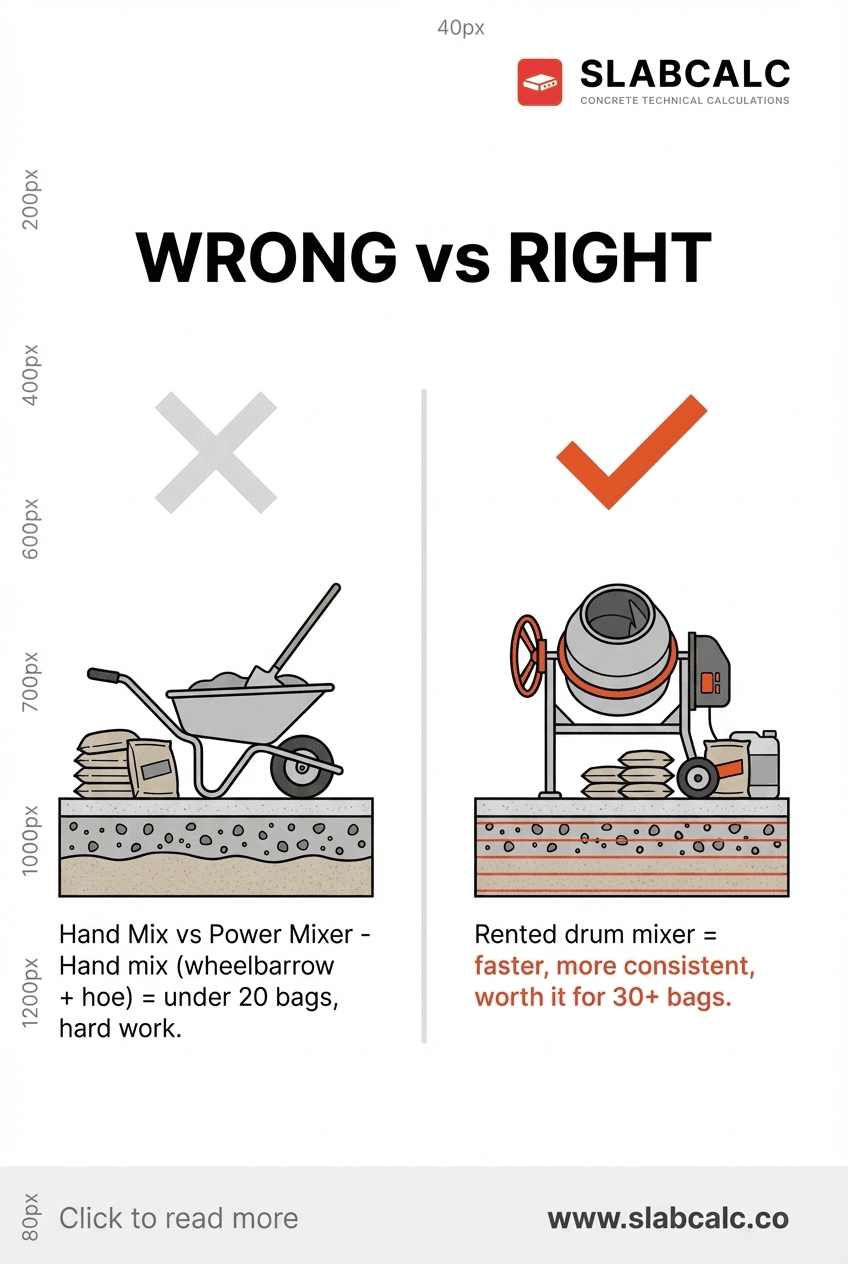
Choose hand mixing (wheelbarrow + hoe) if:
- Your project requires 20 bags or fewer
- You have 2-3 people available
- You're pouring over 4+ hours (batch mixing is fine)
- Budget is under $100 total
Rent a drum mixer if:
- Your project needs 30+ bags
- You're pouring within a 2-3 hour window (consistency matters)
- You value consistent strength and workability
- Budget allows $40-80 daily rental
Gray zone (20-30 bags): Hand mixing is possible but exhausting. A rented mixer costs $50-70/day and saves 6-8 hours of labor. Do the math: is your time worth less than $10/hour?
Why Mixing Method Affects Concrete Quality
Most DIYers don't realize that how you mix is as important as what you mix. Hand mixing and power mixing produce different results, especially when the project size grows.
Hand mixing challenges:
- Difficult to achieve uniform water distribution
- Fatigue leads to incomplete blending (especially in wheelbarrows)
- Inconsistent batches reduce overall strength
- Hard to maintain the critical water-to-cement ratio across multiple batches
- Physical labor in heat risks mistakes and poor consistency
Power mixer advantages:
- Drum rotation ensures even hydration
- Faster cycle time (3-5 minutes per batch vs. 8-12 minutes by hand)
- More consistent slump and workability across all batches
- Reduces operator fatigue and errors
- Better aggregate distribution reduces honeycombing
For small pours (under 10 bags), consistency variance won't significantly impact your finished slab. For larger pours (40+ bags poured over 2 hours), a power mixer prevents weak spots caused by uneven mixing.
The Hidden Cost Factor
Hand mixing isn't free labor. Calculate the true cost:
Hand mixing 40 bags:
- 8-10 hours of work for 2 people
- Physical strain (back, shoulders, knees)
- Risk of adding too much water (most common DIY mistake)
- Uneven mixing can reduce strength 5-15%
Rented drum mixer (40 bags):
- Rental: $60/day
- Setup/cleanup: 1-2 hours
- Mixing time: 2 hours
- Fuel (minimal): $5
- Total cost: $65-80
The mixer pays for itself in time savings alone. More importantly, you get better concrete quality because consistent mixing is easier to control.
The Water-Ratio Problem
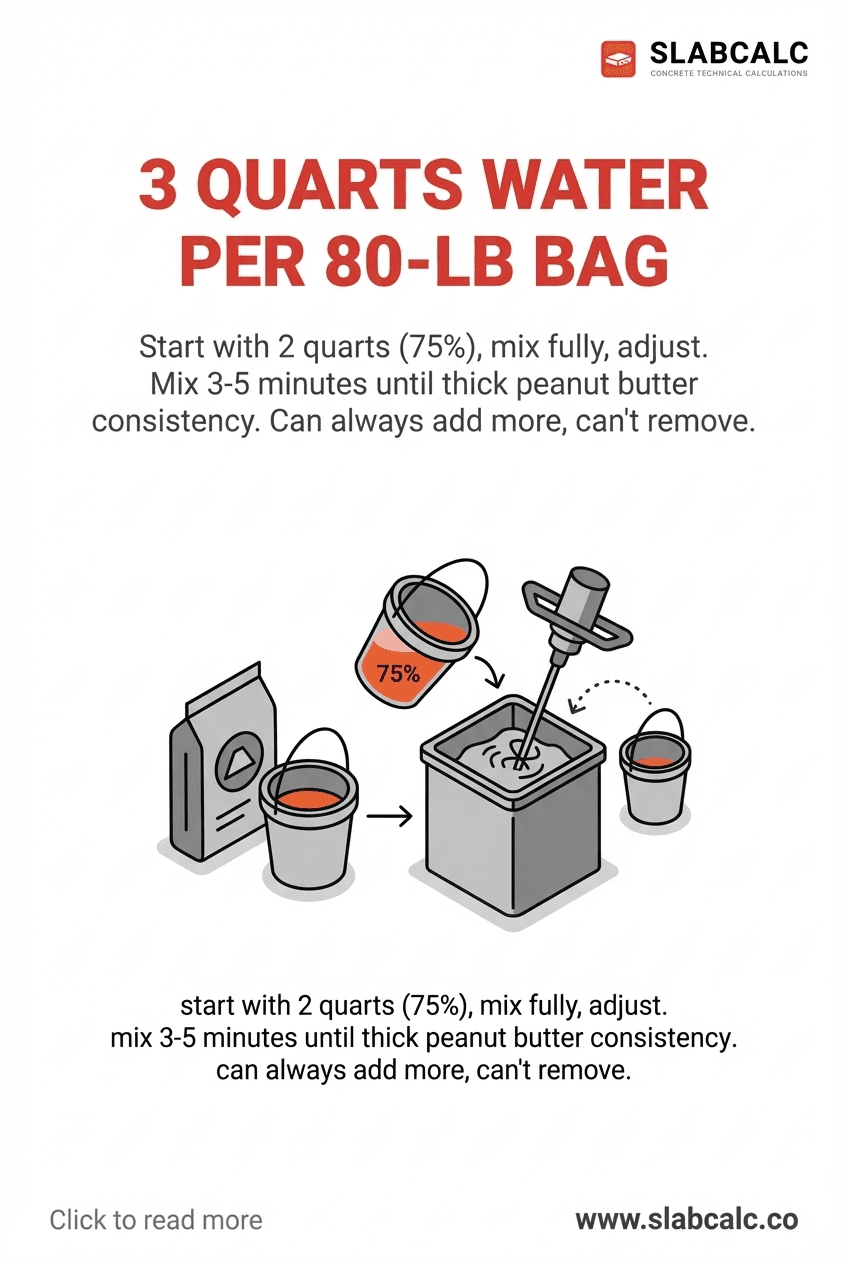
This is where mixing method becomes crucial. Hand mixing in a wheelbarrow makes it nearly impossible to distribute water evenly across a full 80-pound bag. You'll often end up with:
- Dry pockets at the bottom
- Over-wet material on top
- Inconsistent strength
A drum mixer tumbles the concrete 20-30 times per batch, ensuring every aggregate particle hydrates uniformly. This directly translates to stronger, more durable concrete.
Final Recommendation
For projects under 25 bags: Hand mix in a wheelbarrow. Your labor cost is the only expense, and small pours forgive mixing inconsistencies.
For projects 30+ bags: Rent a drum mixer. At $60-75/day, it's the cheapest "insurance" for strength and workability. You'll finish faster, produce better concrete, and avoid the back-breaking work.
For 25-30 bags: Calculate your hourly rate. If your time is worth $15+/hour, rent the mixer. If not, grit your teeth and hand mix in batches, being religiously careful with water control.
The goal isn't just mixing—it's creating uniform, strong concrete in a reasonable timeframe without risking your body or your slab's durability.