

Quikrete vs Sakrete vs Generic Concrete: Which Bag Should You Buy?
Quikrete and Sakrete are equal - buy whichever is cheaper or more available. Generic and store-brand concrete is acceptable for non-structural fill (topping off a post hole, patching a low spot), but skip it for any structural pour - driveways, slabs, footings - where consistent [PSI](/glossary/psi) and code compliance matter.
The 3-Brand Comparison
| Factor | Quikrete | Sakrete | Generic / Store-Brand |
|---|---|---|---|
| Standard mix PSI | 4,000 | 4,000 | Often unlabeled or 3,000-4,000 |
| High-strength mix PSI | 5,000 (Quikrete 5000) | 5,000 (5000 Plus) | Rarely offered |
| Specialty SKUs | Extensive (15+ products) | Extensive (10+ products) | Minimal (1-2 products) |
| PSI documented on bag | Yes | Yes | Often no |
| Primary retailer | Home Depot | Lowe's | Home Depot / Lowe's house brand |
| Approx. price per 80-lb bag | $6-8 | $6-8 | $5.00-6.50 |
| Structural use | Recommended | Recommended | Avoid |
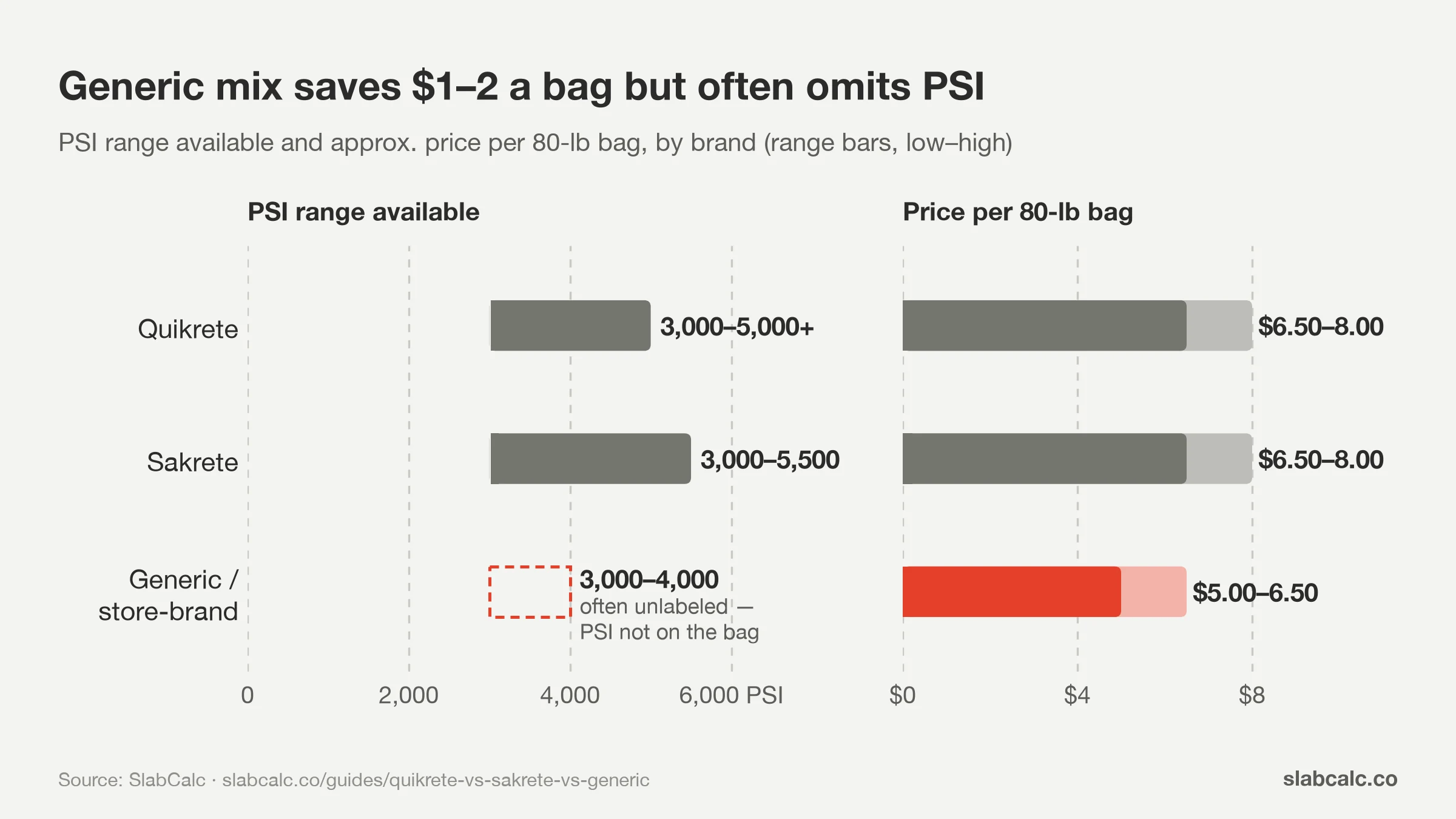
Bottom line: For structural work, Quikrete and Sakrete are equally good. Generic saves you a dollar or two per bag - not worth it when the pour matters.
Quikrete
Founded in 1940 and headquartered in Atlanta, Quikrete is the largest manufacturer of packaged concrete in the US. You'll find it at Home Depot, Ace Hardware, Menards, and most independent lumber yards.
Common product lineup:
- Concrete Mix (4,000 PSI) - standard all-purpose mix for general pours
- Quikrete 5000 (5,000 PSI) - high-strength for driveways and structural slabs
- Fast-Setting Concrete (4,000 PSI) - sets in 20-40 minutes, no mixing required for post holes (50-lb bag)
- Crack Resistant Concrete (4,000 PSI) - fiber-reinforced for large slabs prone to shrinkage cracking
- ProFinish 5000 (5,000 PSI) - smoother finish for flatwork
Who it's for: Anyone who shops at Home Depot, needs a specific specialty product, or is matching product previously used on a project.
Sakrete
Founded in 1936 and now owned by Oldcastle APG (a CRH company), Sakrete is the primary brand at Lowe's and Menards.
Common product lineup:
- High-Strength Concrete Mix (4,000 PSI) - Sakrete's standard all-purpose mix, despite the name; the equivalent of Quikrete Concrete Mix
- 5000 Plus (5,000 PSI) - high-early-strength mix, the equivalent of Quikrete 5000
- Fast-Setting Concrete Mix (4,000 PSI) - sets in about 30 minutes, for posts (50-lb bag)
- Crack-Resistant Concrete Mix (4,000 PSI) - fiber-reinforced
- MAXIMIZER (5,500 PSI) - lightweight, high-yield mix with the highest rating in the standard DIY range
Watch the naming: Sakrete's "High-Strength" bag is its 4,000 PSI everyday mix. If a job calls for 5,000 PSI, the Sakrete product is 5000 Plus.
Who it's for: Lowe's and Menards shoppers, and anyone who wants MAXIMIZER's higher yield per bag.
Availability by Retailer
| Retailer | Quikrete | Sakrete |
|---|---|---|
| Home Depot | Primary brand | Limited/varies |
| Lowe's | Available | Primary brand |
| Menards | Available | Available |
| Ace Hardware | Primary brand | Limited |
| True Value | Available | Available |
If you shop at Home Depot, you'll likely buy Quikrete; Lowe's shoppers usually find the better Sakrete selection. Price gaps between comparable bags are usually under $0.50, which is not worth a second trip.
Generic / Store-Brand Concrete
This is the section most guides skip. Here's the honest breakdown.
What generic concrete actually is
Store-brand concrete (Home Depot house brand, Lowe's private label) is not a separate manufacturing operation. It's typically produced by one of the major manufacturers - often Quikrete or Sakrete themselves, or a regional equivalent - then repackaged under the retailer's label. The raw materials and process are usually the same.
So why does it matter? Two reasons.
What the bag doesn't tell you
Named brands publish consistent product specs. Every bag of Quikrete 5000 is guaranteed to reach 5,000 PSI at 28 days if you follow the mix ratio. That spec is tested, documented, and consistent across production runs.
Generic bags frequently omit this documentation or list a range without a guaranteed minimum. When you're buying 30 bags for a driveway pour, "approximately 3,000-4,000 PSI" is not the same as "4,000 PSI minimum." See how to read a concrete bag label for what to look for before you buy.
For structural work, PSI consistency across every bag matters. See what PSI concrete do I need for the right spec for your project.
When generic is fine
- Filling the last few inches of a post hole
- Leveling a low spot that won't bear load
- Non-structural patches and fill
- Temporary work
When to avoid generic
- Driveways, patios, garage slabs
- Footings and foundations
- Any pour subject to building inspection or code compliance
- Projects where compressive strength documentation will be checked
The cost savings on generic are real but small - roughly $1-2 per 80-lb bag. On a 20-bag driveway pour, that's $20-40. Not worth the uncertainty on a pour you'll live with for 20 years.
Fast-Setting Concrete: Quikrete vs Sakrete
Both brands sell fast-setting concrete, and both work. Here's the practical comparison:
| Factor | Quikrete Fast-Setting | Sakrete Fast-Setting |
|---|---|---|
| PSI rating | 4,000 PSI | 4,000 PSI |
| Set time | 20–40 minutes | About 30 minutes |
| Typical use | Fence posts, mailbox posts | Fence posts, mailbox posts |
| Dry-pour compatible | Yes (no mixing needed for posts) | Yes |
| Bag size | 50 lb | 50 lb |
The verdict on fast-setting: They are functionally identical. Both set in roughly half an hour and are rated 4,000 PSI at 28 days. Buy whichever is on the shelf.
One note: fast-setting mixes are formulated for post-hole applications — you set the post, pour the dry mix around it, and add water. They're not a substitute for standard mix on flat slab pours, where the accelerated set time works against you (you'll run out of working time before finishing).
Quikrete vs Sakrete for Fence Posts
Use the fast-setting mix from either brand. Both are designed to be poured dry into the hole around the post and soaked with water, both set in about 20-40 minutes, and both come in 50-lb bags. Size your holes and bag count with the fence post concrete calculator.
Standard mix also works for posts if you can brace them for a day while it cures; it is cheaper per bag, but it has to be mixed first.
Can You Mix Quikrete and Sakrete?
Yes. Bags with the same specification (the 4,000 PSI standard mix from each brand, for example) are chemically compatible and can go in the same pour, even the same batch. Two rules keep the result predictable:
- Match the product type. Don't combine a fast-setting mix with a standard mix in one batch; the fast-set portion will stiffen before the rest.
- Match the strength. Blending a 4,000 PSI bag with a 5,000 PSI bag gives you something in between, so a pour specified at 5,000 PSI should use only 5,000 PSI bags.
Is Quikrete as Good as Concrete?
Quikrete Concrete Mix is concrete: portland cement, sand and gravel, pre-blended in the bag. Mixed at the right water ratio and cured properly, it reaches 4,000 PSI at 28 days, the same strength class as typical residential ready-mix. What people usually mean is one of two different comparisons:
- Concrete mix vs. sand mix or mortar mix. Quikrete also sells Sand/Topping Mix and Mortar Mix, which contain no gravel. They are for thin toppings and masonry joints, not slabs or footings. See concrete vs mortar vs grout.
- Bagged vs. ready-mix. Same material, different scale. Bags make sense up to about 1 cubic yard (45 bags of 80-lb mix); beyond that, ready-mix is cheaper and more consistent. See ready-mix vs bagged.
What Matters More Than Brand
Technique and product selection outweigh brand choice on any pour. Rather than repeat what's already covered, see how to mix concrete for water ratio, mixing time, and curing procedures.
The product type you choose matters more than the brand name on the bag. Using standard 4,000 PSI mix for a driveway instead of a high-strength 5,000 PSI product is a worse decision than picking Quikrete over Sakrete.
Use the concrete slab calculator to figure out how many bags you need before you're standing in the store aisle, or see how many bags of concrete do I need for the manual calculation.
Decision Guide
Buy Quikrete if:
- You shop at Home Depot
- You need a specialty product (fast-set, fiber-reinforced, ProFinish)
- It's priced lower than Sakrete on the day you're buying
- It's what's on the pallet
Buy Sakrete if:
- You shop at Lowe's or Menards
- You want MAXIMIZER (5,500 PSI, higher yield per bag)
- It's priced lower or more available
- It's what's on the pallet
Buy generic if:
- The work is non-structural fill
- You can verify PSI documentation on the bag before buying
- The savings matter and the application is low-stakes
Don't buy generic if:
- You're pouring a driveway, slab, footing, or anything structural
- You need consistent, documented PSI across multiple bags
- There's any chance of building inspection
Key Takeaways
- Quikrete and Sakrete are equal - no meaningful quality or strength difference for residential work
- Buy based on price and store availability, not brand loyalty
- Generic is not the same as bad - it's appropriate for fill, not for structural pours
- The missing PSI documentation on generic bags is the real risk, not the concrete itself
- Product type matters most - right PSI for the application beats brand choice every time
Next Steps
- Calculate how many bags you need: Concrete Slab Calculator
- Choose the right PSI: What PSI Concrete Do I Need?
- Read the bag before you buy: How to Read a Concrete Bag Label
- Mixing and curing procedure: How to Mix Concrete