

Concrete PSI Explained: 3000, 4000, or 5000 PSI — Which Do You Need?
PSI stands for pounds per square inch — it's the number on your concrete bag or your ready-mix ticket that tells you how strong the hardened concrete will be. Choosing the wrong PSI wastes money (over-spec) or creates a slab that fails too soon (under-spec). This guide shows you exactly which rating to use for the most common residential projects.
Use 3,000 PSI concrete for patios and walkways, 4,000 PSI for driveways, garage floors, steps, and footings, and 4,500 PSI for driveways in freeze-thaw climates that see deicing salt. Standard 80-lb bags of concrete mix are rated about 4,000 PSI at 28 days, so bagged concrete already covers most DIY work. The International Residential Code sets lower legal minimums of 2,500–3,500 PSI depending on exposure. Treat those as a floor, not a target.
What Does PSI Actually Measure?
Compressive strength is the force needed to crush a hardened concrete cylinder. Engineers test this in a lab at 28 days after the pour — that's why you see specs like "4000 PSI at 28 days."
In plain terms: higher PSI = harder concrete that resists cracking, surface damage, and heavy loads better.
PSI does NOT measure flexibility, surface texture, or resistance to chemicals (those require other admixtures). It's purely a measure of how hard the finished concrete is.
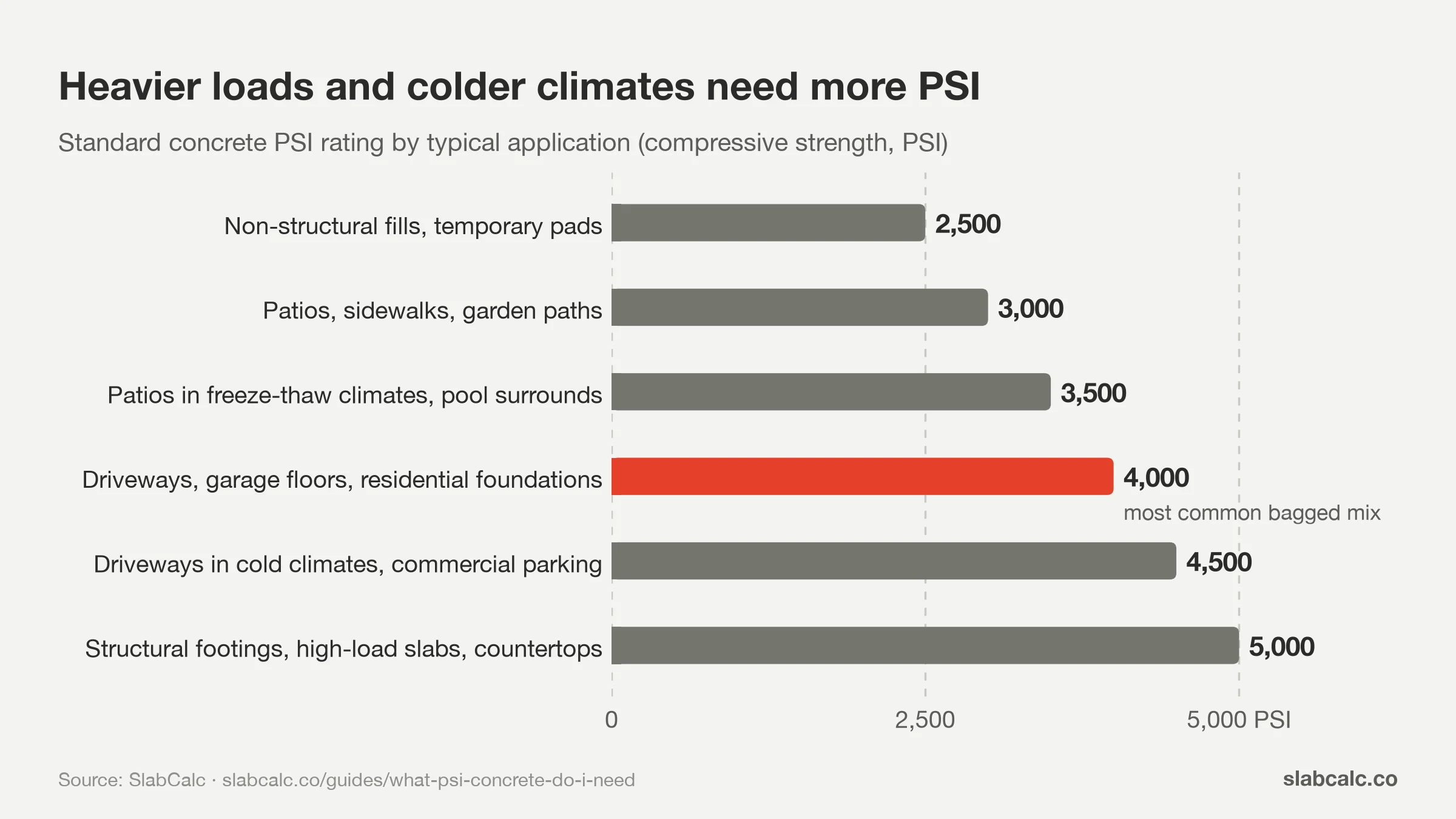
The Standard PSI Ratings and When to Use Them
| PSI Rating | Common Applications | Notes |
|---|---|---|
| 2500 PSI | Non-structural fills, temporary pads | Rarely used anymore; most pre-mixes start at 4000 |
| 3000 PSI | Patios, sidewalks, garden paths | Standard residential spec; fine for foot traffic only |
| 3500 PSI | Patios in freeze-thaw climates, pool surrounds | Good middle ground when 3000 feels risky |
| 4000 PSI | Driveways, garage floors, residential foundations | Most common bagged concrete is 4000 PSI |
| 4500 PSI | Driveways in cold climates, commercial parking | Better freeze-thaw resistance |
| 5000 PSI | Structural footings, high-load slabs, countertops | Overkill for most DIY projects |
What the Building Code Requires
The IRC sets minimum compressive strength by where the concrete is and how harsh the local weathering is (IRC Table R402.2). Your building department's weathering map tells you which column applies:
| Concrete Location | Negligible Weathering | Moderate Weathering | Severe Weathering |
|---|---|---|---|
| Basement walls, foundations, other concrete not exposed to weather | 2,500 PSI | 2,500 PSI | 2,500 PSI |
| Basement slabs and interior slabs on grade (except garage floors) | 2,500 PSI | 2,500 PSI | 2,500 PSI |
| Foundation and exterior walls exposed to weather | 2,500 PSI | 3,000 PSI | 3,000 PSI |
| Porches, carport slabs, steps exposed to weather, and garage floor slabs | 2,500 PSI | 3,000 PSI | 3,500 PSI |
In moderate and severe weathering areas, the IRC also requires the weather-exposed concrete to be air-entrained at 5–7% air content. Engineered work follows ACI 318, which sets 2,500 PSI as the structural minimum and raises it for freeze-thaw exposure. Concrete exposed to freezing plus deicing chemicals (exposure class F3) needs 5,000 PSI.
Notice the gap between code and practice. The code allows a 2,500 PSI garage floor in a mild climate, but most contractors pour 4,000 PSI because the price difference is only $5–10 per cubic yard and the surface wears far better.
For deeper guidance on thickness decisions, see how thick should concrete be — PSI and thickness work together.
Matching PSI to Your Project
Patios and Walkways
Use 3000–3500 PSI. Foot traffic and patio furniture don't require high compressive strength. The bigger risks on a patio are surface finishing (too wet = scaling) and curing quality, not PSI.
Exception: If you live in a climate with hard freezes, use 3500–4000 PSI and add air entrainment. Freeze-thaw cycles are more destructive to weaker concrete.
Driveways
Use 4000 PSI minimum. A standard passenger car weighs 3,000–4,500 lbs. SUVs and trucks push 5,500–7,000 lbs. At 3000 PSI, driveways show surface scaling within a few years — this is the most common driveway mistake we see. For more on driveway concrete decisions, read our driveway guide.
Garage Floors
Use 4000 PSI. Same logic as driveways, plus the additional weight of parked vehicles and heavy equipment.
Fence Posts and Footings
Use 3000–4000 PSI. Post-hole concrete is mostly there to anchor, not carry loads. Bagged fast-setting concrete (which is typically 4000 PSI) is perfect.
Steps and Retaining Walls
Use 4000 PSI. Steps take repeated impact loads. A 3000 PSI step chips at the nosing edge within a few years.
Countertops
Use 5000 PSI or a dedicated countertop mix. The extra strength resists chipping at thin edges and gives a smoother surface for polishing.
How Bagged Concrete Compares to Ready-Mix
Bagged concrete: Most 80-lb bags at hardware stores are rated 4000 PSI. Read the bag label — it will show the 28-day strength. This is more than sufficient for patios, fence posts, and small slabs.
Ready-mix concrete: Ordered by the cubic yard from a concrete plant. You specify PSI when you order. For residential work, 3500–4000 PSI is standard. The driver will have the mix design ticket showing the spec.
The PSI system is the same for both — it's just the delivery method that differs. See our concrete water ratio guide to understand the other factor that affects strength: how much water you add during mixing.
How to Order the Right PSI
When you call a ready-mix plant, give them four numbers, not just one:
- Strength at 28 days: for example, "4,000 PSI." Ready-mix is produced to ASTM C94, and the ticket should show the mix design strength.
- Air entrainment: ask for 5–7% air for any outdoor slab in a freezing climate. Air-entrained concrete resists freeze-thaw scaling far better than a higher PSI without air.
- Slump: 4–5 inches is typical for hand-placed flatwork. Don't let the crew add water at the site to make it flow, since that lowers the delivered strength.
- Maximum aggregate size: 3/4 inch is standard for residential slabs; 3/8 inch pea gravel mix for thin toppings or pump lines.
For bagged concrete, the strength is printed on the bag. General-purpose mixes are about 4,000 PSI; high-strength mixes like Quikrete 5000 are labeled 5,000 PSI.
How Long Concrete Takes to Reach Its PSI
The PSI rating is the strength at 28 days. Concrete keeps gaining strength after that, but most of the gain happens in the first week, provided it's kept moist and above about 50°F:
| Age | Typical Share of 28-Day Strength | A 4,000 PSI Mix Reaches About |
|---|---|---|
| 3 days | ~40% | 1,600 PSI |
| 7 days | ~65–70% | 2,600–2,800 PSI |
| 14 days | ~85–90% | 3,400–3,600 PSI |
| 28 days | 100% | 4,000 PSI |
These are rules of thumb for normal Type I/II cement mixes; cold weather slows the curve considerably. In practice, that means foot traffic after 1–2 days, cars after about 7 days, and heavy trucks or RVs after 28 days. See how long concrete takes to cure for temperature adjustments.
Why Over-Specifying Wastes Money
Ordering 5000 PSI for a garden path doesn't make it last longer in any meaningful way. The path will still crack if the subbase isn't compacted, if you don't cut control joints, or if you over-water the mix. PSI is one factor — not the only one.
Save the higher-PSI spec for where it actually matters (driveways, structural footings) and use the money saved on proper base prep and curing supplies.
The Water Ratio Connection
Here's the counterintuitive part: adding too much water to a high-PSI mix lowers the actual strength. A 4000 PSI bag that gets over-watered might only achieve 2800 PSI in the finished slab. The PSI on the bag assumes you follow the water instructions exactly.
This is why the water-to-cement ratio matters more than almost any other variable. Never add more water than the bag specifies to make mixing easier.
Quick Reference
- Patio, walkway, garden path: 3000–3500 PSI
- Driveway, garage floor: 4000 PSI minimum
- Driveways in cold climates: 4500 PSI
- Fence posts, anchor footings: 3000–4000 PSI (bagged fast-set is fine)
- Countertops: 5000 PSI or dedicated countertop mix
- Standard bagged concrete: Usually 4000 PSI — check the label
Related Guides
- How Thick Should Concrete Be? — Thickness and PSI work together; get both right
- Concrete Water Ratio Guide — Why adding too much water undermines your PSI spec
- Types of Concrete — Beyond PSI: specialty mixes and when to use them